
We make boring business stories sparkle.
Your Company Is Limited Liability. You May Not Be.
A founder sits in a bank branch and feels proud. The company has a name. It has a UEN. It...

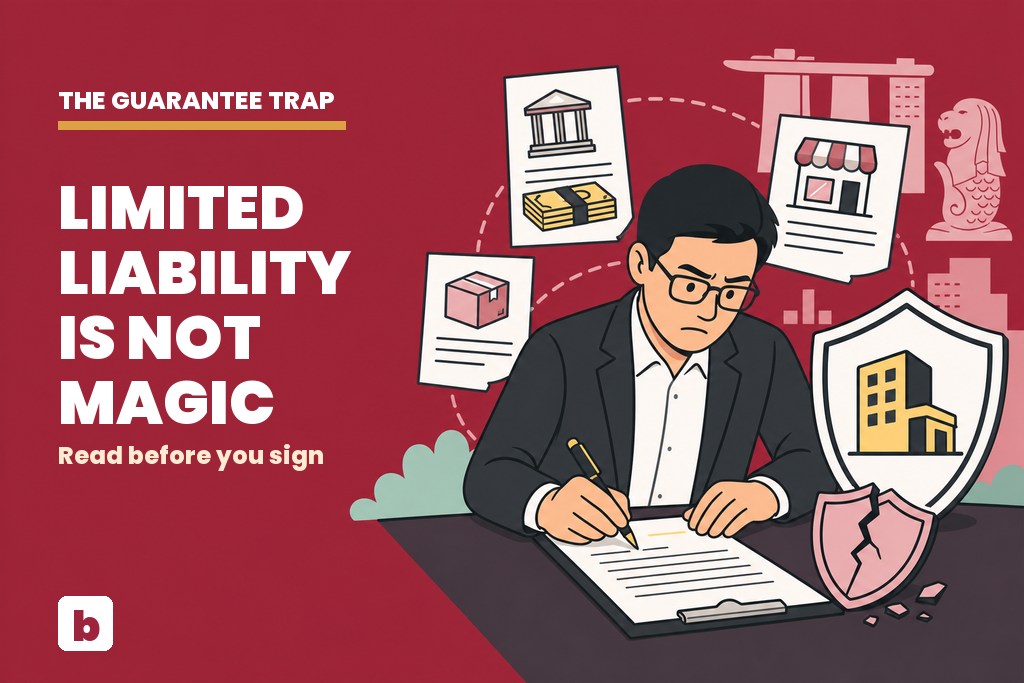
A founder sits in a bank branch and feels proud.
The company has a name. It has a UEN. It has a business account. The rubber stamp exists. The invoice template looks official. The founder tells himself the adult part of business has begun.
Then the loan officer pushes across one more document.
“We will also need the director’s personal guarantee.”
That is the moment many owners discover the sentence they only half-understood: a company may be limited liability, but the human behind it may not be.
This is not an argument against incorporating a company. A private limited company can still be the right structure for many Singapore businesses. The problem is the lazy belief that a Pte Ltd magically protects the owner’s life from every bad business decision.
It does not. A company is a useful wall. But a wall with your personal signature on it has a door.
This article is general business commentary, not legal or financial advice. Before signing a guarantee, lease, loan or high-risk contract, read the actual document and get proper advice where needed.
The Dangerous Half-Truth Of Limited Liability
The clean textbook version is comforting. ACRA explains that a company is a separate legal entity: it can sue, be sued and own property in the company’s name. ACRA also states that shareholders have limited liability, meaning they are not personally responsible for the company’s debts and losses.
That part matters. It is one reason owners choose a company instead of a sole proprietorship or general partnership. ACRA’s business-structure comparison says a sole proprietorship has no legal split between owner and business, so the owner is fully liable for debts and losses.
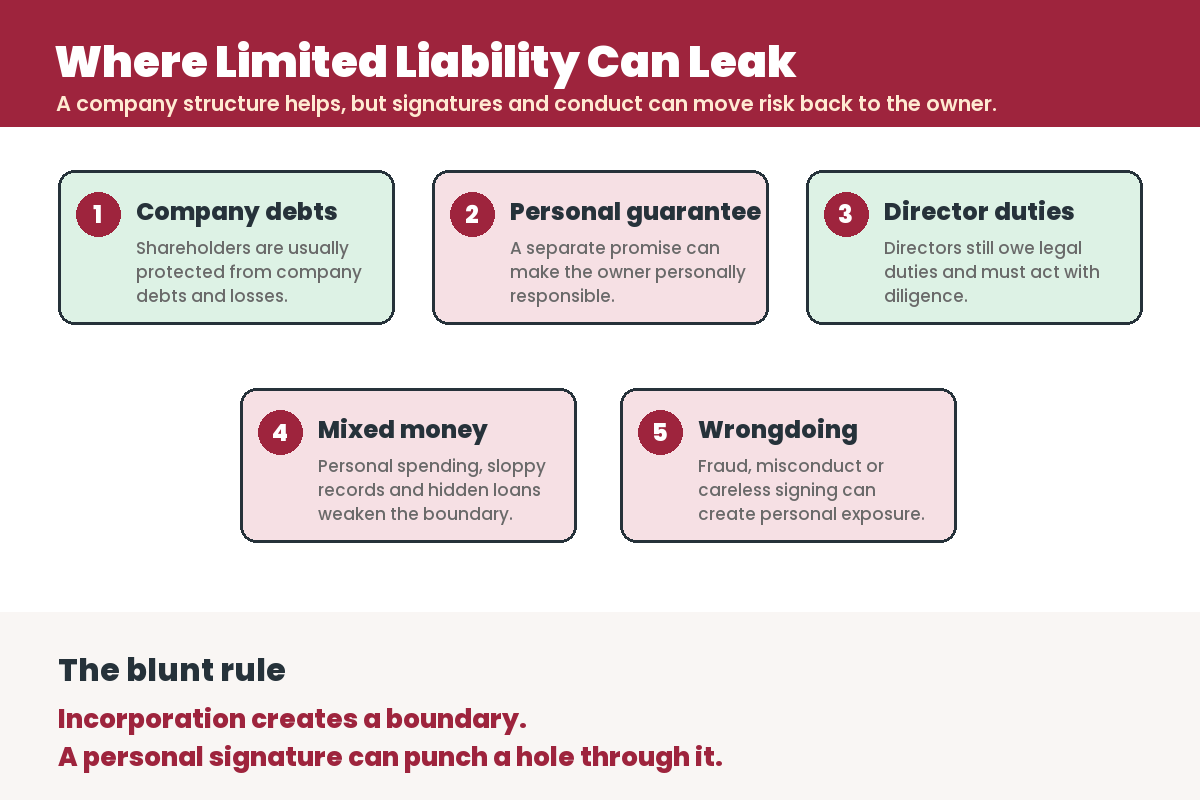
But limited liability is not a force field. It does not stop you from taking on a personal obligation. It does not erase director duties. It does not protect sloppy behaviour. It does not make fraud clever. It does not turn every bad contract into someone else’s problem.
The sharpest way to say it is this: incorporation protects you from some business liabilities, not from your own signatures and conduct.
What Limited Liability Actually Helps With
Limited liability works best when the debt or obligation belongs only to the company, the company has kept proper records, and the owner has not personally promised to pay.
Situation | Where the company structure helps | Where the owner may still be exposed |
|---|---|---|
Ordinary supplier debt | The supplier usually claims against the company. | If the owner signed a personal guarantee or misrepresented facts. |
Bank loan | The borrower may be the company. | If directors or shareholders signed personal guarantees. |
Shop or office lease | The tenant may be the company. | If the landlord required a director guarantee or personal indemnity. |
Tax, records and filings | The company is the reporting entity. | Directors still have statutory duties and may face enforcement for failures. |
Wrongful conduct | The company can contract and operate separately. | Fraud, dishonest conduct, misuse of position or personal wrongdoing can create personal risk. |
This table is why the phrase “Pte Ltd protects me” is too vague. The correct question is: protects you from what, under which document, and after whose signature?
The Personal Guarantee Changes The Game
The personal guarantee is the document that destroys many owners’ false comfort.
A personal guarantee is a separate promise by a person to answer for the company’s obligation if the company does not pay. The company remains a separate legal entity. The guarantee simply creates another route to the human being.
This is common in SME financing. Enterprise Singapore’s business finance guidance notes that for unsecured SME loans, it is not uncommon for banks to ask for a personal guarantee from company owners or directors. The Association of Banks in Singapore also explains that banks generally ask directors for personal guarantees as a sign of commitment toward facilities granted.
In plain English: the bank knows your Pte Ltd is separate. That is why it asks you to stand behind it.
Where Owners Accidentally Sign Personally
The risk is not only bank loans. Small business owners sign personal exposure into the business in quieter places.
- Commercial leases: landlords may ask directors to guarantee rent, reinstatement, damages or early termination exposure.
- Supplier credit: trade accounts may include personal guarantee clauses in onboarding forms.
- Corporate credit cards: some facilities may depend on owner or director responsibility.
- Equipment financing: the company may use the equipment, but the owner may guarantee payment.
- Personal cards used for business: if the debt is on your personal card, the debt is yours even if the spending was for the company.
- Informal family loans: the legal paperwork may be vague, but the relationship damage can be very personal.
The problem is not that these arrangements are always wrong. Many businesses cannot get started without some owner support. The problem is signing like an optimist and repaying like a realist.
Director Duties Are Not Decorative
Another misunderstanding: some owners think personal risk only appears when they sign a guarantee.
Not true.
ACRA’s director guidance says company directors must meet duties and obligations under the Companies Act 1967, including keeping proper records, preparing financial reports where required, filing documents on time and acting in the company’s best interests. Singapore Statutes Online section 157 says a director must act honestly and use reasonable diligence in discharging the duties of office.
That means “I am only a small company” is not a serious defence for carelessness. A one-person company still has a director. A dormant company still has obligations. A nominee director is not a sleeping decoration.
If the company boundary is supposed to protect you, respect the boundary. Keep records. Separate money. Record decisions. Understand what is being filed. Do not outsource responsibility and then act surprised when responsibility returns.
The Risk Audit Before You Sign
Before signing anything meaningful, pause long enough to ask who is really carrying the risk.
Document | Question to ask | Why it matters |
|---|---|---|
Loan offer | Who is borrower, guarantor and security provider? | The company may borrow, but the owner may still guarantee. |
Lease | Does the director guarantee rent or reinstatement? | Premises commitments can survive poor sales. |
Supplier account | Is there a personal guarantee hidden in the form? | Small credit limits can become large unpaid balances. |
Corporate card | Is the liability corporate only or personal too? | Convenience can quietly move debt to the owner. |
Shareholder loan | Is money equity, debt or informal support? | Unclear funding creates disputes later. |
Director resolution | What exactly did directors approve? | Company decisions should be documented before memories change. |
The best time to understand a guarantee is before the business needs rescue. After default, everyone becomes very good at reading clauses.
How To Reduce Risk Without Being Naive
Some owners hear this and swing too far the other way: “Then I will never sign anything personally.”
That sounds strong, but it may not be realistic. New SMEs often have thin financial history, low asset base and founder-dependent revenue. Banks, landlords and suppliers are not stupid. They price that risk back to the owner because the owner is often the business.
The smarter response is not blind refusal. It is deliberate exposure.
- Know the cap: if a guarantee is required, ask whether it is capped and exactly what it covers.
- Match debt to cash flow: use a loan calculator before borrowing so the repayment is not based on hope.
- Keep business and personal money separate: sloppy bank habits make risk harder to understand.
- Maintain clean records: bookkeeping is not admin theatre; it is evidence of what happened.
- Negotiate release points: for some facilities, ask whether guarantees can be reviewed after repayment history improves.
- Insure where appropriate: some operational risks should be transferred instead of personally absorbed.
- Read before signing: if the document is important and unclear, pay for advice before the mistake becomes expensive.
For broader financing decisions, SBO’s guide to business loan options in Singapore and the loan calculator can help owners think about cost before taking debt. For company setup context, read SBO’s guides on how to register a company in Singapore and sole proprietorship vs Pte Ltd.
Do Not Worship The Company Structure
A Pte Ltd is useful. It can improve credibility, support investment, separate ownership from management, create continuity and limit shareholder exposure in many ordinary situations.
But business owners sometimes worship the structure and ignore behaviour. That is backward.
A clean company with poor records is not clean. A limited-liability company with unlimited personal guarantees is not emotionally limited. A director who signs everything without reading is not protected by having a corporate secretary. A founder who mixes personal spending and company cash is asking for confusion.
The company is a tool. It does not replace judgment.
The Final Opinion
The phrase “limited liability” gives founders a little too much confidence.
The better phrase is “structured liability”. Some risk belongs to the company. Some risk belongs to the person. Some risk moves because you signed it across. Some risk appears because you behaved badly, ignored duties or kept the business like a messy drawer.
So yes, incorporate when it makes sense. Build through a company when the business needs that structure. But do not use “Pte Ltd” as a sleeping pill.
Your company may be limited liability. You may not be.
Official References
- ACRA: Choosing a business structure
- ACRA: Company directors’ duties and key obligations
- Singapore Statutes Online: Companies Act 1967, section 157
- Enterprise Singapore: Ways to get your business into a good financial position
- Association of Banks in Singapore: SME FAQs
Frequently Asked Questions
Does a Pte Ltd protect business owners from all debts?
No. A Singapore company can give shareholders limited liability for company debts, but owners may still be personally exposed if they sign guarantees, act wrongly, mix personal and company obligations, or breach director duties.
What is a personal guarantee in business financing?
A personal guarantee is a separate promise by an individual, often a director or shareholder, to repay a company’s obligation if the company does not pay. Always read the actual guarantee terms before signing.
Should business owners refuse every personal guarantee?
Not always. Some young SMEs may need owner support to access financing, leases or supplier credit. The key is to understand the cap, scope, repayment ability and alternatives before accepting personal exposure.
Is this article legal advice?
No. This article is general business commentary for Singapore owners. For specific guarantees, leases, disputes or director-liability questions, speak to a qualified lawyer or relevant professional adviser.
Explore More Content
Table of Content