
We make boring business stories sparkle.
A Business Should Be A System, Not A Job You Created For Yourself
There is a business owner who cannot take a holiday. If he stops replying to WhatsApp, sales slow down. If...

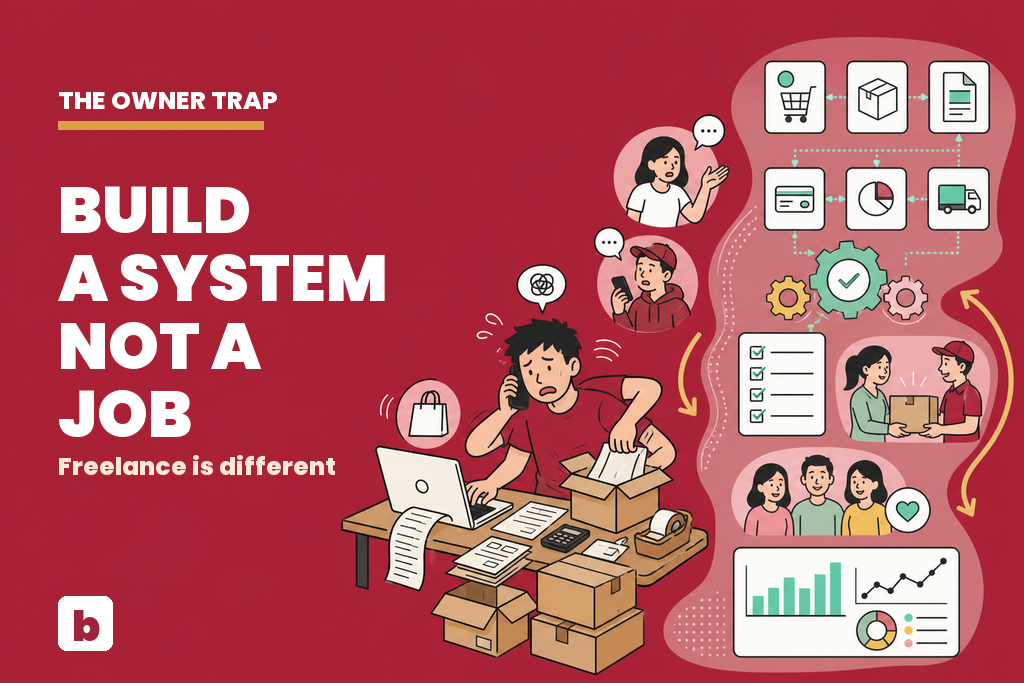
There is a business owner who cannot take a holiday.
If he stops replying to WhatsApp, sales slow down. If he stops checking orders, mistakes appear. If he stops showing up at the shop, staff wait for him to decide. If he stops posting online, enquiries die. If he gets sick for one week, the whole operation becomes nervous.
He calls it a business.
Maybe it is. But the harsher answer is this: he may have created a job for himself with a logo, a UEN, invoices and customers.
That is not shameful. Freelancing, self-employment and owner-operated work can be honest ways to earn a living. But we should stop pretending they are the same thing as a sustainable business system.
My opinion: a business should be built as a system. If the only real system is the owner’s body, memory, mood and personal hustle, the business is still immature.
The Lie Many Owners Tell Themselves
The lie sounds productive: “Nobody can do it like me.”
Sometimes that is true. At the start, the founder may understand the customer best. The founder may sell best, deliver best, solve problems fastest, and care more than everyone else.
But if that remains true forever, it is not a compliment. It is a design failure.
A business owner who is permanently the best salesperson, best operator, best customer-service staff, best quality checker, best accountant, best cleaner, best recruiter and best firefighter has not built a business. He has built a dependency.
Freelance Is Fine. Just Call It What It Is.
There is nothing wrong with freelance work.
A freelancer sells personal skill. The customer pays for the person’s taste, speed, craft, judgment or labour. A freelance designer, consultant, photographer, copywriter, tutor, coach or developer can make good money and live a good life.
The problem begins when a freelancer borrows business language to avoid facing the model. They say “we are scaling” when they only mean “I am working more hours”. They say “my company” when the company is just their calendar. They say “team” when the team is a few outsourced tasks held together by their personal panic.
Again, no shame. But clarity matters. If income stops when you stop, the model is closer to a job than an asset.
The Difference Between A Job, Freelance Work And A Business System
These are different games. Confusing them creates bad decisions.
Model | What creates value | Main risk | What progress looks like |
|---|---|---|---|
Employment | You perform a role inside someone else’s system. | Your income depends on the employer and job market. | Higher salary, better role, stronger skills, more options. |
Freelance | Your personal skill, reputation and available hours. | Your capacity is limited by your time and energy. | Better clients, higher rates, clearer scope, less chaos. |
Owner-operated business | Your personal involvement plus some process and support. | The business still depends heavily on the owner. | Repeat customers, documented work, stable cash flow, first hires. |
Business system | A repeatable way to create, sell and deliver value through people, process and tools. | The system can become rigid or poorly managed if ignored. | Better margins, less owner dependency, stronger team, predictable delivery. |
The goal is not for every person to build a large company. The goal is to know which game you are playing.
A Business System Has Five Parts
A sustainable business is not just “more sales”. More sales can destroy a weak operation faster.
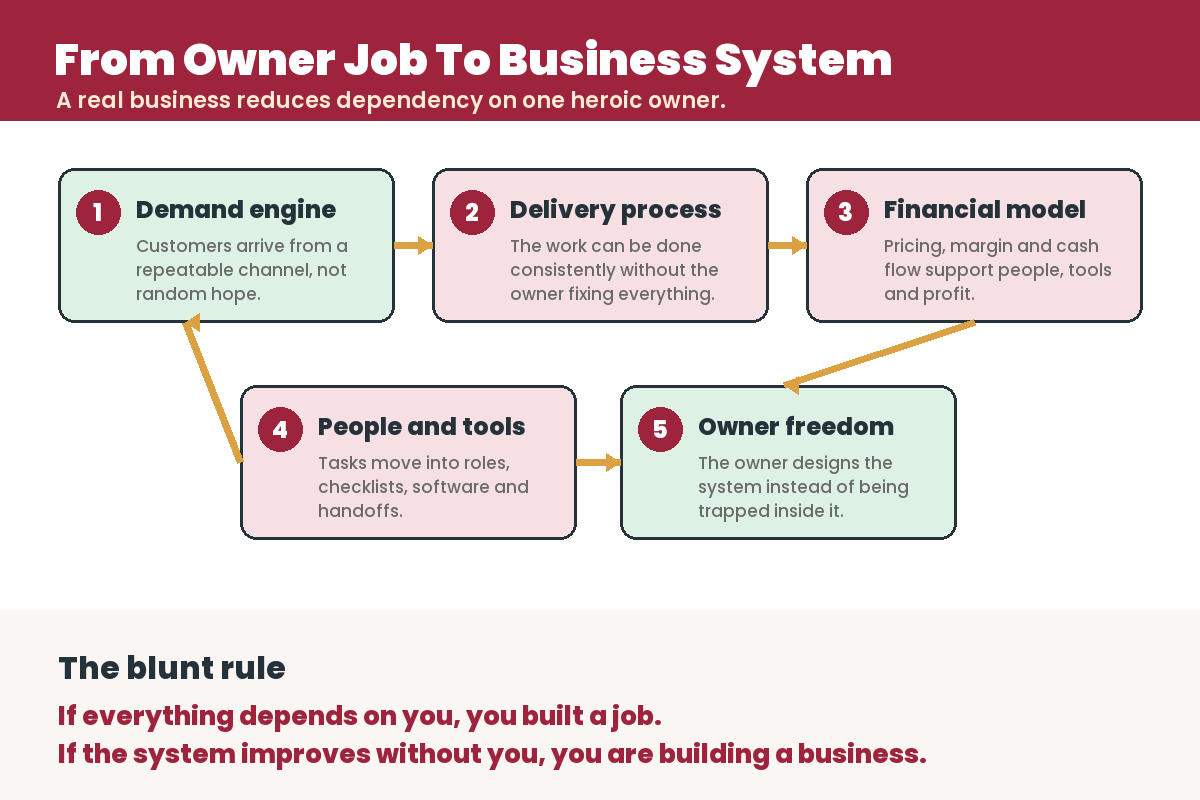
A business system needs five parts working together.
- A demand engine: a repeatable way to attract the right customers.
- A sales process: a way to qualify, price and close without relying only on founder charm.
- A delivery process: a clear method for producing the promised result consistently.
- A financial model: pricing, margin, cash flow and reserves that can support people and tools.
- A feedback loop: a way to learn from complaints, mistakes, data and customer behaviour.
Miss one part, and the owner becomes the patch. Miss many parts, and the owner becomes the whole business.
The Owner Should Not Be The Product Forever
In the beginning, the owner often is the product.
The owner’s taste wins the first customers. The owner’s speed saves the first project. The owner’s personal trust closes the first deal. That is normal.
But the mature business slowly moves value out of the owner’s head and into the system.
That means templates, checklists, training, scripts, hiring standards, pricing rules, quality checks, dashboards, operating rhythms, customer handover notes and documented decisions.
This sounds boring because it is. Boring is how a business stops depending on drama.
If You Cannot Leave For Two Weeks, Study The Reason
A simple test: can you leave the business for two weeks without revenue collapsing, customers being abandoned, staff freezing, invoices being forgotten or delivery becoming embarrassing?
If the answer is no, do not use that as proof that you are important. Use it as a diagnostic tool.
If the business breaks when you… | The real missing system may be… | First fix |
|---|---|---|
Stop replying to every enquiry | Lead qualification and sales workflow | Create response templates, pricing rules and a clear next-step process. |
Stop checking every order | Quality control and fulfilment checklist | Document order stages, error checks and handoff responsibilities. |
Stop approving every small decision | Decision rights and staff training | Define what staff can decide without approval. |
Stop posting daily | Marketing channel dependency | Build reusable content, email lists, referrals and search assets. |
Stop chasing payment | Billing and credit-control process | Standardise invoices, due dates, reminders and payment terms. |
The point is not to disappear. The point is to stop confusing personal exhaustion with business strength.
The Business Owner’s Job Is To Build The Machine
Many owners stay busy because busyness feels morally safe. They pack orders, answer every message, do every quote, handle every complaint and tell themselves they are hardworking.
Hard work matters. But at some point, the owner’s highest-value work changes.
The owner should stop being only the person doing the work and become the person improving how the work gets done.
That means asking:
- Why does this mistake keep happening?
- Which task should not require me?
- Which customer type creates profit instead of noise?
- Which product or service is too dependent on one person’s talent?
- Which decision can be turned into a rule?
- Which process can be taught?
- Which number tells us whether the system is getting better?
These questions are less exciting than launching a new offer. They are also what separate a business from a personal workload.
Profit Is Not Greed. Profit Is System Fuel.
A business cannot become sustainable if it prices like a hobby.
Many owners undercharge because they are scared customers will leave. Then they complain that they cannot hire, cannot train, cannot improve software, cannot buy equipment, cannot take leave and cannot replace themselves.
Of course they cannot. They priced the business to require personal sacrifice.
Profit is not only the owner’s reward. Profit is what allows the business to build buffers, hire support, improve operations, absorb mistakes and survive slow months.
A business with no profit is not noble. It is fragile.
Some People Should Stay Freelance
Not everyone needs to build a system-led business.
Some people like direct client work. Some people want creative control. Some people dislike managing staff. Some people would rather earn well as a skilled solo operator than become a stressed small boss.
That is fine.
The problem is not freelancing. The problem is pretending freelancing is a scalable business while making decisions that only suit a solo operator.
If you want freelance freedom, build a freelance model properly: strong positioning, high rates, good clients, low overheads, clear boundaries and enough savings.
If you want a business, accept the less romantic work of building systems, managers, margins and processes.
Our earlier article on productized services sits between these worlds: it shows how service work can become more packaged, repeatable and less chaotic.
The First System To Build Is Usually Not Software
Business owners love software because it feels like progress. CRM, project management, accounting app, chatbot, dashboard, automation tool.
Useful, yes. But software cannot save a confused business.
If the offer is unclear, the customer is wrong, pricing is weak, staff do not know who owns what, and the owner changes the process every week, software simply makes the confusion faster.
The first system is usually thinking:
- Who do we serve?
- What problem do we solve?
- What do we refuse to do?
- How do we price?
- What does good delivery look like?
- How do we know if the customer is satisfied?
- What must never depend on memory?
Only after that should tools enter.
The Hard Truth About Being Indispensable
Many owners secretly enjoy being indispensable. It makes them feel needed. It proves they are important. It gives them a reason to resent everyone else while still keeping control.
But indispensability is a trap.
If nobody can do anything without you, you are not powerful. You are the bottleneck. If every customer insists on you personally, the brand has not become bigger than your face. If every staff member waits for your answer, you trained them to be dependent.
The business owner has to outgrow the emotional reward of being the hero.
The Final Opinion
A business should be sustainable as a system.
It should not merely create a job for the business owner. That is self-employment. That is freelance. That may be honest and profitable, but it is not the same thing as building a business.
A real business slowly becomes less dependent on one person’s hands. It has a way to attract customers, sell, deliver, collect payment, improve quality, train people, preserve knowledge and survive ordinary problems without panic.
The owner is still important. But the owner’s job changes.
At the start, the owner is the engine. Later, the owner must become the designer of the engine.
If you are still the engine forever, do not be surprised when the business feels exactly like a job you cannot resign from.
For related thinking, read our pieces on salary as the hurdle rate before starting a business and when a business owner should go back to employment.
Frequently Asked Questions
What is the difference between freelancing and running a business?
Freelancing usually sells the owner’s personal skill and time. A business system creates, sells and delivers value through repeatable processes, people, tools and financial structure, even when the owner is not personally doing every task.
Is freelancing worse than building a business?
No. Freelancing can be honest, profitable and flexible. The problem is not freelancing; the problem is confusing freelance work with a scalable business and making decisions without understanding the difference.
How do I know if my business is only a job for myself?
If revenue, delivery, customer service, billing and decisions collapse whenever you stop working, the business is still highly owner-dependent. That means you may have built an owner job rather than a sustainable system.
What system should a small business owner build first?
Start with the most painful repeated dependency: enquiries, delivery, quality checks, payment collection or staff decisions. Document the process, define ownership, set rules, and improve it before buying more tools.
Explore More Content
Table of Content