
We make boring business stories sparkle.
Before You Quit Your Salary To Start A Business In Singapore
Imagine this. You are employed in Singapore. The salary comes in every month. The job is not perfect, but it...


Imagine this.
You are employed in Singapore. The salary comes in every month. The job is not perfect, but it pays the bills. Then you look at friends starting businesses, YouTube founders talking about freedom, and LinkedIn posts making employment sound like a slow death.
Part of you wants to quit. Part of you knows that quitting a stable salary in Singapore is not a small emotional decision. It is a financial, family, identity and risk decision.
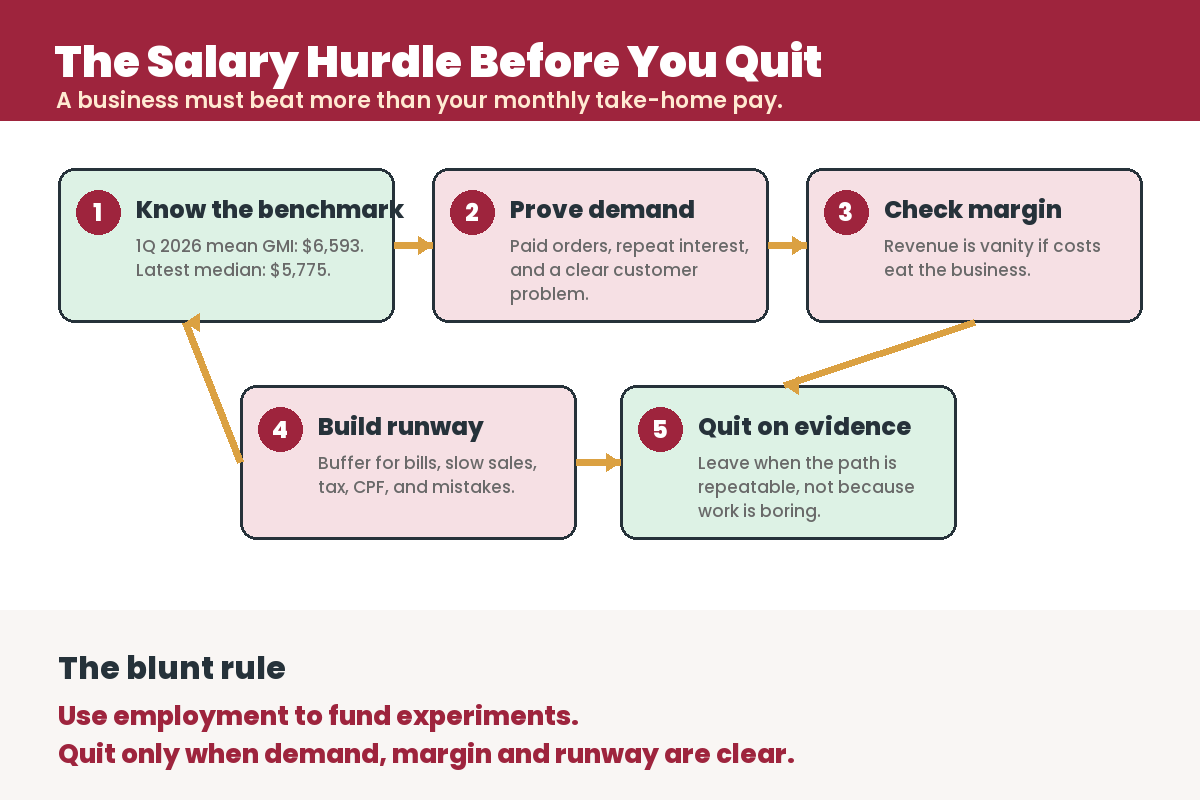
Here is the number that should sober everyone up: MOM’s latest income summary table shows mean gross monthly income from employment of $6,593 in 1Q 2026 for employed residents, including employer or platform operator CPF contributions and excluding bonus. MOM’s latest annual median figure for full-time employed residents is $5,775 at mid-year 2025, including employer or platform operator CPF contributions.
My opinion: your salary is not the enemy. Your salary is the hurdle rate. If you want to start a business, the business must eventually beat the economic value of employment, not just give you the emotional relief of leaving a boss.
The Salary Number Is Not Just A Number
Before anyone uses the $6,593 figure to brag, panic, or make a resignation decision, read it properly.
Official MOM statistic | Latest figure | How an employee should read it |
|---|---|---|
Mean gross monthly income from employment of employed residents | $6,593 in 1Q 2026 | This is the latest quarterly average. It includes employer/platform operator CPF and excludes bonus. |
Median gross monthly income from employment of full-time employed residents | $5,775 at mid-year 2025 | This is closer to the typical full-time resident worker than the mean, because the mean can be pulled up by higher earners. |
Change in mean gross monthly income | +5.0% nominal, +3.5% real from 1Q 2025 to 1Q 2026 | Income rose after inflation, but this does not mean every individual worker received that exact increase. |
Private-sector total wage change | +4.9% nominal, +4.0% real in 2025 | Employment still has wage progression for many workers, even if it may feel slow. |
Bonus quantum | 1.80 months of basic wage in 2025 | A job often includes bonus economics that new founders forget to price into their decision. |
Source: MOM Summary Table: Income, released on 28 May 2026.
The important point is not whether you personally earn more or less than the average. The important point is that employment has a hidden package: salary, employer CPF, leave, medical benefits, bonus possibility, training, colleagues, systems, and a monthly rhythm that lets you plan.
When people compare business to employment, they often compare business dream revenue against employee take-home pay. That is the wrong comparison.
Your Business Must Beat The Salary Hurdle
If you leave employment, the business does not only need to make money. It needs to pay you, survive mistakes, handle taxes, cover slower months, fund marketing, replace benefits, and still have enough left to grow.
That is why “my business can make $6,000 a month” is not enough. Is that revenue? Gross profit? Net profit? Owner salary after expenses? A one-off lucky month? Repeatable demand?
Use $6,593 as a simple benchmark. If a business needs to replace that level of gross monthly employment income, the revenue required depends heavily on margin.
Business net margin | Monthly revenue needed to produce $6,593 owner income | What it means |
|---|---|---|
20% | $32,965 | Low-margin business. You need serious volume before the business pays like a job. |
30% | $21,977 | Still demanding. A few small customers will not replace salary. |
50% | $13,186 | More realistic for some service businesses, but only if sales are consistent. |
70% | $9,419 | Possible for lean expertise-led work, but delivery depends heavily on you. |
This is not precise financial advice. It is a reality check. Business revenue is not personal income. The lower your margin, the more customers you need just to stand still.
Do Not Quit Because Employment Feels Small
Some employees think business is the opposite of employment. Employment means obedience, business means freedom. That is a childish framing.
Business is not freedom at the start. Business is customer rejection, late payment, uncertain demand, boring operations, marketing that fails, suppliers that disappoint, and the need to keep selling even when your mood is bad.
If you hate being accountable to one boss, wait until you are accountable to customers, staff, landlords, vendors, family, banks, and your own cash-flow forecast.
The better reason to start a business is not “I hate my job”. The better reason is: “I have found a painful problem, I can solve it better than the market, and people are willing to pay.”
That is also why our earlier opinion piece on business being like tower defence matters. Do not build a tower where there are no creeps. Do not build a business where there is no demand.
Your Job Can Be Your Investor
Here is the part founder culture often insults but should respect: a job can fund your experiments.
If you are employed, you may have the best possible early-stage investor: your salary. It lets you test demand without needing the business to feed you immediately. It lets you buy tools, run ads carefully, attend courses, build prototypes, meet customers, and make mistakes without turning every mistake into a household crisis.
Use employment as a launchpad, not a cage.
But do it properly. Do not steal clients, misuse company time, copy confidential material, or create a conflict with your employment contract. If the business idea overlaps with your employer’s business, get advice before you do something stupid. Freedom bought through dishonesty is just a future legal problem.
When It Makes Sense To Build While Employed
For most employees, the correct first move is not resignation. It is evidence gathering.
You build while employed when the business can be tested in evenings, weekends, leave days, or through a narrow pilot. You sell before you overbuild. You interview customers before you print name cards. You test distribution before you rent a unit.
The Quit Decision Should Be Boring
The day you quit should not feel like a movie scene. It should feel almost administratively obvious.
You know the customer segment. You know the offer. You know how leads arrive. You have paid proof. You have a runway. You understand your household burn rate. You have checked your contract. You have a plan if month three is worse than expected.
That is boring. Boring is good. Boring means you are not using resignation as therapy.
Signal | Stay employed and test | Consider quitting |
|---|---|---|
Demand | People say the idea is interesting. | People pay, repeat, refer, or wait for delivery. |
Sales channel | You have random enquiries. | You know where leads come from and can repeat the process. |
Margins | You only know revenue. | You know gross margin, net margin, delivery cost and owner pay. |
Runway | You have hope. | You have household savings and a clear low-income survival plan. |
Ethics | The idea may conflict with your job. | You have checked obligations and can proceed cleanly. |
Emotional reason | You want to escape your boss. | You want to serve a market you understand. |
What If You Earn Less Than The Average?
If you earn below the mean or median, entrepreneurship may feel more attractive because the salary hurdle looks lower. That is understandable.
But lower salary does not automatically make business safer. A person earning less may also have less savings, less buffer, fewer professional networks, and less room for failure. The danger is not only quitting a high salary. The danger is quitting without enough evidence.
At the same time, business can be a real path upward for people who are capped in employment. Some people do not have elite credentials, corporate sponsorship, or a smooth promotion ladder. Business lets the market judge them more directly. That can be brutal, but it can also be liberating.
The point is not “stay employed forever”. The point is “do not confuse low satisfaction with a validated business”.
What If You Earn More Than The Average?
If you earn far above the average, your hurdle rate is higher. That does not mean you should never start a business. It means you must be honest about what you are buying with the decision.
Maybe you are buying autonomy. Maybe you are buying ownership. Maybe you are buying the chance to build something that employment will never let you build. Those are valid reasons.
But do not pretend the early-stage business is financially rational if it is not. Say the truth: “I am accepting a temporary economic downgrade for a shot at ownership.” That sentence is more adult than pretending passion automatically pays rent.
The Practical Plan I Would Recommend
If you are employed and thinking of starting a business, I would not start with incorporation. I would start with proof.
- Choose a problem you understand deeply. Prefer problems you have seen repeatedly, not fantasies imported from social media.
- Talk to 20 potential buyers. Not friends who encourage you. Actual people who have the problem.
- Sell a narrow offer first. Avoid building a full company before one person pays.
- Track margin from day one. Revenue without margin is a performance.
- Keep your job while testing. Let salary fund learning until the business earns the right to demand more time.
- Set a quit trigger in writing. For example: six months of repeatable revenue, clear pipeline, adequate savings, and no employment conflict.
- Set a stop-loss too. Decide how much money, time and stress you are willing to spend before rethinking.
You may also want to read when a business owner should give up and go back to employment. It is the same conversation from the other side.
The Opinion
Singapore is expensive. Jobs are not guaranteed forever. Loyalty from employers is not something any adult should blindly rely on. So yes, employees should think about building additional income, skills, assets and business options.
But the answer is not reckless resignation. The answer is disciplined optionality.
Use the job. Use the salary. Use the CPF. Use the stability. Use the evenings. Use the weekends. Use the discomfort. Build something real before you ask your family and your bank account to believe in it.
If the business has demand, margin, repeatability and runway, quitting may be brave. If the business has only excitement, quitting is not brave. It is expensive theatre.
Your salary is not proof that you should stay small. It is the benchmark your business must learn to beat.
What is the average salary in Singapore in 2026?
MOM’s latest quarterly income table shows mean gross monthly income from employment of $6,593 in 1Q 2026 for employed residents, including employer or platform operator CPF contributions and excluding bonus. The latest annual median full-time resident figure is $5,775 at mid-year 2025.
Should I quit my job to start a business in Singapore?
Do not quit only because employment feels frustrating. Consider quitting only after you have paid demand, clear margins, a repeatable sales channel, adequate runway and no employment-contract conflict.
Can I start a business while employed?
Often yes, but you should check your employment contract, avoid conflicts of interest, avoid using company time or confidential information, and keep the first business test narrow and ethical.
How much revenue must a business make to replace salary?
It depends on margin. To produce $6,593 of owner income, a business needs about $13,186 revenue at 50% net margin, but about $21,977 at 30% margin. Revenue is not the same as personal income.
Explore More Content
Table of Content