
We make boring business stories sparkle.
Your Business Is Not Failing Because of Competition. It Is Failing Because Nobody Knows What Game You Are Playing
An opinion piece on why unclear positioning, not competition, is often the real reason a small business struggles to win customers.

Every few weeks, someone says their business is struggling because the market is too competitive.
Sometimes they are right. Usually, they are using competition as a more respectable name for confusion.
The harsh version is this: many businesses are not losing because competitors are too strong. They are losing because customers cannot understand what game the business is playing.
Are you the cheapest? The fastest? The safest? The premium choice? The specialist? The local relationship business? The no-nonsense operator? The creative one? The boring but reliable one?
If the owner cannot answer that clearly, the customer will not work it out on their behalf.
Competition Is the Lazy Diagnosis
Blaming competition is emotionally convenient. It lets a founder feel that the business is good, but the world is unfair.
Maybe the world is unfair. Business is not a school exam where everyone gets equal timing, equal traffic and a polite explanation. Customers are busy, distracted and selfish in the ordinary human way. They do not owe your business deep consideration.
They glance, compare, assume, feel, avoid risk, ask a friend, choose the familiar option, and move on.
That means your positioning has to do more work than your ego wants to admit.
What owners say | What may actually be happening | What to fix first |
|---|---|---|
The market is too competitive. | Customers cannot see why you are different. | Choose a clear position and prove it. |
People only care about price. | You have not explained a reason to pay more. | Show risk reduction, expertise, speed or outcome quality. |
Competitors copy everything. | Your advantage is too easy to copy. | Build process, trust, niche knowledge or distribution. |
Leads are bad quality. | Your message is attracting the wrong audience. | Say who the offer is for and who it is not for. |
Marketing does not work. | The offer is vague before marketing even starts. | Fix the promise before buying attention. |
Customers Need to Know the Game
A customer does not simply choose a vendor. They choose a game.
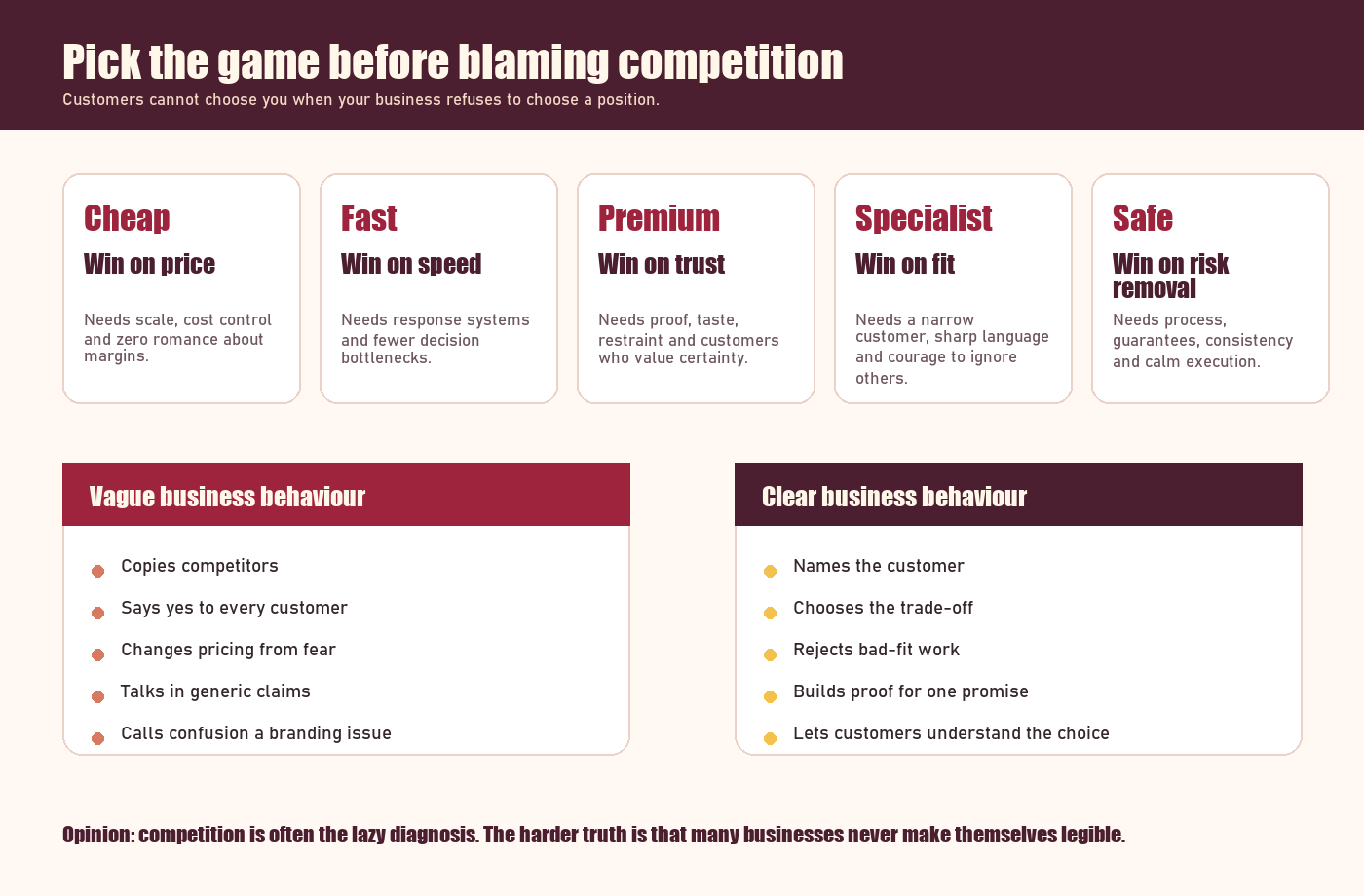
If they want the lowest price, they enter the price game. If they want certainty, they enter the trust game. If they want speed, they enter the urgency game. If they want taste, they enter the premium game. If they have a weird problem, they enter the specialist game.
The problem is that many businesses want to be all of these at once.
They want premium margins and bargain messaging. They want specialist respect and mass-market language. They want to be fast, customised, cheap and high-touch, then act surprised when operations become messy.
This is not strategy. It is the human habit of wanting every upside without paying for the trade-off.
The Undisciplined Business Says Yes to Everyone
One of the clearest signs of weak positioning is the business that cannot reject bad-fit customers.
It takes every enquiry seriously. It customises every proposal. It discounts when pressured. It changes scope when the customer hesitates. It copies a competitor this month and another competitor next month.
The owner calls this being flexible. Often, it is fear wearing a professional shirt.
Flexibility Is Not Always a Virtue
Flexibility is useful when the business knows its centre. Without a centre, flexibility becomes wobbling.
- A premium business should not panic every time a cheap competitor appears.
- A specialist business should not dilute itself for customers outside the niche.
- A speed-based business should not promise endless customisation.
- A low-cost business should not pretend it can provide concierge service.
Every real position has a cost. If there is no cost, there is probably no position.
The Five Games a Small Business Can Choose
This is not an academic exercise. A small business owner should be able to look at the business and say which game it is trying to win.
Game | How you win | What you must accept |
|---|---|---|
Price game | Be cheaper without destroying yourself. | You need volume, cost control and simple operations. |
Speed game | Respond and deliver faster than alternatives. | You need tight process and less custom decision-making. |
Premium game | Make the customer feel lower risk and higher status. | You need proof, taste, service consistency and restraint. |
Specialist game | Solve one painful problem better than generalists. | You must ignore many possible customers. |
Safety game | Make the customer feel protected from mistakes. | You need documentation, reliability and boring discipline. |
Some businesses can blend games, but not lazily. A business can be premium and fast if it charges enough and designs operations around speed. A business can be specialist and safe if it has deep expertise and clear process. But a small business cannot usually be cheap, fast, premium, customised, specialist and high-touch at the same time.
That is not unfair. That is physics.
Humans Love Vague Dreams
Here is the uncomfortable part.
Many owners do not avoid positioning because they are stupid. They avoid it because clarity hurts.
Clarity forces a person to admit that the business is not for everyone. It forces trade-offs. It forces the owner to stop hiding inside potential. It removes the fantasy that one day the market will magically understand everything the business could become.
Humans love vague dreams because vague dreams cannot be measured. The moment you choose a game, reality gets a scoreboard.
Marketing Cannot Save an Unclear Business
Marketing amplifies the business. It does not rescue the owner from refusing to choose.
If the positioning is unclear, marketing simply spreads the confusion to more people. You get more impressions, more polite interest, more weak enquiries and more reasons to blame the algorithm.
Before asking how to market, ask this:
- Who is this definitely for?
- What problem do they already know they have?
- Why would they choose us instead of a familiar alternative?
- What do we refuse to compete on?
- What proof makes our claim believable?
If those answers are weak, the business does not have a marketing problem yet. It has a thinking problem.
Stop Worshipping Competitors
Competitor research is useful. Competitor worship is pathetic.
A business that stares too long at competitors slowly becomes a cheaper, nervous version of them. It copies their packages, wording, promotions and content calendar, then wonders why customers treat it as interchangeable.
The point of studying competitors is not to become them. It is to understand what game they are playing, then decide whether to play that game better or play a different one.
This is connected to the demand-lane idea in SBO’s article on business as tower defence. You still need to build where demand moves, but the tower also needs a clear purpose. A confused tower in a busy lane still leaks customers.
A Simple Positioning Test
Try this test before blaming the market.
Question | Weak answer | Stronger answer |
|---|---|---|
Who are you for? | Anyone who needs our service. | Small service businesses hiring their first admin staff. |
Why choose you? | We are experienced and affordable. | We set up the process in one week so the owner stops handling every task. |
What do you refuse? | We are flexible. | We do not do custom enterprise projects because they slow our core clients. |
What proof do you show? | Testimonials. | Before-after workflow examples, response-time metrics and named case studies. |
If the stronger answer feels narrower, good. Narrow is not the enemy. Invisible is the enemy.
The Opinion
Small businesses should stop using competition as a blanket excuse.
Yes, competitors matter. Yes, some markets are crowded. Yes, customers compare. But comparison is not the same as defeat.
The bigger issue is that too many businesses ask customers to decode them. They speak in generic promises. They refuse trade-offs. They chase every enquiry. They copy whoever looks successful this month. Then they call the result a competitive market.
No. It is an unclear game.
Pick the game. Pay the cost. Make the choice obvious.
If you are still deciding what business to build, SBO’s opinion piece on what business makes sense in Singapore is a useful companion. If you are wondering whether starting is worth the pain, read Is It Worth Starting a Business in Singapore?.
Frequently Asked Questions
What does it mean to choose a business game?
It means deciding the basis on which customers should choose you: price, speed, trust, specialisation, safety, taste or another clear advantage. Without that, customers compare you as a generic option.
Is competition still important?
Yes. Competition matters, but it is often not the root problem. If your positioning is unclear, even light competition can feel overwhelming.
Can a business play more than one game?
Yes, but only deliberately. For example, premium and fast can work if pricing and operations support it. Trying to be cheap, premium, fast and customised at the same time usually creates confusion.
How can a small business improve positioning?
Start by naming the ideal customer, the painful problem, the reason to choose you, the customers you should reject and the proof that makes your claim believable.
Explore More Content
Table of Content