
We make boring business stories sparkle.
Stop Doing Things That Make the Business Harder, Then Calling It Growth
An opinion piece on fake growth: the business decisions that add complexity, weaken margins and make the company harder to run.

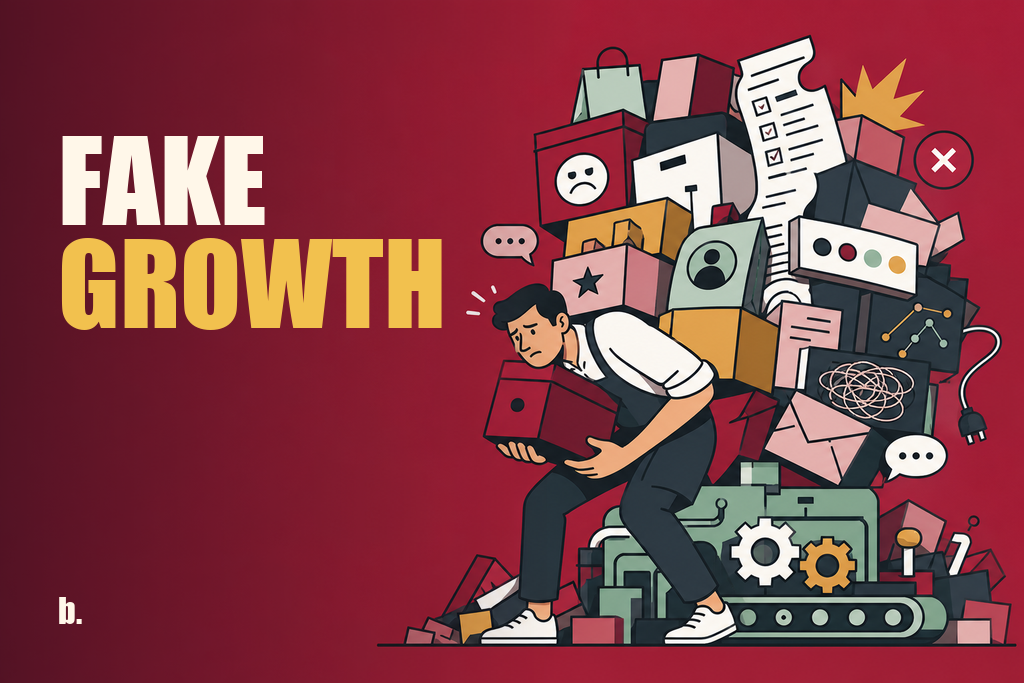
Stop doing things that make the business harder, then calling it growth.
This is one of those obvious truths that humans keep refusing to recognise because the lie feels better.
More clients feels like growth. More services feels like ambition. More platforms feels like marketing. More custom work feels like customer care. More hiring feels like scale. More revenue feels like proof.
But sometimes the business is not growing. It is getting heavier.
Not All Growth Is Progress
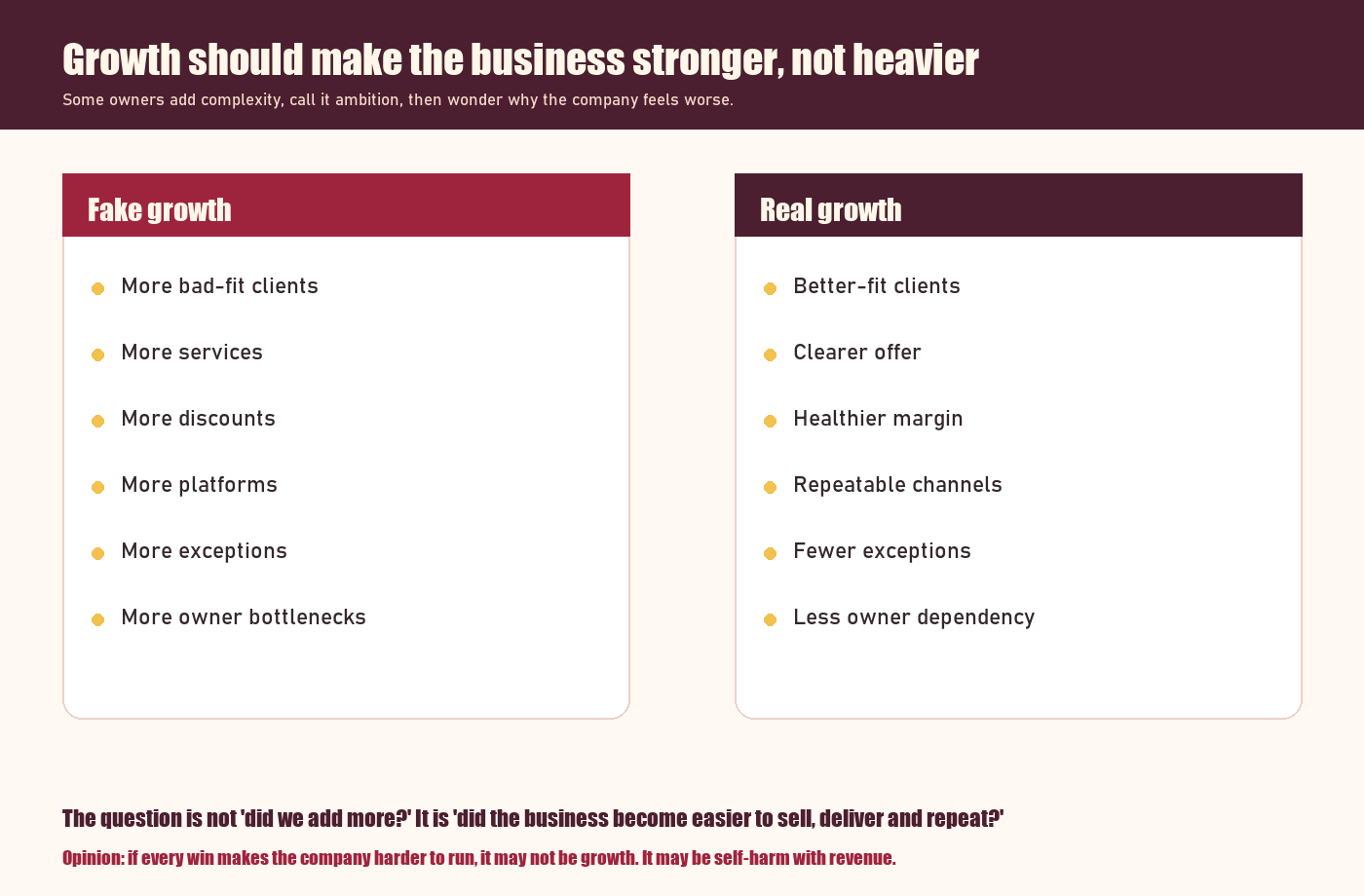
Growth should make a business stronger, more repeatable, more profitable or less dependent on chaos.
If every new win makes the company harder to sell, harder to deliver, harder to manage and harder to explain, it is worth asking whether the owner is building a business or collecting problems with invoices attached.
Looks like growth | May actually be | Hard truth |
|---|---|---|
More clients | More bad-fit obligations. | Revenue is not useful if it buys chaos. |
More services | A diluted offer. | Choice can make the business harder to understand. |
More discounts | Weak positioning. | Cheap work still consumes real capacity. |
More platforms | Attention fragmentation. | Being everywhere can mean owning nowhere. |
More customisation | Operational debt. | Every exception becomes a future tax. |
Humans Like Addition Because Subtraction Feels Like Loss
This is the psychological trap.
Adding feels active. Cutting feels scary. Saying yes feels generous. Saying no feels rude. Launching another service feels entrepreneurial. Killing one feels like admitting defeat.
So owners add. They add services, channels, tools, meetings, discounts, exceptions, processes, reports, people, offers and obligations. Then the business becomes a messy pile and everyone acts surprised.
The obvious thing not to do is often obvious from the beginning. The owner does it anyway because it promises relief now and charges interest later.
Bad-Fit Revenue Is Not Free Money
Bad-fit clients are expensive even when they pay.
They need more explanation. They ask for exceptions. They argue about scope. They pull the team away from good clients. They make the owner anxious. They distort the offer because the business starts bending around their demands.
Then the owner says, “But it is revenue.”
Yes. So is selling your time at a loss while damaging your standards.
Some Customers Are Negative Margin in Disguise
- They pay late.
- They need too much custom explanation.
- They ignore process, then blame delivery.
- They pressure the team into exceptions.
- They make the business worse for better customers.
A business owner who cannot reject bad-fit revenue is not growth-minded. They are frightened.
Complexity Is a Cost, Even When It Has No Invoice
One of the most damaging human blind spots is ignoring invisible cost.
A new service does not only need a price. It needs sales copy, onboarding, delivery, quality control, training, support, revisions, reporting and expectation management. A new platform does not only need posts. It needs attention, consistency, response and learning. A new discount does not only reduce price. It changes customer perception.
Decision | Visible benefit | Hidden cost |
|---|---|---|
Add a service | More things to sell. | More complexity in delivery and positioning. |
Accept a custom request | Win the deal. | Create a precedent and a process exception. |
Discount heavily | Close faster. | Train customers to doubt your value. |
Hire quickly | More hands. | More management if process is unclear. |
Use every channel | More visibility. | Less focus and weaker consistency. |
The Owner Often Is the Problem
This is the part people do not enjoy.
Many businesses are hard because the owner keeps making them hard. Not because the market demanded it. Not because customers forced it. Because the owner keeps choosing short-term relief over long-term shape.
They say yes to avoid discomfort. They discount to avoid rejection. They customise to avoid positioning. They hire to avoid documenting. They add services to avoid choosing. They stay busy to avoid seeing that the business model is weak.
Then they call the resulting chaos “growing pains”.
No. Sometimes pain is not from growth. Sometimes pain is from refusal to stop doing stupid things.
Real Growth Often Looks Like Doing Less
A stronger business is often narrower, clearer and less dramatic.
It sells fewer things better. It serves fewer customer types with more confidence. It says no faster. It repeats delivery. It protects margin. It reduces exceptions. It removes the owner from routine decisions. It becomes easier to explain.
That may feel less exciting. Good. Excitement is not a business model.
Question | Weak answer | Stronger answer |
|---|---|---|
What should we sell? | Whatever customers ask for. | The offer we can deliver profitably and repeatedly. |
Who should we serve? | Anyone with budget. | The customers who fit our process and value our standard. |
When should we customise? | When it helps close the deal. | Only when the premium covers the complexity. |
When should we hire? | When everyone is overloaded. | After process is clear enough for someone else to operate. |
What is good growth? | More revenue. | More repeatable profit with less chaos per dollar. |
This links closely to SBO’s article on productised services. Productising is not just a marketing tactic. It is a way to stop turning every sale into a new operational mess.
The Opinion
Humans love to rename bad decisions so they sound noble.
Fear becomes flexibility. Confusion becomes experimentation. Discounting becomes competitiveness. Overcommitment becomes ambition. Chaos becomes growth.
But the business knows the truth. The team knows. The customers feel it. The owner feels it at night.
If the business becomes harder every time it “wins”, stop celebrating the win. Study the cost.
The obvious thing not to do is this: do not add weight to a weak structure and call it scaling.
For related opinion pieces, read why customers cannot choose a business that has not chosen its game and why polished output cannot replace clear thinking.
Frequently Asked Questions
What is fake business growth?
Fake growth is activity or revenue that makes the business harder, less profitable, less focused or more dependent on chaos.
Why do business owners accept bad-fit clients?
Often because revenue feels safer than saying no. But bad-fit clients can consume capacity, damage standards and distract the business from better customers.
Is adding more services always bad?
No. Adding services can work when they fit the positioning, margin and delivery system. It becomes dangerous when every new service creates more confusion and exceptions.
What does real growth look like?
Real growth usually means better-fit customers, clearer offers, healthier margins, repeatable delivery and less owner dependency.
Explore More Content
Table of Content