
We make boring business stories sparkle.
People-Pleasing Is Selfish Too: When Approval Costs Your Family
People-pleasing can look selfless while your family, health and existing responsibilities quietly pay for your need to be liked.


At 8.47pm, the food was already cold.
His wife and son were waiting at the dining table when his phone lit up. A client wanted “one small change” before the next morning. It was not an emergency. It was not inside the agreed scope. It was simply convenient for the client to ask.
He replied immediately: “No problem. I will settle it tonight.”
Earlier that day, he had also agreed to cover a colleague’s unfinished work. He had accepted a meeting at a time he had promised to keep free. He had postponed a medical appointment because moving it felt easier than telling someone he was unavailable.
He thought this made him responsible.
When his wife finally asked why strangers always received the most patient and helpful version of him, he defended himself with the sentence people-pleasers know well: “I just do not want them to think I am selfish.”
But the arrangement was already selfish.
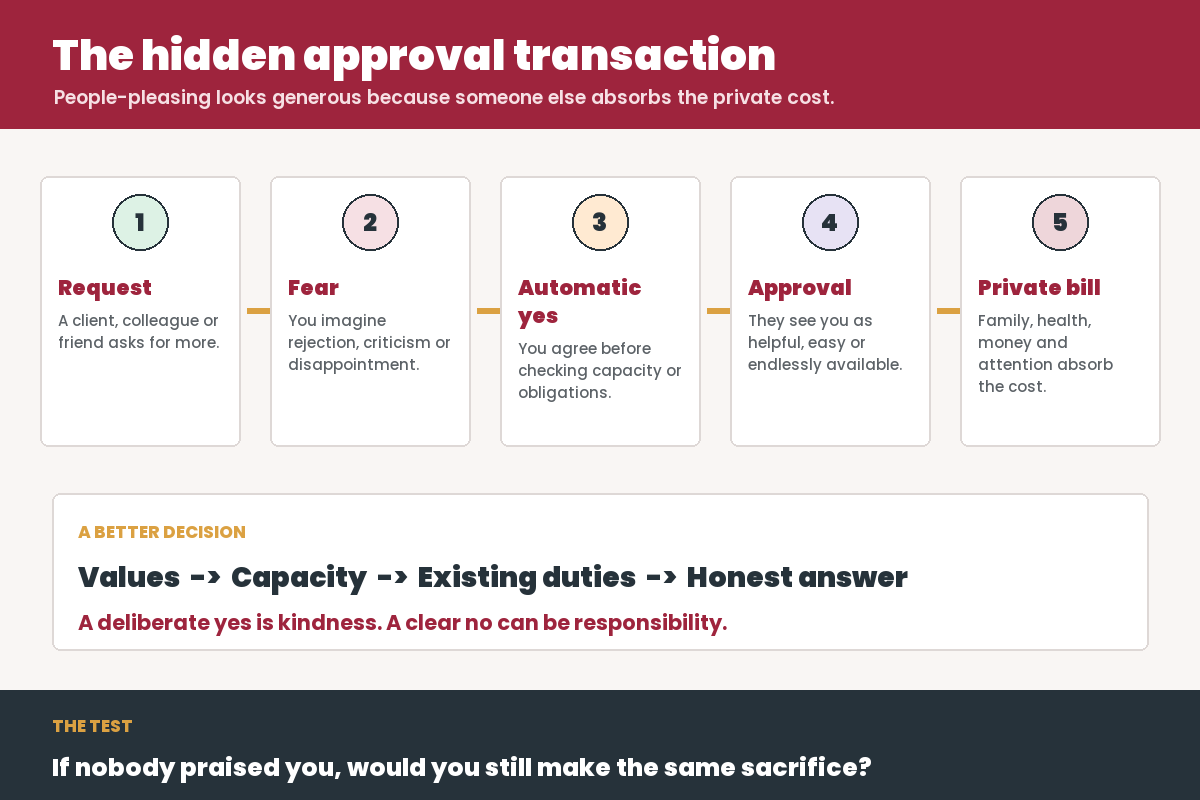
He was protecting his image in other people’s minds using time, attention and emotional capacity that his family had to replace. The client received convenience. The colleague received relief. He received the reassurance of being seen as dependable. His family received the bill.
If you care so much about how other people see you that you repeatedly fail to do the right thing for yourself and the people who depend on you, that is not pure selflessness. It is approval-seeking, and approval-seeking can be deeply selfish.
People-Pleasing Is Reputation Management
People-pleasing is often presented as excessive kindness. That description is too flattering.
Much of it is reputation management. You want to be known as helpful, agreeable, generous, easy to work with, loyal, uncomplaining and always available. You fear being called difficult, greedy, lazy, ungrateful or selfish.
So you arrange your decisions around controlling what other people think of you.
The action may benefit someone else, but the emotional centre of the decision is still you: your image, your fear, your need for reassurance and your discomfort with disapproval.
This does not mean every generous act has a hidden evil motive. It means a good-looking action should not be judged only by who receives the immediate benefit. We should also ask why it was done, who absorbed the cost and which prior responsibility was abandoned.
What you do | What you tell yourself | What may actually drive it | Who pays |
|---|---|---|---|
Accept free extra client work | “I provide excellent service.” | Fear of appearing difficult or expensive | Your margin, evening and family |
Cover a colleague repeatedly | “I am a team player.” | Fear of losing status or belonging | Your workload, health and existing duties |
Stay silent about a bad decision | “I am keeping the peace.” | Fear of conflict or rejection | The team that must live with the result |
Attend every social obligation | “Relationships matter.” | Fear of being forgotten or judged | Your rest and closest relationships |
Never ask for fair payment | “I am not money-minded.” | Fear of looking greedy | Your business and household finances |
You Are Not Choosing Others Over Yourself
People-pleasers like to imagine a noble contest between themselves and everyone else. They believe they keep losing because they are simply too caring.
Often, that is not the real contest.
You are choosing your public image over your private obligations. You are choosing the comfort of an immediate yes over the discomfort of an honest boundary. You are choosing not to feel guilty now, while giving your future self and your family a larger problem later.
That is why the behaviour can be selfish even when it looks sacrificial. The person making the promise receives the psychological reward. Someone quieter absorbs the operational cost.
A spouse handles bedtime alone because you volunteered for work nobody asked you to own. A child learns that your phone outranks their attention. Your health carries the sleep debt. Your business carries the unpaid scope. Your future carries the commitments your present self made to avoid a few uncomfortable seconds.
The people closest to you are often the easiest to disappoint because their love feels safer. Clients can leave. Colleagues can gossip. Acquaintances can exclude you. Family is expected to understand.
So the safest relationship gets the worst allocation.
That is not kindness. It is cowardly accounting.
Your Family Should Not Be The Silent Sponsor Of Your Good Reputation
There is a hidden subsidy behind many supposedly selfless people.
The always-available employee may have a spouse doing more household work. The endlessly accommodating founder may be using family savings to support customers who refuse to pay properly. The person who never says no may return home exhausted, impatient and emotionally absent.
The outside world sees generosity because the cost has been moved offstage.
Your family did not agree to sponsor your need to be liked. They should not have to surrender their time, financial security or emotional peace so that colleagues can call you helpful and clients can call you easy to work with.
This does not mean your family owns every minute of your life. It means their legitimate claims should not automatically rank below every request made by someone whose opinion frightens you.
Before saying yes, ask a basic question: Who will have to compensate for this decision?
If the answer is repeatedly your spouse, children, health, savings or future, stop describing the pattern as harmless generosity.
Duty And People-Pleasing Are Not The Same
Real duty can be costly. A parent may sacrifice sleep for a sick child. A business owner may stay late to correct a mistake the company caused. A colleague may step in during a genuine crisis. A friend may need help at a terrible time.
The existence of sacrifice does not prove people-pleasing.
The difference is whether the decision comes from a considered responsibility or from a desperate need to avoid disapproval.
Test | Genuine duty or kindness | People-pleasing |
|---|---|---|
Reason | Aligned with values, responsibility or a deliberate choice | Driven mainly by fear of judgment, conflict or rejection |
Capacity | You check what you can realistically give | You agree first and discover the damage later |
Existing promises | You consider duties already owed to others | The newest or loudest requester wins |
Communication | You can state limits without inventing excuses | You hide limits until resentment or failure appears |
Recognition | You would still act if nobody praised you | The imagined opinion of others controls the decision |
Pattern | Sacrifice is purposeful and sustainable | The same people benefit while the same people pay |
A useful question is: If nobody knew I had done this, would I still believe it was the right thing to do?
If the answer changes when the praise disappears, the sacrifice may be more about identity than generosity.
Clients Are Not Moral Authorities
Business owners are especially vulnerable to confusing accommodation with virtue.
A client asks for work outside scope. You agree because you want to be seen as service-minded. A customer sends a message late at night. You respond immediately because silence feels rude. A prospect negotiates the price below sustainability. You accept because walking away feels arrogant.
Then you call the resulting exhaustion “customer service”.
It is not excellent service to make promises your business cannot sustainably keep. It is not generosity to undercharge until your household subsidises the client. It is not professionalism to answer every request with yes and later deliver with resentment.
SBO’s article on why the cheapest customer can cost the business the most describes the commercial version of this mistake. Bad boundaries do not only waste time. They train clients to expect more while respecting the original agreement less.
A client is allowed to ask. You are allowed to price, schedule, narrow or decline the request. Their disappointment is information, not a moral verdict.
Your Colleagues Do Not Get To Spend Your Home Life
Workplace belonging can become another approval trap.
You accept every undesirable task because you want to be known as reliable. You laugh at behaviour you dislike because you want to fit in. You avoid challenging weak decisions because the room may become uncomfortable. You remain available after hours because everyone else appears to be doing the same.
But colleagues do not experience the whole cost of your compliance. They see the person who said yes. They do not live with the depleted person who returns home.
Being cooperative is useful. Making yourself structurally unable to refuse is not. A team that depends on one person’s fear of saying no is not healthy teamwork. It is an operating model built on emotional leverage.
Reputation still matters. Build a reputation for honest capacity, clear commitments and reliable delivery. That is more valuable than being known as the person who agrees to everything and quietly drops something later.
A Clean No Can Be More Selfless Than A Resentful Yes
Saying no is not automatically selfish. Sometimes it is the only honest answer available.
A clean no prevents false expectations. It protects work already promised. It stops another person from planning around capacity that does not exist. It forces a client to confront the real price and timeline. It allows a colleague to find a genuine owner for the task.
Most importantly, it prevents you from making generous-looking promises and then charging the emotional cost to uninvolved people.
Situation | Approval-seeking answer | Responsible answer |
|---|---|---|
Client requests extra work | “Sure, no problem.” | “That is outside scope. I can add it for $X and deliver by Friday.” |
Colleague transfers urgent work | “I will handle everything.” | “I can take A or B today. Which has priority?” |
Meeting invades protected time | Accept, then complain privately | “I am unavailable then. These two times work.” |
Friend asks for repeated unpaid help | Keep helping to avoid awkwardness | “I cannot continue doing this regularly.” |
You agreed too quickly | Disappear or deliver resentfully | “I answered before checking. I need to correct my commitment.” |
Boundaries do not require aggression, a speech or a fake excuse. State the limit, offer a real alternative when appropriate, and let the other adult manage their feelings.
Use The Six-Question Approval Test
Before making a sacrifice, especially one that affects other people, ask:
- If nobody praised me, would I still do this?
- Who will pay for my yes in time, money, attention or stress?
- Which existing promise will be displaced?
- Is this actually my responsibility, or am I afraid of how refusal will look?
- Would I advise my spouse, child or closest friend to accept the same arrangement?
- What is the realistic consequence of a polite no?
Do not answer these questions as the person you wish to appear to be. Answer them as the person who will have to live with the decision tomorrow.
The article Your Life Is Not a Productivity Problem makes a related point: better tools cannot fix priorities you refuse to choose. The advice a 40-year-old man might give his 21-year-old self also matters here. Time becomes expensive long before people admit it.
You May Have Learned This Pattern For A Reason
Some people learned early that being agreeable kept them safe, included or praised. They became skilled at reading a room, preventing conflict and meeting needs before anyone asked.
That history may explain the pattern. It does not make the pattern harmless.
Once you recognise that your fear of disapproval is making decisions for your family, business and future, you are responsible for changing how those decisions are made. Self-awareness that never changes behaviour is only a more articulate excuse.
Start small. Delay the automatic answer. Say, “Let me check and come back to you.” Compare the request with existing commitments. Practise letting a reasonable person be mildly disappointed. Notice that discomfort is survivable.
You do not need everyone to agree that your boundary is fair. People who benefited from having no boundary are rarely neutral judges of the new one.
The Final Opinion
Stop calling every surrender kindness.
If you repeatedly neglect yourself and your family because you cannot bear the thought of colleagues, clients or acquaintances judging you, the behaviour is not as selfless as it looks. You are protecting your reputation, avoiding your discomfort and outsourcing the cost to people with less power over your decisions.
Do the right thing, not the thing that makes you look good to the nearest audience.
Keep your real duties. Help when the help is deliberate and affordable. Be generous without making involuntary sponsors of the people who love you. Let clients negotiate with clear terms. Let colleagues discover that your time has limits. Let some people misunderstand you.
Your family should not have to keep paying for the version of you that strangers admire.
Frequently Asked Questions
Is people-pleasing really selfish?
It can be. When the main motive is controlling how others see you, and your family, health or existing duties repeatedly absorb the cost, the behaviour is centred on your need for approval even if someone else benefits immediately.
Is caring what other people think always unhealthy?
No. Reputation, empathy and cooperation matter. The problem begins when fear of disapproval overrides your values, capacity and responsibilities to people who depend on you.
How can I tell kindness from people-pleasing?
Ask whether you would still act without praise, whether you checked your capacity, who pays for the decision and whether you can state a reasonable limit without inventing an excuse.
Will setting boundaries hurt my career or client relationships?
Some people may dislike a new boundary, especially if they benefited from the old pattern. Clear scope, honest timelines and reliable delivery usually create a stronger professional reputation than automatic agreement followed by resentment or failure.
What is the first step to stop people-pleasing?
Stop answering immediately. Say that you need to check, compare the request with existing commitments, then give a deliberate yes, a limited alternative or a clear no.
Explore More Content
Table of Content