
We make boring business stories sparkle.
Would You Pay More For A Business That Hires Only Singaporeans?
You walk into a restaurant near your office. The sign is proud: locally owned, locally staffed, only Singaporeans on the...

You walk into a restaurant near your office.
The sign is proud: locally owned, locally staffed, only Singaporeans on the floor and in the kitchen. The cashier is friendly. The service is clear. The owner looks tired but sincere. The food arrives hot.
Then the bill comes.
The same meal that costs $7.50 elsewhere is $11.80 here. Not because the ingredients are imported from heaven. Not because the chair is more comfortable. The owner explains plainly: local staff cost more, and if the business wants to hire and retain them properly, the menu cannot be priced like a stall built on the cheapest labour available.
Now the real question begins.
Would you pay more for that business?
If your honest answer is no, then the next sentence may be uncomfortable: do not blame business owners for trying to reduce cost.
The Public Loves Local Hiring Until The Receipt Arrives
Singaporeans often say businesses should hire more locals. Fair enough. A country should care whether its own people have access to decent work, training, progression and dignity.
But customers also compare prices ruthlessly. They check Google reviews, delivery app promos, set-lunch deals, hawker alternatives, JB prices, Shopee prices, Taobao prices and “why so expensive” comments before they decide where to spend.
So we should be honest. Many people support local hiring emotionally, but not economically. They like the idea until it appears as a higher price.
That gap between what people praise and what people pay for is where business owners live.
This Is Not A Complaint Against Singaporean Workers
Let us remove the lazy interpretation first.
This is not an argument that Singaporeans are bad workers. It is not an argument that businesses should avoid locals. It is not an argument for unfair hiring, worker exploitation, or turning every workplace into a lowest-cost contest.
In Singapore, employers are expected to practise fair hiring. MOM’s Fair Consideration Framework says employers should not discriminate based on non-job-related characteristics such as age, sex, nationality or race. MOM’s fair employment guidance also describes fair employment as merit-based and non-discriminatory.
So the phrase “hire only Singaporeans” in this article is not a recommendation to write discriminatory job ads. It is a consumer question: if a business positions itself around local staffing and carries the cost of that choice, will customers actually reward it?
Local Labour Has A Real Cost Structure
There is a reason business owners obsess over manpower cost. For many restaurants, retailers, cleaning operators, clinics, service firms and small shops, manpower is not a small line item. It is one of the business.
For Singapore Citizen and Singapore Permanent Resident employees, CPF contributions apply. CPF Board’s current 2026 table shows that for Singaporeans and SPRs from third year onwards aged 55 and below earning more than $750 monthly, the employer contribution is 17% and the employee contribution is 20%, for a total of 37%.
At the same time, foreign manpower is not a free-for-all. MOM says Work Permit holders are limited by quota and subject to levy. For services, the dependency ratio ceiling is 35%, meaning Work Permit and S Pass holders cannot exceed 35% of the total workforce. MOM also says quota computation uses CPF information from local employees, and a local employee earning at least $1,800 per month counts as one local employee for quota purposes.
In other words, this is not a cartoon where employers simply choose “cheap foreigners” because they are evil. The real world has wages, CPF, levies, quotas, rosters, training, turnover, productivity and customers who complain about price.
For the mechanics behind quota planning, read our Singapore work permit quota guide. For the employee-side version of the same cost reality, read why salary is the hurdle rate before quitting to start a business.
Cost or rule | What it means | Why customers should care |
|---|---|---|
Local salary | Singaporeans and PRs need wages that make sense in Singapore’s cost environment. | If a business hires locals seriously, pricing has to support those wages. |
Employer CPF | For younger Singaporean/third-year SPR employees above $750 monthly wage, employer CPF is 17% in 2026. | The wage cost to the business is more than the salary line customers imagine. |
Foreign worker quota | MOM caps Work Permit/S Pass ratios by sector; services DRC is 35%. | Businesses cannot always replace locals with unlimited cheaper manpower. |
Foreign worker levy | Work Permit holders are subject to monthly levy. | Foreign manpower may reduce some wage pressure, but it still has regulated costs. |
Training and turnover | New staff need time before they become productive. | Higher service standards cost money before customers see the benefit. |
Sources: CPF Board contribution rates, MOM foreign worker quota and levy requirements, and MOM Fair Consideration Framework.
Your Receipt Is Your Vote
Consumers often think their opinions shape the economy. They do, but not the way people imagine.
Your receipt is more powerful than your Facebook comment. Your repeat purchase is more powerful than your “support local” slogan. Your willingness to pay is more powerful than your complaint that businesses are heartless.
If customers consistently choose the cheapest option, businesses learn that price matters more than staffing philosophy. If customers reward better service, ethical employment, local training and reliable quality, businesses learn that those things can be monetised.
Markets are not built from what people say they value. Markets are built from what people actually pay for.
The Restaurant Example Is Brutal Because It Is Familiar
Take a small restaurant.
It wants to hire local service staff. It needs people who can speak confidently with customers, handle complaints, explain menu items, manage delivery orders, clean tables, operate POS systems and not disappear after two weeks.
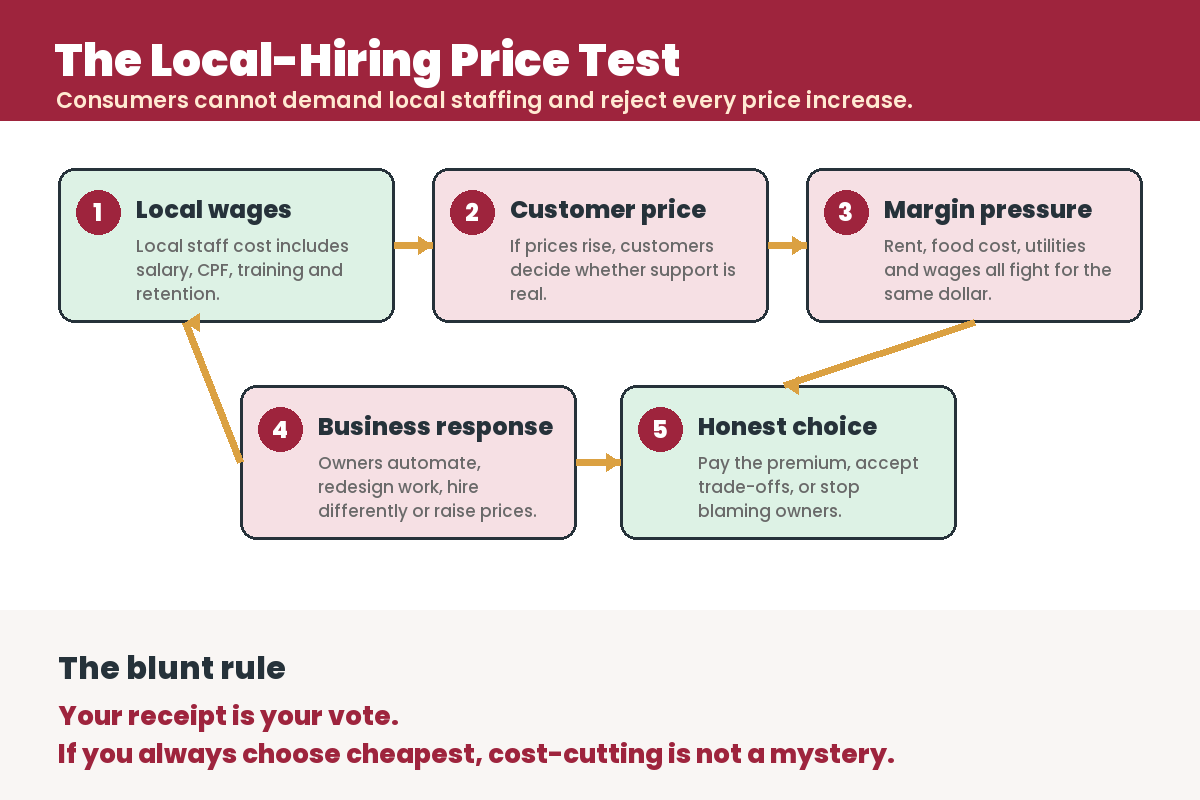
If it pays too little, it cannot attract or retain them. If it pays properly, payroll rises. If payroll rises, the owner has only a few options:
- Raise menu prices.
- Reduce owner income.
- Reduce headcount and make service slower.
- Use technology and redesign operations.
- Change opening hours.
- Hire differently within legal manpower rules.
- Close.
Customers usually want the impossible version: local staff, cheap food, fast service, clean space, long opening hours and owner accountability when anything goes wrong.
That business model exists only if someone else absorbs the pain.
There Are Only Four Honest Consumer Positions
Most people do not need to become manpower policy experts. But they should at least choose an honest position.
Your position | What it really means | What you should stop doing |
|---|---|---|
I will pay more for local staffing | You accept that local wages and service standards need pricing support. | Stop comparing every local business to the cheapest alternative. |
I want cheap prices first | You are voting for cost efficiency over staffing ideals. | Stop pretending business owners are immoral for controlling labour cost. |
I want better jobs for locals | You support training, productivity, progression and fair employment practices. | Stop reducing the issue to nationality slogans. |
I do not care who is hired | You care mainly about price, product and convenience. | Stop joining outrage only when it is socially fashionable. |
The worst position is the dishonest one: demanding local hiring in public, then punishing every business that prices for it.
Business Owners Are Not Charities With Cash Registers
A business exists to serve customers profitably. That last word matters.
If a business cannot make a reasonable profit, it cannot keep hiring anyone. Not locals. Not foreigners. Not part-timers. Not older workers. Nobody.
There is a strange habit of treating small business owners as if they are public utilities. Customers expect them to solve social problems, absorb cost increases, maintain quality, keep prices low, train workers, support national goals and smile through bad reviews.
Some businesses are badly run. Some owners are cheap, short-term and unpleasant. Fine. Criticise them.
But do not pretend the good owners can escape arithmetic.
Local Hiring Needs Productivity, Not Just Sentiment
If Singapore wants better local jobs in service, retail, food, operations and small-business work, the answer cannot only be “hire locals”. That is too shallow.
The harder question is: how do we make local labour productive enough to command the wage?
That means better systems, better training, clearer job scopes, fewer useless manual processes, smarter scheduling, self-ordering where appropriate, central kitchens where appropriate, better equipment, fair but firm performance management, and customers who understand that a higher service standard has to be paid for.
Customers do not owe every local business a blank cheque. But businesses do not owe customers a fantasy price either.
The “Only Singaporeans” Promise Can Be A Brand, But It Must Be A Real Brand
A business can choose to make local hiring part of its identity. That can work if the promise means something beyond a label.
If the staff are knowledgeable, service is better, communication is clearer, training is visible, and customers feel the experience is worth more, some people will pay. Not everyone, but enough of the right customers may.
But if “we hire locals” is only used to justify a higher price without better product, better reliability or better experience, customers will not care. They should not care.
A hiring philosophy is not automatically a value proposition. It must become one.
The Business Owner’s Side Is Also Not Unlimited
Business owners should not use cost pressure as an excuse for everything.
Cost reduction has limits. You still need fair employment practices. You still need to obey labour laws. You still need to pay people on time. You still need to avoid discriminatory hiring practices. You still need to build a workplace that people can tolerate without losing their dignity.
The argument is not “owners can do anything because customers are cheap”. The argument is “customers cannot demand expensive values and cheap prices at the same time”.
The Final Opinion
If you would genuinely pay more for a business that hires Singaporeans, good. Do it. Go there repeatedly. Bring friends. Leave reviews. Buy without waiting for a promo code. Make your values commercially visible.
If you would not pay more, that is also your right. Price matters. Everyone has budgets. Not every meal or service purchase needs to carry a national mission.
But then be honest.
Do not shame business owners for trying to reduce cost when customers constantly reward lower cost. Do not demand local hiring and then abandon the business when the bill reflects local wages. Do not pretend the owner is greedy just because the owner refuses to run a social policy at a loss.
The market is a mirror. If the reflection is ugly, consumers should not act surprised.
Pay the premium, accept the trade-off, or stop pretending the problem belongs only to business owners.
Frequently Asked Questions
Should businesses in Singapore hire only Singaporeans?
Businesses should follow fair, merit-based and non-discriminatory hiring practices. This article discusses whether consumers would pay more for a business that chooses to build its brand around local staffing, not whether employers should write discriminatory job ads.
Why can local staff cost more for Singapore businesses?
Local employees need wages that make sense in Singapore’s cost environment, and CPF contributions apply to Singapore Citizens and Permanent Residents. For employees aged 55 and below earning above $750, the 2026 employer CPF contribution rate is 17% for Singaporeans and third-year SPRs.
Are foreign workers simply cheaper for business owners?
Not always. Foreign manpower is regulated by quotas and levies, and businesses still face training, supervision, accommodation or operational constraints depending on sector and worker type. The real decision is cost, availability, productivity and compliance together.
Would customers pay more for local hiring?
Some will, but many will not. The practical test is repeat purchase: if consumers choose cheaper alternatives every time, businesses receive a clear signal to control costs.
Explore More Content
Table of Content