
We make boring business stories sparkle.
Work Permit Quota in Singapore: Complete Employer Guide
A practical Singapore employer guide to Work Permit quota, LQS count, sector factors, existing passes, PRC/NTS source caps and how to use the Work Permit Calculator.


A small contractor wins a new project. The operations manager promises the client that two more workers can start next month. HR calls the recruiter. The recruiter finds candidates. Everyone relaxes.
Then the MOM application does not go through because the company has not enough quota. The painful part is not just the rejection. It is the timing: the client is waiting, the candidates are waiting, and the business owner has already planned the job around manpower that does not exist yet.
Before you recruit, use SBO’s Work Permit Calculator to estimate your remaining Work Permit quota. This guide explains what the calculator is checking, why the result can change, and what employers should confirm before making hiring promises.
What Work Permit Quota Really Means
Work Permit quota is not a magic number sitting in isolation. It is a manpower control based on your Singapore local workforce count, your sector, and the number of existing migrant workers you already employ.
For a business owner, the practical question is simple: after counting eligible local employees and existing S Pass and Work Permit holders, how many more Work Permit workers can the company probably hire?
The important word is probably. A quota estimate is not the same as approval. MOM still checks whether the company, job, sector, worker, source country and documents meet the applicable rules.
The Fast Way To Estimate Your Work Permit Quota
The useful employer formula is:
Additional Work Permit capacity = floor(Local Qualifying Salary count x sector factor) – existing S Pass holders – existing Work Permit holders.
That is the mental model behind the Work Permit Calculator. The calculator then adds source-cap checks for manufacturing and services, where PRC and NTS or NTS-OL workers may face a lower limit than your total capacity.
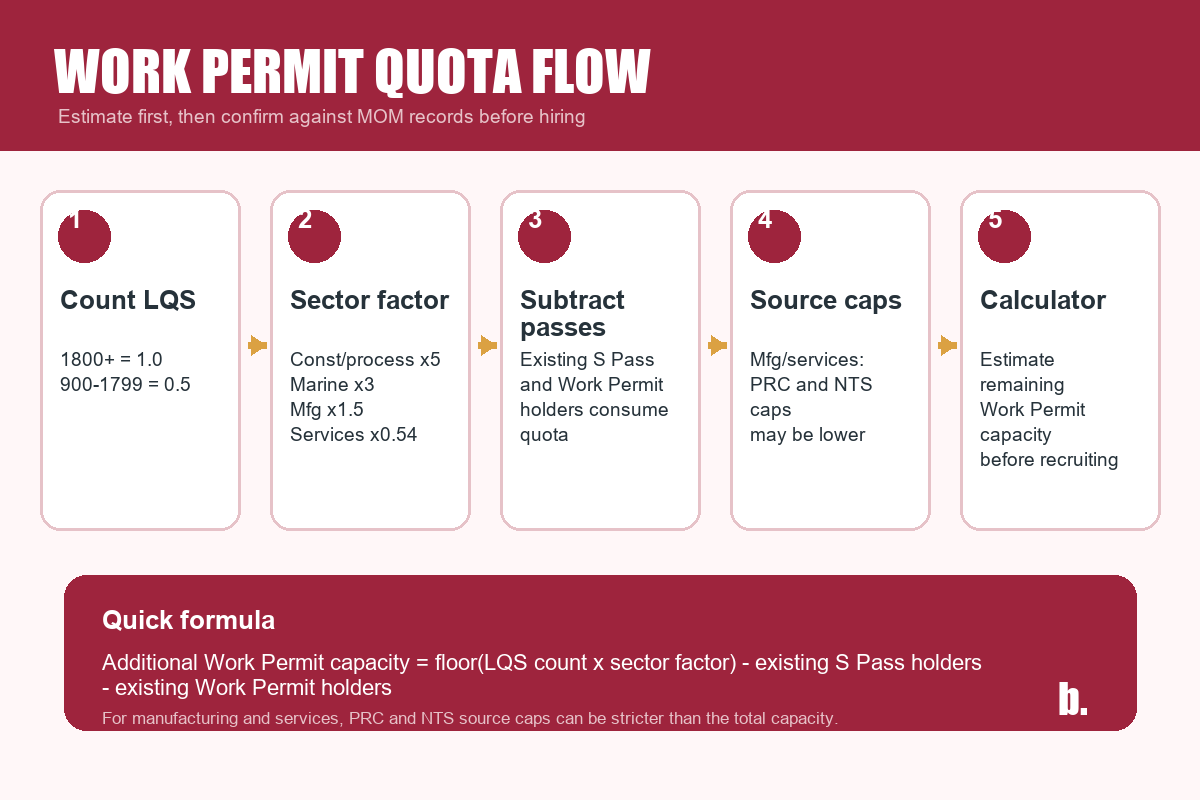
Step 1: Count Your Local Workforce Correctly
Many quota mistakes start here. Employers look at local headcount, but MOM quota calculations use Local Qualifying Salary count. A local employee may count as 1, 0.5, or not at all for quota purposes.
Local payroll situation | Quota count | Employer note |
|---|---|---|
Local employee paid at least $1,800 per month | Counts as 1 local employee | This is the full Local Qualifying Salary threshold used by the calculator. |
Local employee paid $900 to below $1,800 per month | Counts as 0.5 local employee | Useful for part-time or lower-hours local staff, but do not treat headcount as full quota. |
Local employee below $900 per month | Does not count for quota | A person can be on payroll but still not help the Work Permit quota count. |
In practical terms, a company with 12 Singapore Citizen or PR employees on payroll may not have 12 quota-counted locals. If some employees are below the LQS thresholds, your Work Permit quota can be much lower than your headcount suggests.
Step 2: Apply The Correct Sector Quota
Your sector matters. A construction company and a services company with the same LQS count can have very different Work Permit capacity.
Sector | Dependency ratio ceiling | Calculator factor | What employers should watch |
|---|---|---|---|
Construction | 83.3% | LQS count x 5 | High manpower sectors. Quota still depends on source, levy and approval rules. |
Process | 83.3% | LQS count x 5 | Common for plant maintenance and process-related contractors. |
Marine shipyard | 75% | LQS count x 3 | Applies to eligible marine shipyard work under MOM’s sector rules. |
Manufacturing | 60% | LQS count x 1.5 | PRC and NTS Work Permit holders also face separate source caps. |
Services | 35% | LQS count x 0.538462 | The tightest quota among these sectors. PRC and NTS caps also apply. |
The factor is the easier way to estimate quota from LQS count. For example, 10 LQS-counted locals in services gives about 5 maximum migrant workers, while 10 LQS-counted locals in construction gives about 50 maximum migrant workers.
Do not guess your sector. If your company does mixed work, or if your business activity has changed, check MOM’s sector-specific rules before treating a calculation as reliable.
Step 3: Subtract Existing S Pass And Work Permit Holders
A common employer mistake is to count only existing Work Permit holders. Existing S Pass holders also consume quota. If your quota pool is 20 and you already have 4 S Pass holders and 12 Work Permit holders, you do not have 8 spaces left. You have about 4 spaces left before source caps.
Employment Pass holders are different. The calculator does not include Employment Pass holders in this Work Permit quota calculation.
Step 4: Check Source Caps For Manufacturing And Services
For manufacturing and services, total Work Permit capacity may not be the binding constraint. PRC and NTS or NTS-OL source caps can be stricter.
Sector | Source group | Source cap | Planning implication |
|---|---|---|---|
Manufacturing | PRC Work Permit holders | 25% of total workforce | The calculator checks capacity using MOM’s prospective total workforce + 1 approach. |
Manufacturing | NTS / NTS-OL Work Permit holders | 8% of total workforce | This can be lower than the overall Work Permit capacity. |
Services | PRC Work Permit holders | 8% of total workforce | Services employers can run out of source capacity even when total quota remains. |
Services | NTS / NTS-OL Work Permit holders | 8% of total workforce | Plan source mix before promising start dates. |
This is why a business can have total remaining quota and still be unable to hire the exact worker source it wanted. A Malaysian hire, a PRC hire, and an NTS hire do not always consume the same source-cap space.
Worked Examples
The examples below are simplified calculator-style estimates. They help you understand the arithmetic, but the final result should still be checked against MOM’s systems and the latest sector rules.
Scenario | LQS count | Max migrant workers | Existing passes | Estimated result |
|---|---|---|---|---|
Manufacturing example | 20 full LQS locals + 4 half LQS locals = 22 LQS | floor(22 x 1.5) = 33 migrant workers | 3 S Pass + 18 Work Permit | 12 estimated additional Work Permit capacity before PRC/NTS caps |
Services example | 10 full LQS locals = 10 LQS | floor(10 x 0.538462) = 5 migrant workers | 1 S Pass + 3 Work Permit | 1 estimated additional Work Permit capacity before PRC/NTS caps |
Example 1: Manufacturing Employer
A manufacturing company has 20 full LQS locals and 4 half LQS locals. Its LQS count is 22. Manufacturing uses an estimate of LQS x 1.5, so the maximum migrant worker count is floor(22 x 1.5), or 33.
If the company already has 3 S Pass holders and 18 Work Permit holders, it already uses 21 migrant-worker slots. The rough remaining capacity is 12. But if the next hire is PRC or NTS, the source cap can reduce what is actually available.
Example 2: Services Employer
A services company has 10 full LQS locals. Services uses an estimate of LQS x 0.538462, so the maximum migrant worker count is floor(10 x 0.538462), or 5.
If the company already has 1 S Pass holder and 3 Work Permit holders, it has used 4 migrant-worker slots. The rough remaining Work Permit capacity is 1 before PRC or NTS source caps.
What The Work Permit Calculator Helps You Decide
The SBO Work Permit Calculator is useful before you speak to recruiters, quote a manpower-heavy job, or promise a start date to a client.
- Use it to estimate whether your total Work Permit capacity is positive.
- Use it to see how existing S Pass holders affect Work Permit hiring room.
- Use it to compare manufacturing or services source capacity for PRC and NTS workers.
- Use it to test whether hiring one more local employee could change your capacity.
It should not be used as the only authority for a final hiring decision. It is an educational planning tool, not MOM’s official approval system.
Common Mistakes Employers Make
Using headcount instead of LQS count
This is the most basic mistake. A person on payroll does not automatically count as 1 local employee for quota.
Forgetting that S Pass holders use quota
Existing S Pass holders reduce the remaining migrant worker capacity available for Work Permit holders.
Ignoring source caps
Manufacturing and services employers can run out of PRC or NTS source capacity before they run out of total Work Permit capacity.
Treating quota as approval
Quota is only one gate. MOM may still reject an application if sector, source, levy, documentation or worker conditions are not met.
Planning only after the client signs
If manpower is central to delivery, calculate quota before pricing, promising timelines or accepting large new jobs.
What To Confirm Before You Hire
- Confirm your current LQS count from payroll and CPF records.
- Confirm your current S Pass and Work Permit holders.
- Confirm your intended sector classification and whether the job fits that sector.
- Confirm source-country eligibility for the worker you intend to hire.
- Estimate levy cost with the Foreign Worker Levy Calculator after you estimate quota.
- Check current MOM pages before submission, especially if rules have changed recently.
How Quota Links To Levy And Hiring Cost
Quota answers one question: can you probably hire another Work Permit worker under the manpower ratio rules?
Levy answers a different question: what will the worker cost to hold each month after approval? A company can have quota and still find the levy tier too expensive for the job’s margin.
For a fuller cost view, read our foreign worker levy guide and use the Foreign Worker Levy Calculator.
Official Sources To Check
This guide was prepared against MOM’s Work Permit quota and sector rules as checked in July 2026. Because manpower rules can change, employers should verify the latest pages before making a final hiring decision.
- MOM sector-specific rules for Work Permit
- Construction sector Work Permit requirements
- Manufacturing sector Work Permit requirements
- Marine shipyard sector Work Permit requirements
- Process sector Work Permit requirements
- Services sector Work Permit requirements
Bottom Line
Work Permit quota is not just an HR admin detail. It affects whether you can take on work, staff a project, expand a shift, or deliver what you promised a client.
The disciplined approach is boring but effective: count LQS properly, apply the right sector rule, subtract existing passes, check source caps, estimate levy cost, then confirm with MOM before committing.
Start with the Work Permit Calculator. It will not replace official checks, but it can stop you from making manpower promises before you know whether the quota is even there.
Frequently Asked Questions
What is Work Permit quota in Singapore?
It is the estimated number of Work Permit and S Pass workers an employer may hire based on its local workforce count and sector quota rules. Actual approval still depends on MOM requirements.
Do S Pass holders affect Work Permit quota?
Yes. Existing S Pass holders consume part of the same migrant worker quota pool, so they reduce the remaining space for Work Permit holders.
Does every Singapore local employee count fully for quota?
No. Local employees usually count based on Local Qualifying Salary thresholds. A full LQS local counts as 1, a half LQS local counts as 0.5, and a lower-paid local may not count.
Why can the calculator say I have quota but MOM still rejects an application?
Quota is only one check. MOM may also consider sector classification, worker eligibility, source-country rules, levy status, documentation, salary declarations and other pass conditions.
Which sectors have PRC and NTS Work Permit source caps?
Manufacturing and services employers need to watch PRC and NTS or NTS-OL source caps in addition to total quota. Other sector and source rules should still be checked on MOM’s site.
Explore More Content
Table of Content