
We make boring business stories sparkle.
Your Life Is Not a Productivity Problem
An opinion piece arguing that many people do not need another productivity system. They need a more honest direction.

Your life is not a productivity problem.
That sentence annoys the part of us that wants a cleaner app, a better routine, a sharper calendar and a fresh system that finally turns us into the person we keep imagining.
But many people do not need another productivity method. They need to admit they are optimising a life they have not honestly chosen.
Efficiency feels responsible. It gives the day a shape. It lets a person say, “I am trying.” But effort in the wrong direction is not noble. It is expensive.
Productivity Is Often Avoidance With a Timer
People love productivity because it turns emotional confusion into a technical problem.
If you are unhappy, maybe you need a better morning routine. If you feel behind, maybe you need a better task manager. If work feels pointless, maybe you need deeper focus blocks. If your life feels thin, maybe you need to wake up at 5am and drink more water while journaling about discipline.
Some of that helps. I am not against routines. I am against pretending a routine can answer a question the person is too scared to ask.
Surface problem | Productivity answer | Deeper question |
|---|---|---|
I cannot keep up. | Use a better task system. | Why did you say yes to this much? |
I feel unmotivated. | Build discipline. | Is the goal actually yours? |
I waste time. | Block distractions. | What discomfort are you escaping? |
I am always busy. | Automate and optimise. | Who benefits from your busyness? |
I feel behind in life. | Set more goals. | Whose scoreboard are you using? |
The World Sells You Dashboards Because Dashboards Are Easier Than Meaning
A dashboard is comforting because it converts life into metrics.
Steps. Calories. Hours slept. Books read. Revenue. Net worth. Tasks completed. Streaks. Followers. Meetings. Output. Growth. Progress bars everywhere.
Metrics are useful. The problem starts when humans mistake measurement for meaning.
A person can hit every metric and still be living a life that feels borrowed. A business owner can grow revenue and hate the company they built. A professional can optimise the calendar until there is no useless hour left and still feel spiritually unemployed.
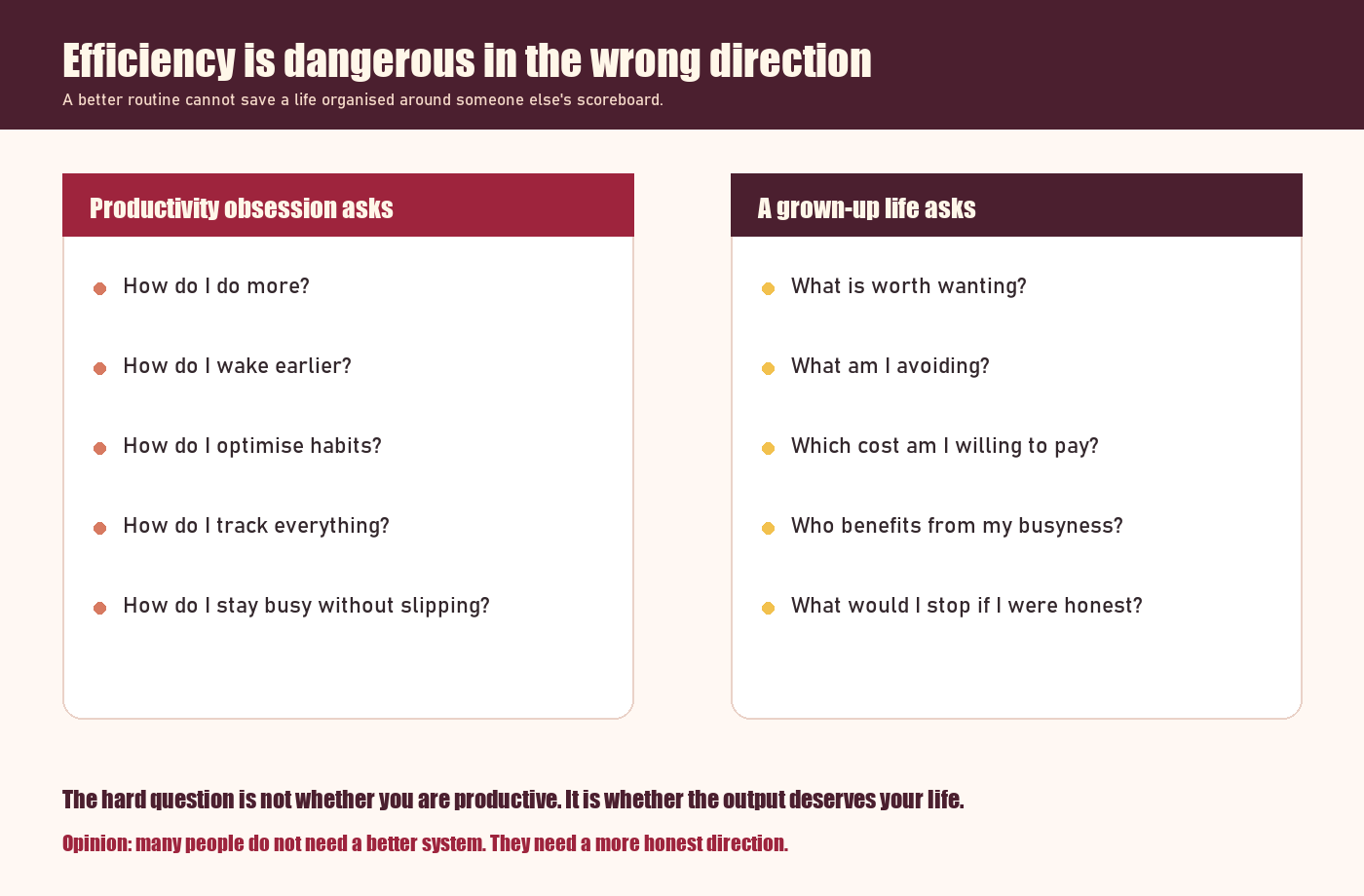
Efficiency Is Dangerous When Direction Is Wrong
The scariest person is not always the lazy person. Sometimes it is the highly disciplined person going in the wrong direction.
Discipline can become a weapon against the self. It can help a person endure a life they should be changing. It can turn fear into a respectable schedule. It can keep someone climbing a ladder they should have questioned years ago.
This is why productivity advice often feels both useful and empty. It improves the machine without asking whether the machine should be running.
The Harder Question Is Wanting
Humans are strangely bad at knowing what they want.
We borrow desires from parents, peers, bosses, founders, influencers, industries and whatever status game is loudest in our environment. Then we act as if the problem is merely execution.
But if the desire is borrowed, execution will not save you. It will only make you more successful at someone else’s life.
Business Owners Do This Too
Small business owners are especially vulnerable because business rewards motion.
There is always something to improve: leads, systems, cash flow, hiring, content, operations, sales, pricing, branding, reporting, automation. A business can absorb infinite attention and still leave the owner avoiding the central question.
What kind of life is this business supposed to create?
Business optimisation | Useful when | Empty when |
|---|---|---|
More revenue | It supports profit, freedom or strategic capacity. | It buys a bigger prison for the owner. |
More clients | The business can serve them well. | The owner is collecting stress as proof of success. |
More systems | They reduce chaos and improve consistency. | They avoid a hard positioning or staffing decision. |
More content | It clarifies the offer and attracts the right people. | It becomes noise to avoid sales conversations. |
More productivity | It protects time for important work. | It helps the owner do unimportant work faster. |
This connects to SBO’s opinion piece on knowing what game your business is playing. A business without a clear game creates work without a clear life.
Many People Are Not Lazy. They Are Unconvinced
Not all procrastination is weakness.
Sometimes procrastination is the body quietly refusing a lie the mind keeps defending. Sometimes the task is not hard; it is meaningless. Sometimes the person does not need more discipline; they need to stop pretending they care.
Of course, this can become an excuse. Some things matter even when we do not feel like doing them. Bills exist. Customers exist. Families exist. Health exists. Responsibility is real.
But responsibility is not the same as surrendering your whole life to tasks you never chose.
The Productivity Industry Loves Your Insecurity
There is a whole market built on making people feel like they are one system away from becoming acceptable.
New planner. New app. New habit stack. New routine. New template. New challenge. New method. New version of you, available after a subscription and a little self-disgust.
I do not think all of this is useless. Tools help. But tools are also a convenient place to hide.
Buying a better notebook is easier than having an honest conversation. Rearranging tasks is easier than quitting a bad commitment. Tracking habits is easier than admitting the goal no longer matters.
A Better Way to Think About Productivity
Productivity should be a servant, not a religion.
Its job is to protect attention for what matters. Not to turn every breath into an efficiency project.
Ask this first | Then use productivity to | Do not use it to |
|---|---|---|
What is worth wanting? | Make space for chosen priorities. | Chase borrowed goals faster. |
What am I avoiding? | Turn avoidance into a small honest action. | Decorate avoidance with a system. |
What cost am I willing to pay? | Plan around real trade-offs. | Pretend every good thing fits. |
What should I stop? | Remove commitments that no longer deserve time. | Add more hacks to survive them. |
Who needs me present? | Protect attention from low-value noise. | Become efficient at ignoring people who matter. |
The Human Issue
What I really hope humans understand is that the point is not to become a better machine.
A person is not a dashboard. A life is not a quarterly report. A family is not a KPI. A business is not automatically good because it grows. A calendar full of completed tasks is not proof that the tasks deserved the calendar.
The modern tragedy is not only that people are distracted. It is that many people are focused on the wrong things with impressive discipline.
The Opinion
If your life feels wrong, do not rush to optimise it.
First, interrogate it.
Ask what you are chasing. Ask who taught you to chase it. Ask what you are afraid would happen if you stopped. Ask whether your business, job, habits and goals are building a life you would actually choose with open eyes.
Then use productivity as a tool. Not as a hiding place.
For related SBO opinion pieces, read The Most Dangerous Business Advice Is ‘Just Start’ and Doing Business Is Like Playing Tower Defence. Both are really about the same thing: movement is not enough if the direction is wrong.
Frequently Asked Questions
Is productivity bad?
No. Productivity is useful when it protects time and attention for what matters. It becomes harmful when it helps people avoid deeper questions about direction, values and trade-offs.
Why do people over-optimise their lives?
Optimisation feels controllable. It is easier to improve a routine than to admit a goal is borrowed, a job is wrong, or a business is creating the wrong life.
How should business owners think about productivity?
Business owners should ask what kind of life the business is supposed to create. Productivity should support that direction, not simply produce more work.
What should someone do before choosing another productivity system?
Ask what is worth wanting, what should be stopped, what discomfort is being avoided and whether the current goals are actually yours.
Explore More Content
Table of Content