We make boring business stories sparkle.
AI Will Not Replace Lazy Thinking. It Will Expose It Faster
An opinion piece on why AI makes judgment more important, not less, and why lazy thinking will become easier to spot.

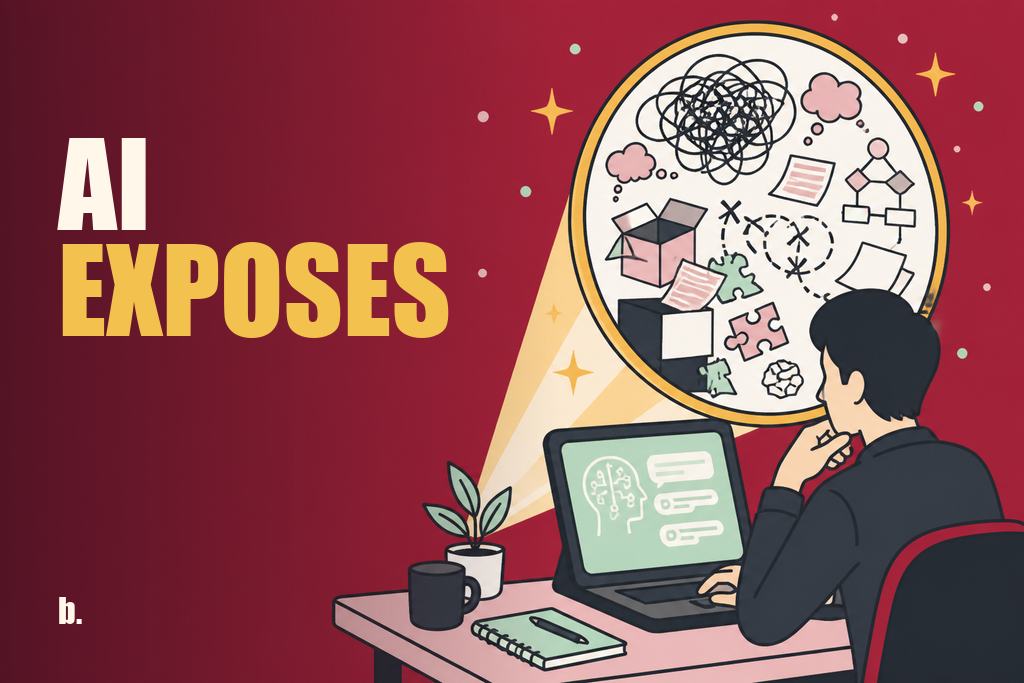
AI will not replace lazy thinking. It will expose it faster.
That may be the most uncomfortable thing about this technology.
People keep asking whether AI will replace jobs, writers, designers, analysts, marketers, programmers, assistants and managers. Fair question. But the quieter issue is more personal: AI is going to reveal who was thinking and who was merely producing.
For years, many offices rewarded the appearance of thought. Long documents. Many slides. Serious words. Meetings with frameworks. Strategies that sounded balanced because they said nothing dangerous. AI can now generate that stuff in seconds.
So if your value was mainly polished vagueness, yes, you should be worried.
AI Makes Output Cheap
This is the part humans are handling badly.
When output becomes cheap, people try to produce more output. More content. More proposals. More reports. More captions. More plans. More summaries. More decks. More noise wearing a clean shirt.
But abundance does not automatically create value. It often creates landfill.
The real bottleneck moves from production to judgment. Anyone can ask AI to write. Fewer people can tell whether the answer is useful, relevant, honest, strategically sound or dangerously fluent.
Old advantage | What AI changes | New advantage |
|---|---|---|
Can write a polished memo. | AI can draft one quickly. | Can frame the real issue and reject weak arguments. |
Can produce many ideas. | AI can produce endless ideas. | Can choose the few ideas worth testing. |
Can summarise information. | AI can summarise at scale. | Can spot missing context, bad assumptions and hidden trade-offs. |
Can sound strategic. | AI can imitate strategy language. | Can make a decision and own the consequences. |
Can move fast. | AI makes speed cheaper. | Can slow down at the exact point where judgment matters. |
The Problem Is Not AI Hallucination. It Is Human Abdication
People like to complain that AI makes things up. It does. That matters.
But humans also make things up. Humans misremember, exaggerate, repeat nonsense from confident people, hide uncertainty, and use jargon to avoid admitting they do not know. The difference is that AI does it at industrial speed and in a tone that sounds strangely calm.
The deeper danger is not that AI sometimes lies. The deeper danger is that humans will stop feeling responsible for checking.
That is the weakness I really hope people understand: tools do not remove responsibility. They move it.
Prompting Is Not Magic. Thinking Is Still the Work
Some people talk about prompts as if the right phrase is a secret spell.
It is not. A good prompt is usually just evidence that the human has done some thinking before asking for help.
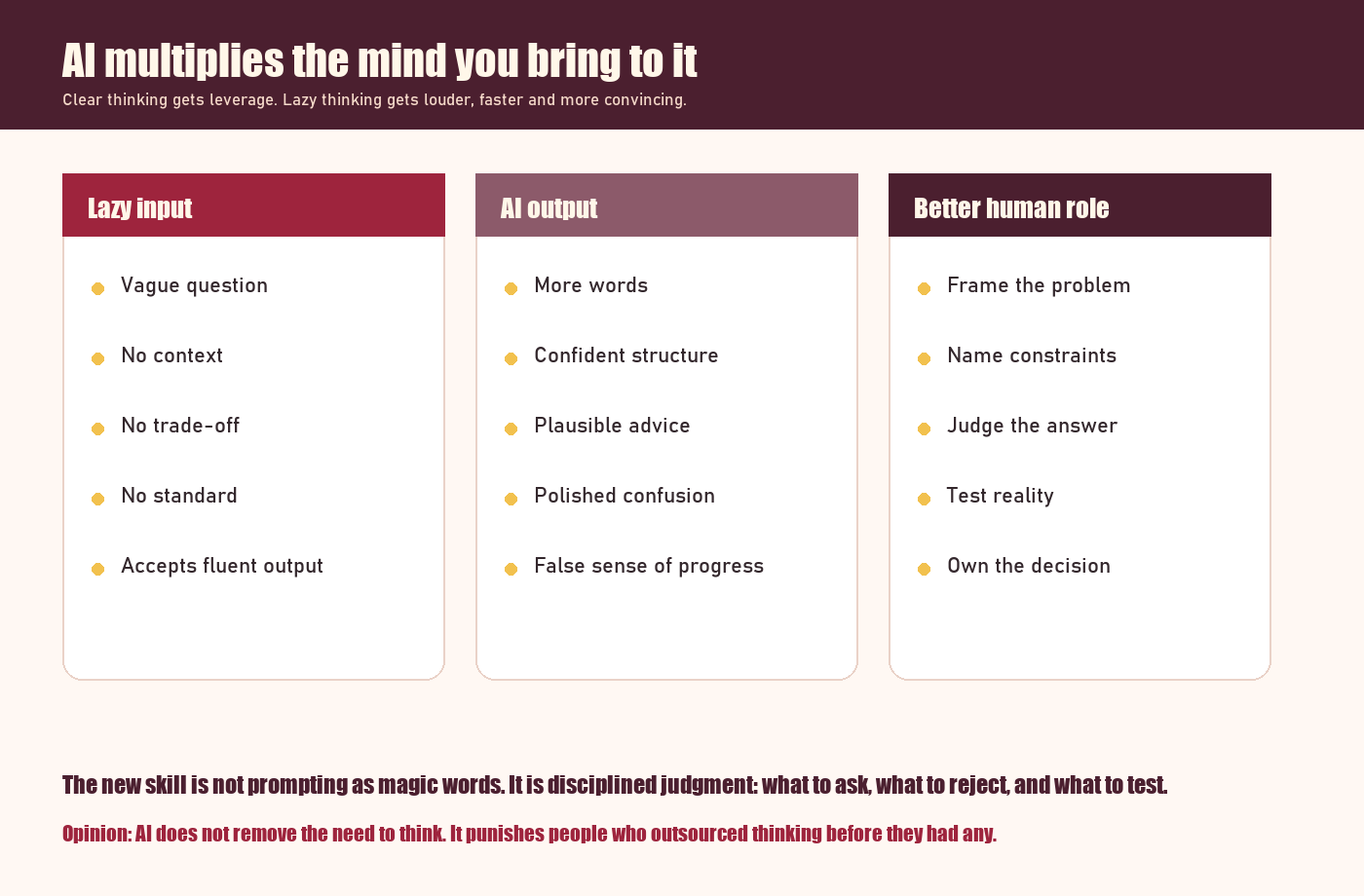
If you know the audience, goal, constraints, examples, trade-offs and standard of quality, AI can be useful. If you do not know those things, AI will often produce a confident blur that lets you feel productive while remaining intellectually absent.
Bad Inputs Create Polished Weakness
- Ask a vague question, get a vague answer with better grammar.
- Give no context, get generic advice that sounds reasonable.
- Refuse trade-offs, get a list that pretends everything can be done.
- Avoid judgment, get more options to avoid judgment with.
AI is a mirror with horsepower. If the thinking is lazy, the output becomes lazy at scale.
AI Will Punish People Who Hide Behind Process
A lot of business culture is process theatre.
People hold meetings to discuss meetings. They create documents to prove alignment. They use frameworks to make indecision look responsible. They ask for more analysis when what they really want is protection from blame.
AI will make process theatre cheaper. That is not good news. It means organisations can now generate even more fake clarity, faster.
Human weakness | How AI can amplify it | Better habit |
|---|---|---|
Vagueness | Turns unclear thinking into confident paragraphs. | Write the actual decision in one sentence. |
Overproduction | Creates more content than anyone should read. | Decide what should not be produced. |
Fear of judgment | Provides endless options to hide behind. | Choose a test and define failure upfront. |
Status anxiety | Produces impressive language for ordinary ideas. | Use plain language that can be challenged. |
Outsourced responsibility | Makes errors feel like the tool’s fault. | Keep human ownership of the final call. |
The People Who Benefit Most Will Be the Least Passive
The best AI users will not be the people who ask AI to think for them. They will be the people who use it to pressure-test their thinking.
They will ask for objections. They will ask what is missing. They will compare options. They will request a simpler explanation. They will use it to find blind spots, then still make a human judgment.
That is very different from pasting a lazy instruction and accepting whatever comes back.
AI Should Make You More Demanding
If AI makes you less demanding, it is making you worse.
- Demand clearer assumptions.
- Demand better examples.
- Demand sharper trade-offs.
- Demand evidence where evidence matters.
- Demand simpler language where language is hiding weakness.
The new literacy is not just knowing how to use AI. It is knowing when the output is not good enough.
Small Businesses Should Use AI, But Not Worship It
For small businesses, AI can be genuinely useful.
It can help draft emails, structure proposals, brainstorm marketing angles, summarise customer feedback, prepare checklists, turn messy notes into plans and reduce blank-page friction.
But it cannot decide what your business should stand for. It cannot feel the customer’s hesitation. It cannot own a bad promise. It cannot replace the courage to choose a position. That still belongs to the owner.
This connects to SBO’s opinion piece on knowing what game your business is playing. AI can help you express a position. It cannot give you one if you refuse to choose.
What Humans Need to Learn
I hope humans learn this before they drown themselves in generated output: the scarce thing is not words. It is clarity.
Before asking AI | Ask yourself | Why it matters |
|---|---|---|
Goal | What decision or action should this support? | Prevents content for content’s sake. |
Audience | Who needs to understand or act? | Stops generic language. |
Constraint | What must be true for this answer to be useful? | Forces real-world limits into the work. |
Standard | What would make this answer bad? | Gives you a reason to reject weak output. |
Test | How will we know whether this is right? | Moves the idea from language into reality. |
The Opinion
AI is not the end of thinking. It is the end of getting away with pretending to think.
That is why some people will become dramatically better with AI, and others will become dramatically noisier. The difference is not the tool. The difference is the mind using it.
If your thinking is clear, AI gives you leverage. If your thinking is lazy, AI gives your laziness a nicer font.
That is not a technology problem. That is a human problem, which is the oldest kind.
For another SBO opinion on avoiding empty action, read The Most Dangerous Business Advice Is ‘Just Start’. If you want the business strategy angle, read Doing Business Is Like Playing Tower Defence.
Frequently Asked Questions
Will AI replace human thinking?
No. AI can generate and organise output, but humans still need to frame the problem, judge the answer, check reality and own the decision.
Why can AI make lazy thinking worse?
AI can make vague ideas look polished. If the human does not challenge the output, weak thinking becomes faster, longer and more convincing.
What is the best way for small businesses to use AI?
Use AI to reduce blank-page work, explore options, summarise information and pressure-test ideas. Do not use it as a substitute for positioning, judgment or customer understanding.
What skill becomes more important because of AI?
Judgment becomes more important: knowing what to ask, what matters, what to reject and how to test the answer in the real world.
Explore More Content
Table of Content