
We make boring business stories sparkle.
Do Not Choose a Business Partner Because You Are Afraid to Start Alone
A co-founder should contribute durable value, not merely make entrepreneurship feel less frightening. Test the relationship before sharing ownership.

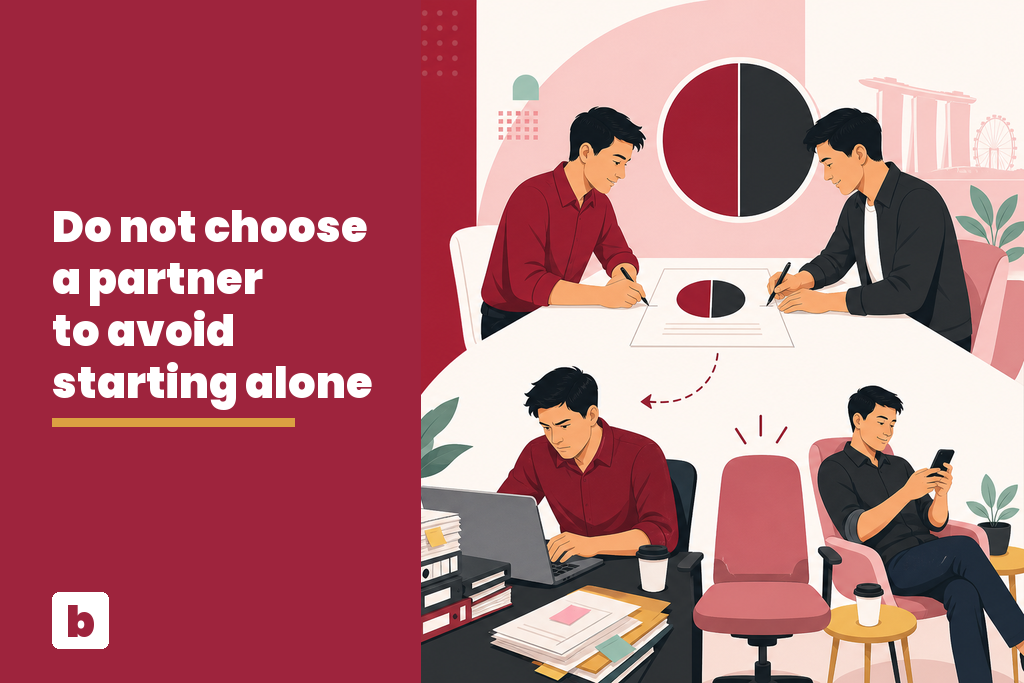
Two friends sit in a cafe and decide to start a company.
Neither wants to do it alone. They split the shares equally because equal feels fair. They appoint themselves directors, announce the partnership and promise that they will build everything together.
Six months later, one founder is selling, delivering, answering customers and funding expenses. The other attends occasional meetings and says work has become busy.
The active founder finally says, “Maybe we should separate.”
The inactive founder replies, “Of course. You can buy my half.”
The mistake did not begin when one person stopped working. It began when two frightened people used permanent ownership to purchase temporary courage.
This article is general business commentary, not legal advice. Share ownership, vesting, transfers, director duties and founder exits should be documented with advice suited to the actual company and people involved.
Fear Is A Terrible Co-Founder Selection Process
Starting alone is uncomfortable. There is nobody to confirm that the idea is sensible, share rejection or sit beside you when revenue is zero.
A partner can reduce that emotional weight. But emotional comfort is not automatically worth half a company.
The fear usually disappears before the ownership does. Once the founder learns to sell, deliver and make decisions, the original reason for the partnership may be gone. The shares remain.
That is why “I do not want to do this alone” is not a contribution. It is a feeling. Feelings deserve support. They do not automatically deserve equity.
Shares Are Ownership, Not A Friendship Certificate
ACRA states plainly that shares represent ownership in a company. Depending on the share type and arrangements, shareholders may have voting, information, dividend and other rights.
A share allocation is therefore not a motivational gesture. It changes who owns the outcome if the business becomes valuable.
ACRA’s business-structure guidance also distinguishes the roles: shareholders own the company through shares, while directors manage it and do not always own shares. Founders should stop treating “partner”, “director”, “employee” and “shareholder” as interchangeable words.
Role | What it usually represents | Question to settle |
|---|---|---|
Shareholder | Ownership and associated rights | Why should this person own this percentage? |
Director | Governance and management duties | Who has authority and accountability? |
Employee | Work performed for compensation | What role, salary and performance are expected? |
Contractor | Defined external deliverable | Can the capability be bought without equity? |
Adviser | Occasional expertise or introductions | How limited is the time and responsibility? |
Investor | Capital accepted on agreed terms | What risk, rights and return accompany the money? |
A person can hold more than one role. That makes documentation more important, not less.
A Good Partner Must Add Something Durable
A partner may be justified when the business genuinely requires complementary capability, capital, relationships, intellectual property, regulatory standing or operating responsibility that cannot sensibly be hired or contracted.
But founders use vague labels to avoid measuring contribution. “Strategy”, “network” and “business development” sound important while producing no observable result.
Claimed contribution | Evidence before equity | Possible alternative |
|---|---|---|
Can sell | Closes real customers at a viable price | Commission or sales employment |
Can build | Ships and maintains the required product | Paid prototype or contractor |
Has a network | Relevant introductions become opportunities | Referral agreement or advisory role |
Will fund the business | Capital amount and timing are documented | Loan or investment terms |
Will run operations | Owns recurring work with measurable standards | Employment with progression |
Provides courage | No durable business contribution | Mentor, peer group or adviser |
The question is not whether a partner is useful. Many excellent companies were built by strong founding teams. The question is whether the permanent ownership reflects a contribution the business will still value after the founders stop being afraid.
Test The Relationship Before Registering The Marriage
Friendship tests whether two people enjoy each other. Partnership tests whether they can create value under stress.
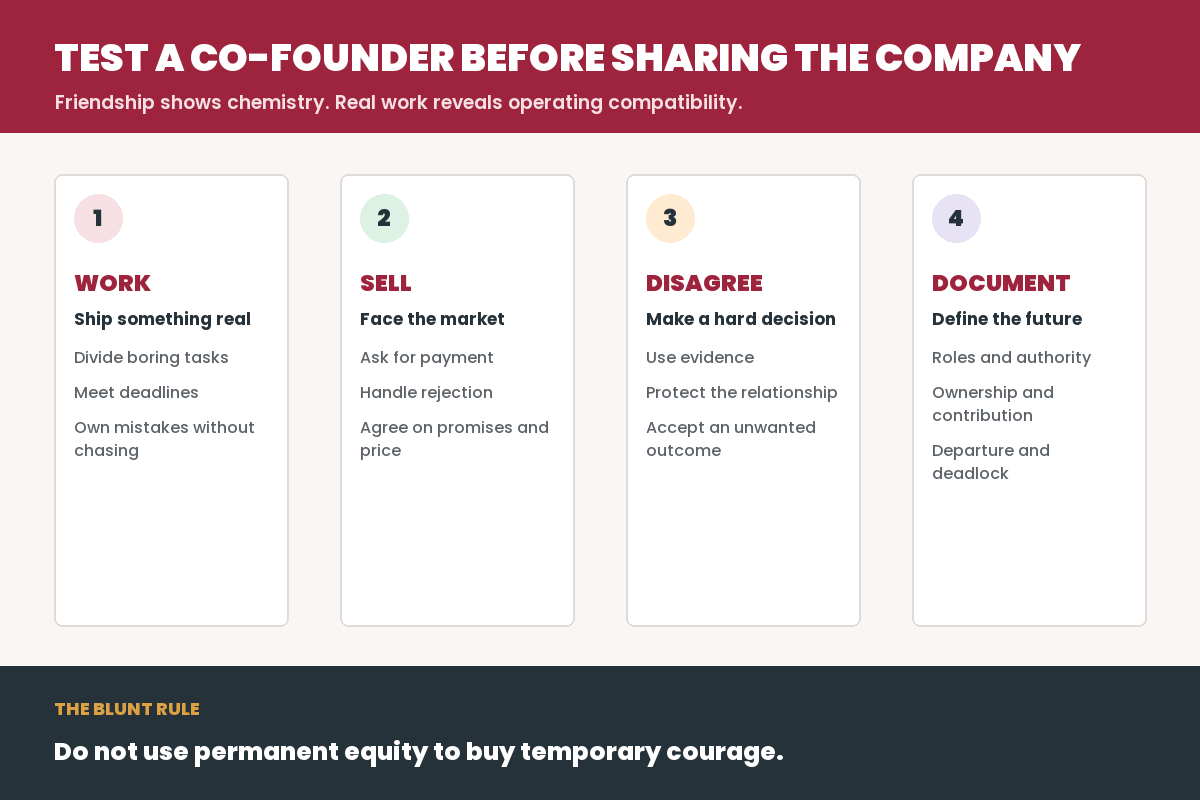
Work together on a real, time-limited project before dividing the company. Sell something. Deliver it. Handle customer criticism. Spend a small budget. Miss a deadline. Disagree about quality. Decide whether to refund someone.
Watch what happens when the work is boring and nobody is praising the idea.
- Who does what without being chased?
- Who tells the truth when progress is poor?
- Who can make an unpopular decision?
- Who treats company money differently from personal money?
- Who accepts evidence that contradicts their preferred idea?
- Can both people disagree without attacking the relationship?
A weekend brainstorming session reveals chemistry. It does not reveal operating compatibility.
Equal Friendship Does Not Require Equal Ownership
Founders often choose a 50/50 split because any other number feels insulting.
That is not fairness. It is conflict avoidance performed at incorporation.
Equal ownership may be appropriate when contributions, risks and long-term responsibilities are genuinely equal and the founders have a credible decision process. It should not be the default because two names appear on the registration form.
Before agreeing on percentages, document cash invested, assets contributed, expected time, salary assumptions, decision rights, future fundraising, departure scenarios, illness, misconduct, deadlock and what happens if one founder stops contributing.
ACRA explains that a company constitution sets governance rules and defines rights and responsibilities. Founders may also need a shareholders’ agreement tailored to their private arrangements. SBO’s guide to a shareholders’ agreement versus a company constitution explains why these documents serve different purposes and should work together.
Discuss Departure While Everyone Still Likes Each Other
Founders resist exit discussions because they think distrust will poison the beginning.
The opposite is usually true. Silence stores the conflict for a time when money, exhaustion and resentment make agreement harder.
Discuss what happens if someone resigns, becomes unable to work, takes another job, fails a defined obligation, wants to sell, dies, divorces, becomes bankrupt or simply loses interest. Discuss how shares may be valued and transferred, and which approvals apply.
ACRA’s current guidance shows that adding or removing shareholders requires actual share transactions. A founder does not disappear from ownership merely because the working relationship ended.
SBO’s article Your Co-Founder Stopped Working. Why Do They Still Own Half the Company? examines that painful distinction in more detail.
Vesting Is Not An Insult
Founders sometimes treat vesting or buyback arrangements as proof that the other person expects betrayal.
A properly designed arrangement can instead align ownership with continued contribution. The exact structure, tax treatment, enforceability, price and documents require professional advice. Do not copy a Silicon Valley template and assume it works for a Singapore company.
The principle is simpler than the paperwork: nobody should receive the full long-term reward on day one for work that is supposed to happen over several years.
There Are Cheaper Ways To Stop Feeling Alone
Before creating a co-founder, ask what emotional or practical need you are actually trying to meet.
- Use a mentor for judgement.
- Use an accountability group for discipline.
- Use a contractor for specialist delivery.
- Use an employee for a recurring role.
- Use an adviser for occasional expertise.
- Use a referral agreement for introductions.
- Use an investor or loan for capital on documented terms.
Each option has costs and risks. But most are more adjustable than giving away a large part of the company because launch day felt lonely.
Do Not Confuse Loyalty With Competence
A loyal friend may be a poor operator. A brilliant operator may be a poor partner. Trust is necessary, but trust alone does not allocate work, resolve deadlock or produce customers.
The best partnership combines character with demonstrated capability and explicit rules. It does not ask friendship to carry every commercial disagreement.
Incorporating a company also does not erase personal exposure from guarantees, conduct or director duties. SBO’s opinion on why your company may have limited liability while you do not is useful before founders casually sign obligations for each other.
My Opinion
Do not give someone half a company because you need a person beside you at the beginning.
Work together first. Sell together. Fail at something small. Handle money. Make a hard decision. Learn whether the person adds durable value when the excitement has left the room.
A genuine co-founder can multiply a business.
A fear-based co-founder can own half of something they stopped helping to build.
Sources And Further Reading
- ACRA: Understanding share types and shareholding
- ACRA: Preparing or adopting a company constitution
- ACRA: Overview of share transactions
Frequently Asked Questions
Should friends start a business together?
They can, but friendship is not evidence of operating compatibility. Test real work, money, deadlines, customer pressure and disagreement before allocating ownership.
Is a 50/50 ownership split fair?
It can be appropriate when long-term contribution, risk and responsibility are genuinely equal and deadlock is addressed. It should not be automatic merely because there are two founders.
What should founders agree before starting a company?
Discuss roles, time, cash, salary, authority, ownership, vesting or buyback arrangements, intellectual property, fundraising, deadlock and departure scenarios with suitable professional advice.
Can a co-founder lose shares by stopping work?
Not automatically. Employment, directorship and share ownership are separate. Any transfer, vesting or buyback outcome depends on the company’s documents, agreements and applicable law.
Explore More Content
Table of Content