
We make boring business stories sparkle.
Shareholders’ Agreement vs Company Constitution In Singapore
A founder-focused guide to how a shareholders' agreement and company constitution differ, interact and should be aligned.

Two friends started a company with equal shares.
They downloaded the model constitution, incorporated quickly and agreed that every major decision would be made together. Nobody wrote down what “major” meant. Nobody discussed what would happen if one founder stopped working, wanted to sell or refused the next funding round.
Three years later, one founder still owned half the company but contributed almost nothing. A buyer wanted the business. One founder wanted to accept. The other would not sign.
The company had a constitution. What it did not have was a complete founder agreement.
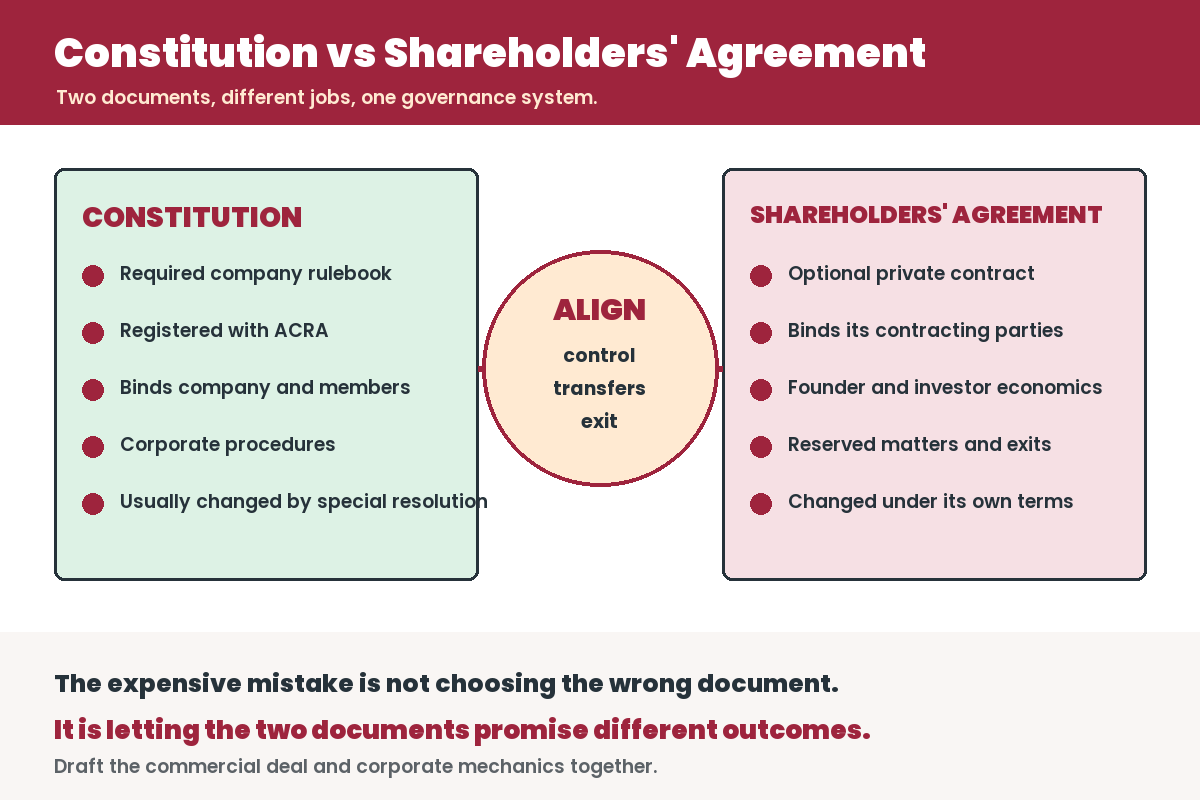
A Singapore company constitution and a shareholders’ agreement are related but not interchangeable. The constitution is the company’s registered rulebook. The shareholders’ agreement is usually a private contract that records the commercial deal among its parties.
The Short Answer
Issue | Company constitution | Shareholders’ agreement |
|---|---|---|
Status | Required corporate document | Optional private contract |
Visibility | Lodged or adopted through ACRA | Usually confidential among parties |
Who it binds | Company and members under the Companies Act | Parties that entered the agreement |
Main job | Corporate rules and procedures | Commercial rights, control and founder expectations |
Typical change | Usually special resolution, subject to law and entrenchment | Consent threshold stated in the contract |
Best use | Rules the company must operate through | Deals too detailed or private for the constitution |
Many multi-owner companies need both, drafted to work together.
What The Company Constitution Does
ACRA describes the constitution as the rules for running the company. It addresses matters such as shareholder liability, share capital, governance, share transfers, meetings, directors and company-secretary requirements.
At incorporation, a company can upload a customised constitution or adopt the statutory model constitution. ACRA currently allows the model to be adopted either “in force from time to time”, so future model amendments flow through, or at a fixed point in time.
Section 39 of the Companies Act 1967 states that the registered constitution binds the company and its members as if each had covenanted to observe it. That statutory effect is a major difference from an ordinary private agreement.
Unless the Act provides otherwise, section 26 says the constitution may be altered or added to by special resolution. A special resolution generally requires at least three-fourths of voting members who vote, subject to the statutory meeting and notice rules. Entrenched provisions can impose a higher threshold or other conditions.
What A Shareholders’ Agreement Does
A shareholders’ agreement is a contract. It can bind the founders, investors, shareholders and sometimes the company if each is a party. It does not automatically bind somebody who never joined it, and it does not override the Companies Act.
Its strength is commercial detail. Founders can record:
- who appoints directors and controls the board;
- which decisions need founder, investor or supermajority approval;
- what each founder is expected to contribute;
- what happens when a founder leaves or stops working;
- how new shares are issued and future funding is handled;
- when shares may be transferred and to whom;
- how a sale of the company can proceed;
- how deadlock and disputes are resolved;
- how confidential information and intellectual property are protected.
These terms are not boilerplate. A venture-backed company, family company, professional practice and equal-founder startup need different answers.
Clauses Founders Should Discuss While They Still Like Each Other
Clause | Question it answers | Failure without clarity |
|---|---|---|
Founder roles | Who must work, invest or deliver what? | Passive founder keeps full economics. |
Board rights | Who appoints and removes directors? | Ownership and operational control diverge. |
Reserved matters | Which decisions need special consent? | Routine management freezes or minority is ignored. |
Vesting and leavers | What happens when a founder leaves? | Departed founder retains an unearned stake. |
Funding | Who provides more capital and on what terms? | Unexpected dilution or cash deadlock. |
Pre-emption | Can existing owners buy before outsiders? | Unexpected third party enters ownership. |
Tag-along | Can minority holders join a sale? | Minority remains with an unknown controller. |
Drag-along | Can a qualifying majority deliver a full sale? | Small holder blocks a genuine exit. |
Deadlock | How is an unbreakable split resolved? | Company cannot act or raise money. |
IP and confidentiality | Who owns the work and information? | Key product sits outside the company. |
Reserved Matters Need A Carefully Chosen Threshold
Reserved matters protect owners from fundamental decisions being made without them. Examples may include issuing shares, taking major debt, changing the business, selling key assets, approving related-party transactions or appointing senior leadership.
If every small expense requires unanimous consent, governance becomes paralysis. If nothing important requires minority consent, the protection is cosmetic. Set thresholds according to the decision’s consequence.
Founder Vesting Is Not Only For Investors
When founders receive all shares on day one, a person who leaves after three months may keep the same percentage as the founder who works for five years. Vesting and good-leaver or bad-leaver terms allocate that risk, but the buyback mechanics must comply with company law and be properly implemented.
Deadlock Clauses Should Resolve, Not Merely Delay
A 50:50 company needs more than “the founders will discuss in good faith”. Escalation can involve board reconsideration, mediation, independent expertise, a buy-sell mechanism or a sale process. Each mechanism can be abused if financial power is uneven, so the design should match the owners.
Exit Rights Must Match The Cap Table
Tag-along rights protect minorities by allowing them to participate when a controlling holder sells. Drag-along rights can allow a qualifying majority to require other holders to sell on the same terms so a buyer can acquire the whole company.
Thresholds, notice, price, warranties and treatment of different share classes matter. A one-line clause can fail precisely when a real acquisition arrives.
What Happens If The Documents Conflict?
This is where founders discover that two documents do not automatically become one system.
Suppose the shareholders’ agreement requires investor consent before issuing shares, but the constitution gives the board broad authority and the corporate approvals are otherwise passed. The private agreement may create contractual consequences among its parties, while the corporate validity and remedies can raise separate questions.
The solution is not a generic sentence saying one document “wins”. The drafter should identify which commercial protections need to appear in the constitution, which remain private, what the Companies Act requires and how each obligation will be enforced.
Commercial term | Constitution role | Agreement role |
|---|---|---|
Share transfer restriction | Corporate transfer machinery | Detailed sale process and promises |
Board appointment | Appointment and removal mechanics | Nomination rights and voting commitments |
New share issue | Authority and class rights | Consent, funding and dilution protections |
Company sale | Transfer mechanics where appropriate | Tag, drag, warranties and process |
Founder work obligation | Usually limited role | Detailed service, vesting and leaver terms |
When The Model Constitution Is Not Enough
The model constitution is useful for a straightforward company. It supplies a functioning baseline and avoids drafting every corporate rule from zero.
It does not know:
- that one founder contributed cash and another contributed software;
- that an investor needs approval rights;
- that siblings must keep ownership within a family branch;
- that a professional licence restricts who may own or control the company;
- that founders expect to sell within five years;
- that a 50:50 split could freeze the company.
Customisation becomes more valuable as ownership, regulation, funding and exit expectations become more complicated.
A Practical Founder Process
- Write the commercial deal in plain language: ownership, work, money, control and exit.
- Model bad scenarios: departure, illness, non-performance, funding refusal, divorce, death, dispute and acquisition.
- Choose the decision thresholds: board, ordinary shareholder, supermajority and unanimous matters.
- Map each term to the right document: constitution, shareholders’ agreement, employment agreement, IP assignment or share subscription agreement.
- Align the mechanics: definitions, notices, transfer rules, classes, approvals and remedies.
- Make future holders join: use an appropriate deed-of-adherence mechanism where advised.
- Update after major changes: investment rounds, founder exits and restructurings can make old documents misleading.
Read SBO’s article on common shareholder disputes for examples of what happens when ownership, work and control stop moving together.
The Final Rule
The constitution tells the company how to function. The shareholders’ agreement tells the owners what they promised one another. Neither document can cure a deal the founders have never honestly discussed.
Do not wait for trust to disappear before writing down what trust currently means.
Official References
- ACRA: Preparing or adopting a company constitution
- Singapore Statutes Online: Companies Act provisions on constitutions
- Singapore Statutes Online: Special resolutions
- ACRA: Share types and shareholding
- ACRA: Company forms and model constitution
This article was reviewed on 23 July 2026 and provides general business information, not legal advice. The effect and enforceability of governance documents depend on their drafting, parties and facts. Obtain advice from a qualified Singapore corporate lawyer.
Frequently Asked Questions
What is the difference between a shareholders’ agreement and company constitution in Singapore?
The constitution is the company’s required registered rulebook and binds the company and its members under the Companies Act. A shareholders’ agreement is usually an optional private contract binding the parties that entered it.
Does a Singapore company need a shareholders’ agreement?
It is not generally required for incorporation, but it can be valuable where there are multiple founders or investors and detailed rules are needed for control, funding, transfers, leavers, deadlock and exit.
Can a shareholders’ agreement override the company constitution?
Do not assume so. The Companies Act, corporate effect of the constitution and contractual obligations under the agreement can operate differently. The documents should be drafted and aligned together.
Can a company change its constitution later?
Yes. Unless the Companies Act or an entrenched provision requires otherwise, a constitution may generally be altered by special resolution and the required filing and procedural steps must be followed.
Explore More Content
Table of Content