
We make boring business stories sparkle.
How To Recover An Unpaid Business Debt In Singapore
A practical escalation guide for recovering unpaid Singapore business debts while managing evidence, legal cost and collection risk.

The invoice was only supposed to be thirty days.
On day 31, the customer said accounts was processing it. On day 45, the contact asked for another copy. On day 60, finance said the purchase order did not match. On day 90, the employee who approved the work had left.
The supplier had delivered everything. Payroll was still due. The customer was now using the supplier’s cash as free working capital.
Recovering an unpaid business debt in Singapore is not a single legal action. It is an escalation process: prove what is owed, identify whether the debt is genuinely disputed, choose a proportionate forum and keep the commercial objective in sight.
First Decide Whether This Is A Debt Or A Dispute
A debt is easier to pursue when the obligation, amount and due date are clear. A dispute exists when the customer contests performance, quality, authority, scope, pricing, delivery or another part of the contract.
Calling every disagreement an “overdue invoice” does not remove the disagreement. Before escalating, build an evidence pack:
- signed contract, quotation, purchase order or accepted terms;
- invoice and agreed payment date;
- delivery orders, completion records or acceptance emails;
- timesheets, change requests and approved variations;
- account statements and payment history;
- messages acknowledging the debt or proposing payment;
- details of any complaint, credit note or counterclaim.
Situation | What it suggests | Next question |
|---|---|---|
Customer admits amount but needs time | Cash-flow problem | Can a secured or documented payment plan work? |
Customer disputes part of the work | Quantum or performance dispute | What amount is undisputed? |
Customer stops responding | Higher recovery risk | Is the entity still trading and solvent? |
Invoice lacks agreed support | Evidence gap | Can delivery and authority be reconstructed? |
Debtor raises a plausible counterclaim | Litigation risk | What is the net commercial exposure? |
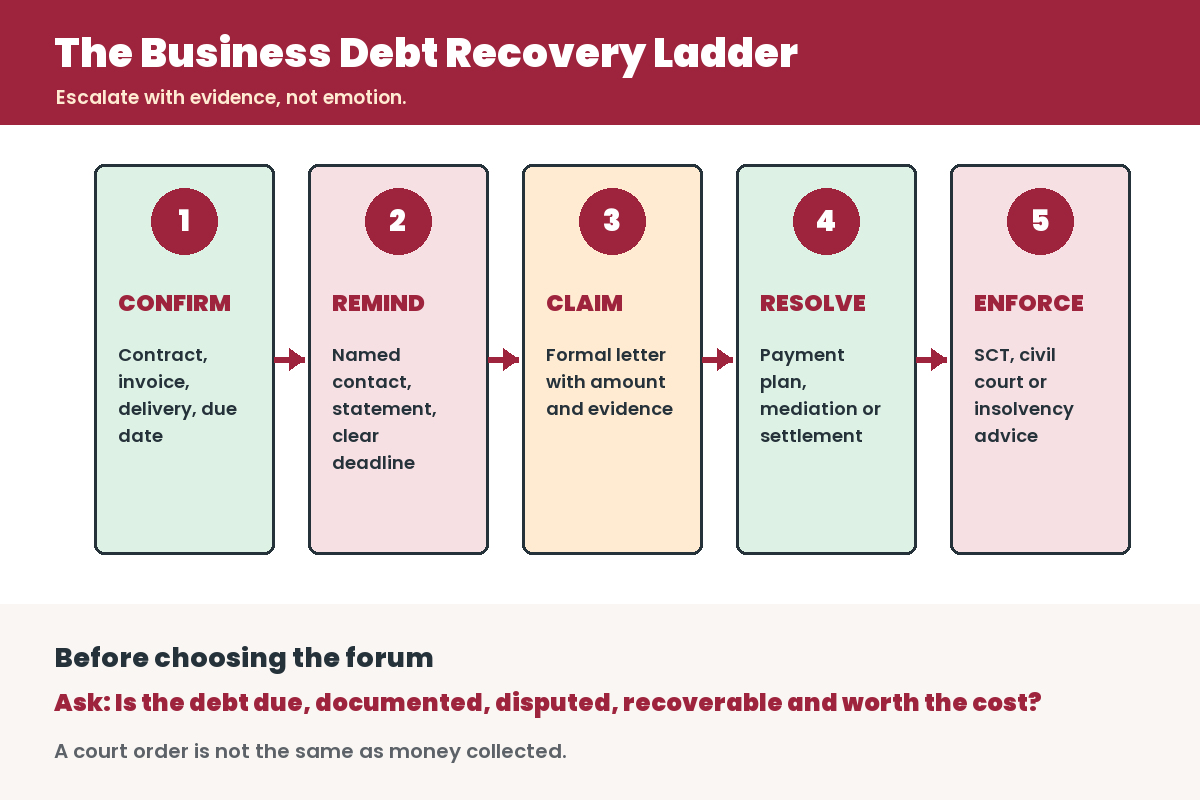
The Business Debt Recovery Ladder
Step 1: Confirm The Amount And Debtor
Check the legal entity name, UEN, registered address, contract party, invoice amount, GST treatment, credits, interest and due date. A brand name may not be the contracting company. Suing or demanding payment from the wrong entity wastes time and can damage the claim.
Reconcile the ledger. If three invoices total S$18,000 but a S$2,000 credit note applies, the claim should not pretend otherwise.
Step 2: Send A Clear Commercial Reminder
Contact both the operational sponsor and accounts-payable owner. State the invoice, amount, due date and requested payment date. Attach the supporting documents in one organised package.
A useful reminder is precise. An emotional message describing how badly the business needs money is not a substitute for stating the contractual obligation.
Step 3: Issue A Formal Letter Of Claim Or Demand
A formal letter should identify the parties, contract, amount, interest or charges, key facts and supporting evidence. It should explain what response or payment is required and by when. The purpose is to state a provable claim, create a final opportunity to resolve it and narrow any genuine dispute.
Do not rely blindly on old Singapore templates labelled as the State Courts Pre-Action Protocol for Business-to-Business Debt Claims. The Judiciary deleted that general protocol with effect from 2 August 2021. Specific types of disputes may still have their own pre-action requirements, and current court rules and practice directions must be checked before proceedings. Obtain legal advice where the claim is material or contested.
Step 4: Explore Settlement Or Mediation
Settlement is not weakness. A prompt S$9,000 payment may be commercially better than spending months and legal fees pursuing S$12,000 from a weak debtor.
If agreeing to instalments, record:
- the acknowledged balance;
- payment dates and amounts;
- treatment of interest and costs;
- what happens after a missed instalment;
- whether security or a guarantee is provided;
- whether existing rights are preserved.
Mediation can help where both sides want a commercial solution but disagree about facts or value. The point is to compare settlement against the expected net recovery after time, evidence risk and enforcement cost.
Step 5: Choose The Right Formal Route
Route | Typical fit | Important limits or risks |
|---|---|---|
Negotiated plan | Debt admitted; debtor needs time | Further default and loss of leverage. |
Small Claims Tribunals | Eligible goods or services claim | Up to S$20,000, or S$30,000 with written consent; generally file within 2 years. |
Magistrate’s Court | Civil claim not exceeding S$60,000 | Procedure, proof, costs and enforcement. |
District Court | Civil claim above S$60,000 and up to S$250,000 | Greater legal cost and litigation exposure. |
High Court | Generally claims exceeding S$250,000 | Complexity and material adverse-cost risk. |
Corporate insolvency demand | Undisputed debt exceeding S$15,000 due from a company | Serious insolvency route; misuse or disputed debt creates risk. |
The current Singapore Judiciary guidance says the Small Claims Tribunals can hear eligible claims up to S$20,000, or S$30,000 if both parties consent in writing, and the claim generally must be filed within two years of the cause of action. Goods and services claims may qualify, but commercial-property leases do not fall within the ordinary tenancy category stated for the SCT.
The civil courts have different monetary jurisdictions. Procedure also depends on the claim and the Rules of Court 2021 for proceedings generally commenced on or after 1 April 2022. A company should obtain legal advice before litigation where the value, evidence or counterclaim is material.
When A Statutory Demand Enters The Picture
Section 125 of the Insolvency, Restructuring and Dissolution Act 2018 provides one basis on which a company may be deemed unable to pay its debts: a creditor owed more than S$15,000 that is due serves a written demand at the company’s registered office, and the company neglects for three weeks to pay, secure or compound the debt to the creditor’s reasonable satisfaction.
This is not merely a stronger reminder. It is connected to winding-up consequences. It should not be used casually to pressure payment of a genuinely disputed debt. Both creditor and debtor should seek prompt insolvency advice before acting or ignoring it.
Do Not Forget Limitation And Enforcement
Under section 6 of Singapore’s Limitation Act 1959, actions founded on contract generally cannot be brought after six years from the date the cause of action accrued, subject to the Act and the facts. The SCT has its own shorter filing window for eligible claims.
Do not wait for the final month to reconstruct years of correspondence.
Also remember that winning and collecting are different. Before spending heavily, investigate whether the debtor has assets, is still operating, is already in liquidation or faces multiple creditors. An enforcement order against an empty company may have little commercial value.
What Not To Do
- Do not publicly shame people with personal data: debt collection does not suspend the PDPA or laws concerning harassment and doxxing. Read SBO’s guides to PDPA for small businesses and doxxing in Singapore.
- Do not invent fees: claim interest and charges only on a proper contractual or legal basis.
- Do not threaten criminal action for an ordinary civil debt: dishonesty and non-payment are not automatically the same issue.
- Do not keep supplying blindly: pause or change credit only according to the contract and commercial circumstances.
- Do not split claims artificially: tribunal limits cannot be avoided by dividing one claim improperly.
- Do not treat every debtor as solvent: more legal spending cannot create assets that do not exist.
Prevent The Next Unpaid Invoice
Debt recovery begins before the sale:
- verify the customer’s legal entity and creditworthiness;
- use signed payment terms and define acceptance;
- collect deposits or milestone payments for concentrated risk;
- set credit limits and stop-work triggers;
- invoice promptly with the required purchase-order details;
- track overdue balances by age and owner;
- escalate consistently rather than when cash becomes desperate.
SBO’s guide to tracking a small-business sales pipeline should be extended beyond signed deals: a sale is not complete until the cash arrives at an acceptable margin.
The Final Business Test
Ask five questions before each escalation:
- Is the debt legally and factually clear?
- What is the debtor’s real defence or counterclaim?
- Does the debtor have money or assets to satisfy an outcome?
- What will recovery cost in fees, management time and relationship damage?
- What settlement produces the best expected net result?
The objective is not to win the angriest argument. It is to recover the most value lawfully, proportionately and while evidence is still available.
Official References
- Singapore Judiciary: Cases eligible for a small claim
- Singapore Judiciary: Role and structure of the State Courts
- State Courts: Deletion of the former business-to-business debt protocol
- Singapore Judiciary: Rules of Court 2021
- Singapore Statutes Online: IRDA section 125
- Singapore Statutes Online: Limitation Act 1959
This article was reviewed on 23 July 2026 and is general business information, not legal advice. Court jurisdiction, procedure, limitation and insolvency consequences depend on the facts. Consult a qualified Singapore lawyer for a specific debt or demand.
Frequently Asked Questions
How can a business recover an unpaid invoice in Singapore?
Confirm the debtor and evidence, send a clear reminder, check any current pre-action requirements, consider settlement or mediation, and then choose an eligible tribunal, civil court or insolvency route proportionate to the claim.
Can a company use the Small Claims Tribunals for unpaid invoices?
It may be able to for eligible goods or services claims. The current limit is S$20,000, or S$30,000 with both parties’ written consent, and the claim generally must be filed within two years.
What is the limitation period for a contractual debt in Singapore?
Actions founded on contract are generally subject to a six-year limitation period from accrual under the Limitation Act, but exceptions and other forums’ shorter deadlines can apply. Obtain advice for the actual dates.
Can I issue a statutory demand for any unpaid company invoice?
Do not treat a statutory demand as an ordinary reminder. The corporate insolvency provision concerns a due debt exceeding S$15,000 and serious winding-up consequences. A genuinely disputed debt requires particular caution and legal advice.
Explore More Content
Table of Content