
We make boring business stories sparkle.
Commercial Tenancy Agreement Singapore: 12 Clauses To Check Before Signing
A practical guide to the commercial lease clauses, Fair Tenancy rules and exit costs Singapore business owners should check before signing.

Mei signed the tenancy agreement on a Friday afternoon.
The monthly rent looked manageable. The location had foot traffic. The landlord offered a short rent-free fit-out period, and the agent said the lease was “quite standard”.
Eighteen months later, Mei wanted to leave. Sales were below plan, but the business still had to pay rent until the end of the term. The deposit did not cap her liability. Reinstatement meant removing the renovation and returning the unit to an earlier condition. A director’s guarantee put her personal savings in the conversation.
The expensive part of the lease was not the monthly rent. It was everything that happened when the shop did not perform as expected.
A commercial tenancy agreement allocates risk for premises, money, operations and exit. This guide explains the clauses a Singapore business owner should understand before signing, including the mandatory rules that may apply to qualifying retail leases.
What A Commercial Tenancy Agreement Does
The agreement gives the tenant a right to occupy and use the premises on stated terms. In return, the tenant accepts obligations that commonly extend beyond rent: deposits, service charges, permitted use, repairs, insurance, renovation approvals, compliance, reinstatement and default consequences.
Commercial leases are not the same as residential tenancies. A retail, office or industrial unit may have different regulatory, operational and allocation-of-risk issues. The business owner should read the actual lease and obtain Singapore legal advice where the exposure is material or the drafting is unclear.
A letter of intent, offer letter or term sheet may record important commercial terms, but it is not a substitute for reviewing the final tenancy agreement. The final document may contain obligations that never appeared in the headline offer.
Does The Fair Tenancy Code Apply?
Singapore’s Lease Agreements for Retail Premises Act 2023 came into operation on 1 February 2024. The Act supports a mandatory Code of Conduct for qualifying retail leases.
According to the Fair Tenancy Industry Committee, the regime generally applies where a new or renewed lease is signed on or after 1 February 2024, lasts at least one year and concerns premises used primarily for retail sale of goods or supply of services. Administrative offices, and many industrial or non-retail arrangements, fall outside that description.
The current Code addresses key tenancy terms such as exclusivity, sales performance, pre-termination, floor area changes, legal costs, confidentiality and data transparency. A covered agreement must be accompanied by a checklist. Where a leasing principle permits a deviation and both sides agree, the declaration of permitted deviation generally must be submitted within 14 days after signing.
Question | Why it matters | What to verify |
|---|---|---|
Is the premises retail? | The statutory Code focuses on qualifying retail premises. | Actual primary use, not only the building label. |
Is the term at least one year? | The duration affects whether the regime applies. | Initial term plus the Act’s treatment of extensions or renewals. |
When is it signed or renewed? | Mandatory compliance applies from 1 February 2024 for covered agreements. | Date accepted by both parties. |
Is there a deviation? | Some deviations need express agreement and filing. | Checklist, marked clause and 14-day submission. |
Do not assume the entire lease is fair or affordable merely because the Code applies. It regulates identified leasing principles. The rest of the commercial bargain still requires judgment.
12 Clauses To Check Before Signing
Clause | Business question | Common exposure |
|---|---|---|
Premises and area | Exactly what space is included? | Paying for unusable or differently measured space. |
Permitted use | Does it cover every planned activity? | Breach despite having a registered company. |
Rent and charges | What is fixed, variable or adjustable? | Service, marketing, utilities and turnover charges. |
Deposit | When can it be used or returned? | Deposit retained while further sums remain due. |
Fit-out | When can work start and rent begin? | Delay, approval costs and lost rent-free days. |
Repair | Who maintains which systems? | Air-conditioning, plumbing, structure and wear. |
Reinstatement | What condition is required on exit? | Demolition and restoration costs. |
Renewal | Is renewal a right or a negotiation? | Unknown future rent and relocation risk. |
Early termination | Can the tenant exit before expiry? | Continuing rent, damages and conditions. |
Relocation or redevelopment | Can the landlord move or end the lease? | Fit-out loss and business interruption. |
Guarantee | Who is personally promising payment? | Director assets exposed beyond the company. |
Default and disputes | What triggers termination or enforcement? | Interest, costs, re-entry and forum expense. |
1. Premises, Floor Area And Access
Confirm the unit, floor area, common areas, storage, loading access, operating hours, parking and any shared facilities. Ask whether rent or service charges change if a later survey shows a different floor area. For retail leases within the Code, floor-area alterations are one of the regulated tenancy terms.
2. Permitted Use And Regulatory Approval
The permitted-use clause should cover what the business will actually do, not merely a broad brand description. A lease allowing “retail” may not automatically permit food preparation, tuition, medical services, entertainment or another regulated activity.
Check planning use and sector approvals before committing. SBO’s guides to business licences in Singapore and GoBusiness Licensing explain why ACRA registration alone does not authorise every activity.
3. Rent, GST, Service Charges And Turnover Rent
Model the all-in occupancy cost. Base rent may sit beside GST, service charge, advertising and promotion contributions, utilities, after-hours air-conditioning, maintenance and gross-turnover rent.
Illustrative monthly item | Amount | Annual effect |
|---|---|---|
Base rent | S$8,000 | S$96,000 |
Service and marketing charges | S$1,200 | S$14,400 |
Utilities and maintenance estimate | S$900 | S$10,800 |
Occupancy cost before GST and turnover rent | S$10,100 | S$121,200 |
This example is not a market quotation. Its purpose is to show why negotiating only the base rent can understate the commitment.
4. Security Deposit
Read the events that allow the landlord to draw the deposit, whether it must be topped up, how long it may be held after exit and whether deductions can include reinstatement, interest or legal costs. The deposit is security; it is not automatically the maximum amount the tenant can lose.
5. Fit-Out, Handover And Rent Commencement
Record the handover condition, renovation approval process, fit-out period and rent commencement trigger. Allocate the risk of delayed possession, rejected plans and authority approvals. A rent-free period has little value if the tenant cannot lawfully or practically complete the works.
6. Repair, Maintenance And Insurance
Separate structural obligations from tenant-installed equipment and internal systems. Clarify responsibility for air-conditioning, fire-safety equipment, plumbing, waterproofing, pests and damage caused by neighbouring units. Check required insurance and who receives the benefit of a claim.
7. Reinstatement
Reinstatement can become a large exit bill. Identify the reference condition: bare shell, original handover, approved plans or another specification. Ask whether the landlord can waive reinstatement in writing and when that decision must be made.
8. Renewal
An option to renew should state the notice window, conditions and rent-setting method. “Subject to agreement” may provide less certainty than the business expects. Model what happens if the landlord raises rent sharply or refuses renewal after the location has built customer traffic.
9. Early Termination And Assignment
Business owners often assume they can return the keys when the venture fails. The lease may say otherwise. Check break clauses, assignment, subletting, change-of-control restrictions and whether landlord consent can be withheld. Understand the financial result if a replacement tenant is found.
10. Relocation, Redevelopment And Sales Performance
Retail landlords may reserve rights connected with redevelopment, relocation or sales performance. The Fair Tenancy Code sets principles for identified pre-termination and sales-performance clauses in covered leases. Read the current Code rather than relying on a summary from an old template.
11. Personal Guarantees
A private limited company does not protect a director from a separate personal promise. Check whether the guarantee is capped, time-limited and released on assignment, renewal or change of control. SBO’s opinion on why limited liability may not protect the owner explains this distinction.
12. Default, Legal Costs And Dispute Resolution
Review payment grace periods, default interest, re-entry rights, acceleration, indemnities and legal-cost clauses. A dispute clause may require mediation, arbitration, adjudication or court proceedings. For Code non-compliance complaints, the statutory regime provides a specialised mediation and adjudication path.
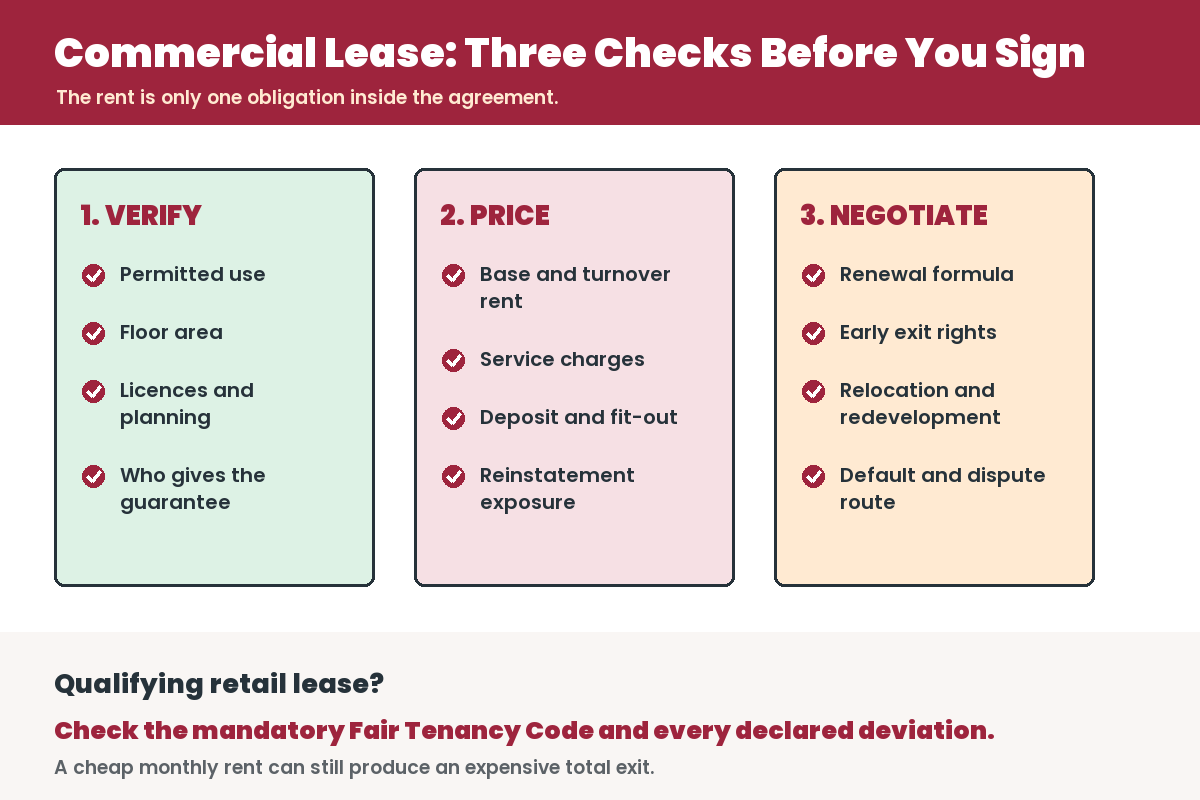
What To Do Before Paying The Deposit
- Write the operating plan: activities, hours, equipment, deliveries, staffing and customer flow.
- Verify the premises: approved use, utilities, capacity, access and physical condition.
- Check regulatory dependencies: licences, planning, fire safety and sector approvals.
- Build the all-in cost model: rent, charges, GST, renovation, maintenance and exit.
- Stress-test weak sales: calculate how long cash lasts at 70%, 50% and 30% of planned revenue.
- Mark every non-standard term: especially guarantee, exit, relocation, renewal and reinstatement.
- Review the Code checklist: for a qualifying retail lease, identify every permitted deviation.
- Obtain advice before signing: legal review is most valuable while terms can still change.
This matters especially in F&B, where the recent SBO opinion that good food is no longer enough explains how rent and capital can change the competitive baseline.
The Final Rule: Price The Exit Before Admiring The Entrance
A good location can help a business. It can also turn an uncertain demand forecast into a fixed legal obligation.
Before signing, ask what happens if approval is delayed, renovation costs rise, the owner wants to sell, a co-founder leaves, sales fall or the shop needs to close. The agreement should be read in those scenarios, not only in the optimistic opening-day scenario.
Rent tells you what occupancy costs when everything goes to plan. The lease tells you what it can cost when it does not.
Official References
- Singapore Statutes Online: Lease Agreements for Retail Premises Act 2023
- Fair Tenancy Industry Committee: Code of Conduct
- Fair Tenancy Industry Committee: Frequently Asked Questions
- Lease Agreements for Retail Premises Regulations 2023
This article was reviewed on 23 July 2026 and provides general business information, not legal advice. Lease terms and their effect depend on the actual document and facts. Obtain advice from a qualified Singapore lawyer for a material commitment or dispute.
Frequently Asked Questions
What should I check in a commercial tenancy agreement in Singapore?
Check the premises, permitted use, total rent and charges, deposit, fit-out, repairs, reinstatement, renewal, early termination, relocation, personal guarantees, defaults and dispute process.
Does the Fair Tenancy Code apply to every commercial lease?
No. It applies to qualifying retail leases that meet the statutory scope. Office, industrial, short-term and other arrangements may fall outside it. Check the current Act and Code for the actual premises and term.
Can I end a commercial lease if my business is losing money?
Not automatically. Your rights depend on the lease, including any break, assignment or early-termination clause. Closing the shop does not by itself end the contractual rent obligation.
Is the security deposit the most a commercial tenant can lose?
Usually not. The lease may allow claims for unpaid rent, reinstatement, damage, interest, legal costs or other losses beyond the deposit. Read the actual liability clauses.
Explore More Content
Table of Content