
We make boring business stories sparkle.
GoBusiness Licensing Singapore: How to Find and Apply for the Right Licence
A founder registers a company, signs a lease, pays a contractor and tells friends that opening day is next month....

A founder registers a company, signs a lease, pays a contractor and tells friends that opening day is next month.
Then a supplier asks a simple question: “Has your licence been approved?”
The founder has an ACRA business profile, a UEN and a corporate bank account. What the founder does not have is permission to conduct the regulated activity that the entire shop was built around.
This is the expensive lesson GoBusiness Licensing is meant to prevent. Registering an entity and obtaining an operating licence are different jobs. The first creates the business. The second may determine whether that business can legally do what it plans to do.
This guide explains how to use GoBusiness Licensing, how it relates to the wider GoBusiness portal, what to prepare before applying, and where business owners commonly go wrong.
What GoBusiness Licensing Actually Is
GoBusiness is a Singapore Government platform that connects businesses to government e-services and resources. GovTech describes it as a one-stop platform covering business registration, licensing and grants, with more than 120 government e-services and more than 200 e-Advisers.
The licensing side lets users find licence information, submit applications for participating agencies, pay licence-related fees, track applications, and manage actions such as renewal, amendment or termination where the particular licence supports them.
The important phrase is one-stop portal, not one universal licence. GoBusiness brings many transactions into one place, but the relevant government agency still decides whether an application meets its legal and operational requirements.
System or party | What it does | What it does not prove |
|---|---|---|
ACRA / Bizfile | Registers the entity and its business particulars. | That every planned activity is licensed. |
GoBusiness | Helps identify and transact for many licences and permits. | That a submitted application is approved. |
Regulatory agency | Assesses the application and enforces its rules. | That other agencies’ approvals are unnecessary. |
Business owner | Provides accurate information and meets licence conditions. | That a consultant or portal carries the owner’s responsibility. |
If you first need to determine whether your activity may be regulated, read SBO’s broader guide to business licences in Singapore. This article focuses on using the portal once licensing is on your checklist.
When To Check GoBusiness
Check before the business makes commitments that are hard to reverse.
- Before incorporating: a regulated activity may affect the business structure, applicant type, local personnel or SSIC code you choose.
- Before signing a lease: the premises may need to meet planning, layout, safety or agency requirements.
- Before renovation: a beautiful layout is useless if it cannot satisfy the regulator.
- Before ordering stock or equipment: approval may depend on the goods, storage method or operating process.
- Before advertising an opening date: processing times vary and incomplete submissions create delay.
- Before adding a new service: an existing company can enter a newly regulated activity even if its original business did not need a licence.
ACRA’s post-registration guide states that a company may need additional licences or permits before starting operations and points owners to the GoBusiness Licence e-Advisers. Treat that check as an operating decision, not an administrative afterthought.
Start With The Activity, Not The Company Name
A vague company description produces vague licensing research. “Trading”, “consulting” and “lifestyle services” are not operational descriptions.
Write down what the business will actually do:
- What will customers pay for?
- Will you prepare, import, store, transport or sell physical goods?
- Will customers visit a premises?
- Will you handle food, health, education, employment, finance, transport, public entertainment or controlled products?
- Will the activity take place at home, in a shop, in a factory, at an event or at a customer’s site?
- Will the applicant be an individual or a UEN-registered entity?
This description also helps when choosing an SSIC code. An SSIC code can support the check, but it should not replace a plain-language review of the real activity.
How To Use GoBusiness Licensing Step By Step
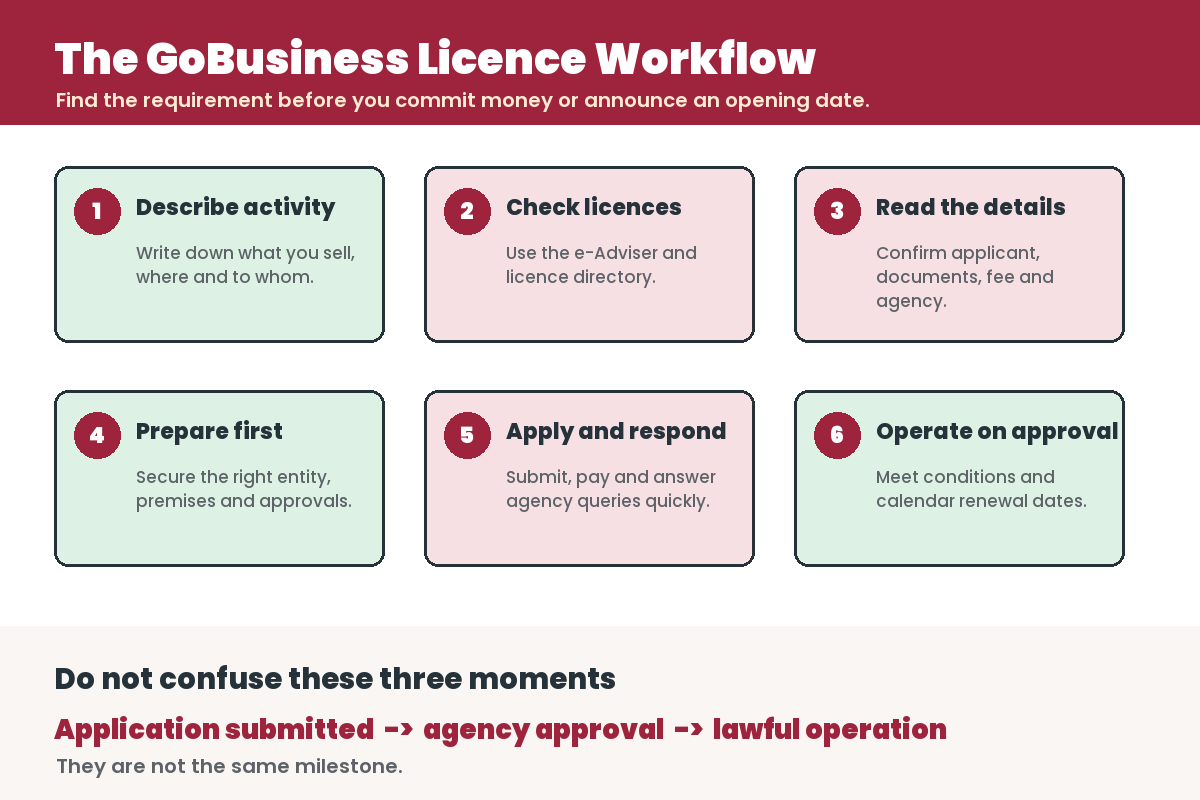
1. Use the e-Adviser when you do not know the licence name
The Licence e-Adviser asks questions about the business and recommends licences or permits to investigate. It is useful for new founders because regulators name licences by legal activity, not necessarily by the words business owners use in conversation.
Treat the recommendation as a guided shortlist. Read each licence page and confirm uncertain cases with the responsible agency.
2. Search the licence directory when you know the agency or licence
If you already know what you need, browse the GoBusiness licence directory by agency or licence name. A licence page can state whether it is for an individual or business user, which agency administers it, what the application covers, the fee, required documents and other conditions.
Do not apply merely because the licence title sounds close. Read the activity definition and eligibility section.
3. Choose the correct login profile
GoBusiness distinguishes between individual and business transactions. GovTech’s guidance says an individual profile is used for matters such as registering a new entity, trading under an NRIC name or applying without a registered UEN. A business profile is used when acting for a UEN-registered entity.
Your situation | Likely profile | Prepare |
|---|---|---|
Licence issued to you personally | Individual | Singpass and personal eligibility documents. |
Applying for a registered company | Business | Singpass, Corppass access and the correct UEN. |
No entity or UEN yet | Depends on licence | Check whether pre-registration application is allowed. |
Agent filing for a client | Authorised access | Agency-specific authorisation and supporting documents. |
The licence page is the source of truth for applicant type. Some licences are issued to people; others are issued to entities or tied to specific premises.
4. Prepare every dependency before submission
A licence form is often the final container for decisions made elsewhere. The application may depend on a registered entity, suitable premises, a tenancy document, a layout plan, qualified personnel, training records, declarations or approvals from another agency.
Create a document folder before opening the form. Use filenames that another person can understand, confirm that scans are readable, and check whether documents must be recent or signed.
5. Submit, pay and save the acknowledgement
Review the applicant, UEN, activity, premises and contact details before payment. Save the application reference and acknowledgement. If several people are involved, nominate one owner for monitoring the application.
6. Respond to agency questions quickly
Submitting the form does not make the application complete forever. The agency may ask for clarification, revised documents, an inspection or changes to the proposed setup.
Check the dashboard and the application email address. A founder who never opens the government inbox can turn a manageable query into a delayed launch.
7. Wait for approval before conducting the regulated activity
“Submitted” is not “approved”. A payment receipt is not a licence. A contractor saying the premises looks fine is not agency approval.
Read the approval notice and licence conditions. Confirm the permitted activity, licensee, premises, validity dates and any conditions that continue after approval.
8. Manage renewal, amendments and cancellation
A licence is not a one-time setup document. Changes to the entity, address, activity, directors, qualified personnel or premises may trigger an amendment or fresh application, depending on the licence.
Put renewal dates in a shared compliance calendar and begin preparation before the portal reminder becomes urgent.
A Practical Readiness Checklist
Check | Question | Evidence to keep |
|---|---|---|
Activity | What exactly will the business do? | Service list, product list and operating flow. |
Applicant | Is the licence personal or tied to an entity? | Identity, UEN and authorisation records. |
Premises | Is this use allowed at the location? | Tenancy, owner consent, plans and approvals. |
People | Are qualifications or appointments required? | Certificates, employment details and declarations. |
Documents | Are files complete, current and readable? | Final submission folder and acknowledgement. |
Timeline | What must happen before opening? | Dependency plan and realistic launch buffer. |
After approval | What conditions and renewal dates apply? | Licence copy and compliance calendar. |
What GoBusiness Cannot Decide For You
The portal reduces navigation. It does not remove business judgment.
- It cannot make unsuitable premises suitable.
- It cannot guarantee approval because the form was accepted.
- It cannot choose an accurate activity description for a founder who is vague about the business.
- It cannot replace professional advice for a complex legal, planning or regulated setup.
- It cannot stop an owner from spending too early.
The best use of GoBusiness is early. Once the lease is signed, equipment is installed and opening announcements are published, every licensing surprise becomes more expensive.
Common GoBusiness Licensing Mistakes
- Assuming incorporation is approval: ACRA registration and activity licensing are separate.
- Searching by brand language: regulators care about the activity, goods, premises and risk.
- Using the wrong profile: an individual licence and a company licence are not interchangeable.
- Committing to premises first: the chosen unit may not support the intended use or layout.
- Uploading weak documents: unreadable, inconsistent or incomplete files invite queries.
- Planning around best-case timing: applications can require clarification, other approvals or inspection.
- Ignoring conditions after approval: a valid licence still has operating obligations.
When To Get Help
A straightforward application may be manageable in-house. Get help when the activity is unfamiliar, several agencies are involved, the premises commitment is large, the licence depends on technical plans, or rejection would materially affect the business.
Ask the responsible agency about policy and eligibility. Ask a qualified professional about technical, legal or premises matters. GoBusiness provides navigation and transaction access; the regulator provides the decision.
For the surrounding setup work, use SBO’s guides on registering a company, registered address options and the full cost of starting a business in Singapore.
The Bottom Line
GoBusiness Licensing is valuable because it gives business owners a practical starting point across many government licensing transactions. But the portal works best when the owner already understands the proposed activity, applicant and premises.
Use it before spending. Read the actual licence page. Prepare the dependencies. Submit under the correct profile. Respond to the agency. Operate only when approval and conditions are clear.
The most expensive licence problem is usually not the application fee. It is discovering the requirement after the business has committed everything else.
Official References
- GoBusiness Licensing
- GovTech: GoBusiness overview
- ACRA: Post-registration guide for local companies
- ACRA: Business names, licences and approvals
This guide was reviewed on 21 July 2026. Licence requirements, fees, forms and processing arrangements can change. Check the relevant GoBusiness licence page and responsible agency before acting.
Frequently Asked Questions
What is GoBusiness Licensing in Singapore?
GoBusiness Licensing is a Singapore Government portal used to find, apply for and manage many business licences and permits across participating agencies. The relevant agency still assesses and approves each application.
Does an ACRA-registered company still need a business licence?
It may. ACRA registration creates the entity, but regulated activities can require separate licences, permits, approvals or registrations before operations begin.
Should I log in as an individual or business user?
Use the profile required by the specific licence. Personal licences are generally handled as an individual, while applications for a UEN-registered entity generally use the business profile and appropriate Corppass access.
Can I start operating after submitting a licence application?
Do not assume so. Submission and payment are not the same as approval. Check the governing rules and wait for the relevant approval before conducting an activity that requires a licence.
Explore More Content
Table of Content