
We make boring business stories sparkle.
How to Start a Tuition Centre in Singapore
A step-by-step guide to MOE registration, commercial-school premises, tutor hiring, class economics and operations for a Singapore tuition centre.

A teacher finishes an evening lesson and a parent waits outside to ask a simple question: “Can my younger child join too?”
Within months, the teacher has eight students around a dining table, a waiting list in WhatsApp and a growing belief that the next logical step is a tuition centre.
The demand may be real. The dangerous assumption is that a tuition centre is merely private tutoring in a rented room. Once the operation teaches enough learners, hires tutors and occupies premises as a commercial school, it becomes a regulated education business with registration, premises and operating responsibilities.
This guide explains how to start a tuition centre in Singapore in the order that reduces expensive mistakes.
First Decide What You Are Actually Starting
Model | Operational character | Main regulatory question |
|---|---|---|
Solo private tutor | One tutor, small number of learners | Does the activity remain below private-school registration scope and comply with premises rules? |
Online tuition business | Remote classes and digital materials | Where is the business operated, how is student data handled and does scale trigger registration? |
Tuition centre | Dedicated premises, courses and multiple classes | MOE registration, commercial-school use and fire safety |
Enrichment or preschool-like programme | Skills, care or education for young children | Whether MOE, SSG or ECDA is the correct regulator |
A tuition centre is not automatically the best first move. A founder can validate curriculum, pricing and retention with smaller classes or authorised rented classrooms before accepting a multi-year lease.
When Is MOE Registration Required?
MOE’s current private-school registration guidance states that a private school must register its school, courses and permitted teachers if it offers education for 10 or more persons. This includes tuition and enrichment centres teaching subjects taught in mainstream schools.
The “10 or more” threshold should not be treated as a clever limit to design around while operating like a centre. If your model is near the boundary, describe the actual course structure, enrolment and delivery method to MOE and obtain a written answer.
Different regimes may apply to full-time private education, post-secondary qualifications, preparatory courses, foreign curricula or early-childhood care and education. MOE specifically notes that an early-childhood development centre may fall under ECDA where care or education is habitually provided for five or more children below seven for a fee. Do not assume that calling a programme “enrichment” determines the regulator.
MOE Registration Covers More Than The Premises
A registered private school must register the school, the courses it offers and the teachers permitted to teach those courses. MOE also requires a School Management Committee. Later additions of teachers, courses, committee members, relocation or expansion require the appropriate amendment or notification.
MOE’s application instructions say operators should complete renovation and furnishing before applying through GoBusiness. The school name must clearly indicate a place of learning and align with the ACRA-registered business name. A new application accepts up to 10 courses and 10 teachers; additional courses and teachers can be registered after the school is approved.
Registration component | What to prepare | Common oversight |
|---|---|---|
School | ACRA entity, school name, management committee and premises documents | Business name and school name do not align |
Courses | Course titles, level, content and teaching arrangement | Launching a new subject before registering it |
Teachers | Identity, qualifications and course assignment | Assuming a contractor needs no MOE registration |
Premises | Approved use, layout, capacity and required safety documents | Signing first and checking commercial-school use later |
Registration gives a school the right to operate after meeting basic requirements. MOE says it is not an endorsement or accreditation of quality. A registered operator should describe itself only as “Registered with the Ministry of Education”, not “MOE approved” or wording that suggests academic endorsement.
Choose Premises That Can Lawfully Be A Commercial School
URA treats tuition centres as commercial schools. Whether a proposed centre can operate depends on the property type and approved use. Commercial units may qualify for instant approval and lodgment or may require a change-of-use application. Residential units in mixed developments are not automatically usable as commercial schools.
Check the approved use before signing. Also verify landlord consent, student capacity, toilets, accessibility, pick-up and waiting areas, signage, noise, emergency lighting, exits and building-management rules. A cheap upper-floor unit can become expensive if parents cannot wait safely or the approved occupancy is too low for the revenue model.
Fire-safety obligations depend on the building and works. Renovations affecting fire-safety systems may require plans and certification through qualified professionals. Do not treat an existing landlord Fire Certificate as proof that your proposed layout and occupancy are approved.
Use SBO’s commercial tenancy guide before paying the deposit, especially for permitted use, approval conditions, fit-out, reinstatement and early termination.
Build The Unit Economics Before The Timetable
Tuition centres sell seats in time slots. The same classroom can be profitable at 80% utilisation and destructive at 25%, even when every occupied class has a positive gross margin.
Illustrative class | Calculation | Amount |
|---|---|---|
Monthly class revenue | 8 students x S$320 | S$2,560 |
Tutor cost | 4 lessons x S$120 | (S$480) |
Materials and payment cost | Illustrative | (S$160) |
Contribution to rent and overhead | Before fixed costs and tax | S$1,920 |
This example is not a market price. Test the same calculation at four, six and eight students. Then map every classroom and teaching hour. A centre can appear full on Saturday and remain underused for most of the week.
Hiring Tutors: Quality, Registration And Employment
Start with a written hiring standard: subject mastery, teaching demonstration, communication with parents, safeguarding behaviour, reliability and willingness to follow the registered curriculum. Verify qualifications and references rather than buying prestige through a job title.
Where MOE registration applies, register teachers for the courses they teach. Do not assume describing a tutor as a freelancer removes the school’s registration responsibilities.
Separately, classify the working relationship correctly. If the centre controls teaching hours, curriculum, pricing, classroom, student allocation and how work is performed, the arrangement may look more like employment than an independent business. Employees who are Singapore Citizens or Permanent Residents and earn more than S$50 a month generally attract CPF obligations. SBO’s CPF contribution calculator helps model the payroll cost.
Create processes for attendance, make-up lessons, complaints, fee collection, refunds, student dismissal, emergencies and substitute teachers. The brand is damaged by operational inconsistency long before it is damaged by a weak logo.
Data Protection And Marketing To Parents
A tuition centre holds children’s names, school information, results, contact details, photographs and sometimes learning or behavioural observations. Define who can access each category, how long it is retained and how it is deleted. Obtain consent before using testimonials, photographs, examination results or student work in marketing.
Avoid guarantees such as “your child will improve two grades”. You control curriculum and teaching quality, not every student’s result. Publish precise facts: class size, lesson duration, tutor, syllabus, fee, replacement policy and what support is included.
A Practical Launch Sequence
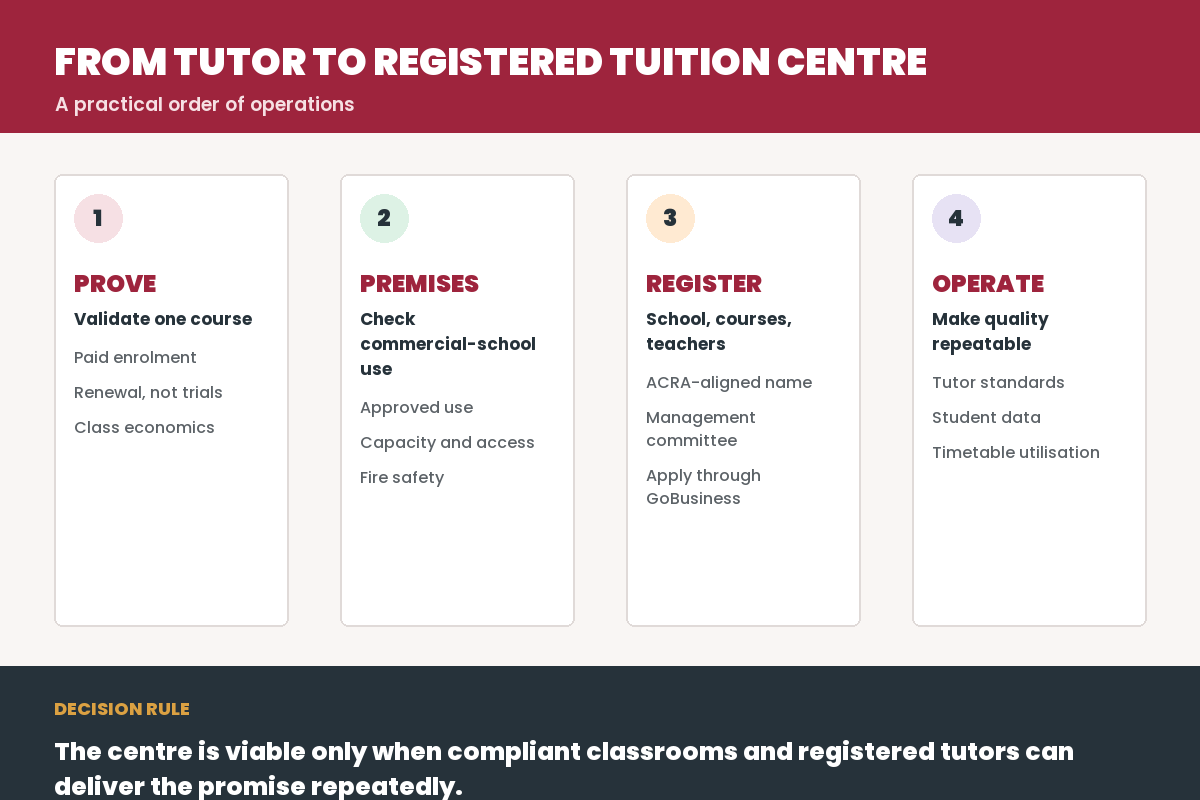
- Validate one course. Prove that parents renew, not merely that they attend a discounted trial.
- Register the ACRA entity. Align the proposed school and business names.
- Shortlist premises. Verify commercial-school use, owner consent and capacity before committing.
- Design the curriculum and staffing map. Know which registered teacher teaches each course.
- Complete fit-out and required clearances. Keep approvals as conditions in the lease where possible.
- Apply through GoBusiness. Submit the school, courses and teachers to MOE.
- Open only after approval. Build enrolment around realistic room and tutor utilisation.
The centre is not the product. The product is a repeatable learning outcome delivered by a compliant school even when the founder is not in every classroom.
Official References
- MOE: Register a private school
- MOE: How to register a private school
- URA: Commercial-school property-use guidance
- SCDF: Fire Safety Certificate and Temporary Fire Permit
Reviewed on 25 July 2026. Education and premises requirements depend on the course, student group, scale and property. Confirm the current requirements with MOE, URA, SCDF and other relevant agencies.
Frequently Asked Questions
When must a tuition centre register with MOE?
MOE states that a private school offering education for 10 or more persons must register the school, courses and permitted teachers. This includes relevant tuition and enrichment centres.
Can I operate a tuition centre in any commercial unit?
No. URA treats tuition centres as commercial schools. Check the unit’s approved use, whether lodgment or change of use is needed, landlord consent, capacity and fire-safety requirements before signing.
Must tutors be registered with MOE?
Where private-school registration applies, teachers must be registered for the courses they are permitted to teach. Later teachers and courses require the relevant amendment process.
Does MOE registration mean the centre is MOE approved?
No. MOE says registration is not endorsement or quality accreditation. A centre should use only the permitted wording, Registered with the Ministry of Education.
Explore More Content
Table of Content