
We make boring business stories sparkle.
How to Start a Food Business in Singapore: Licences, Formats and Costs
A comprehensive guide to starting a Singapore food business, including SFA licences, home-based limits, halal certification and hawker versus restaurant economics.

A home baker receives thirty orders after one video goes viral. By Sunday night, the kitchen is full of boxes, the family refrigerator is overloaded and a café owner asks whether she can supply cakes every week.
It feels like the moment to “go commercial”. But that phrase can mean four very different businesses: remaining a small home-based seller, taking a stall in a coffee shop, tendering for a hawker stall or opening a restaurant with a full kitchen and dining area.
Each format has different licensing, premises, staffing and capital requirements. The mistake is not starting small. The mistake is choosing a format whose fixed costs arrive before demand is repeatable.
This is a comprehensive 2026 refresh of SBO’s original F&B startup guide. It explains the current SFA licence framework, halal certification, hawker-versus-restaurant decision, premises sequence and operating economics.
Choose The Food Business Format First
Format | Typical approval route | Capital intensity | Key limitation |
|---|---|---|---|
Home-based food business | No SFA licence currently, subject to food-safety and residential-scheme rules | Low | No catering, no supply to SFA-licensed food retailers and other restrictions |
Food stall in coffee shop or food court | SFA Food Stall Licence | Medium | Shared operator rules, limited space and menu constraints |
NEA hawker stall | Tenancy process plus SFA licensing administration | Medium | Tender and tenancy conditions; hands-on operating expectations |
Restaurant, café or standalone takeaway | SFA Food Shop Licence plus premises and activity-specific approvals | High | Rent, fit-out, manpower and compliance complexity |
Central kitchen or food manufacturing | Food processing establishment requirements | High | Different upstream licensing and facility standards |
SFA’s food retail licensing guide says food businesses generally need a licence to prepare and sell food to consumers. Restaurants, cafés, caterers, coffee shops, food courts, standalone takeaway kiosks and similar operations fall under a Food Shop Licence. An individual stall inside a multi-unit food shop generally needs a Food Stall Licence.
Can You Start From Home?
Home-based food businesses currently do not need an SFA licence, but they remain subject to food laws and SFA’s home-based food requirements.
The exemptions are narrow in practical terms. A home operator must not provide catering, supply food to SFA-licensed retailers, sell home-prepared food at temporary fairs or sell ready-to-eat raw seafood. Ingredients must be legally sourced, and food must be safe. SFA recommends food-safety training even where a licence is not required.
A café asking to resell your home-baked product is therefore not merely a bigger order. It may be the point at which production must move to a licensed establishment. Read SBO’s guide to starting a business from an HDB flat for the surrounding residential-use conditions.
Food Shop And Food Stall Licences
Apply before operations begin. As at July 2026, SFA lists the annual Food Shop Licence fee at S$195 and the Food Stall Licence at S$32 a year or S$64 for two years, with a reduced fee for specified school and hawker stalls. Licence cost is rarely the expensive part. Premises, layout, renovation, exhaust, grease management, utilities, equipment and approval delay dominate the capital decision.
For a food stall, SFA requires a secured location, tenancy or lease documents, stamp-duty documentation where applicable, a dimensioned layout plan and food handlers who meet training requirements. Food Shop applications have their own self-checklist and supporting documents. Licences are not transferable, so a buyer taking over an outlet must make a fresh application rather than assuming the seller’s licence follows the business.
Do Not Sign The Lease In The Wrong Order
- Confirm the approved use and whether change of use is required.
- Check that the proposed layout can meet SFA, building and fire-safety requirements.
- Make the tenancy conditional on approvals where negotiation allows.
- Allocate responsibility for exhaust, grease traps, utilities, air-conditioning and reinstatement.
- Submit the correct licence application through GoBusiness.
- Open only after the licence is issued.
ACRA registration does not authorise food operations. Use SBO’s guides to business licences in Singapore and GoBusiness Licensing alongside the current SFA checklist.
Hawker Stall Versus Restaurant
Question | Hawker stall | Restaurant |
|---|---|---|
What are customers buying? | Focused food value and speed | Food plus space, service and experience |
Menu strategy | Narrow menu with fast throughput | Broader menu but greater inventory complexity |
Fixed cost | Usually lower, but tender and tenancy conditions matter | Usually much higher due to lease and fit-out |
Labour | Lean and owner-dependent | Kitchen, floor and management layers |
Failure mode | Owner exhaustion and insufficient volume | Rent and payroll consume cash before demand matures |
NEA’s hawker startup process begins with tendering for a stall and completing tenancy administration. In NEA-managed centres, NEA assists operators with the SFA licence. Centres managed by appointed operators may require the operator to apply directly to SFA. Eligibility and tenancy conditions differ, so read the current tender documents rather than relying on a general article.
A restaurant offers more control over brand and experience, but every square foot needs to earn its place. SBO’s opinion on why good food is no longer enough explains why founders must compare their unit economics with competitors who may value market presence for reasons beyond one outlet’s profit.
Is Halal Certification Required?
MUIS halal certification is not a blanket licence required for every food business. It is a formal certification route for businesses that want their products or premises certified halal. Do not imply MUIS certification before approval.
The current MUIS certification process includes preparation against the Halal Certification Conditions, a Halal Competency Assessment, application, document review, audit or inspection, certification and post-certification obligations. MUIS states an average 30-working-day processing time for a complete new application and certificate validity of one or two years.
Certification affects suppliers, ingredients, storage, preparation, staffing, records and change control. It should be designed into procurement and kitchen operations, not added as a sticker after opening. NEA also states that non-Muslim operators selling halal cooked food in NEA-managed hawker stalls must obtain halal certification under tenancy requirements.
Other Approvals Depend On What You Sell And Do
- Liquor: supplying alcohol generally requires the appropriate Police liquor licence.
- Entertainment: live music, performances or other public entertainment may require a separate licence.
- Importing food: commercial import activity may require SFA registration, licensing or permits depending on the food category.
- Signage and outdoor refreshment: building, landowner and authority approvals may apply.
- Central production: manufacturing or processing food for supply to retailers is not the same as ordinary food retail.
Run the actual concept through GoBusiness instead of copying another restaurant’s licence list.
Model The Plate, Labour Hour And Outlet
Illustrative dish | Amount | Share of S$18 price |
|---|---|---|
Ingredients and packaging | S$5.40 | 30% |
Platform or payment cost | S$1.44 | 8% |
Contribution before labour and fixed costs | S$11.16 | 62% |
This illustration is deliberately incomplete. The remaining S$11.16 still has to fund kitchen and service labour, employer costs, rent, utilities, cleaning, spoilage, marketing, repairs, licences and tax. A popular dish can lose money if preparation is slow, wastage is high or delivery commission is ignored.
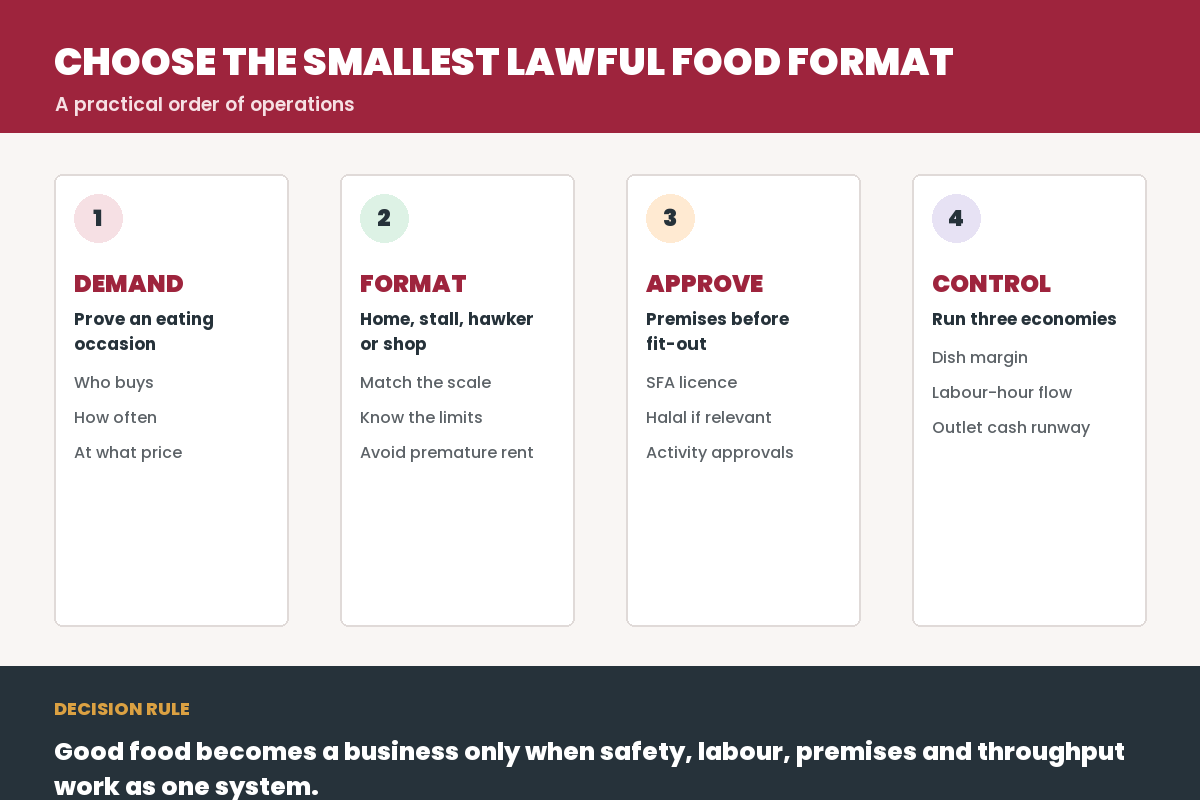
Build three linked models:
- Dish economics: ingredient yield, packaging, commission, waste and preparation time.
- Shift economics: covers or orders per labour hour, staffing minimum and peak bottleneck.
- Outlet economics: rent, utilities, management, debt, depreciation and cash runway.
Hiring And Operating Systems
Food businesses depend on repeatability. Document receiving, storage, temperature control, preparation, allergen handling, cleaning, pest control, opening, closing and incident response. Food-handler training is a minimum; supervisors still need to enforce the system on a busy Saturday.
When hiring local employees, budget employer CPF and Skills Development Levy in addition to salary. If foreign manpower is part of the plan, check the correct sector quota and levy before signing a lease. SBO’s Work Permit calculator can help model the headcount constraint, but MOM’s current rules remain authoritative.
Do not solve a broken process by continuously adding people. Simplify the menu, reduce unique ingredients, design stations for flow and measure ticket time and waste by item.
A Lower-Risk Launch Sequence
- Choose one customer and one repeatable eating occasion.
- Test paid demand through a lawful low-fixed-cost format.
- Select the smallest format that can legally serve the proven demand.
- Verify premises and licence feasibility before committing to renovation.
- Build dish, shift and outlet economics using conservative volume.
- Apply for the correct SFA and activity-specific approvals.
- Open with a controlled menu and enough cash for delay and weak months.
A food business is not a recipe with rent attached. It is a food-safety, labour, property and throughput system that must produce the same promise repeatedly.
Official References
- SFA: Food retail businesses that need a licence or permit
- SFA: Requirements for food retail licences and permits
- SFA: Home-based food business requirements
- MUIS: Singapore halal certification process
- NEA: Becoming a hawker
Reviewed on 25 July 2026. Food, premises and manpower requirements change by format and activity. Check the latest SFA, MUIS, NEA, MOM, URA, SCDF and GoBusiness requirements before committing.
Frequently Asked Questions
What licence do I need to start a food business in Singapore?
It depends on the format. Restaurants and standalone food shops generally need a Food Shop Licence, while stalls inside multi-unit food shops generally need a Food Stall Licence. Other activities can require additional approvals.
Can I start a food business from home without an SFA licence?
Home-based food businesses currently do not need an SFA licence, but must comply with food laws and restrictions. They cannot cater, supply SFA-licensed retailers or sell ready-to-eat raw seafood from home.
Is halal certification compulsory for every food business?
No. MUIS halal certification is not a blanket requirement for every food business, but it is required if the business wants formal MUIS certification and may be required under specific tenancy conditions.
Is a hawker stall cheaper than a restaurant?
A hawker stall usually requires less fit-out and space, but tender, tenancy, manpower and operating conditions still matter. Compare realistic volume and owner workload, not only rent.
Explore More Content
Table of Content