A partnership can start with trust, friendship, or a shared opportunity, but it should not run only on assumptions. A proper partnership agreement sets out what each partner contributes, who makes decisions, how profits and losses are shared, and what happens if someone wants to leave. For Singapore business owners, the agreement is not just paperwork. It is a practical way to prevent expensive misunderstandings when money, workload, or control becomes sensitive.
What a partnership agreement should do
A partnership agreement should make the business relationship operational. It should be clear enough that partners can use it when deciding payments, signing contracts, admitting a new partner, handling a dispute, or winding down the business.
Define each partner’s contribution and ownership interest.
Set decision-making authority and spending limits.
Explain how profits, losses, and drawings are handled.
Clarify duties, working time, and management roles.
Plan for exit, death, incapacity, deadlock, or disputes.
Key clauses to include
Clause
What it should cover
Why it matters
Partners and structure
Names, business structure, registration details, and start date.
Confirms who is bound by the agreement.
Capital contributions
Cash, assets, intellectual property, labour, or other contributions.
Prevents later arguments about who put in what.
Profit and loss sharing
Percentages, drawings, reinvestment, and timing of distributions.
Money disputes are one of the fastest ways to damage a partnership.
Roles and authority
Daily duties, bank signing rules, spending limits, and contract authority.
Stops one partner from overcommitting the business.
Exit and buyout
Resignation, sale, valuation method, notice period, and payment terms.
Gives the business a process when someone leaves.
Dispute resolution
Escalation, mediation, arbitration, court, and deadlock rules.
Creates a path before disagreement becomes a full breakdown.
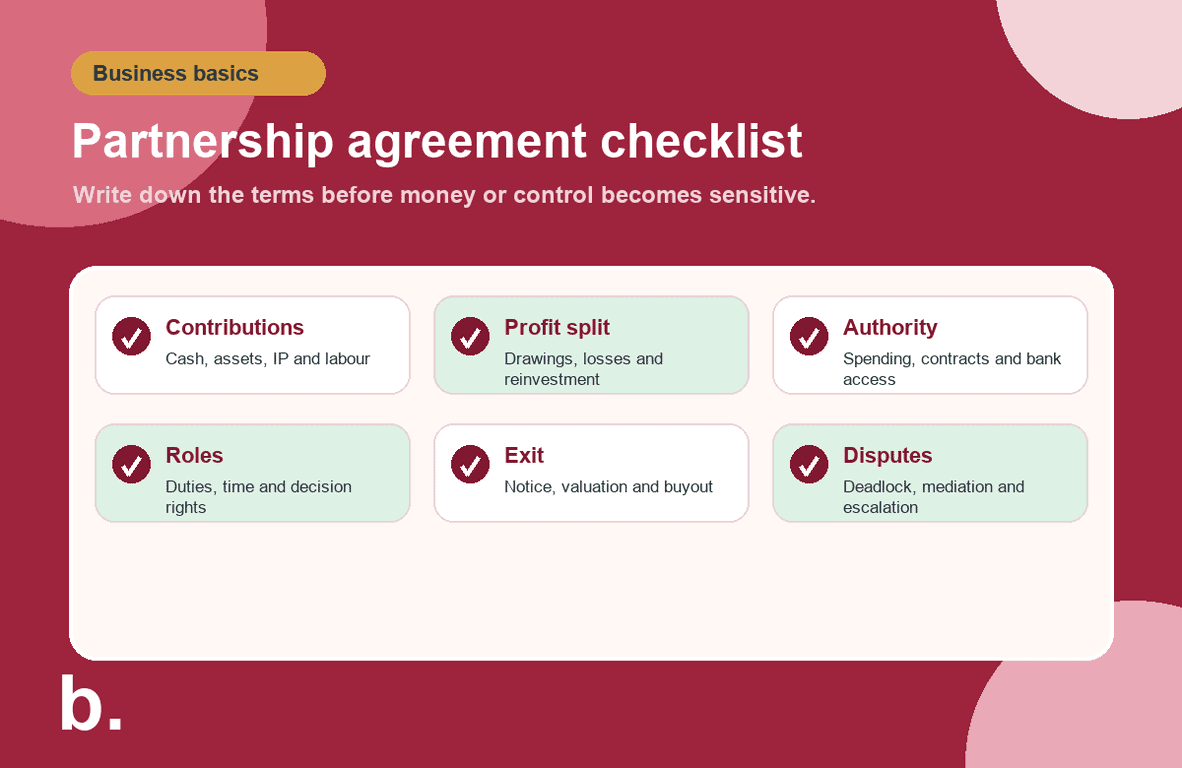
A good partnership agreement makes money, authority, roles, exit and disputes explicit before problems arise.
Questions partners should answer before drafting
Before writing clauses, have the difficult conversation. The agreement is only useful if it reflects how the partners really expect to work.
Who contributes cash, assets, customer relationships, labour, or IP?
Are profits split equally, by ownership, or by role?
Who can sign contracts, hire staff, borrow money, or approve expenses?
Can a partner work for another business at the same time?
What happens if one partner stops contributing?
How will the business be valued if someone exits?
What happens to customer lists, brand assets, domains, and social accounts?
Common drafting mistakes
Mistake
What can go wrong
Cleaner approach
Using equal ownership without role clarity
One partner may feel they are doing more work for the same share.
Separate ownership, duties, salary, and profit distribution.
No spending authority limits
A partner may commit the business to unaffordable obligations.
Set bank, contract, borrowing, and expense approval rules.
No exit clause
A departing partner can freeze decisions or trigger disputes.
Define notice, valuation, buyout, and transfer restrictions.
No IP and customer ownership terms
Partners may fight over brand assets, code, content, or client relationships.
State what belongs to the business and what remains personal.
No deadlock process
Important decisions can stall indefinitely.
Use escalation, mediation, reserved matters, or buy-sell mechanics.
Partnership agreement vs shareholders’ agreement
If the business is a registered partnership, a partnership agreement normally governs the partners’ business relationship. If the business is a Pte Ltd, the owners usually need a shareholders’ agreement instead, alongside the company constitution. The purpose is similar, but the legal structure is different. Do not copy clauses blindly across structures.
When to get a lawyer involved
Use a lawyer when the business has meaningful money, IP, employees, regulated activity, investors, personal guarantees, unequal contributions, or complex exit terms. A template can help partners discuss the issues, but it may not protect the business if the structure, liability, or enforcement terms are wrong.
It is strongly recommended whenever two or more people run a business together. The agreement reduces uncertainty around money, roles, authority, exit, and disputes.
What should a partnership agreement include?
It should include partner details, contributions, ownership, profit and loss sharing, decision rights, duties, spending authority, exit terms, dispute resolution, and IP or customer ownership rules.
Is a partnership agreement the same as a shareholders’ agreement?
No. A partnership agreement fits a partnership structure. A shareholders’ agreement is used for company shareholders, usually alongside the company constitution.
Can I use a free partnership agreement template?
A template can help with planning, but get legal advice if the business has meaningful money, IP, staff, investors, unequal contributions, or complex exit terms.