
We make boring business stories sparkle.
Strike Off vs Winding Up A Company In Singapore: Which Should You Choose?
Understand when an inactive company can be struck off and when debts, assets or claims require a formal winding-up process.

Daniel’s company had stopped trading nine months earlier.
The office was gone, the staff had moved on and the bank account was almost empty. He assumed closing the company meant clicking “strike off” in Bizfile.
Then the accountant found an unpaid supplier, an equipment deposit that might be refundable and a final corporate tax return that had not been filed. The company was inactive, but it was not clean.
That distinction determines the closure route. In Singapore, striking off is generally for an inactive company that owns nothing and owes nothing. Winding up is the formal process for dealing with debts, obligations and assets before dissolution.
Strike Off And Winding Up Are Not Cheaper And Expensive Versions Of The Same Thing
ACRA’s current guidance states the basic distinction directly: a company may be struck off if it is inactive and debt-free, while winding up is used where debts need to be settled.
Issue | Strike off | Winding up |
|---|---|---|
Typical company | Stopped or never traded | Has affairs, debts or assets to resolve |
Assets and liabilities | None, including potential future claims | Collected, realised, settled and distributed |
Liquidator | Not normally appointed | Required for the formal process |
Creditors | No unpaid creditors | Formally addressed according to the route |
ACRA filing fee | Current strike-off application is free | Professional and filing costs vary |
Timing | At least three months after approval if unopposed | Depends on complexity, assets and claims |
Best question | Is the company completely empty? | How must its affairs be settled? |
When A Company Can Apply To Strike Off
ACRA’s guidance updated on 25 May 2026 says a company must meet all the stated conditions, including:
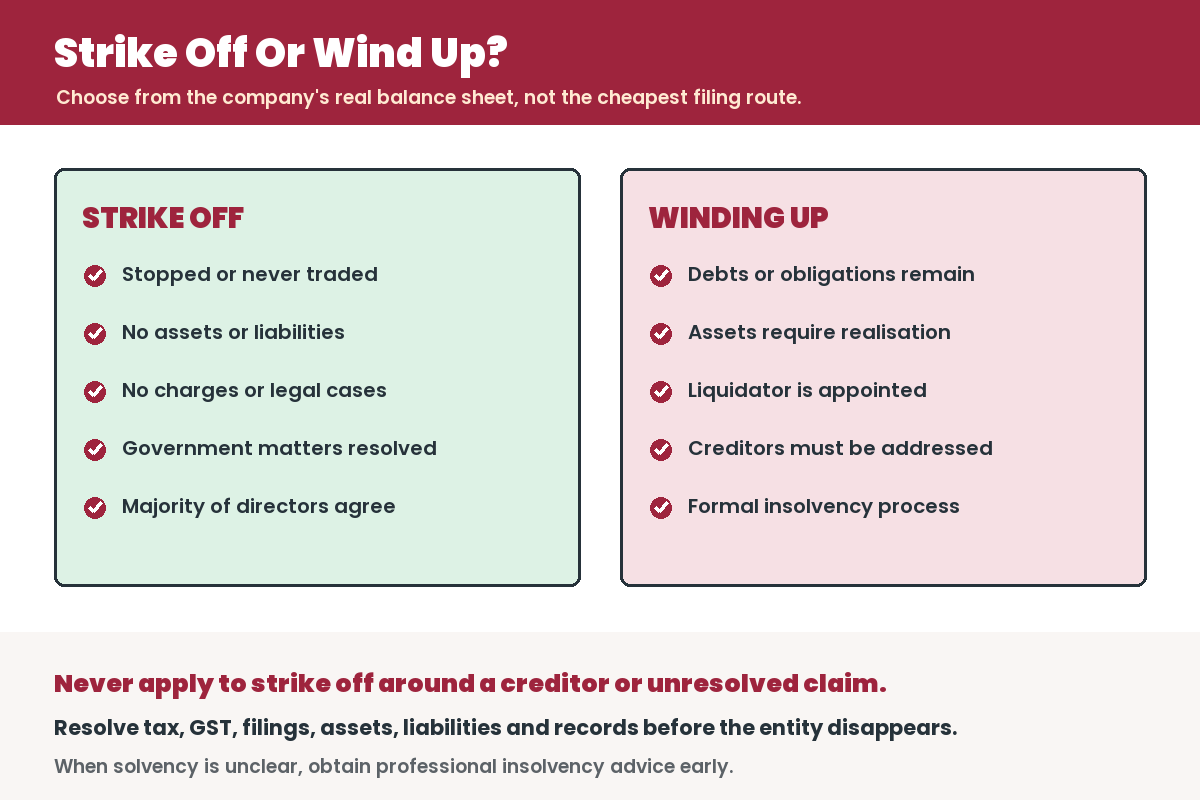
- it has stopped trading or never started business since incorporation;
- it has no unpaid debts or unresolved matters with a government agency;
- there are no loans or charges in the charge register;
- it is not involved in legal cases in Singapore or overseas;
- it is not subject to ongoing or pending regulatory or disciplinary proceedings;
- it owns nothing and owes nothing, including property, debts or potential future claims;
- all or a majority of directors agree to the strike off.
The phrase “owns nothing and owes nothing” should stop a director from treating strike off as a shortcut around creditors. Receivables, deposits, tax credits, shareholder loans, guarantees, lawsuits and contingent claims all require attention.
Who Applies And What It Costs
A company officer such as a director or company secretary may apply, or a corporate service provider may file on the company’s behalf. ACRA currently states that the application fee is free. Where director endorsement is required, the relevant directors must endorse within 14 days or the application lapses.
What Happens After Approval
Approval does not dissolve the company immediately. ACRA describes a process involving review, an opportunity to object, a First Gazette Notification, a 60-day waiting period and a Final Gazette Notification. The total process takes at least three months after approval if no issue delays it.
The company remains live until it is officially struck off. If an accepted objection is not resolved within the stated period, the application may lapse and a new application may be needed.
Restoration Is Possible
ACRA states that a struck-off company can be restored within six years by obtaining a Court Order and filing it through Bizfile. Dissolution should therefore not be used to conceal an unresolved asset, creditor or dispute.
Tax And GST Must Be Cleared Before Strike Off
IRAS says companies must settle outstanding tax liabilities and obligations before applying to ACRA. Otherwise, IRAS may object and delay the strike off.
The closing company should ensure:
- corporate income tax returns are filed up to the date business ceased;
- outstanding queries, assessments, taxes and penalties are resolved;
- GST registration is cancelled and GST matters are settled where applicable;
- relevant tax notices and statements are downloaded before the company ceases to exist.
IRAS does not issue a special tax-clearance letter merely for strike off. It points companies to their latest Notice of Assessment and Statement of Accounts as records of tax position.
A dormant company is not automatically exempt from filing. IRAS states that a dormant company generally must file its corporate income tax return annually unless it has received a waiver.
When Winding Up Is The Correct Route
Winding up is a formal process in which the company’s affairs are brought to an end, debts and obligations are addressed, assets are realised and any remaining value is distributed according to law. A liquidator or provisional liquidator is appointed for the applicable process.
ACRA lists four broad routes in its July 2026 guidance:
Route | When it applies | Central feature |
|---|---|---|
Members’ voluntary winding up | Directors believe debts can be paid within 12 months after commencement | Solvent closure with a liquidator. |
Simplified Winding Up Programme | Eligible micro or small company cannot pay its debts | Simplified insolvency route under the SIP. |
Creditors’ voluntary winding up | Company cannot continue because of debts | Creditors and liquidator are central. |
Court-ordered winding up | Court orders closure on a statutory ground | Compulsory process under court authority. |
ACRA describes a micro company for the simplified programme as having annual revenue under S$1 million and a small company as having annual revenue under S$10 million. Eligibility involves more than revenue alone, so owners should check the current programme requirements.
A Practical Decision Test
Choose Strike Off Only If Every Answer Is Clean
- Has all trading stopped?
- Are all suppliers, employees, landlords, lenders and shareholders settled?
- Are tax, GST and government matters resolved?
- Are all bank accounts, investments, deposits and receivables dealt with?
- Are there no charges, lawsuits, guarantees, disputes or potential claims?
- Do the required directors agree?
If any answer is uncertain, investigate before making the declaration.
Consider Winding Up When Affairs Need Administration
- the company cannot pay creditors when due;
- assets need to be sold and distributed;
- creditors disagree or compete for limited value;
- claims, contracts or employee matters remain;
- the company is solvent but too complex for an empty-company strike off;
- directors need an orderly insolvency process.
Do Not Wait Until Directors Lose Control Of The Options
A company under pressure should not prefer insiders, strip assets, incur credit it cannot reasonably repay or ignore demands. Director duties continue during financial distress, and insolvency creates additional risks requiring professional advice.
SBO’s article on when a business owner should give up addresses the emotional decision. The legal decision comes next: close the entity through the route that matches its actual assets, liabilities and solvency.
The company must also keep proper records. ACRA’s current director guidance says accounting records generally must be retained for at least five years after the relevant financial year transactions or operations were completed.
A Closure Checklist
Area | What to resolve | Evidence to retain |
|---|---|---|
Customers | Deposits, refunds, warranties and data | Settlement and communication records |
Suppliers | Invoices, contracts and retained property | Final statements and releases |
Employees | Salary, leave, CPF and termination duties | Payroll and exit records |
Tax | Returns, assessments, GST and payment | Notices and statements of account |
Assets | Cash, equipment, IP, deposits and receivables | Sale or distribution records |
Corporate | Charges, litigation, registers and filings | Bizfile and professional records |
The Final Rule
Strike off is simple because the company should already be empty. It is not a mechanism for making difficult obligations disappear.
Winding up is more formal because somebody must administer the reality that remains.
Do not choose the closure route from the filing fee. Choose it from the balance sheet, the creditor position and the truth.
Official References
- ACRA: Striking off a local company
- ACRA: Winding up a local company
- IRAS: Companies applying for strike off
- IRAS: Companies under liquidation
- ACRA: Company directors’ duties and obligations
This article was reviewed on 23 July 2026 and provides general business information, not legal or insolvency advice. A company’s solvency, liabilities and correct closure process depend on its facts. Consult a qualified Singapore lawyer, licensed insolvency practitioner, accountant or corporate service provider as appropriate.
Frequently Asked Questions
What is the difference between striking off and winding up a company in Singapore?
Strike off is generally for an inactive company that owns nothing and owes nothing. Winding up is the formal process for settling debts, realising assets and closing the company through a liquidator.
Can a company with unpaid debts apply to strike off?
It should not declare that it meets ACRA’s criteria if unpaid debts or unresolved liabilities remain. The debts must be resolved, or the company should obtain advice on the appropriate winding-up or restructuring route.
How long does striking off a Singapore company take?
ACRA states that the process takes at least three months after approval, depending on objections and whether issues arise. The company remains live until the Final Gazette Notification takes effect.
Must tax matters be settled before striking off?
Yes. IRAS requires outstanding corporate income tax and GST obligations to be settled. IRAS may object to an ACRA application where tax matters remain unresolved.
Explore More Content
Table of Content