
We make boring business stories sparkle.
Stop Trying to Look Like a Bigger Business
Small businesses often destroy their flexibility by buying the appearance of size. Credibility should come from clear promises and reliable delivery.


Two people start similar service businesses in the same month.
The first founder rents a polished office. He orders a reception sign, matching shirts, premium name cards and enough desks for the team he plans to hire. His social posts make the company look established.
The second founder works from a lawful home setup, rents meeting rooms when needed and uses a plain proposal template. She spends most of her time speaking to customers, delivering the work and collecting payment.
Six months later, the first business looks bigger.
The second business is bigger.
New founders waste an extraordinary amount of money trying to remove the embarrassment of being small. They should be doing the opposite. Smallness is one of the few unfair advantages available to a new business.
Looking Established Is Not The Same As Being Trusted
Customers do need signals of credibility. They want to know who they are dealing with, what will be delivered, whether data and money are handled properly, and what happens if something goes wrong.
But credibility does not require theatre.
A clear scope, professional domain, accurate invoice, responsive communication, relevant proof, sensible contract and reliable delivery create trust. An unused office creates rent.
The mistake is using expensive size-signals to compensate for missing trust-signals.
Spend | Can create trust? | Can become vanity? |
|---|---|---|
Professional email and website | Yes, when clear and current | Yes, if endlessly redesigned |
Office or studio | Yes, when customers or operations need it | Yes, when mostly empty |
Brand identity | Yes, when it improves recognition and clarity | Yes, when it replaces selling |
Employees | Yes, when they remove a proven bottleneck | Yes, when hired to look substantial |
Software stack | Yes, when it controls real work | Yes, when nobody uses it |
Company merchandise | Occasionally | Very easily |
Smallness Is A Strategic Position
A large company has more resources. It also has more coordination, approvals, payroll, fixed cost and internal politics.
A small business can speak directly to the customer who complained in the morning and change the process by afternoon. It can customise an early offer, refuse a bad segment, test a price and abandon an idea without holding a regional meeting.
That speed has economic value. Do not exchange it prematurely for the appearance of maturity.
When you add rent, headcount and systems before demand, you do not become a larger business. You become a small business carrying a large business’s costs.
The Founder Is Often Buying Emotional Comfort
Vanity overhead is not always arrogance. Often it is anxiety.
The founder worries that former colleagues will think the venture is unserious. Family members keep asking whether it is a “real company.” Prospects ask how big the team is. The founder responds by purchasing visible evidence.
But the business cannot afford to use cash to regulate the owner’s self-esteem.
A bigger office may reduce embarrassment for a month while reducing runway for a year. An unnecessary hire may make the founder feel like a leader while creating a payroll obligation the market never requested.
This is especially dangerous in Singapore because professional services, offices, fit-outs and manpower can become expensive quickly. SBO’s guide to the full cost of starting a business in Singapore should be read as a warning against premature fixed cost, not a shopping list.
You Need A Registered Office, Not A Corporate Stage Set
A Singapore company has genuine administrative requirements. ACRA’s current local-company registration guidance requires company details including a registered office and its opening hours.
Nothing about that requirement means a young consulting, software or online business needs a staffed reception area and twelve empty desks.
Choose a lawful arrangement that fits the work. SBO’s guides to registered address options and starting a business from an HDB flat explain the practical boundaries. Some businesses genuinely need approved commercial, industrial, education, fitness or food premises. Many do not need them on day one.
Use A Spending Gate
Before adding a meaningful recurring expense, force the decision through four questions.
Question | Good answer | Warning answer |
|---|---|---|
What constraint does this remove? | A measured capacity, compliance or conversion problem | “It will make us look serious” |
What evidence proves the constraint? | Lost sales, full utilisation or repeated failure | A founder’s feeling |
Can we test a smaller version? | Rental, contractor, pilot or monthly plan | Long lease or annual commitment first |
What result pays for it? | Named revenue, margin, risk reduction or time saved | General brand exposure |
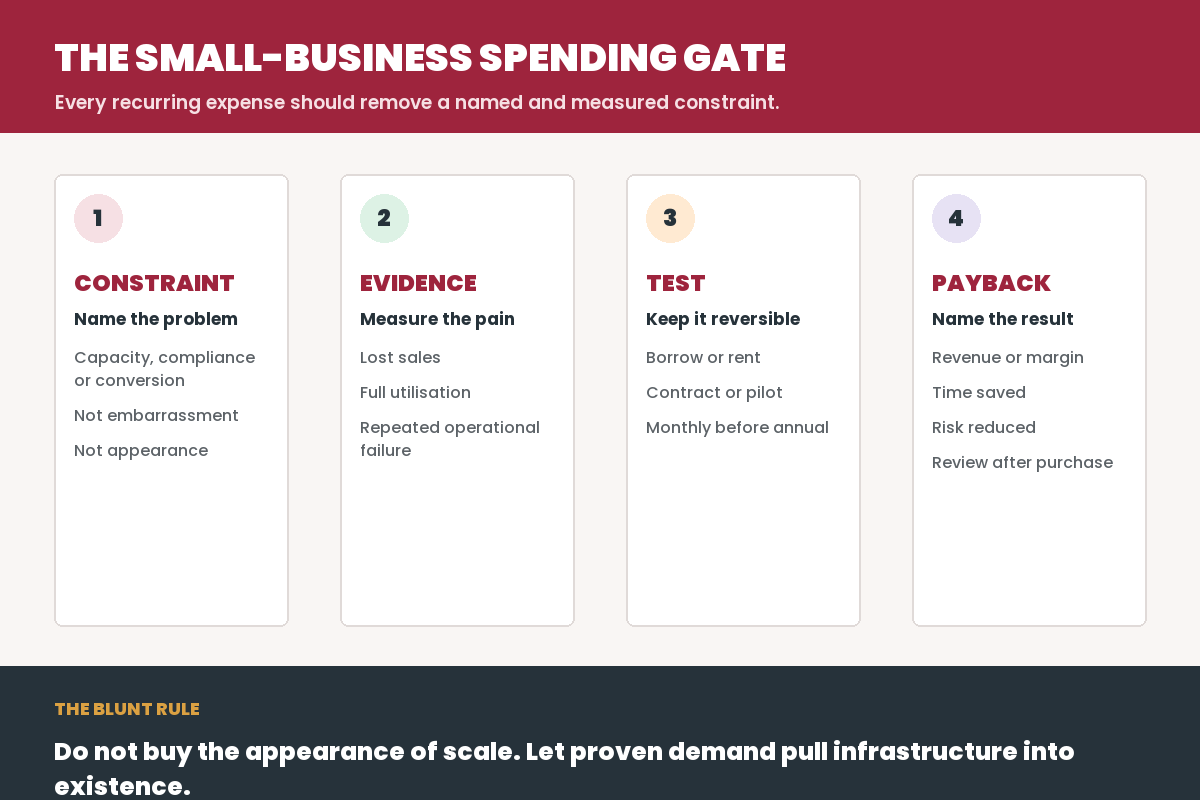
This gate does not ban ambition. It requires ambition to produce evidence.
Borrow, Rent, Contract, Then Buy
Reversibility matters when the business is still learning.
Use a meeting room instead of a permanent boardroom. Rent equipment before buying it. Use a contractor before creating a role with unclear workload. Run the first cohort in a compliant shared venue before signing a dedicated lease. Buy software monthly until the workflow proves durable.
This can cost more per unit. That is acceptable. Early businesses should sometimes pay a higher variable cost to avoid a much larger fixed mistake.
Efficiency is not always the lowest unit price. Sometimes efficiency is preserving the right to change your mind.
Do Not Pretend To Have Capabilities You Do Not Have
There is an ethical boundary. Looking professional is sensible. Pretending to have a large team, proprietary facility, deep inventory or in-house capability when none exists is misleading.
Small businesses should not apologise for using partners and specialists. Say how delivery works. Name the accountable person. Explain which work is in-house and which is subcontracted where the distinction matters.
A clear small company is more trustworthy than a vague company performing largeness.
When Looking Bigger Finally Makes Sense
Spend when scale is already pressing against the business.
- A dedicated venue makes sense when compliant shared capacity is repeatedly full or the customer experience requires control.
- A hire makes sense when a defined workload can support the full employment cost and the role removes a recurring bottleneck.
- A stronger brand system makes sense when multiple people and channels need consistency.
- Inventory makes sense when reliable demand and lead times justify holding it.
- Management software makes sense when the current process is losing money, data or accountability.
The business should pull infrastructure into existence. Infrastructure should not be built in the hope that a business appears.
Cash Is More Impressive Than Appearance
A business can be profitable on paper and still run out of money. Premature overhead makes that gap worse because deposits, fit-outs, annual subscriptions and payroll consume cash before their value is proven.
Read SBO’s guide to why a profitable business may have no cash in the bank. Then connect it to the broader principle that a business should be a sustainable system. A system is not measured by how many people sit inside it. It is measured by whether value can be delivered repeatedly at an acceptable margin.
My Opinion
Founders should stop being embarrassed by small beginnings.
Answer the phone yourself. Meet customers in a rented room. Use the same laptop until it becomes a bottleneck. Tell prospects the truth about the team. Let the work look larger than the office.
There is no prize for achieving the visual appearance of a 30-person company while carrying the revenue of a three-person company.
Look clear. Look reliable. Look accountable.
Do not pay to look big. Grow until the business has no choice.
Sources And Further Reading
- ACRA: Registering a local company via Bizfile
- ACRA: Common offences and registered-office requirements
- GoBusiness: Change of Use Approval
Frequently Asked Questions
How can a small business look professional without pretending to be large?
Use a clear offer, professional domain, accurate documents, responsive communication, relevant proof and reliable delivery. Be honest about the team and how work is performed.
When should a new business rent an office?
Rent dedicated space when the activity requires approved premises, customers need the setting, shared capacity is repeatedly full or the operational benefit can support the full recurring cost.
Is branding a waste of money for a startup?
No. A clear name, identity and message can improve trust and recognition. It becomes wasteful when repeated design work replaces selling, testing and delivery.
When should a founder make a fixed cost variable?
Use rentals, contractors, pilots and monthly plans while workload and demand remain uncertain. Accepting a higher unit cost can be sensible when it preserves the ability to change direction.
Explore More Content
Table of Content