
We make boring business stories sparkle.
How to Start a Personal Training or Fitness Business in Singapore
A practical Singapore guide to launching a personal training business, from NREP credentials and insurance to premises, pricing and CPF when hiring.

A client tells you that your coaching changed her life. A second client asks whether you can train her husband. A friend says you should stop giving away advice and turn personal training into a real business.
The tempting next step is to rent a studio, buy a rack of equipment and announce a grand opening. That is also where a coaching skill can become an expensive lease before demand has become a business.
A personal training business in Singapore can begin with little more than expertise, insurance, a booking system and access to suitable space. It can also become a staffed gym with significant rent, payroll and safety exposure. The right setup depends on what clients already pay you for, not on what looks impressive online.
This guide explains the practical sequence: credentials, business registration, where sessions can be held, insurance, pricing, the studio-versus-freelance decision and CPF obligations when you hire.
Start With The Business Model, Not The Equipment
Model | Fixed cost | Best use | Main risk |
|---|---|---|---|
Mobile or outdoor trainer | Low | Testing demand and building a client base | Venue permissions, weather and travel time |
Rent space by session | Low to medium | Professional setting without a full lease | Peak-hour availability and revenue share |
Home-based coaching | Low | Online programming or very small-scale administration | Residential-use, visitor and nuisance limits |
Private studio | High | Proven recurring demand and team growth | Rent, fit-out, approvals and unused capacity |
The leanest route is usually to sell coaching before buying premises. Train clients at a facility that permits independent trainers, rent a studio by the hour, deliver online programming or arrange authorised outdoor sessions. Keep a written record of who paid, how often they return and which time slots fill without discounting.
A studio makes sense when it solves a demonstrated capacity problem. It does not make sense merely because operating from borrowed space feels less established.
Do Personal Trainers Need A Licence In Singapore?
There is no single blanket government licence called a “personal training business licence”. That does not mean anyone should coach without qualifications, first-aid readiness or appropriate scope-of-practice boundaries.
Sport Singapore’s National Registry of Exercise Professionals (NREP) is the main professional registry. Registration requires relevant fitness or exercise certification, a valid Standard First Aid certificate with CPR and AED, Safe Sport certification, acknowledgement of the professional code of ethics and, from 1 June 2026, Basic Exercise Science certification or an accepted equivalent. NREP registration is valid for three years and continuing education applies to renewal.
NREP is more than a marketing badge if you want institutional work. SportSG has stated that government agencies engaging significant numbers of exercise professionals use NREP-registered professionals. Private clients may not ask for it, but corporate, community and public-sector buyers increasingly care about verifiable standards.
Stay within your competence. A trainer can design exercise programmes and coach technique. Diagnosing an injury, prescribing treatment or presenting yourself as an allied-health professional may enter a different regulated scope. Build referral relationships with physiotherapists, doctors and dietitians rather than pretending one certificate makes you all three.
Register The Business And Set Up The Basics
- Choose the structure. A sole proprietorship is simple but does not separate business liabilities from the owner. A private limited company creates a separate legal entity but brings more administration. Compare the options in SBO’s guide to sole proprietorship versus Pte Ltd.
- Register with ACRA. Choose business activities that accurately describe fitness instruction, sports services or operation of a fitness facility.
- Open business banking and bookkeeping. Separate client receipts and expenses from personal spending from the first month.
- Use written client documents. Include informed consent, health screening, emergency contact, cancellation policy, package expiry and a clear explanation that waivers do not excuse negligence.
- Protect health data. Medical history, progress photos and measurements are sensitive personal information. Collect only what you need, restrict access and obtain consent for marketing use.
Use SBO’s GoBusiness Licensing guide to screen for approvals connected to your actual premises and activities.
Check The Premises Before Signing A Studio Lease
URA treats a fitness centre or gymnasium as a specific use. Its current property-use guidance for fitness centres differs by property type. Commercial units may qualify for lodgment or require a change-of-use application. Industrial units face tighter location and use restrictions, and planning permission is not guaranteed.
Before paying a deposit, verify the approved use, obtain owner or landlord consent, check floor loading, ceiling height, ventilation, toilets, accessibility, noise transmission, emergency exits and whether the building allows weights to be dropped. Planning approval does not replace fire-safety or building-management approval.
Read SBO’s commercial tenancy checklist. The expensive clauses for a gym often sit outside base rent: reinstatement, air-conditioning hours, personal guarantees, repair responsibility, access hours and restrictions on assignment.
Can You Train Clients From Home?
Residential business schemes are designed for small-scale activities that do not change the residential character of the premises or create nuisance. Administrative work and online coaching are easier to fit within that principle than regular groups of clients, heavy equipment, noise and frequent visitors. Check HDB or URA conditions and your property’s rules before offering in-person sessions from home. SBO’s guide to starting a business from an HDB flat explains the distinction.
Insurance Is Part Of The Product
Cover | What it may address | Who should consider it |
|---|---|---|
Public liability | Third-party injury or property damage connected with operations | Freelancers, studios and outdoor trainers |
Professional indemnity | Claims arising from professional advice or programme design | Anyone prescribing training programmes |
Equipment and property | Loss or damage to owned business assets | Studio operators and trainers carrying equipment |
Business interruption | Some loss following an insured event | Studios dependent on one location |
Work injury compensation | Employer liability for covered work injuries | Businesses with employees where insurance is compulsory or prudent |
Policy wording matters. Confirm that the insurer knows the activities you conduct, where you conduct them, the client groups you train and whether you use subcontractors. A generic small-business policy may exclude the exact physical activity that creates the risk.
Price Capacity, Not Just The Hour
A trainer who charges S$100 for a one-hour session does not earn S$100 an hour. Sales calls, programme design, travel, cleaning, cancellations, payment fees, rent, continuing education, insurance and administration consume the rest of the day.
Illustrative month | Calculation | Amount |
|---|---|---|
Delivered sessions | 70 sessions x S$110 | S$7,700 |
Space rental | 70 x S$25 | (S$1,750) |
Software, insurance and marketing | Monthly estimate | (S$750) |
Amount before tax and owner benefits | Revenue less listed costs | S$5,200 |
This is an illustration, not a market rate. Its purpose is to reveal capacity. If your sustainable limit is 80 sessions a month, discounting packages to fill 120 sessions creates a delivery promise you cannot keep.
Hiring Trainers: Employee Or Independent Contractor?
Do not label someone a freelancer merely to avoid payroll. The real working arrangement matters: control, integration, ability to work for others, provision of tools, financial risk and how the service is delivered.
If you hire employees who are Singapore Citizens or Permanent Residents and earn more than S$50 in total wages a month, the CPF Board states that employer CPF obligations apply. Budget employer CPF, Skills Development Levy, leave, payroll administration and insurance in addition to salary. Use SBO’s CPF contribution calculator and guide to employer CPF contributions.
WICA covers most employees under a contract of service. MOM requires WIC insurance for all employees doing manual work and for non-manual employees earning S$2,600 or less a month. Fitness coaching can involve physical duties, so confirm classification and coverage with MOM or a qualified insurer rather than assuming a trainer is non-manual.
A Sensible 90-Day Launch Plan
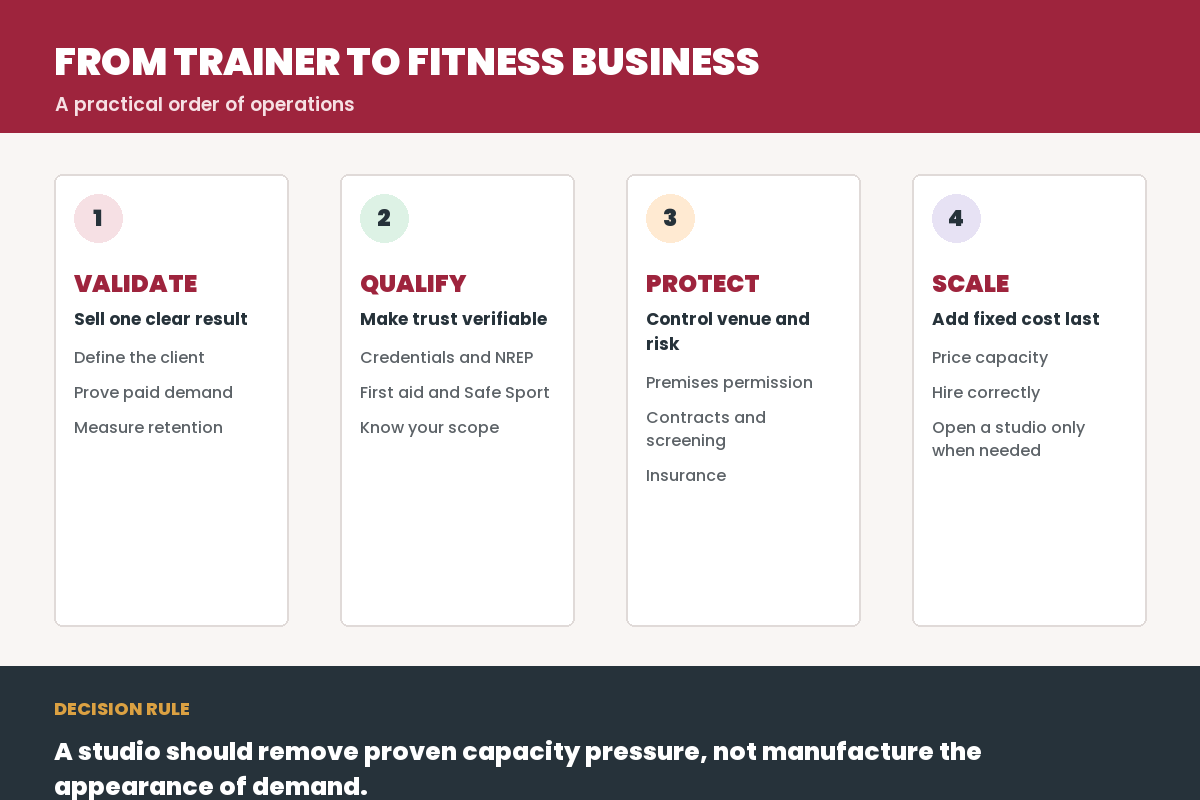
- Weeks 1-2: define one client segment and one result you are qualified to coach.
- Weeks 3-4: complete credentials, first aid, business registration, contracts and insurance.
- Month 2: sell a small paid programme using authorised rented or partner space.
- Month 3: measure retention, referrals, revenue per delivered hour and demand by time slot.
- Only then: consider equipment, a longer lease or additional trainers to remove a proven bottleneck.
The first asset of a fitness business is not a studio. It is a repeatable result delivered safely to a defined client.
Official References
- Sport Singapore: National Registry of Exercise Professionals
- URA: Considerations for fitness-centre and gym use
- CPF Board: Employer obligations
- MOM: Work injury compensation insurance
Reviewed on 25 July 2026. Requirements depend on the activity, premises and working arrangement. Confirm the current position with the relevant authority and your insurer before committing.
Frequently Asked Questions
Do personal trainers need a licence in Singapore?
There is no single blanket personal-training business licence. Trainers should hold relevant qualifications and first-aid credentials, consider NREP registration and obtain any approvals connected to their premises or activities.
Should a personal trainer rent a studio or work freelance?
Most new trainers should validate recurring demand through authorised rented, partner, outdoor or online settings before accepting a long lease. A studio makes sense when it removes a proven capacity constraint.
What insurance should a personal trainer consider?
Common covers include public liability and professional indemnity. Studio operators may also need property, equipment, business interruption and WIC insurance. Confirm the actual activities with an insurer.
Do I pay CPF when I hire trainers?
Generally yes for employees who are Singapore Citizens or Permanent Residents earning more than S$50 a month. The real working arrangement matters; labelling an employee a freelancer does not remove statutory obligations.
Explore More Content
Table of Content