
We make boring business stories sparkle.
Singapore Is Easy To Incorporate, But Hard To Actually Survive In
An opinion piece on why Singapore's clean incorporation process can mislead new founders into underestimating the real survival test.

A founder can register a company, open a spreadsheet, announce a new venture, and feel productive before the business has earned the right to exist.
That is the strange beauty and danger of Singapore. The front door is efficient. The systems are clear. The country does not make you suffer just to begin.
But that ease can create a false sense of progress. Incorporation is paperwork. Survival is economics, taste, timing, margin, customer trust, hiring discipline, and cash flow. Those are different games.
The blunt view: Singapore does not punish people for starting businesses. It punishes people who start without a real commercial edge.
Singapore Makes Starting Look Deceptively Clean
There is a reason many founders like Singapore. The operating environment is orderly compared with many markets. The legal and banking ecosystem is mature. The government systems are more navigable than what many foreign founders are used to.
That is a genuine advantage. It should not be mocked.
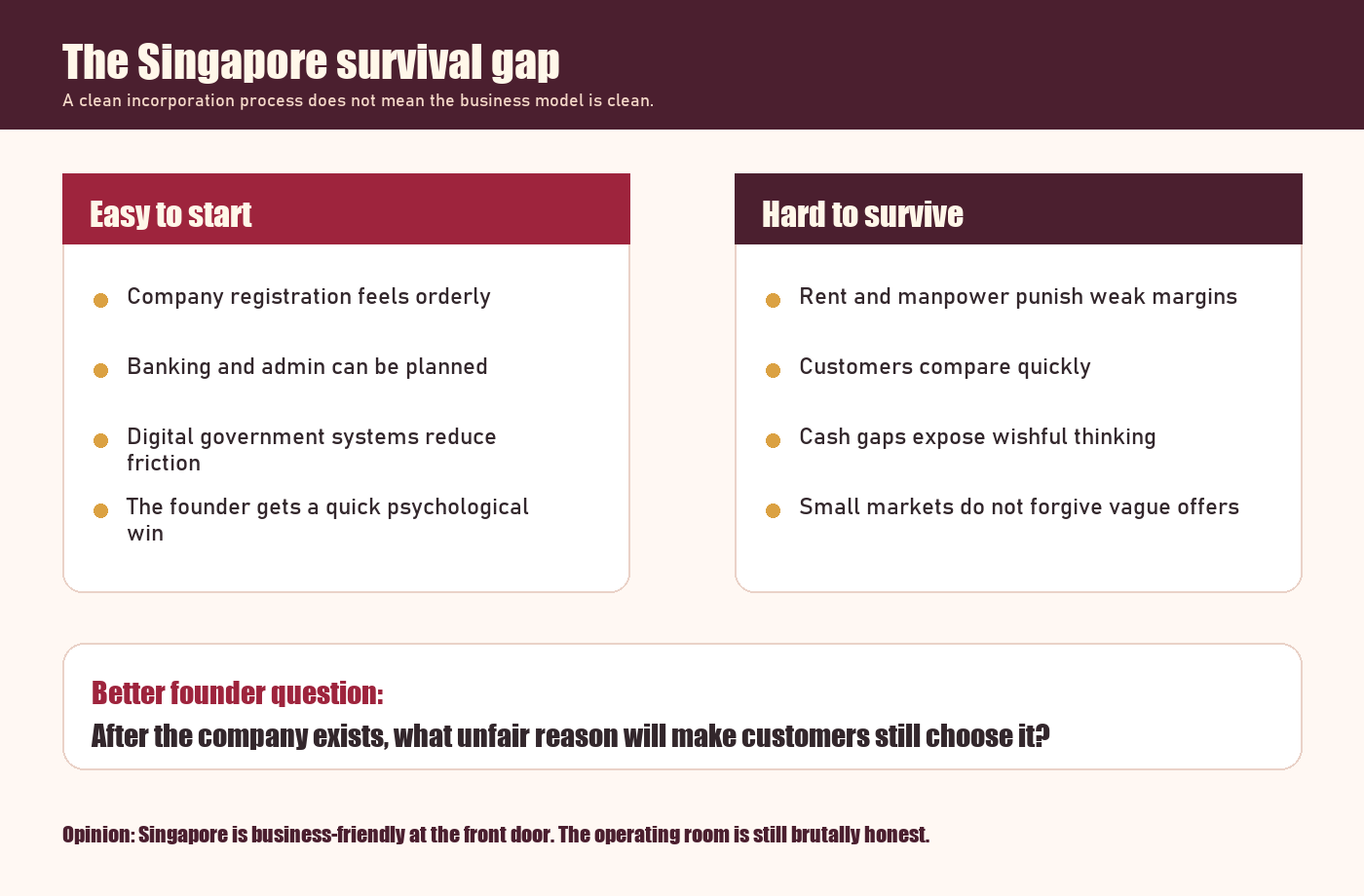
But it also creates a psychological trap. When the admin is clean, the founder may confuse administrative readiness with business readiness.
A registered company is not a strategy. A company name is not demand. A logo is not distribution. A corporate bank account is not cash flow. A website is not trust.
The Real Test Starts After ACRA
The real test begins when nobody cares that you started.
Customers do not reward you for incorporating. Landlords do not lower rent because your founder story is sincere. Staff do not become cheaper because you are new. Suppliers still want payment. Competitors still answer enquiries. Existing habits still protect incumbents.
Singapore is not hard because the paperwork is impossible. Singapore is hard because the market is small, expensive and fast to compare.
Founder milestone | Why it feels like progress | Why it may not matter yet |
|---|---|---|
Company incorporated | The business feels official. | Customers still need a reason to buy. |
Logo and website launched | The brand looks real. | Traffic, trust and conversion are still unproven. |
Office, shop or equipment secured | The founder feels committed. | Fixed costs now need reliable sales. |
First hires made | The company feels bigger. | Payroll magnifies weak margins and unclear systems. |
First marketing spend | The business is finally visible. | Attention cannot save a vague offer. |
Why Easy Incorporation Can Be Dangerous
Friction is not always bad. Some friction forces thinking.
When starting is too easy, a founder may skip the ugly questions because there is no immediate penalty. The penalty arrives later, usually after money has been spent and pride has entered the room.
These are the questions that should hurt before the company is born:
- Who exactly will pay? Not “SMEs”, not “consumers”, not “everyone”. A real buyer with a real context.
- Why now? If the customer has lived with the problem for years, what changed?
- Why you? If ten vendors can say the same thing, the business has no sharp edge.
- What must be true for the numbers to work? Sales volume, margin, rent, staff cost, repeat purchase and payment timing.
- What can go wrong in delivery? Many businesses sell a promise they cannot repeatedly fulfil.
Singapore Is Friendly To Serious Operators, Not Casual Dreamers
This is where Singapore is misunderstood.
It is business-friendly in the sense that systems are reliable. It is not business-easy in the sense that customers will subsidise weak thinking. In fact, the cleaner the market, the less room there is to hide behind chaos.
If your pricing is sloppy, your rent will expose it. If your hiring plan is vague, payroll will expose it. If your offer is generic, comparison shopping will expose it. If your cash-flow discipline is weak, payment timing will expose it.
Singapore does not need to be hostile to be unforgiving. Cost structure alone can do the job.
The Better Way To Start
The better approach is not to fear starting. It is to stop treating starting as the achievement.
Before spending heavily, a founder should build evidence:
- Talk to real potential buyers before designing the full brand.
- Sell a narrow version of the offer before building the full operation.
- Estimate fixed costs, working capital and runway before signing commitments.
- Decide what the business will refuse, not only what it will sell.
- Test whether the founder can tolerate the daily work, not only the launch excitement.
If you are still at the structural stage, read SBO’s guide on how to register a company in Singapore. If you are working out whether the numbers make sense, start with the cost to start a business in Singapore and a simple cash-flow dashboard.
What Actually Helps A New Business Survive
The boring survival factors are rarely glamorous, but they matter more than launch energy.
A sharp offer
Customers should understand what you do, who it is for, what outcome you improve, and why they should choose you instead of the lazy default.
Enough margin to absorb mistakes
Thin margins make every mistake dramatic. New businesses make mistakes. Pricing must leave oxygen.
Distribution before decoration
A beautiful brand with no path to customers is theatre. A plain offer with a working channel can be improved.
Operational discipline
The first sale is not the business. Repeated delivery is the business.
Final View
Singapore is one of the better places to start a serious business. That is exactly why weak businesses can fool themselves here.
The clean start removes excuses. After that, the market asks a colder question: does this company deserve to keep existing?
If the answer is yes, Singapore can be a strong base. If the answer is no, incorporation only made the failure more official.
Frequently Asked Questions
Is Singapore a good place to start a business?
Yes, Singapore is a strong place to start a serious business because the systems are clear and the commercial environment is reliable. But high costs and a small market mean weak offers get exposed quickly.
What is the biggest mistake new founders make in Singapore?
The common mistake is treating incorporation, branding and setup work as proof that the business is ready. The harder work is proving demand, margin, cash flow and repeatable delivery.
Should I register a company before testing my idea?
It depends on the risk, contracts and seriousness of the activity. For many early ideas, founders should first test customer demand and basic economics before taking on heavy fixed costs.
Why do small businesses fail even when setup is easy?
They fail because setup removes only administrative friction. It does not solve pricing, customer acquisition, rent, payroll, delivery quality, cash-flow timing or positioning.
Explore More Content
Table of Content