
We make boring business stories sparkle.
Singapore Makes It Too Easy to Start a Company
Singapore's efficient incorporation process is an advantage, but founders should not confuse company registration with evidence that customers want the business.

On Sunday night, a man decides he is going to start a business.
By Monday, he has reserved a name. By Tuesday, he has a company. By Wednesday, he has ordered name cards, opened social accounts and changed his LinkedIn title to Founder and Managing Director.
On Thursday, he sits at his desk waiting for the first customer.
Nobody comes.
This is one of Singapore’s great strengths and one of its quiet traps. We have made the administrative act of starting a company remarkably efficient. That is good public infrastructure. But efficient infrastructure can cause an inexperienced founder to confuse permission with proof.
ACRA can confirm that your company exists. It cannot confirm that your business should exist.
Singapore Makes Incorporation Feel Like Progress
ACRA currently lists a S$15 fee to apply for a business entity name and a S$300 fee to register a local company. Most straightforward registrations are approved soon after payment.
That speed is excellent. Founders in many countries face slower and less predictable administration. Singapore should not make incorporation deliberately painful just to teach people a lesson.
But the psychological effect is real. A formal process gives instant feedback. You submit information, pay money and receive a result. Market validation is the opposite. It is awkward, uncertain and full of rejection. So founders naturally retreat toward the task that feels official and controllable.
They refine the company name instead of the offer. They choose corporate colours instead of a customer. They debate share capital while avoiding the question that could kill the whole idea: who will pay for this?
A UEN Is Not Evidence Of Demand
Milestone | What it proves | What it does not prove |
|---|---|---|
Company registered | The legal entity exists | Customers want its offer |
Business bank account | The entity can receive money | Money will arrive |
Website launched | The business can explain itself | Buyers believe the explanation |
Social followers | People noticed some content | They will become customers |
Office opened | The founder accepted fixed cost | The cost was necessary |
Grant approved | A project met programme criteria | The underlying offer has product-market fit |
None of these milestones is useless. The problem is assigning each one a meaning it does not possess.
A queue outside a launch is not automatically durable demand. A survey saying 80% of respondents are interested is not revenue. A government registration is certainly not a customer order. SBO’s earlier article on why a queue is not the same as a market applies here: count repeated buying behaviour, not signals that make the founder feel important.
Founders Prefer Corporate Cosplay Because Selling Hurts
There is a reason incorporation, branding and administration become attractive distractions. They do not reject you.
The logo designer does not say your idea is unnecessary. The company secretary does not ask why customers already have a better alternative. The office agent does not care whether your unit economics work. Every vendor is delighted to help you feel like a business because you are already their customer.
Actual customers are less polite. They delay. They compare. They say the problem is not urgent. They ask for a lower price. Sometimes they tell you the idea is good and still refuse to pay.
That discomfort is not a detour from entrepreneurship. It is the work.
A founder who spends three weeks hearing “no” from buyers may be making more progress than one who spends three weeks producing a beautiful brand book. Rejection contains information. Corporate decoration mostly contains invoices.
What To Prove Before You Build The Full Company
You do not always need to delay registration. Some contracts, regulated activities, payment arrangements, liability concerns or partner structures require an entity early. The point is not to operate illegally or collect substantial money casually under your personal name.
The point is to run the cheapest lawful test that can answer the biggest commercial question.
Question | Weak evidence | Stronger evidence |
|---|---|---|
Is the problem real? | People agree it sounds annoying | They describe recent time or money lost |
Is it urgent? | They say they may solve it someday | They are already searching or paying for alternatives |
Does the offer work? | They praise a presentation | They complete a paid pilot |
Is the price viable? | They say the price seems fair | They pay without a friendship discount |
Can demand repeat? | One enthusiastic launch | Renewals, referrals or a second cohort |
A Better Order Of Operations
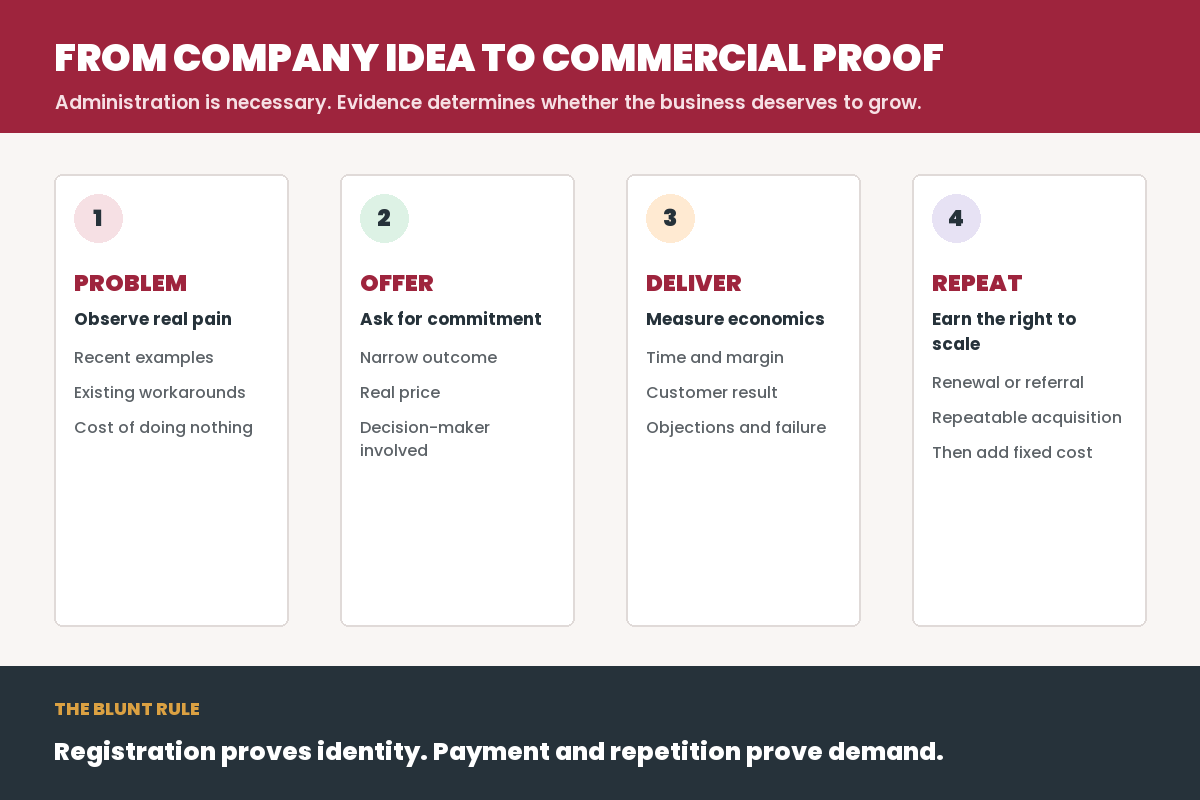
First, name a narrow customer and an expensive problem. “SMEs need marketing” is not a problem definition. “Independent tuition centres lose enquiries because nobody responds after 8pm” is at least testable.
Second, speak to people who recently experienced the problem. Do not pitch immediately. Ask what happened, what they tried, what it cost and who approved the spending.
Third, sell a small outcome. A paid diagnostic, workshop, prototype, preorder, limited service package or pilot can expose whether the need survives contact with a price.
Fourth, measure delivery. A sale that requires 40 hours of founder labour for S$300 is not automatically validation. It may only prove that you are willing to underpay yourself.
Then formalise and expand at the pace required by the actual activity. Use SBO’s practical guides to registering a company in Singapore, choosing between a sole proprietorship and Pte Ltd, and calculating the real cost of starting a business.
Do Not Use Grants As Customer Substitutes
Singapore offers useful business-support programmes. Use them carefully. Funding can accelerate an activity that already has a credible destination. It cannot force customers to care.
Even Enterprise Singapore’s current Enterprise Development Grant material refers to market viability, market validation and commercialisation planning in relevant project areas. That should tell founders something: spending money and proving a market are separate activities.
If the project makes sense only because someone else pays part of the invoice, ask whether the business or the vendor ecosystem is the real beneficiary.
The Company Should Be The Container, Not The Idea
A company is a container for contracts, people, assets, liabilities and decisions. It is not the business itself.
The business is the repeatable exchange: a customer has a problem, trusts your promise, pays enough, receives the result and has a reason to return or refer someone else.
That is why the tower-defence comparison remains useful. In SBO’s article on business being like tower defence, the first responsibility is to place the tower where demand actually moves. Registering the tower does not create the creeps.
My Opinion
Singapore should remain one of the easiest places in the world to register and operate a legitimate business. Administrative efficiency is an advantage worth protecting.
Founders, however, need to stop treating ease of incorporation as evidence of entrepreneurial readiness.
The government can give you a UEN. A designer can give you a logo. A landlord can give you an office. LinkedIn can give you a title.
Only customers can give you a business.
Sources And Further Reading
- ACRA: Registering a business
- ACRA: Registering a local company via Bizfile
- Startup SG: Market validation and analysis
Frequently Asked Questions
Is it really easy to register a company in Singapore?
For a straightforward local company, ACRA says most registrations are approved soon after payment once the required name and company information are ready. Complex or referred applications can take longer.
Should I validate an idea before registering a company?
Where lawful and practical, test the customer problem and willingness to pay before accepting major fixed costs. Some contracts, regulated activities, partnerships or liability risks may still justify registering earlier.
Does having a UEN mean a business is legitimate?
A UEN identifies a registered entity. It does not prove service quality, financial health, regulatory approval for every activity or customer demand.
What is the strongest early proof of a business idea?
A full-price purchase from a genuine target customer is useful evidence. Repeat purchases, renewals and referrals are stronger because they test the delivered value as well as the promise.
Explore More Content
Table of Content