
We make boring business stories sparkle.
You Are Not Competing With Better Businesses. You Are Competing With Different Sources Of Money
The small furniture maker found the perfect showroom. It sat on a visible corner near the customers he wanted. The...


The small furniture maker found the perfect showroom.
It sat on a visible corner near the customers he wanted. The workshop was already profitable. He knew how many tables and cabinets he would need to sell each month, so he calculated the maximum rent carefully and submitted an offer.
Another company offered far more.
The maker assumed the rival must be better at retail. Later, an agent explained that the rival did not expect the showroom to pay for itself. Its factories, distributors and regional business made money elsewhere. The Singapore address was a brand statement, a place to meet architects and proof that the company belonged in a premium market.
The maker had been bidding for a profitable shop.
The rival had been bidding for a billboard with doors.
They were not playing the same game.
You are often not competing with better businesses. You are competing with different sources of money.
The Most Dangerous Assumption In Competition
Business owners study competitors and copy what appears to work.
If a rival charges less, they cut price. If a rival opens in an expensive mall, they assume the location must be profitable. If a startup hires quickly, they assume revenue supports the payroll. If a chain survives years of losses, they assume the unit economics will eventually make sense.
All of these conclusions may be wrong because visible operations do not reveal the source or purpose of capital.
A competitor can look commercially confident while being funded by:
- profits from other outlets or countries;
- investor capital seeking growth rather than current earnings;
- a parent company that benefits from distribution or data;
- property ownership that removes market rent;
- family wealth with no formal return deadline;
- debt, grants or government-supported financing;
- another product that the visible business helps to sell.
You cannot understand a competitor’s behaviour by looking only at its storefront, headcount or advertised price.
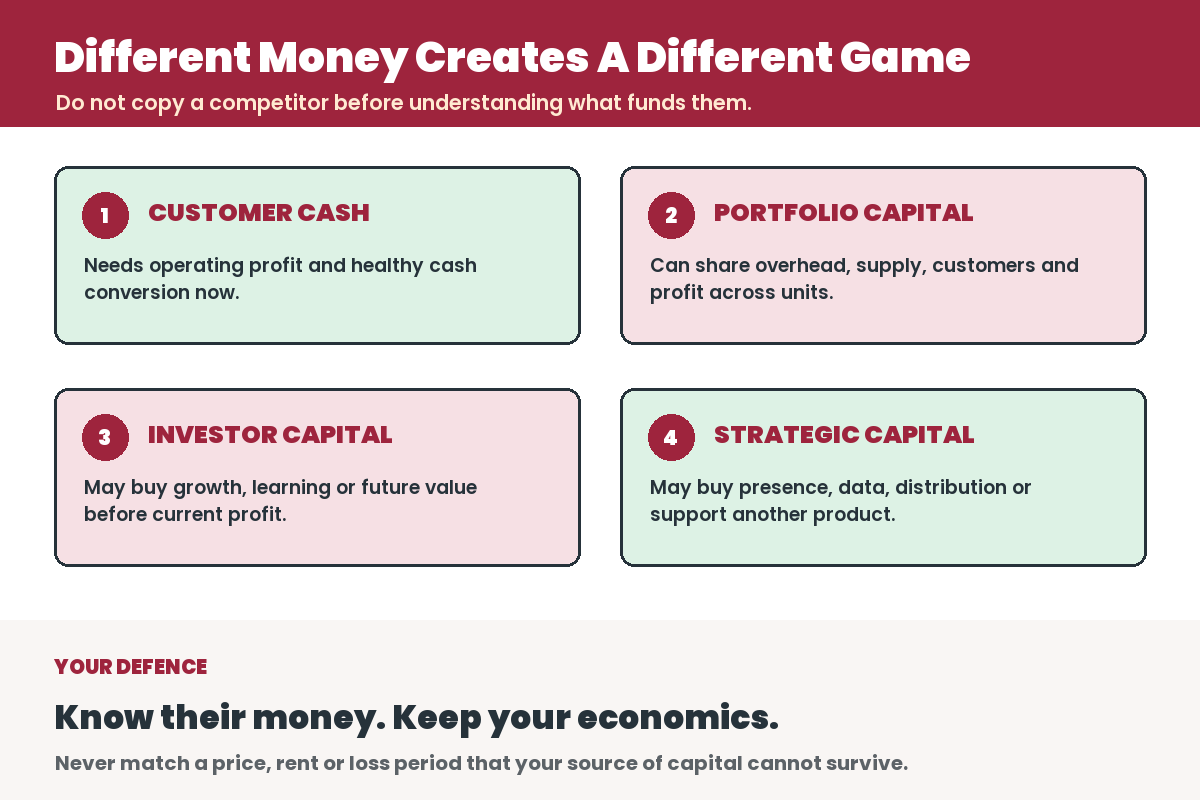
Source of money | What it may optimise for | Danger when copied |
|---|---|---|
Customer-funded owner | Cash profit and owner income | Growth may be slow but honest |
Profitable group or chain | Portfolio return and market coverage | One location can be cross-subsidised |
Investor-backed company | Growth, learning or future valuation | Losses may be planned for years |
Strategic parent | Distribution, data or another product | Visible price may be a loss leader |
Family or lifestyle capital | Interest, status or optionality | Return requirements may be informal |
Owner-occupied property | Combined operating and property value | Rent economics cannot be compared directly |
Different Money Changes Rational Behaviour
A price that looks irrational to you may be rational to the competitor.
A software company may give away a tool because the real product is enterprise implementation. A payment company may subsidise hardware to gain transaction volume. A regional retailer may tolerate a flagship loss because the address helps wholesale negotiations. A property owner may operate a mediocre business because the unit would otherwise sit vacant.
The mistake is assuming every business must earn its return in the place where you can see it.
This changes five competitive behaviours:
- Price: a loss leader can undercut an operator whose only income is the sale.
- Rent: a flagship can pay for visibility that a normal outlet cannot monetise.
- Marketing: investor capital can purchase attention before retention is proven.
- Hiring: a funded company can build capacity ahead of demand.
- Patience: a portfolio business can wait through losses that would bankrupt an independent.
None of this proves the competitor will ultimately succeed. It only means they can remain wrong for longer than you can afford to imitate them.
Singapore Makes These Capital Differences Visible
Singapore deliberately offers many routes to business capital. Enterprise Singapore’s current Enterprise Financing Scheme spans working capital, fixed assets, venture debt, trade, projects and acquisitions. Startup SG supports co-investment and investor participation, while Budget 2026 set aside additional capital for deep-tech investment.
This support is not the problem. Financing enables useful companies to invest, experiment and grow.
The lesson is that a market contains companies with radically different balance sheets, funding conditions and clocks. “Competing business” is not one financial species.
The property market adds another layer. CapitaLand Integrated Commercial Trust reported positive retail rent reversion of 6.6% for FY2025 and described introducing new F&B and lifestyle concepts to strengthen tenant mix and shopper traffic. A landlord evaluates both rent and the value a tenant brings to the asset.
Your competitor may therefore have value to the landlord that does not appear in the competitor’s outlet P&L.
This Is Not Automatically Unfair
Small-business owners understandably resent competitors who can lose money, pay higher rent or buy customers for years.
But unequal capital does not automatically mean dishonest competition.
The better-funded company may have earned its advantage through a strong core business, efficient supply chain, credible investors or patient reinvestment. A chain may genuinely operate better. A parent company may create real value by connecting products. A family-funded owner is allowed to accept a return that another owner would reject.
The correct response is not moral outrage. It is accurate diagnosis.
Ask whether you are observing:
- a real operating advantage;
- a temporary financial subsidy;
- a strategic benefit earned elsewhere;
- or simple irrationality with a large bank account.
These require different responses. Only the first should usually be copied.
How To Read A Competitor’s Money
Look At The Whole Group
How many outlets, products, countries and shareholders sit behind the visible business? Does it manufacture, franchise, own property, sell data or supply other operators? The answer reveals where economic value may be captured.
Ask What Success Means To Them
Success may mean outlet profit. It may also mean users, market share, franchise enquiries, a strategic foothold, investor narrative or higher occupancy for a property portfolio.
Watch Behaviour When Growth Stops
A customer-funded company cuts cost quickly when revenue weakens. A funded company may continue hiring or discounting. A strategic parent may tolerate the unit. Behaviour under pressure exposes the capital structure.
Separate Price From Cost
A competitor’s price tells you what it charges, not what it costs or why it charges that amount. Never use an outside price as proof that your own cost structure can support it. SBO’s guide to small-business pricing strategy helps frame that calculation.
Critical Advice For The Less-Funded Owner
1. Know Your Own Capital Truth
Write down where the money comes from, how long it can wait and what return it requires. If personal savings fund the company, pretend they are free at your own peril. They represent years of life and need a return policy.
2. Do Not Match Their Loss Period
If a competitor can lose money for thirty-six months and you can survive six, copying the price or expansion pace is not courage. It is arithmetic denial.
3. Compete Where Capital Is Clumsy
Large capital likes scalable, visible and repeatable opportunities. It can be weak at narrow niches, unusual service, founder trust, local relationships, fast decisions and customers too small to interest a chain.
Your constraint can force precision. Serve a specific buyer exceptionally well instead of buying the broadest possible market.
4. Keep Fixed Costs Reversible
Use smaller premises, shared infrastructure, contractors, second-hand equipment, pop-ups and staged hiring until demand proves the next commitment. The goal is not to look small. The goal is to preserve decisions.
5. Build A Cash-Conversion Advantage
Collect deposits, shorten receivable periods, reduce inventory, standardise delivery and remove custom work customers will not fund. A competitor may have more capital; you can still need less of it.
6. Never Confuse Survival With Validation
A competitor remaining open does not prove its model works. Capital can postpone evidence. Watch whether the company repeats expansion after full operating cycles, not whether it can afford another launch.
7. Build A Business, Not A Permanent Rescue Operation
If the owner must continually inject salary, savings and unpaid labour, the company has another hidden source of money: the owner’s life. SBO’s article on why a business should become a system rather than an owner job explains that trap.
A Decision Table Before Copying A Competitor
Question | Copy only when | Do not copy when |
|---|---|---|
Where does their money come from? | It resembles your funding reality | The source or return is unknown |
Where is profit captured? | The visible operation earns it | Another product or market benefits |
How long can losses continue? | Your runway is equally credible | Their patience exceeds your survival |
Is this operational excellence? | The process lowers real cost | Capital merely hides bad economics |
Does the tactic fit your customer? | It strengthens your chosen position | It drags you into their game |
The Final Opinion
Competition is not a clean race between equally funded businesses trying to earn profit in the same way.
One company needs this month’s customer cash. Another has profits from twenty outlets. Another is spending investor money to buy growth. Another wants a flagship. Another owns the building. Another is simply wealthy enough not to care yet.
Study them, but do not worship their visible confidence.
The lesson from SBO’s recent article on why the F&B rulebook has changed applies far beyond restaurants: never bid like a strategic showcase when you need a livelihood.
Know their money. Keep your economics. Compete in a game your capital can survive.
References
- Enterprise Singapore: Enterprise Financing Scheme
- Enterprise Singapore: Budget 2026 business support
- CapitaLand Integrated Commercial Trust FY2025 results
This opinion article was reviewed on 23 July 2026. The opening story is a fictional composite used to illustrate different capital purposes.
Frequently Asked Questions
What does competing with different sources of money mean?
Businesses can be funded by customer cash, group profits, investors, debt, family wealth, property ownership or strategic parents. Those sources create different return requirements and loss tolerance.
Should a small business copy a funded competitor’s prices?
Only after confirming that the price covers the small business’s own costs and required return. A funded competitor may be using a loss leader or accepting losses for strategic reasons.
How can a less-funded business compete?
Choose a narrow customer, keep fixed costs reversible, improve cash conversion, use founder trust and speed, and avoid markets where the main contest is who can lose money for longer.
Does more funding mean a competitor has a better business?
No. Funding can support real operating advantages, but it can also postpone evidence of weak economics. Longevity and expansion do not prove profitability without understanding the whole group.
Explore More Content
Table of Content