
We make boring business stories sparkle.
The Quiet Patriotism Of Running A Small Business In Singapore
At 7.45 on a public-holiday morning, the shutters of a small neighbourhood shop rise. The owner could have opened later....

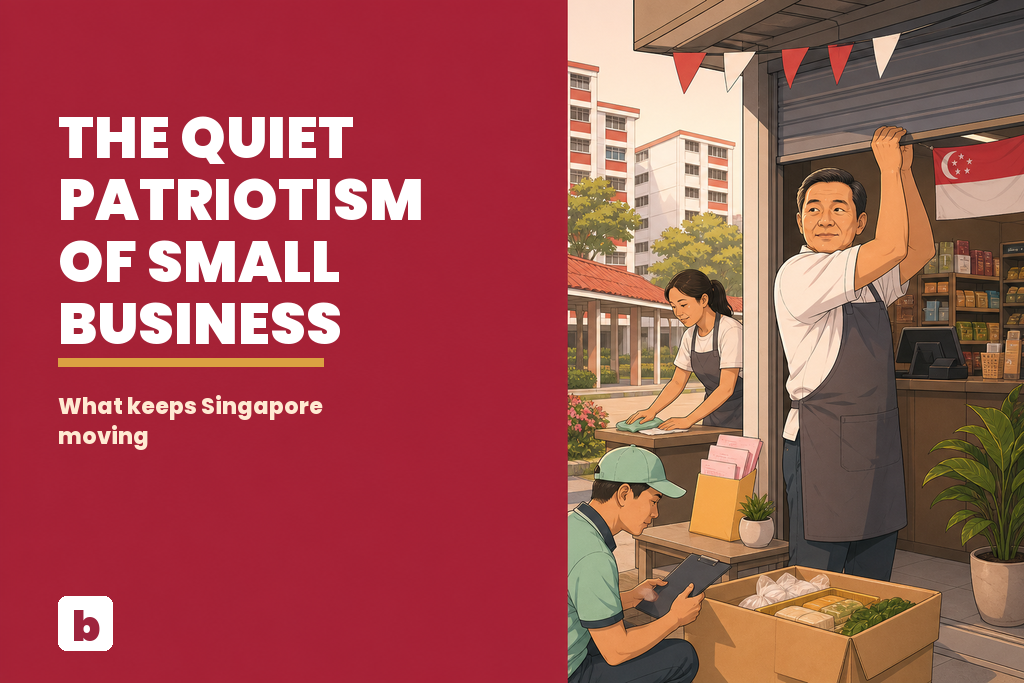
At 7.45 on a public-holiday morning, the shutters of a small neighbourhood shop rise.
The owner could have opened later. Instead, he checks the delivery, wipes yesterday’s marks from the counter and asks a young employee whether she is ready to handle the first customer alone.
There is no camera. No speech. No one calls this nation-building.
At the end of the month, the salaries will be paid. The supplier will not need to chase. A customer will receive what was promised. A teenager working part-time will learn how to speak to strangers, solve a complaint and be responsible for something beyond school.
That work is easy to overlook because it is ordinary.
But a country is held together by ordinary reliability. The quiet patriotism of running a small business in Singapore is not the flag at the storefront. It is the decision to build something useful, employ people responsibly, honour obligations and open again tomorrow.
Patriotism Does Not Need To Be Loud
National Day brings flags, fireworks and songs. They have a place. A shared ritual reminds a crowded island that it is more than a collection of private interests.
Yet patriotism becomes cheap when it demands only emotion. Loving a country must eventually appear in behaviour.
For a business owner, that behaviour is rarely dramatic. It is found in payroll, training, safety, product quality, honest invoices, fair dealing and the willingness to keep improving a company that other people depend on.
Singapore’s 2026 National Day Parade theme is “Majulah Singapura, Go Beyond!” Going beyond need not mean building the next global giant. Sometimes it means refusing to run a careless small company.
Small Businesses Are Not Small To The People Inside Them
According to the Singapore Department of Statistics’ 2026 economy infographic, Singapore had about 356,100 enterprises in 2024. Small and medium-sized enterprises represented 99% of enterprises, employed 70% of workers and contributed 47% of nominal value added.
Those percentages are impressive, but percentages can also make responsibility feel abstract.
A ten-person company may be statistically tiny. To its ten employees, it is salary, routine, confidence, family planning and perhaps the first place that trusted them with serious work. To a supplier, it may be the account that keeps a production line busy. To a neighbourhood, it may be the service that makes daily life easier.
There is nothing small about a small business to the people whose lives touch it.
Ordinary business act | Immediate effect | Wider contribution |
|---|---|---|
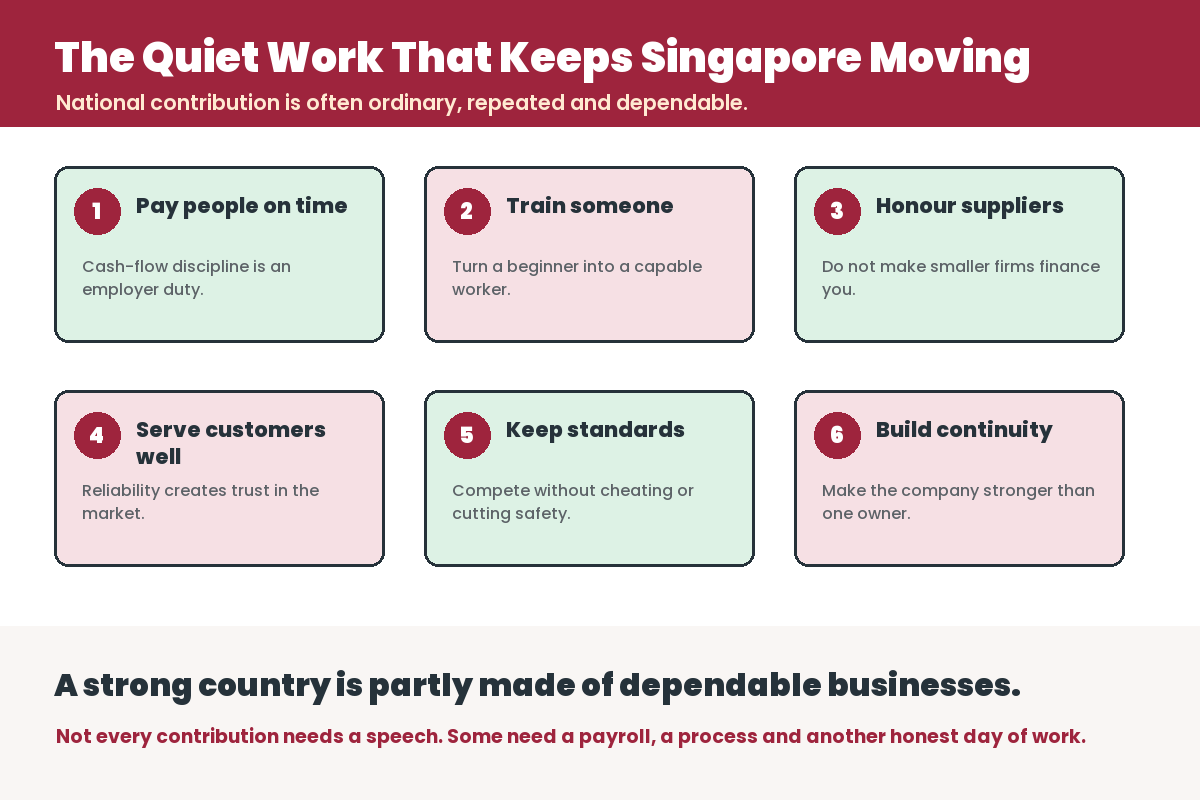
Pay salaries and CPF on time | Workers can plan their lives | Trust in employment |
Train an inexperienced hire | A person becomes more capable | Stronger human capital |
Pay suppliers as agreed | Smaller firms protect cash flow | Healthier business networks |
Deliver consistent quality | Customers waste less time and money | Higher market trust |
Build processes and successors | The company depends less on one person | More durable local capability |
Paying People Properly Is A National Contribution
A salary is not generosity. It is payment for work. Employers should not expect applause for meeting a basic obligation.
But that does not make the obligation unimportant.
Every month, thousands of small-business owners have to make payroll before paying themselves. Some carry the anxiety quietly. Some manage it badly. The responsible ones price carefully, collect receivables, maintain reserves and make difficult decisions early because employees should not discover the owner’s cash-flow problem on payday.
That discipline supports more than one company. It strengthens faith that work will be honoured.
Patriotism is not an excuse to overhire, retain roles the company cannot sustain or pretend labour cost does not matter. SBO’s earlier opinion asked whether consumers would pay more for a business that hires only Singaporeans. Customers cannot demand every social outcome while refusing every price consequence.
The owner’s duty is more practical: hire when there is real work, pay fairly for the role, comply with the law, manage performance honestly and build a company capable of keeping its promises.
Training Someone Is How Capability Spreads
Every experienced worker was once inconvenient.
They were slower. They asked basic questions. They made mistakes that an expert would not make. Someone had to explain the standard, review the work and let them try again.
Business owners complain that skilled workers are scarce, then refuse to create beginners. This is understandable in a company with thin margins and no spare management capacity. It is also a dead end.
A country cannot import every finished skill forever. Schools provide foundations. Employers convert those foundations into judgement, craft, commercial awareness and professional confidence.
Small firms often do this especially well because junior staff see the whole operation. They learn how a sale becomes delivery, how a complaint affects margin and how one careless promise creates work for five people.
The owner who teaches those lessons is building human capital, even if nobody gives the programme a grand name.
Paying Suppliers On Time Is Also Patriotism
Large organisations can damage small firms without breaking any law. They demand long payment terms, delay approval, lose invoices, add new requirements after delivery and treat a supplier’s cash flow as someone else’s problem.
Small companies sometimes repeat the same behaviour as soon as they gain bargaining power.
That is not enterprise. It is passing financial stress down the chain to whoever has less power.
A dependable business states terms clearly, disputes bills promptly and pays as agreed. It does not make a supplier finance its poor planning. This may not appear in a National Day video, but it determines whether other local businesses survive.
Standards Matter More Than Slogans
A Singapore business should not expect support merely because it is Singaporean.
Customers do not owe local firms tolerance for bad service, hidden charges, sloppy work or complacency. National loyalty is not a substitute for competitiveness. The strongest contribution a local business can make is to become genuinely worth choosing.
That means:
- answering clearly instead of making customers chase;
- pricing honestly instead of hiding unavoidable fees;
- fixing mistakes without forcing a public argument;
- keeping safety and quality standards when nobody is inspecting;
- refusing corruption, false claims and dishonest shortcuts;
- learning from better foreign and local competitors.
Supporting local businesses should never mean protecting mediocrity. It should mean giving capable firms a fair chance, then expecting them to earn trust repeatedly.
A Sustainable Company Serves Singapore Better Than An Exhausted Owner
There is a romantic image of the owner who sacrifices everything: health, family time, sleep and salary. The business survives because one person absorbs every failure.
That model is not patriotic. It is fragile.
If the company disappears when the owner falls ill, it has not yet built durable capacity. If staff cannot decide without calling the founder, it has not developed leaders. If every relationship lives in one person’s phone, national capability vanishes when that person retires.
A more useful ambition is to make the business sustainable as a system. Processes should preserve knowledge. Managers should gain judgement. Customers should trust the organisation, not only the founder. Our article on why a business must become more than the owner’s job explores this in detail.
Not Every Business Deserves To Survive
This point matters because patriotic language can become emotional blackmail.
A business is not entitled to customers, subsidies or permanent survival because it is local, old or hardworking. Some companies refuse to adapt. Some treat staff poorly. Some provide little value. Some owners want the public to preserve their income while they preserve none of the customer’s value.
Closure can be painful without being a national failure. People and capital sometimes need to move to more productive uses. A healthy economy allows entry, growth, reinvention and exit.
The quiet patriotism of business therefore includes honesty about when a model no longer works. Keeping a zombie company alive through unpaid suppliers, family loans and exhausted staff is not service to the country.
What Responsible Local Enterprise Looks Like
Area | Minimum obligation | Going beyond |
|---|---|---|
Employees | Comply, pay and provide safe work | Train, explain and create progression |
Customers | Deliver what was sold | Make the experience unusually reliable |
Suppliers | Honour contracts | Plan and communicate so partners can thrive |
Community | Avoid nuisance and harm | Become useful to the neighbourhood or industry |
Business itself | Remain solvent and compliant | Build systems, successors and lasting capability |
The Flag Is Not The Proof
Put up the flag. Celebrate National Day. Be proud of what Singapore has achieved and honest about what it still gets wrong.
Then return to the less visible work.
Pay the salary. Teach the apprentice. Fix the defect. Call the supplier before the invoice is late. Improve the process. Keep enough cash. Build a company that does not collapse around one tired person. Give customers a reason to trust a Singapore business.
No anthem will play when these things are done. They still matter.
A strong country is partly made of dependable businesses. Running one well can be a quiet form of patriotism.
Official References
- NDP 2026: Theme and logo
- Singapore Department of Statistics: Singapore economy infographic 2026
- Ministry of Trade and Industry: Spirit of Enterprise Awards 2025 speech
This opinion article was reviewed on 22 July 2026. Enterprise figures cited are for 2024, as published by the Singapore Department of Statistics in 2026.
Frequently Asked Questions
How can running a small business be patriotic?
A responsible small business contributes through useful products, reliable employment, skills development, fair supplier relationships, taxes, compliance and durable local capability. The contribution is practical rather than symbolic.
Do customers have a duty to support every local business?
No. Local ownership does not excuse weak quality, unfair pricing or poor service. Businesses should earn customer trust, while customers can choose to value the wider contribution of responsible local firms.
What is the most important responsibility of a small-business employer?
The basics come first: sustainable hiring, accurate and timely pay, lawful and safe work, honest performance management and enough financial discipline to meet obligations.
Does closing a local business mean the owner failed Singapore?
No. Some business models should change or close. An honest, orderly exit can be more responsible than prolonging an unviable company through unpaid bills, exhausted workers or repeated emergency funding.
Explore More Content
Table of Content