
We make boring business stories sparkle.
Majulah Is A Verb: Singapore Businesses Cannot Keep Waiting To Be Saved
Every few months, a struggling business owner hears about a new grant, programme, financing scheme or industry initiative. For a...

Every few months, a struggling business owner hears about a new grant, programme, financing scheme or industry initiative.
For a moment, relief replaces anxiety. Perhaps this is the answer. Perhaps the government will subsidise the software, help fund the expansion, introduce an overseas market, pay part of the consultant’s bill or soften the cost of hiring.
Then the application becomes the strategy.
The owner spends more time asking, “What can we claim?” than asking, “Why should a customer choose us?” A weak project is redesigned to fit the grant criteria. A purchase that made little commercial sense suddenly appears attractive because someone else may pay part of the bill.
This is how useful support becomes a dangerous comfort.
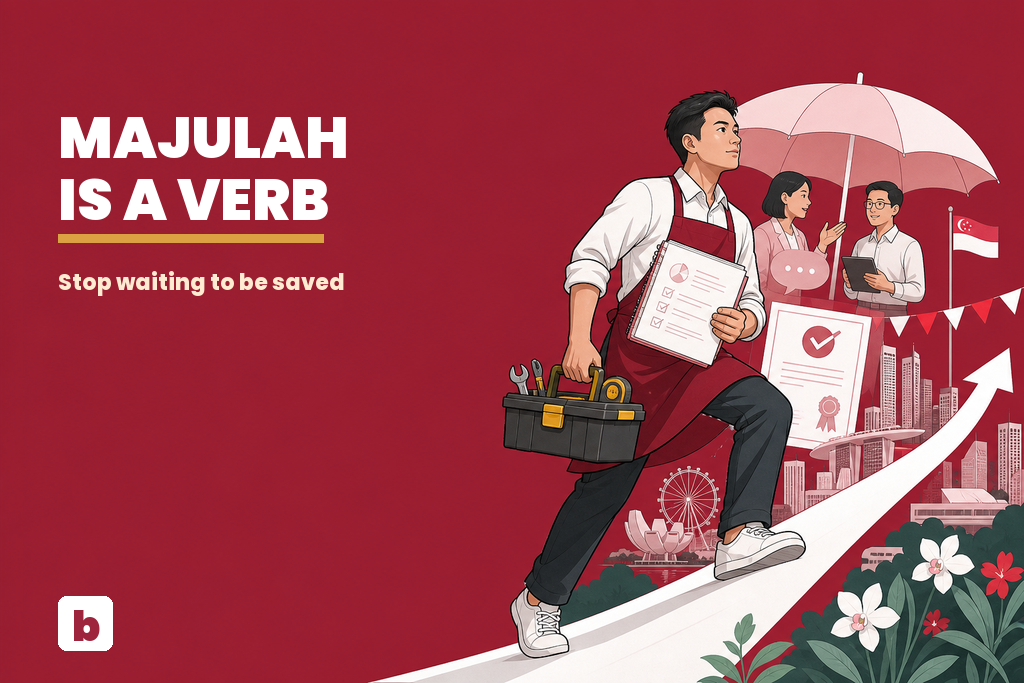
Singapore’s National Day Parade 2026 theme is “Majulah Singapura, Go Beyond!” The official explanation describes Majulah as a commitment to keep moving forward. For business owners, that word should be read as a verb.
Support can improve the odds. It cannot do the moving for you.
Singapore Does Support Business
There is no need to deny reality. Singapore has substantial business support. Enterprise Singapore’s Budget 2026 overview sets out expanded help for capability building, internationalisation, financing and enterprise growth. EnterpriseSG also reported that it supported 11,700 enterprises in 2025, including about 2,400 companies on transformative projects.
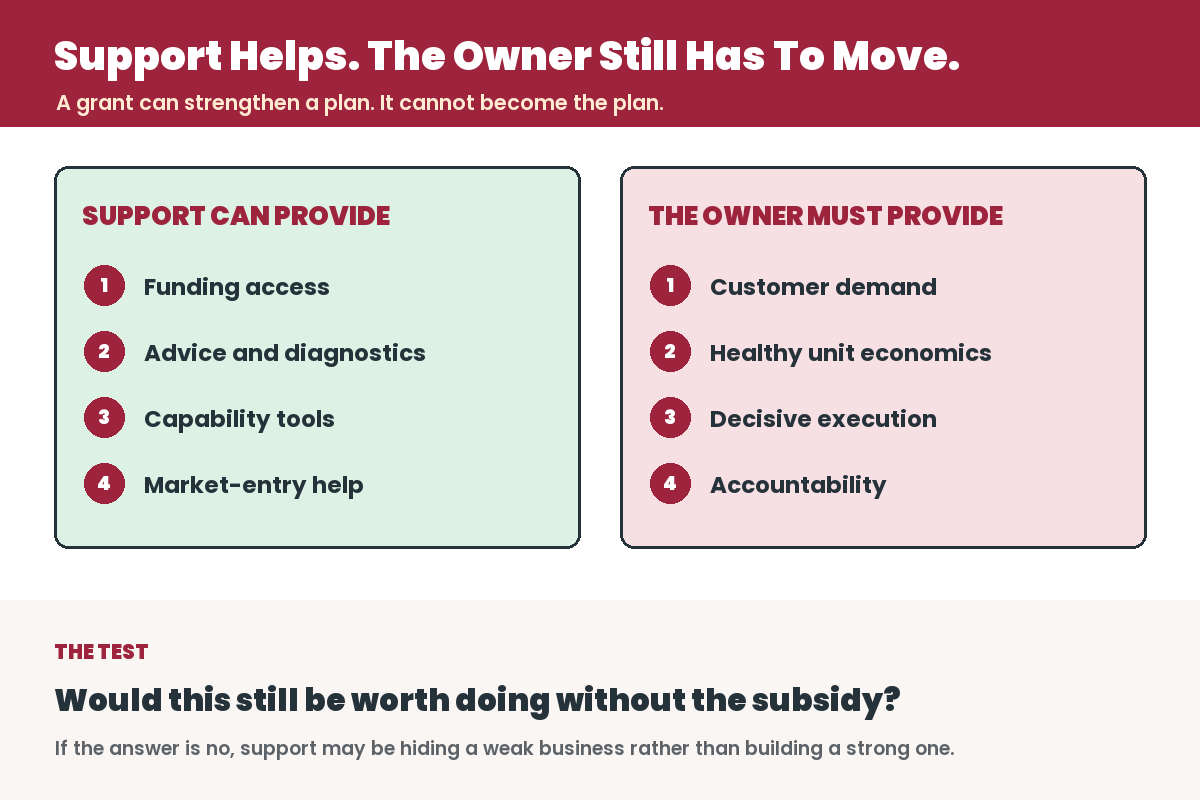
These schemes matter. A well-designed grant can help a viable company adopt technology earlier, enter a new market with less risk, improve its processes or invest during a difficult period. Advice can expose blind spots. Financing can bridge a timing gap. Public infrastructure can make an entire market more productive.
The mistake is not using support. The mistake is confusing support with a business model.
Support can help with | Support cannot guarantee | The owner’s responsibility |
|---|---|---|
Part of an eligible project cost | That the project deserves to exist | Prove the commercial case first |
Consultants, tools or capability development | That staff will use them well | Lead adoption and measure results |
Market-entry activity | That overseas customers will buy | Validate demand and localise the offer |
Access to financing | That debt can be repaid | Protect cash flow and unit economics |
Training and workforce development | That the company becomes a good employer | Build roles, management and accountability |
A Grant Is Not Customer Demand
This is the distinction many founders avoid because it is emotionally unpleasant.
A grant application can be approved while the market still rejects the product. A consultant can complete every deliverable while sales remain flat. A new system can go live while employees quietly return to spreadsheets. A trade mission can produce a stack of name cards and no durable customer relationship.
Administrative success is not commercial success.
Customers do not buy because your project qualified for support. They buy because the offer solves a problem at a price and level of trust they accept. The most polished application cannot create that exchange.
This is why the first question should not be, “Is there a grant for this?” It should be, “If there were no grant, would this still be worth doing?”
If the answer is clearly no, pause. The subsidy may be hiding a weak decision rather than strengthening a good one.
The Rescue Fantasy Is Expensive
Waiting to be saved does not always look passive. It can look extremely busy.
- Attending every briefing while avoiding customer calls.
- Rewriting plans for eligibility instead of improving the offer.
- Buying software before fixing the broken process underneath it.
- Blaming labour cost without redesigning low-value work.
- Waiting for the economy to improve while competitors learn faster.
- Expecting national branding to compensate for weak distribution.
The rescue fantasy is attractive because it transfers responsibility. If the scheme is insufficient, the market is unfair, costs are high or customers are disloyal, then the owner can remain the victim of circumstances.
Circumstances are real. Rent, wages, regulation, competition and economic cycles can crush a company. Some sectors are structurally difficult. But a business owner who gives every cause to the environment also gives every lever away.
Ownership begins when the question changes from “Who will fix this for me?” to “What can I still change?”
What Moving Forward Actually Looks Like
Majulah in business is rarely one dramatic leap. It is a series of uncomfortable, measurable decisions.
Talk To The Market Before Building More
Do not use product development to hide from rejection. Put the offer in front of real buyers. Ask for money, not compliments. Learn why people decline. The earlier article comparing business to tower defence made the same point: placing a stronger tower where there are no creeps does not create demand.
Improve The Economics, Not Just Revenue
Revenue can grow while the company becomes more fragile. Know the gross margin, acquisition cost, fulfilment burden, collection time and cash conversion cycle. If every additional sale creates more chaos than contribution, growth is not rescue.
Stop Making The Owner The Entire System
A company that depends on one person’s memory, relationships and daily intervention has a ceiling. Build repeatable delivery, clear roles and useful records. SBO’s opinion on why a business should be a system, not merely an owner job explains the difference.
Use Support As Acceleration
Once demand, economics and execution are credible, support becomes powerful. It can help the business reach an already defensible destination faster. SBO’s guides to Singapore business grants in 2026 and applying for government grants can help owners approach that process with clearer expectations.
Five Questions Before Seeking Support
Question | A strong answer sounds like | A warning sign sounds like |
|---|---|---|
What customer problem is proven? | Buyers already pay or commit | People say the idea is interesting |
What improves after the project? | A named cost, time or revenue metric | We will become more digital |
Who owns implementation? | A responsible leader with capacity | The vendor will handle everything |
Can we fund our share and delays? | Cash flow can absorb both | Reimbursement must arrive immediately |
Would we proceed without support? | Yes, perhaps at a smaller scale | No, there is no case without subsidy |
The Government Cannot Be Your Customer, Manager And Founder
Government has a legitimate role: create stable rules, invest in infrastructure, correct market failures, develop capability and help firms adapt. It should be judged on how well it performs those roles.
But no serious business ecosystem can be built on the assumption that public support will remove private responsibility.
The government cannot force customers to desire an undifferentiated offer. It cannot protect every margin, choose every manager, repair every founder relationship or decide when an owner should stop throwing good money after bad. It cannot care about your company more than you do.
That boundary is healthy. A business that survives only because someone continually shields it from market feedback may remain alive without becoming useful, productive or resilient.
The National Day Lesson For Business Owners
National Day naturally produces speeches about resilience, progress and shared purpose. Those words become empty when they are treated as personality traits Singapore simply possesses.
Progress is maintenance. Resilience is preparation. Capability is practice. Nobody receives them permanently.
The business version of Majulah is not reckless optimism. It is the discipline to look at reality without surrendering agency:
- If customers are not buying, find out why.
- If margins are weak, redesign the economics.
- If staff are stuck, improve the system and management.
- If the project is sound, use available support intelligently.
- If the model is broken, stop decorating it and make a harder decision.
Help is welcome. Partnership is valuable. Policy matters. But movement remains a verb.
No scheme can take the owner’s next step.
Official References
- NDP 2026: Theme and logo
- NDP 2026: About the parade
- Enterprise Singapore: Budget 2026 support for enterprises
- Enterprise Singapore annual media briefing 2026
This opinion article was reviewed on 22 July 2026. Scheme availability and conditions can change; check the relevant official agency before committing to a project.
Frequently Asked Questions
Should Singapore businesses use government grants?
Yes, when the project has a sound commercial case, the company can fund its share and implementation has a clear owner. A grant should accelerate a viable plan, not become the reason the plan exists.
Why is relying on grants risky?
Support is conditional, time-limited and cannot guarantee customer demand, adoption or profitability. A company may complete a funded project successfully while gaining little commercial value.
What should a business validate before applying for support?
Validate the customer problem, expected financial or operational result, implementation owner, cash-flow capacity and whether the project would still make sense without a subsidy.
What does Majulah mean for a business owner?
It means continuing to move through evidence-based action: speaking to customers, improving economics, building capability, using support intelligently and accepting responsibility for difficult decisions.
Explore More Content
Table of Content