
We make boring business stories sparkle.
Starting a Business From an HDB Flat: Rules, Schemes and Practical Steps
The first order arrives through Instagram. A neighbour buys a cake. A former colleague hires you for design work. A...

The first order arrives through Instagram.
A neighbour buys a cake. A former colleague hires you for design work. A parent asks whether you can tutor a child after school. What began at the dining table starts to look like a real business.
Then the practical questions arrive. Can an HDB flat be used as a business address? Can customers come over? Can someone be hired to work there? Does a home baker need a food licence? Must HDB approve the business?
The answer is not a simple yes or no. Singapore allows certain small businesses to start from home, but the flat must remain a home. The correct route depends on whether you are running a small resident-operated activity or using the flat as an administrative office.
This guide explains the difference between HDB’s Home-Based Business Scheme and Home Office Scheme, the separate ACRA and licensing checks, and when a growing business should move to commercial premises.
The Core Rule: Your HDB Flat Must Remain A Home
HDB permits small-scale business use because it can help residents earn income and test an idea without immediately taking on commercial rent. That flexibility has a boundary: the residential character of the flat and neighbourhood must be protected.
A home business should not create the traffic, noise, smells, storage, machinery or staffing pattern of a commercial unit. If the operation causes disamenities or outgrows residential scale, HDB can require it to stop or move elsewhere.
The first decision is therefore not “Can I register a company?” It is “Which home-business scheme describes what will actually happen inside the flat?”
Home-Based Business vs Home Office Scheme
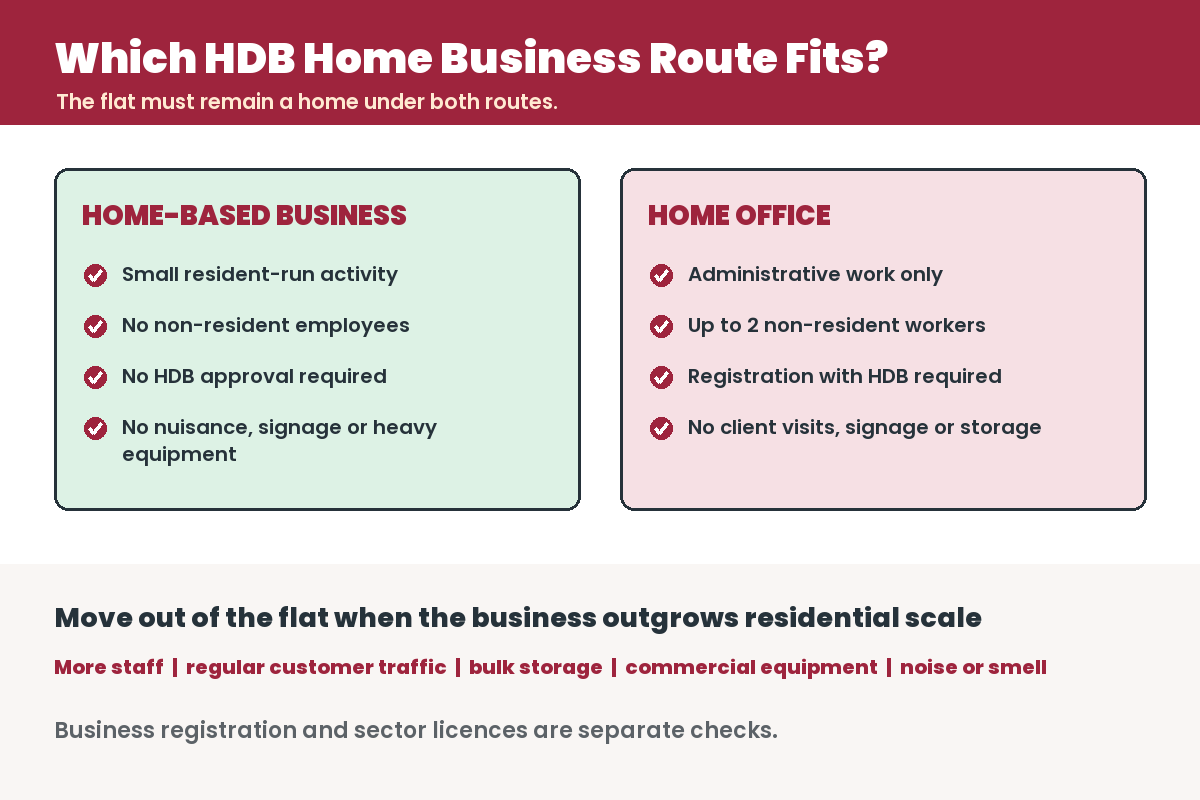
Question | Home-Based Business | Home Office |
|---|---|---|
Main purpose | Small resident-run activity from home. | Administrative office work from home. |
HDB approval | Not required if all conditions are met. | Registration under the scheme is required. |
Who works there | Owners, registered occupants or tenants with owner consent. | Resident operator plus up to two non-residents. |
Customer visits | Some listed activities involve limited customers, subject to scale and no nuisance. | Clients and customers cannot visit the flat. |
Type of work | Examples include small-scale baking, beauty services excluding massage, and tuition for up to three students at a time. | Administrative work for permitted businesses such as consultancy, design or technology services. |
Key limit | No non-resident workers, heavy equipment or large-scale storage. | No non-administrative operations, customer visits or goods storage. |
These schemes are not two names for the same permission. They solve different problems.
Route 1: The Home-Based Business Scheme
HDB says residents may carry out small-scale home-based business activities without seeking HDB approval, provided the flat remains primarily residential and the activity does not inconvenience neighbours.
The business must be operated by the flat owners, registered occupants or tenants. A tenant needs the flat owner’s consent. Third parties and non-resident employees cannot work in the flat under this scheme.
Examples HDB lists as permitted
- Small-scale food businesses such as home baking.
- Hairdressing, facial and beauty services, excluding massage.
- Manicure and pedicure services.
- Private tuition for no more than three students at a time.
- Sewing services.
- Freelance work as an artist, journalist, photographer or writer.
An example is not blanket approval for every version of that business. A home baker producing a manageable number of direct consumer orders is different from a home kitchen supplying restaurants or catering hundreds of packed meals.
Conditions that keep the activity residential
- No advertisements, signboards or posters displayed at the flat.
- No excessive customer, delivery or vehicle traffic.
- No noise, smoke, smell, litter, effluent, dust or danger affecting neighbours.
- No heavy equipment or appliances that are not intended for domestic use.
- No large-scale storage, frequent loading and unloading, bulky goods or use as a distribution centre.
- Compliance with other authorities’ rules, including food and fire-safety requirements where relevant.
HDB specifically says massage services and animal-related businesses such as keeping animals for sale, pet grooming and boarding are not allowed in HDB flats.
Route 2: The Home Office Scheme
The Home Office Scheme is for businesses conducting administrative work inside the flat. HDB lists examples such as accountancy, architecture, consultancy, design, advertising, real estate agencies, technology-based businesses and trading offices other than car trading offices.
The person conducting the business must be the flat owner, registered occupier or tenant and must continue living in the flat. The business activity must remain entirely within the unit.
The scheme permits up to two non-residents, including employees, partners and directors, to work at the home office. This is the major operational difference from the Home-Based Business Scheme.
But the work inside the flat must be administrative. Customers and clients cannot visit. Goods storage, loading and unloading are not allowed. A business that is otherwise non-permitted under the scheme may still use the flat for administrative work or as its ACRA registration address, provided the actual non-administrative activity happens elsewhere and all conditions are met.
Fire-safety requirements still apply
HDB’s Home Office Scheme guidance says a home office must have a smoke detector and a 2kg ABC Dry Chemical Powder fire extinguisher, even when no employee works there. Check the current HDB conditions when registering because safety and application requirements can change.
Do You Need To Register The Business With ACRA?
HDB permission and ACRA registration answer different questions.
ACRA’s current guidance says a person generally needs to register when carrying out an activity for profit on a regular basis, including home-based and online ventures, unless an exemption applies. ACRA specifically gives the example of a home-based business operating under a brand name.
An individual operating only under their full NRIC name may fall within an exemption, but adding other words to the business name generally triggers registration. Do not build the business around an assumed exemption without reading ACRA’s current requirements.
If registration is required, choose the structure deliberately. A simple, low-risk activity may begin as a sole proprietorship, while a business with contracts, employees, partners, significant liability or growth plans may justify a company or LLP. SBO’s guide to sole proprietorship vs Pte Ltd explains the trade-offs.
Can You Use The HDB Address For The Business?
The Home Office Scheme can support using the flat as an administrative office and business registration address, subject to HDB’s conditions. More than one business can be registered at the same flat where the businesses belong to eligible owners, occupiers or tenants, but HDB says separate Home Office applications are required for the individual businesses.
Think about privacy before using a home address. A registered business or office address may appear in searches, documents, invoices and correspondence. SBO’s guide to registered address options in Singapore explains alternatives and trade-offs.
Do You Need Other Licences?
Being allowed to operate from an HDB flat does not exempt the business from sector rules. Check GoBusiness Licensing and the responsible agency before taking orders.
Business type | Home rule | Separate check |
|---|---|---|
Home baking | Small scale may fit the Home-Based Business Scheme. | SFA food-safety rules and sales restrictions. |
Private tuition | HDB lists up to three students at a time. | Check any sector-specific registration or advertising obligations. |
Design or consultancy | May fit Home-Based Business or administrative Home Office use. | ACRA registration, contracts, tax and data protection. |
Importing products | Do not turn the flat into a warehouse or distribution centre. | Customs, product and import controls. |
Regulated professional service | A home address does not create professional eligibility. | Licence, qualification and agency approval. |
Special note for home-based food businesses
The Singapore Food Agency says home-based food businesses currently do not need an SFA food retail licence because they operate on a small scale. They are still subject to food laws and food-safety requirements.
SFA also states that home-based food businesses cannot provide catering, sell home-prepared food to SFA-licensed food establishments, supply temporary fair stalls, or sell ready-to-eat raw seafood. Ingredients must be legally sourced, and the food sold must be safe for consumption.
The absence of a licence is not the absence of responsibility. If demand grows beyond home scale, move production to suitable licensed premises.
A Step-By-Step HDB Home Business Plan
- Describe the activity: list what happens inside the flat, including preparation, storage, customer visits, deliveries and staff.
- Choose the HDB route: compare the Home-Based Business and Home Office conditions against the real operation.
- Confirm your right to use the flat: make sure you are an eligible owner, registered occupier or tenant and obtain owner consent where required.
- Check prohibited or unsuitable activities: do not force a commercial operation into a residential scheme.
- Register with HDB if using the Home Office Scheme: complete the required application and safety setup.
- Check ACRA registration: decide whether the business must be registered and choose the appropriate structure.
- Check licences and regulators: use GoBusiness and the relevant agency pages.
- Set neighbour-safe operating rules: control hours, visits, noise, odour, deliveries and common-area use.
- Separate business administration: use proper records, a business bank account where appropriate, invoices and tax tracking.
- Define the move-out trigger: decide in advance when staff, storage, production or customer traffic will require commercial premises.
Common Mistakes
- Calling any home activity a home office: production and customer-facing work are not automatically administrative work.
- Hiring someone to work in the flat under the wrong scheme: non-resident employees are not allowed under the Home-Based Business Scheme.
- Using the corridor: common areas are not free retail, display or storage space.
- Letting delivery volume grow unchecked: frequent loading and unloading can destroy the residential character of the operation.
- Assuming “no HDB approval” means no rules: every Home-Based Business condition still applies.
- Ignoring food or sector rules: home-based status does not cancel other laws.
- Waiting for complaints before adapting: a good home business designs around neighbours from day one.
When The Business Should Leave Home
Moving out is not failure. It is often proof that the business has crossed from experiment to operation.
Consider commercial premises when you need regular non-resident staff, frequent customer visits, bulk inventory, repeated courier collections, commercial equipment, production separation, stronger food controls, signage, walk-in sales or working hours that affect neighbours.
Do not wait until HDB, a regulator or a neighbour forces the decision. Price the next stage early and include rent, renovation, deposits, utilities, insurance, licences and working capital in the plan. SBO’s startup cost guide can help frame the wider budget.
The Bottom Line
An HDB flat can be a sensible place to start small. It lowers fixed cost, lets an owner test demand and can turn an existing skill into income.
But home is not a loophole. Choose the correct scheme, keep the operation genuinely residential, register the business where required, follow sector rules and plan for the day growth makes the flat unsuitable.
The best home business is not the one that stays at home forever. It is the one that starts responsibly and knows when it has earned the right to move.
Official References
- HDB: Home-Based Business Scheme
- HDB: Home Office Scheme conditions of use
- HDB: Apply and manage Home Office registration
- ACRA: Business registration requirements and eligibility
- SFA: Requirements for home-based food businesses
This guide was reviewed on 21 July 2026. HDB schemes and agency requirements can change. Check the official pages before registering, hiring, fitting out the flat or expanding operations.
Frequently Asked Questions
Can I legally start a business from an HDB flat?
Yes, certain small-scale activities can operate under HDB’s Home-Based Business Scheme, while administrative office use may fit the Home Office Scheme. The flat must remain primarily residential and all scheme conditions must be met.
Do I need HDB approval for a home-based business?
The Home-Based Business Scheme does not require HDB approval when all conditions are met. The Home Office Scheme requires registration with HDB.
Can I hire employees to work in my HDB flat?
Non-resident employees cannot work in the flat under the Home-Based Business Scheme. The Home Office Scheme allows up to two non-residents, but work in the flat must be administrative and clients cannot visit.
Does a home baker need an SFA licence?
SFA says small-scale home-based food businesses currently do not need an SFA food retail licence, but they must follow food laws and restrictions, including no catering, no ready-to-eat raw seafood and no supply to licensed food establishments or temporary fairs.
Explore More Content
Table of Content