We make boring business stories sparkle.
The Cheapest Customer Can Cost Your Business The Most
A business owner takes a job he already knows he should reject. The customer opens with: “Your competitor is cheaper.”...

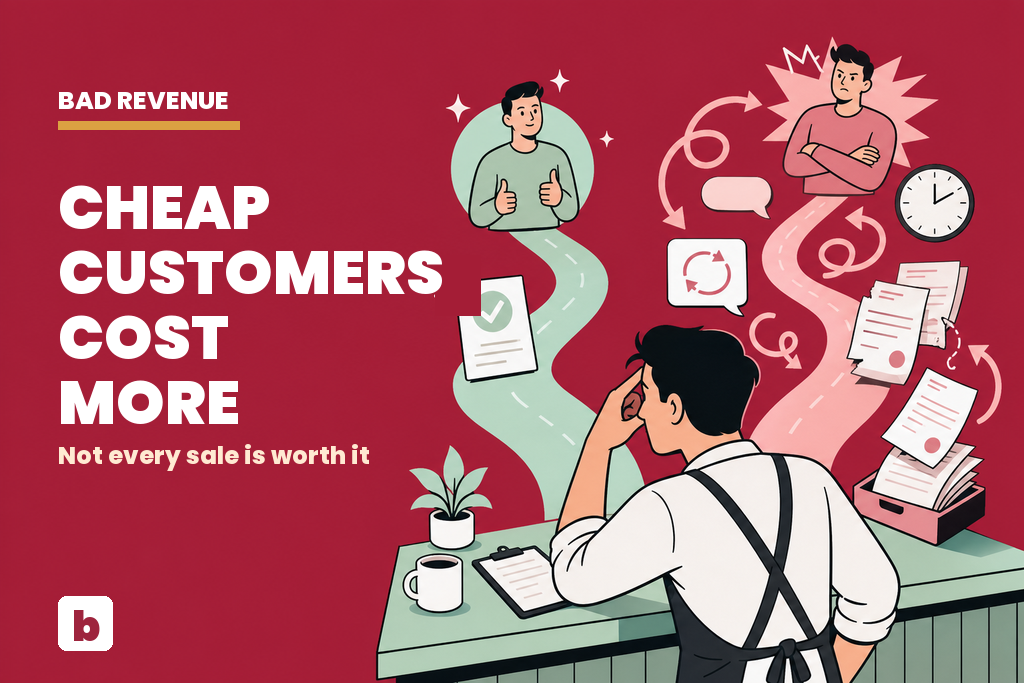
A business owner takes a job he already knows he should reject.
The customer opens with: “Your competitor is cheaper.”
Then comes the familiar dance. Can discount? Can include this also? Can faster? Can pay later? Can revise again? Can you just help a bit? Can you explain why you charge so much?
The owner says yes because revenue is revenue. The order comes in. The team gets busy. The invoice looks like progress.
Then the real bill arrives: extra WhatsApp messages, unclear scope, late payment, more revisions, staff frustration, delivery pressure, and a better customer waiting in the queue.
My opinion: the cheapest customer is often not the cheapest customer. They are the customer who makes the business pay for the privilege of serving them.
Revenue Is Not The Same As Good Revenue
Many small business owners worship sales because sales are visible. A closed deal feels like victory. A full calendar feels like momentum. A busy shop feels like proof.
But revenue is only useful after it survives cost, time, attention, morale and cash flow.
A bad customer can create revenue while damaging the business. They can keep staff occupied but destroy margin. They can make the founder feel wanted while quietly training the company to accept nonsense.
The brutal truth is that some sales are not income. They are disguised expenses.
What Makes A Customer Expensive
This is not about poor customers. It is not about shaming people who need budget options. A clear budget customer who understands the scope, pays on time and respects the business can be perfectly fine.
The expensive customer is different. They buy through distrust. They treat every boundary as a negotiation. They want premium attention at budget price. They make the business prove itself repeatedly, then still behave as if they were cheated.
Customer type | How they behave | Business impact | Owner response |
|---|---|---|---|
Good budget customer | Has a smaller budget but respects the offer. | Low margin, but predictable and manageable. | Serve with a clear package and tight scope. |
Good premium customer | Pays more because they value speed, trust or quality. | Higher margin and better delivery space. | Protect the relationship and deliver well. |
Confused customer | Does not understand what they need yet. | Can consume sales time before becoming ready. | Educate, qualify and set next steps. |
Cheap-expensive customer | Demands the lowest price and the highest attention. | Destroys margin, time, morale and focus. | Decline, narrow scope or charge properly. |
The important distinction is behaviour, not wealth. Some rich customers are terrible. Some careful-budget customers are excellent.
The business owner’s job is not to judge someone’s wallet. It is to protect the business model.
The Discount Is Only The First Loss
Most owners think the cost of a discount is the amount removed from the quote.
That is too shallow.
A discount often changes the relationship. The customer who wins a discount before understanding value learns that your first price was not serious. They may push again because pushing worked the first time.
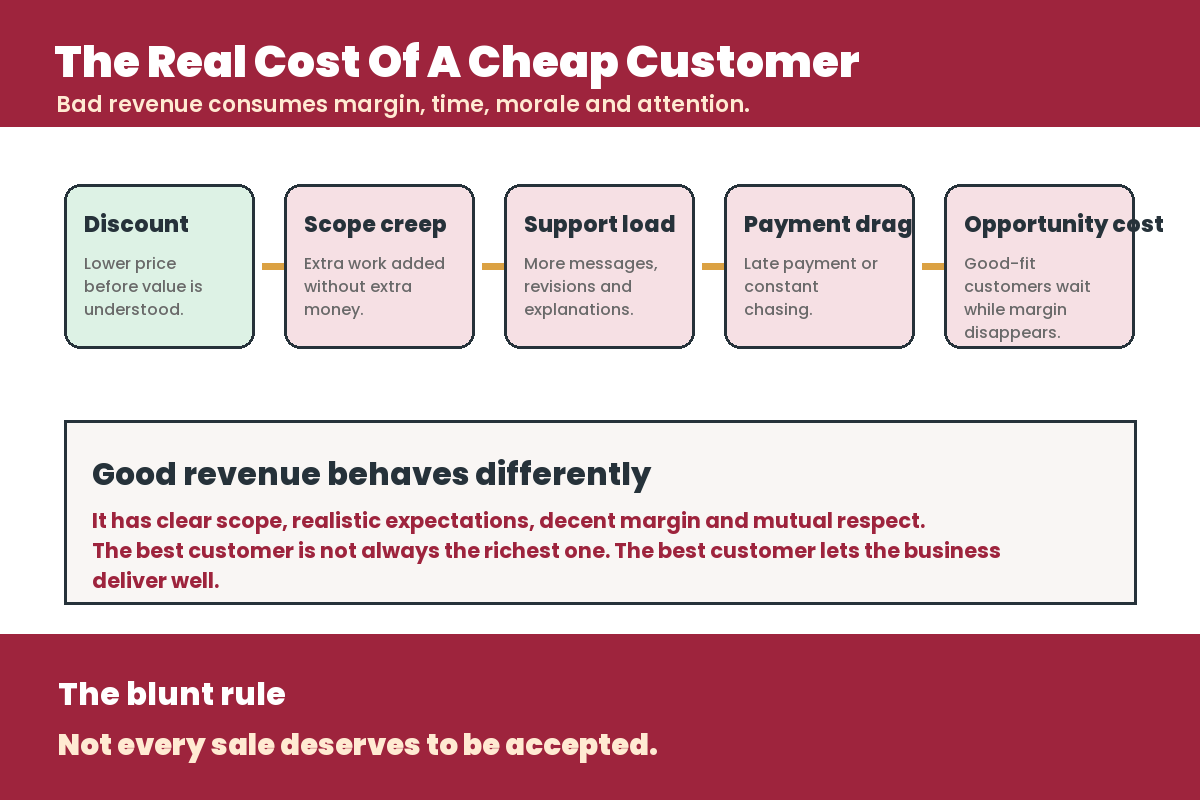
Then the second loss begins: scope creep. The third loss is admin. The fourth is payment chasing. The fifth is the owner’s mental space. The sixth is staff resentment when they are asked to deliver premium service for a customer who argued against the price from the start.
Eventually, the business is not cheaper because it is efficient. It is cheaper because the owner is absorbing pain.
Cheap Customers Train Your Business Badly
Every accepted customer teaches the business what kind of business it is.
If you keep accepting customers who need constant exceptions, your operation becomes exception-based. If you keep accepting underpriced custom work, your team loses the habit of standard delivery. If you keep rewarding pressure, your pricing becomes a confession that your own value is negotiable.
This is where cheap customers create long-term damage.
- They train sales staff to win by discounting instead of qualifying.
- They train operations to accept unclear scope.
- They train finance to tolerate late payment.
- They train the owner to confuse being needed with being profitable.
- They train good customers to wait behind bad ones.
A business does not only make money from customers. It becomes shaped by them.
Good Customers Are Not Always Easy
To be clear, the answer is not “only serve easy people”.
Good customers can be demanding. They can ask sharp questions. They can have high standards. They can negotiate. They can expect accountability. That is normal business.
The difference is whether the customer helps the business deliver a valuable outcome or constantly pulls the business away from one.
A serious customer challenges the proposal so they can make a good decision. A bad customer challenges everything because they do not want to accept the exchange: value for money, scope for price, speed for priority, service for margin.
Measure More Than Sales
If you only measure revenue, cheap-expensive customers hide inside the numbers. They look like success until you measure the work underneath.
Metric | What it reveals | Bad sign |
|---|---|---|
Gross margin by customer type | Whether revenue leaves enough room after direct cost. | Busy jobs with weak margin. |
Support messages per order | How much attention each sale consumes. | Low-value orders needing high-touch service. |
Revision or rework count | How often delivery is repeated or corrected. | Unclear scope or poor-fit expectations. |
Payment delay | Whether the customer respects the commercial agreement. | Frequent chasing after work is delivered. |
Opportunity cost | What better work was delayed or rejected. | Good customers wait while bad revenue occupies the team. |
Once you measure this, some customers stop looking small. They look heavy.
How To Say No Without Becoming Arrogant
Rejecting bad-fit customers does not mean insulting them. It means being clear about what the business does and does not sell.
Useful lines are simple:
- “This package does not include that scope, but we can quote it separately.”
- “We are not the cheapest option, so we may not be the right fit if price is the only deciding factor.”
- “To keep the timeline, we need confirmation and payment by this date.”
- “We do not offer unlimited revisions, but these are the included rounds.”
- “This job needs a custom scope. The budget you mentioned will not cover the outcome properly.”
A serious customer may respect the boundary. A cheap-expensive customer may leave. Both outcomes are useful.
Build For The Customer You Actually Want
If the business keeps attracting poor-fit customers, the problem may not be the market. It may be the offer.
Unclear pricing attracts negotiation. Vague scope attracts scope creep. Weak positioning attracts comparison shoppers. Slow follow-up attracts anxious chasing. Over-customisation attracts operational chaos.
Better customers usually require a better system: clearer packages, stronger proof, cleaner sales qualification, firmer payment terms and a delivery process that protects the team.
For practical follow-up, read SBO’s guide to pricing strategy for small businesses, the guide to productized services, and the sales guide on tracking leads through a sales pipeline. The deeper owner lesson also connects to SBO’s opinion piece on why a business should be a system, not just an owner job.
When Cheap Customers Make Sense
There are exceptions.
A low-price customer can make sense when the offer is self-serve, standardised, low-support, paid upfront and strategically useful. A budget tier can also work when it is deliberately designed with limited scope and low service cost.
The mistake is offering premium treatment through a budget door.
If the customer pays less, the business must deliver a smaller, simpler or more automated version. If the business cannot do that, the discount is not strategy. It is self-harm with an invoice number.
The Final Opinion
Business owners should stop saying “a customer is a customer”.
No. A customer is a set of economics and behaviours.
Some customers make the business sharper. Some make it weaker. Some give the team confidence. Some make everyone dread the phone. Some pay less but fit the system. Some pay more and still should be avoided.
The cheapest customer can cost the business the most because they consume the thing small businesses have least: usable attention.
Revenue is not sacred. Good revenue is.
Frequently Asked Questions
Are cheap customers always bad for business?
No. A budget customer can be good if the scope is clear, support load is low, payment is reliable and the offer is designed for that price point. The problem is low-price customers who demand high-cost service.
How do I know if a customer is too expensive to serve?
Look at margin, support messages, revisions, payment delay, complaints and opportunity cost. If a customer consumes far more time and attention than the price supports, the customer may be unprofitable even if they create revenue.
Should small businesses stop giving discounts?
Not necessarily. Discounts can work when they are deliberate, limited and tied to a clear reason. Random discounts are dangerous because they train customers to negotiate before understanding value.
How can a business attract better customers?
Use clearer positioning, tighter packages, better proof, stronger qualification questions, upfront payment terms and boundaries around scope. Better customers usually come from a better-designed offer and sales process.
Explore More Content
Table of Content