
We make boring business stories sparkle.
Customers Already Told You What Business to Build. You Just Wanted a Cooler Idea
An opinion piece on why founders often ignore obvious, boring demand while chasing cooler ideas that nobody asked for.

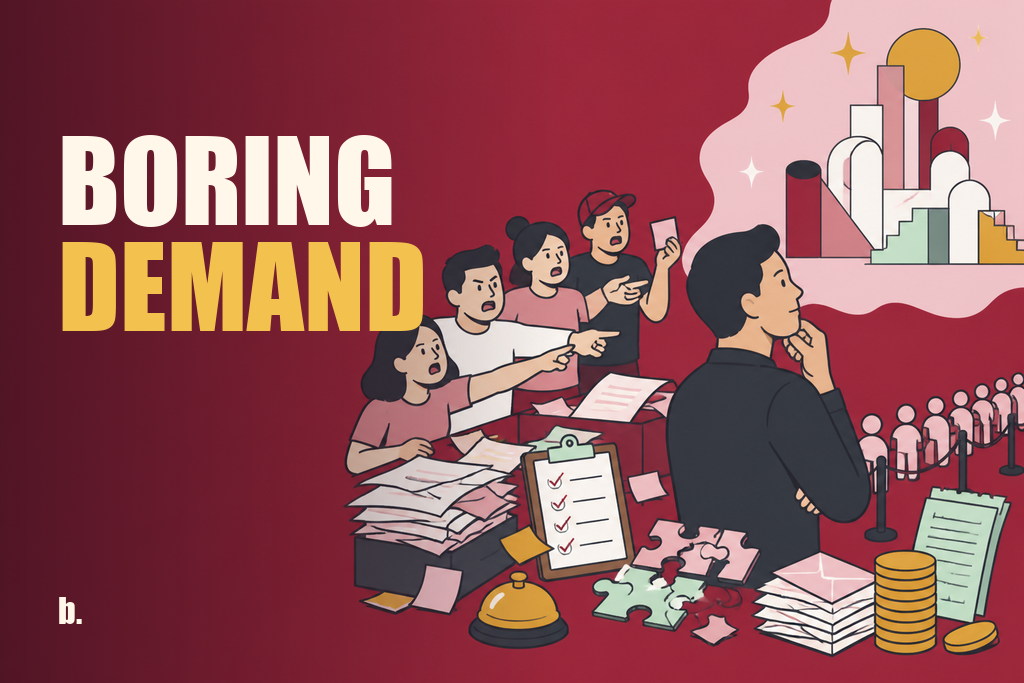
Customers already told you what business to build. You just wanted a cooler idea.
That is one of the most common founder problems I see. Not lack of intelligence. Not lack of opportunity. Not even lack of courage.
Lack of humility.
People say they are looking for a business idea, but what they really mean is that they are looking for an idea that makes them feel clever. The market keeps pointing at boring problems: delays, admin mess, unclear handovers, ugly workflows, repeated complaints, small inefficiencies, annoying coordination work. The founder looks past all of that and asks for something more exciting.
Human beings are strange. We will ignore money on the floor if picking it up does not match the identity we wanted.
The Obvious Opportunity Usually Looks Boring
Most real demand does not arrive wearing a dramatic costume.
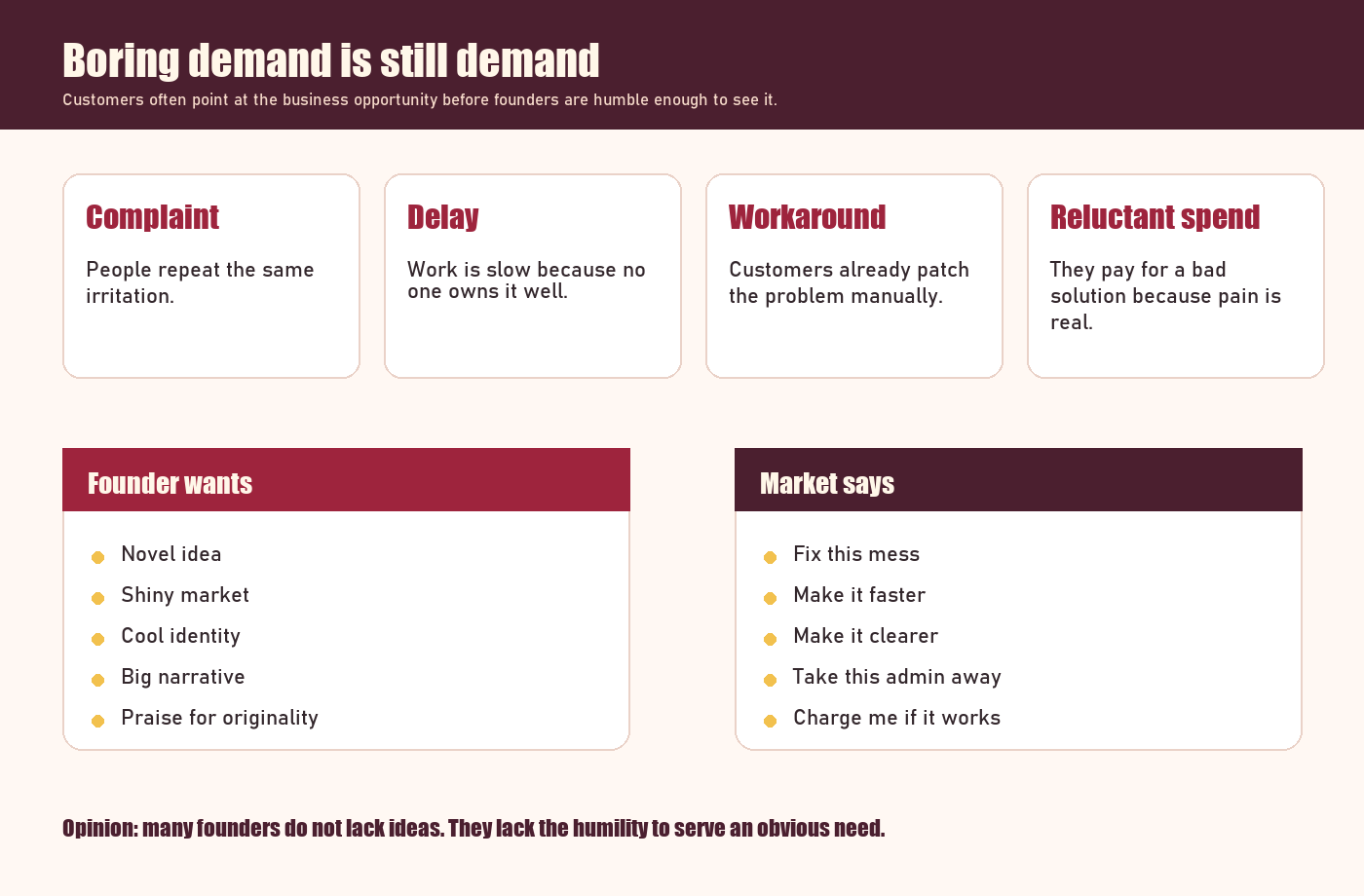
It sounds like someone complaining again. It looks like a spreadsheet nobody wants to maintain. It hides in a WhatsApp group where people keep asking the same question. It appears in a long queue, a slow reply, a messy handover, a form that nobody understands, a task everyone hates, or a service people pay for while grumbling.
That is not glamour. That is demand.
Obvious signal | What humans often think | What a business owner should see |
|---|---|---|
People complain repeatedly. | They are just difficult. | A pain point that has not been solved well. |
People use ugly workarounds. | This is too messy. | Proof that the problem matters enough to patch manually. |
People pay for a bad solution. | The market is low quality. | Demand already exists and may welcome a better operator. |
People ask the same question. | They should search properly. | A chance to package clarity. |
People hate a task but still do it. | That is boring work. | A service opportunity with real urgency. |
Founders Are Addicted to Feeling Original
Originality is overrated when it becomes an excuse to ignore customers.
A founder says, “I want something unique.” Fine. But the market does not pay you because your idea feels unique in your notebook. The market pays when a problem becomes less painful.
This is where many humans lose the plot. They want the emotional reward of being seen as innovative before they have earned the practical reward of being useful.
So they chase a cooler idea. They chase a trend. They chase a market that sounds good at networking events. They chase a startup story they can tell proudly. Meanwhile, a small ugly problem is sitting in front of them with customers already frustrated enough to pay.
The Market Is Not Hiding. Your Ego Is Filtering
People often say opportunity is hard to find. Sometimes it is. But often, opportunity is visible and the founder rejects it because it feels beneath the fantasy.
Cleaning up back-office mess is not sexy. Coordinating vendors is not sexy. Helping small companies reply faster is not sexy. Making compliance, hiring, bookkeeping, content operations, appointment booking or customer follow-up less painful is not sexy.
But businesses pay for unsexy things all the time.
The Boring Need Has Power
- It is easier to validate because people already talk about it.
- It is easier to sell because the pain is known.
- It is easier to improve because current solutions are often mediocre.
- It is easier to price because customers can compare the cost of doing nothing.
- It is easier to repeat because the problem appears in many similar businesses.
That is why boring demand is powerful. It does not need to seduce you. It just needs to exist.
Complaints Are Customer Research If You Are Not Too Proud
A complaint is not always just a complaint. Sometimes it is unpaid consulting from the market.
The important question is not “why are people so annoying?” It is “why does this annoyance keep appearing?”
Complaint pattern | Possible business opportunity | First small test |
|---|---|---|
I never know what documents are needed. | Checklist, concierge, onboarding or document-prep service. | Sell a fixed-scope prep package. |
Vendors take too long to reply. | Faster response service or managed coordination. | Offer a response-time promise to a narrow customer group. |
Everything is manual and messy. | Workflow setup, templates, automation or productised admin support. | Fix one recurring workflow for three clients. |
I do not know who to trust. | Curated provider, review, audit or advisory service. | Package a shortlist or second-opinion offer. |
I hate doing this every month. | Recurring service or subscription support. | Pre-sell one monthly retainer. |
The Cooler Idea Is Often a Disguise
Sometimes “I want a better idea” means “I want an idea where I do not have to sell yet.”
As long as the idea is abstract, it remains perfect. Nobody has rejected it. Nobody has asked for a price. Nobody has compared it to a competitor. Nobody has exposed the weak part. It can live safely in the founder’s imagination.
The boring opportunity is less comfortable because it asks for service immediately. It asks whether you can solve the thing people already complain about. It asks whether you can be useful before you get to feel brilliant.
Stop Asking for Ideas. Start Collecting Friction
If you want a business opportunity, stop starting with ideas. Start with friction.
Where do people slow down? Where do they get confused? Where do they pay reluctantly? Where do they ask the same question? Where do owners waste weekends? Where do teams create manual patches? Where do customers accept bad service because switching is hard?
That is the map.
Friction source | Question to ask | Useful business response |
|---|---|---|
Repeated delays | What handoff keeps failing? | Own the handoff as a service. |
Confusing process | What does the customer not understand? | Package clarity, templates or guided setup. |
Manual workaround | What are people doing by force? | Turn the workaround into a cleaner productised service. |
Bad incumbent | Why do customers stay despite frustration? | Offer reliability, speed or trust in a narrow lane. |
Owner bottleneck | What task steals the owner’s attention? | Remove it with a repeatable offer. |
This connects directly with SBO’s article on business as tower defence. Build where demand already moves. Do not build a beautiful tower in an empty lane because it makes you feel more creative.
The Opinion
Many founders do not need more imagination. They need less vanity.
The market has already told them what hurts. Customers already pointed at the delay, the confusion, the repeated task, the weak provider and the workaround. But the founder wanted an idea that sounded better at dinner.
That is the tragedy. Humans do not merely fail to see opportunity. They often see it, judge it as too boring, then go broke trying to impress themselves.
Serve the obvious need. Earn the right to be interesting later.
For related reading, see SBO’s pieces on why “just start” can be dangerous and how to build productised services.
Frequently Asked Questions
Why are boring business ideas often better?
Boring ideas often solve repeated, visible pain. They may be easier to validate because customers already complain, pay for workarounds or accept poor solutions.
Does a business idea need to be unique?
No. It needs to be useful, reachable and profitable. Originality helps only when it improves the customer’s outcome or makes the offer easier to choose.
How can founders spot obvious demand?
Look for repeated complaints, delays, messy workflows, reluctant spending, manual workarounds and tasks people hate but still need done.
What is the biggest mistake founders make with obvious opportunities?
They reject them because the work feels too ordinary. That is often ego, not strategy.
Explore More Content
Table of Content