We make boring business stories sparkle.
The Most Dangerous Business Advice Is ‘Just Start’
An opinion piece arguing that business owners should start with small tests and evidence, not blind motion disguised as courage.

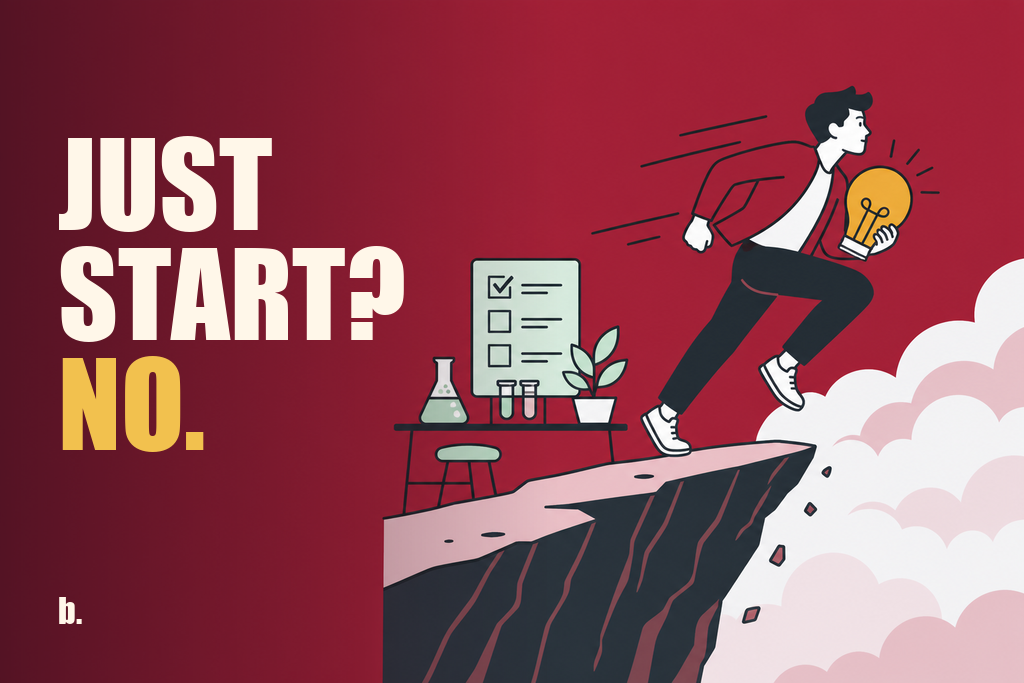
The most dangerous business advice is also one of the most popular: just start.
It sounds brave. It sounds practical. It sounds like the antidote to overthinking.
And sometimes, it is exactly what a stuck person needs to hear.
But as business advice, “just start” has become a slogan people use to avoid thinking properly. It turns action into a moral good by itself. It flatters impatience. It makes random movement feel like courage.
My view is simple: start small, yes. Start ugly, yes. Start before everything is perfect, yes. But do not start blind.
Action Is Not Automatically Wisdom
Modern business culture worships action because action photographs better than thinking.
A person can post the new logo, the new website, the first shipment, the empty office, the launch countdown and the late-night laptop photo. It looks like progress. It feels like identity.
But business is not rewarded for aesthetic effort. Business is rewarded when a real customer pays for a real outcome at a price and process that can survive.
That is a much less romantic sentence, which is probably why people prefer slogans.
Advice | Useful version | Dangerous version |
|---|---|---|
Just start | Test a small promise with real customers. | Spend money before proving demand. |
Move fast | Shorten the feedback loop. | Rush past obvious risks. |
Learn by doing | Run a controlled experiment. | Confuse consequences with lessons. |
Do not overthink | Avoid perfectionism. | Avoid basic thinking. |
Believe in yourself | Stay resilient while testing reality. | Treat doubt as betrayal. |
Humans Use Action to Escape Discomfort
This is the part people do not like.
Many people do not “just start” because they are disciplined. They start because starting lets them avoid a more painful conversation.
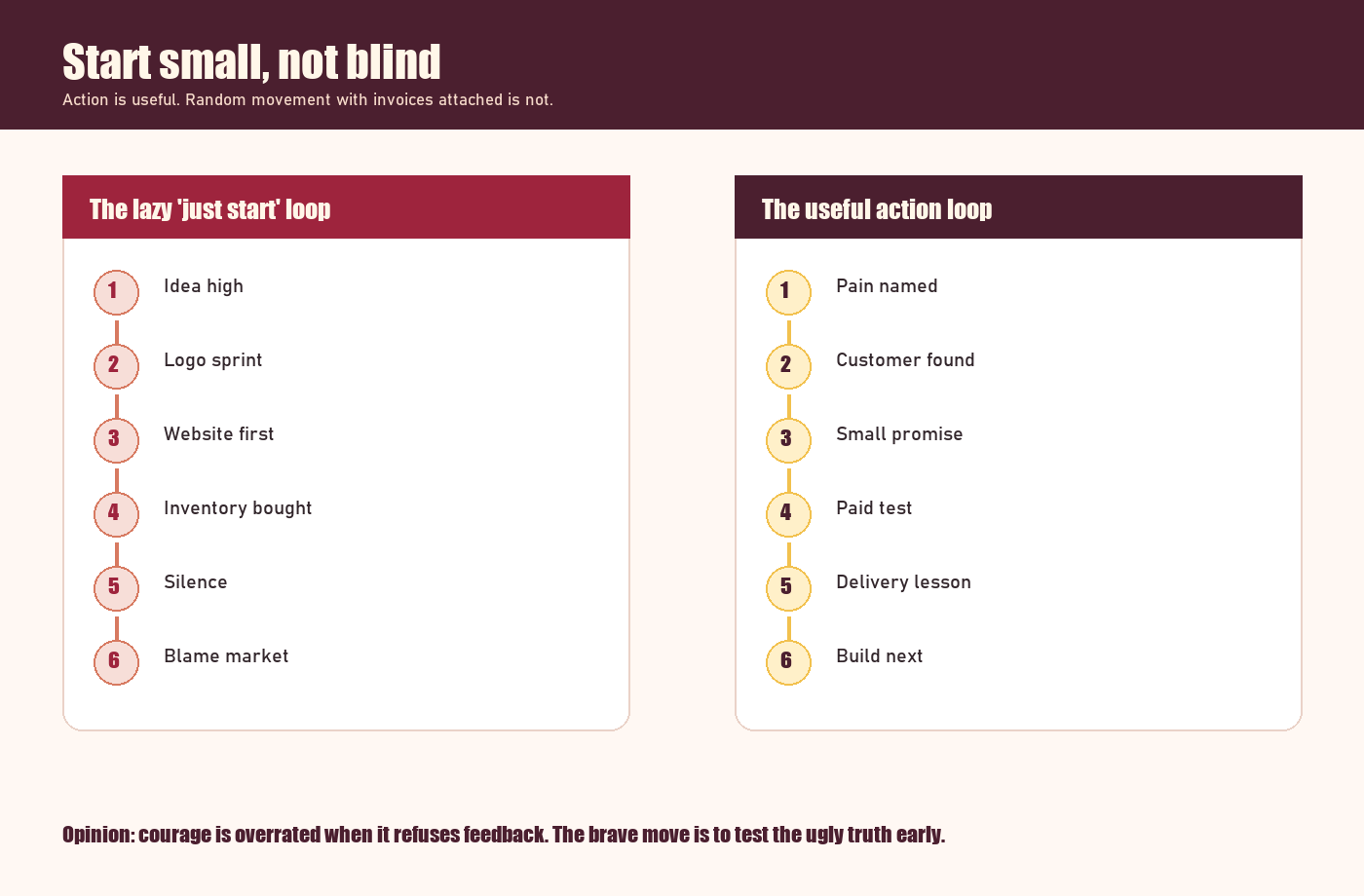
It is easier to buy inventory than ask ten strangers if they would pay. It is easier to design a logo than admit the offer is unclear. It is easier to build a website than test whether anyone wants the service. It is easier to announce a business than sit quietly with the possibility that the idea is weak.
Humans are very good at choosing the form of work that protects the ego.
That is why “just start” can be dangerous. It can become permission to do the comfortable part of entrepreneurship while pretending it is the brave part.
The Problem Is Not Starting. The Problem Is Starting the Wrong Thing
If someone has been thinking for five years and doing nothing, they probably need action. But the action should be designed to create truth.
The first move should not always be a company, lease, full website, stock order, office renovation, expensive branding package or complicated app.
The first move should usually be a test.
A Test Is Not a Vibe
A proper test has a clear question.
- Will this customer pay for this outcome?
- Can I reach this audience without burning too much cash?
- Can I deliver the result manually before automating it?
- Do customers understand the offer without a long explanation?
- Does the price make sense after fulfilment cost and time?
If your first move does not answer a business question, it may just be activity.
Founders Love Fake Progress
Fake progress is seductive because it is visible and controllable.
You can control the colour palette. You can control the name. You can control the product mockup. You can control the launch post. You can control the motivational story you tell yourself.
You cannot control whether customers care.
So people spend weeks on the controllable things and call it preparation. The market remains unbothered.
Fake progress | Why it feels good | Better first test |
|---|---|---|
Perfect logo | It makes the business feel real. | Ask five target customers to explain what the offer means. |
Full website | It creates a launch asset. | Use one landing page and measure enquiries. |
Large inventory order | It feels like commitment. | Pre-sell, take deposits or test a small batch. |
Complex app build | It feels scalable. | Deliver the service manually to prove the workflow. |
Office or studio setup | It gives identity and status. | Sell enough work to justify the fixed cost. |
Perfectionism and Recklessness Are Cousins
People think perfectionism and recklessness are opposites. I think they are often cousins.
The perfectionist avoids reality by endlessly preparing. The reckless founder avoids reality by charging forward without a test. Both are avoiding the same thing: feedback that might hurt.
One hides behind planning. The other hides behind motion.
The serious founder does something harder. They create a small, uncomfortable encounter with the market.
Start Small Means Start With Evidence
Starting small is not about being timid. It is about being honest.
Before you make the business bigger, make the truth bigger.
Stage | Good question | Small action |
|---|---|---|
Problem | Who has this pain now? | Interview real target customers, not supportive friends. |
Offer | Can they understand the promise quickly? | Send a one-page offer and ask them to explain it back. |
Payment | Will someone commit money? | Ask for a deposit, pilot fee or paid trial. |
Delivery | Can you fulfil without chaos? | Serve a small batch manually and document the work. |
Repeatability | Can this become a system? | Turn repeated tasks into templates, SOPs or a productised service. |
The last point matters. A business becomes stronger when repeated work becomes a system. SBO’s guide to productized services explains that idea in a practical way.
Motivation Content Has Made People Allergic to Thinking
A lot of online business advice treats thinking as weakness.
Ask questions, and you are scared. Study the market, and you are procrastinating. Consider downside, and you have a poor mindset. Want evidence, and you do not believe enough.
This is childish.
Thinking is not the enemy of action. Thinking is what makes action less wasteful. The real enemy is endless thinking with no test, but the cure for that is not blind confidence. The cure is disciplined experiment.
The Better Advice
The better advice is not “just start”.
It is this: start with the smallest action that can embarrass your assumption.
If you think customers want it, ask for money. If you think the message is clear, show it to strangers. If you think delivery is simple, fulfil it manually. If you think the channel works, try getting ten qualified leads. If you think you can charge premium, say the price out loud and watch what happens.
That kind of action is not glamorous. It is better than glamorous. It is useful.
It also connects to SBO’s tower defence view of business: build where demand actually moves. Do not build a beautiful tower in an empty lane and call it bravery.
The Opinion
“Just start” is not wrong because action is bad. It is wrong because it is incomplete.
Some people need less fear and more movement. Fine. But many people need less performance and more honesty. They need fewer launch rituals and more customer truth. They need less identity-building and more evidence.
So yes, start.
But start by testing the thing you are most tempted to assume.
If you are deciding whether entrepreneurship is worth the trade-offs, SBO’s piece on whether starting a business in Singapore is worth it is a useful follow-up. If you are still choosing the business direction, read what business makes sense in Singapore.
Frequently Asked Questions
Is ‘just start’ always bad advice?
No. It can help someone who is stuck in endless preparation. The problem is when ‘just start’ becomes an excuse to skip basic validation.
What should a founder do before launching?
A founder should identify the customer, problem, offer, channel and smallest paid test. The goal is not to know everything, but to avoid starting completely blind.
What is the difference between action and random movement?
Useful action answers a business question. Random movement creates activity without proving demand, pricing, delivery or repeatability.
How small should the first business test be?
Small enough to run quickly and cheaply, but real enough to involve target customers, honest feedback and ideally some form of payment or commitment.
Explore More Content
Table of Content