
We make boring business stories sparkle.
Do GEO Monitoring Tools and Agencies Actually Make Sense?
A skeptical business-owner guide to GEO monitoring tools and agencies: what to measure, what to ignore, and how to avoid fake AI ranking claims.

A business owner sees a screenshot: ChatGPT recommended a competitor. A new agency says, “We can track and improve your AI visibility.” A dashboard shows brand mention rate, citation rate, share of AI answer and a list of prompts.
The owner has a reasonable question: is this the next serious marketing channel, or just a new way to sell SEO reports with AI paint?
GEO monitoring tools and agencies can make sense, but only if you treat them as instruments for learning and evidence-building. The moment someone sells you an exact “ChatGPT ranking”, you should become suspicious.
The Short Answer
GEO monitoring tools make sense when they help you answer four practical questions:
- Does AI mention my brand for the questions my buyers ask?
- Does AI cite my website or credible sources about my business?
- Does AI describe my business correctly?
- Which competitors appear more often, and what public evidence supports them?
GEO agencies make sense when they improve the underlying evidence: your website, content, reviews, listings, PR, expert pages, case studies and technical crawlability.
They do not make sense when they sell mystery, guaranteed AI rankings or dashboards with no action behind them.
Why GEO Monitoring Is Harder Than SEO Rank Tracking
Google SEO has messy personalisation too, but the basic object is familiar: a search result page. You can track a keyword, location, device and rank position.
AI answers are different. A user asks a question. The model may answer from general knowledge, run search, cite sources, remember conversation context, interpret location, or rephrase the query. Small prompt changes can produce different answers.
This is why I dislike the phrase “rank in ChatGPT”. It borrows the confidence of SEO while ignoring the mechanics of AI answers.
OpenAI’s ChatGPT Search can answer with links to web sources, and OpenAI documents crawler controls for publishers. The GEO research literature also studies how generative engines choose and present sources. But none of that creates a single fixed leaderboard that every user sees.
When GEO Monitoring Tools Are Useful
A GEO tool is useful when it turns a fuzzy question into a repeatable observation.
Usefulness | Tool output | Why it matters |
|---|---|---|
Useful | Trend tracking across the same prompt set | Shows whether visibility is improving or declining over time. |
Useful | Competitor comparison | Shows which competitors AI systems repeatedly mention and why. |
Useful | Citation gap analysis | Shows whether AI cites your site, competitors, directories, reviews, media or weak sources. |
Useful | Answer accuracy checks | Finds wrong descriptions before they become repeated customer beliefs. |
Misleading | A single screenshot of one AI answer | That is an anecdote, not a monitoring system. |
Misleading | Universal ChatGPT rank | There is no stable public ranking page comparable to Google results. |
In other words, a good tool should help you see patterns. It should not pretend that one answer is destiny.
The Metrics That Matter
Most GEO dashboards are built around a few core metrics. The metric names sound precise, but the interpretation must stay humble.
Metric | What it measures | How to use it |
|---|---|---|
Brand mention rate | How often the brand appears in tracked AI answers. | Directional visibility, not a universal ranking. |
Citation rate | How often the brand’s site or a source about it is cited. | Useful because it reveals which evidence AI exposes. |
Answer accuracy | Whether AI describes the business correctly. | Critical. A wrong mention can damage positioning. |
Competitor share | How often competitors appear for the same prompts. | Good for finding content and reputation gaps. |
Source quality | Whether cited pages are credible and current. | A citation from a weak source may not help trust. |
Answer accuracy is underrated. Everyone wants to be mentioned. But being mentioned wrongly is not a win. If AI says you serve enterprise customers when you actually serve SMEs, your positioning is being distorted.
Why Every User May See A Different Output
AI outputs can vary because the system is not simply returning a fixed ranked list. The answer may be affected by:
- The exact wording of the prompt.
- The user’s previous conversation context.
- The model and version used.
- Whether web search or browsing is enabled.
- The user’s location and language.
- Which sources are available and considered fresh enough.
- How the tool expands or rewrites the query behind the scenes.
That does not make monitoring useless. It means monitoring must be designed like sampling, not like a scoreboard.
A serious GEO report should say, “Across this defined prompt set, model mix and location, your brand appeared in 18% of answers and was cited in 6%.” It should not say, “You are ranked number three in AI.”
How To Judge A GEO Monitoring Tool
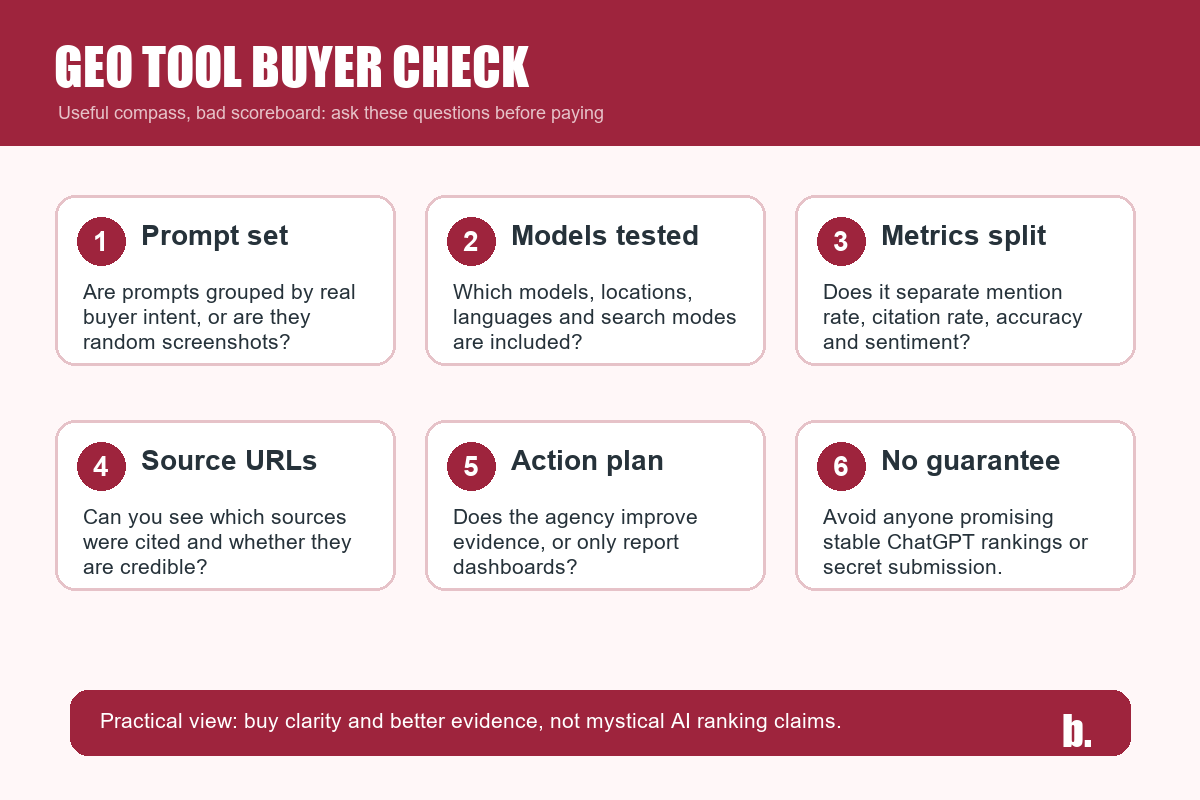
Before paying for a GEO tool, ask these questions:
- Can I control or inspect the prompt set?
- Are prompts grouped by buyer intent?
- Which models are tested?
- Does the tool distinguish model-only answers from search-enabled answers?
- Does it track country, city or language?
- Does it show the exact answer text and source URLs?
- Does it separate brand mention rate from citation rate?
- Can it track competitors consistently over time?
- Does it identify inaccurate or outdated descriptions?
- Does it recommend concrete content, PR, directory or technical fixes?
If the tool cannot explain its methodology, the dashboard is decoration.
When A GEO Agency Makes Sense
A GEO agency makes sense when your category is researched before purchase. This includes B2B services, professional services, software, finance, education, healthcare, agencies and higher-value local services.
The agency’s job should not be “make AI say nice things”. The job should be to improve the public evidence that AI systems can find, understand and cite.
Type | What they say or do | Editorial read |
|---|---|---|
Good agency | Explains prompt set, model mix, location, search mode and limitations. | They understand that AI output varies. |
Good agency | Improves website content, entity clarity, reviews, digital PR and technical SEO. | They build evidence, not just reports. |
Good agency | Separates mentions, citations, sentiment and accuracy. | They do not hide weak data inside one vanity score. |
Bad agency | Guarantees ChatGPT rankings. | They are selling certainty that does not exist. |
Bad agency | Claims secret LLM submission. | Usually a shortcut story, not a real strategy. |
Bad agency | Only sends pretty dashboards. | Reporting without evidence-building is theatre. |
The best GEO agency will look suspiciously like a good SEO, content and digital PR team that understands AI retrieval. That is not a bad thing. It means the work is real.
The Work A Real GEO Agency Should Do
Entity clarity
They should make your business easy to classify: name, location, industry, services, customer segment, credentials, proof and differentiators.
Useful content
They should create pages that answer buyer questions better than your competitors. Comparison pages, pricing explainers, service guides, FAQs and case studies are useful here.
External evidence
They should strengthen reviews, directories, partner mentions, media coverage, expert profiles and industry references. If nobody else on the web confirms your claims, AI has less to work with.
Technical access
They should check crawlability, structured data, internal links, indexability and whether important content is hidden behind scripts, forms or poor architecture.
Measurement
They should track brand mentions, citations, answer accuracy and competitor visibility across a consistent prompt set over time.
Red Flags That Should Make You Walk Away
- They guarantee a specific ChatGPT rank.
- They say they can submit your site directly into every LLM.
- They cannot explain how prompts are selected.
- They show only one-off screenshots as proof.
- They do not ask about your positioning, customers or competitors.
- They do not improve your website or external evidence.
- They talk only about AI and ignore SEO basics.
- They cannot distinguish a mention from a citation.
Blunt view: if an agency cannot explain uncertainty, they are not advanced. They are hiding the hard part.
What To Do Before Hiring Anyone
Before buying a tool or hiring an agency, do a simple manual test.
- Write 20 questions real buyers might ask before choosing a provider.
- Ask those questions in two or three AI tools.
- Record which brands appear.
- Record whether sources are cited.
- Record whether your business is described correctly.
- Compare which pages or third-party sources competitors seem to benefit from.
This rough audit will not be perfect, but it will make you a better buyer. You will know whether a tool or agency is showing you something meaningful or just dressing up obvious gaps.
The Honest Take
GEO monitoring is worth doing. But the industry will attract people who want easy money from confusion. That always happens when a new acronym appears.
The good version of GEO is useful: it forces businesses to become clearer, better cited, better reviewed and more helpful. The bad version is just fake precision.
Buy the tool if it helps you learn. Hire the agency if it improves your evidence. Ignore anyone selling certainty in a system that is built to generate different answers for different contexts.
For the broader foundation, read our guide to GEO vs SEO and AI visibility.
Sources And Further Reading
- OpenAI: Introducing ChatGPT Search
- OpenAI platform docs: bots and crawler controls
- Generative Engine Optimization research paper
Frequently Asked Questions
Do GEO monitoring tools work?
They can work as directional tracking tools if they use consistent prompts, show citations and explain their methodology. They should not be treated like exact ranking trackers.
What should a GEO tool measure?
At minimum, it should separate brand mention rate, citation rate, answer accuracy, competitor share, source URLs and trend over time.
Can a GEO agency guarantee ChatGPT rankings?
No serious agency should guarantee stable ChatGPT rankings because AI answers vary by prompt, model, location, browsing mode and available sources.
Is GEO just SEO with AI reporting?
No. SEO remains foundational, but GEO also cares about brand/entity clarity, public evidence, third-party mentions, citations and whether AI can explain your business correctly.
When should a small business pay for GEO help?
Pay when customers research your category before buying and you need structured help improving content, source quality, reviews, citations and AI answer accuracy.
Explore More Content
Table of Content