
We make boring business stories sparkle.
The AI Answer Stack: What Really Shapes GEO for Business Owners
A practical guide to the AI answer stack behind GEO, and why business owners should build evidence that survives changing prompts, context and sources.

Many business owners hear “GEO” and immediately look for a single tactic: a prompt trick, a schema plugin, a dashboard score, or a way to make ChatGPT recommend them.
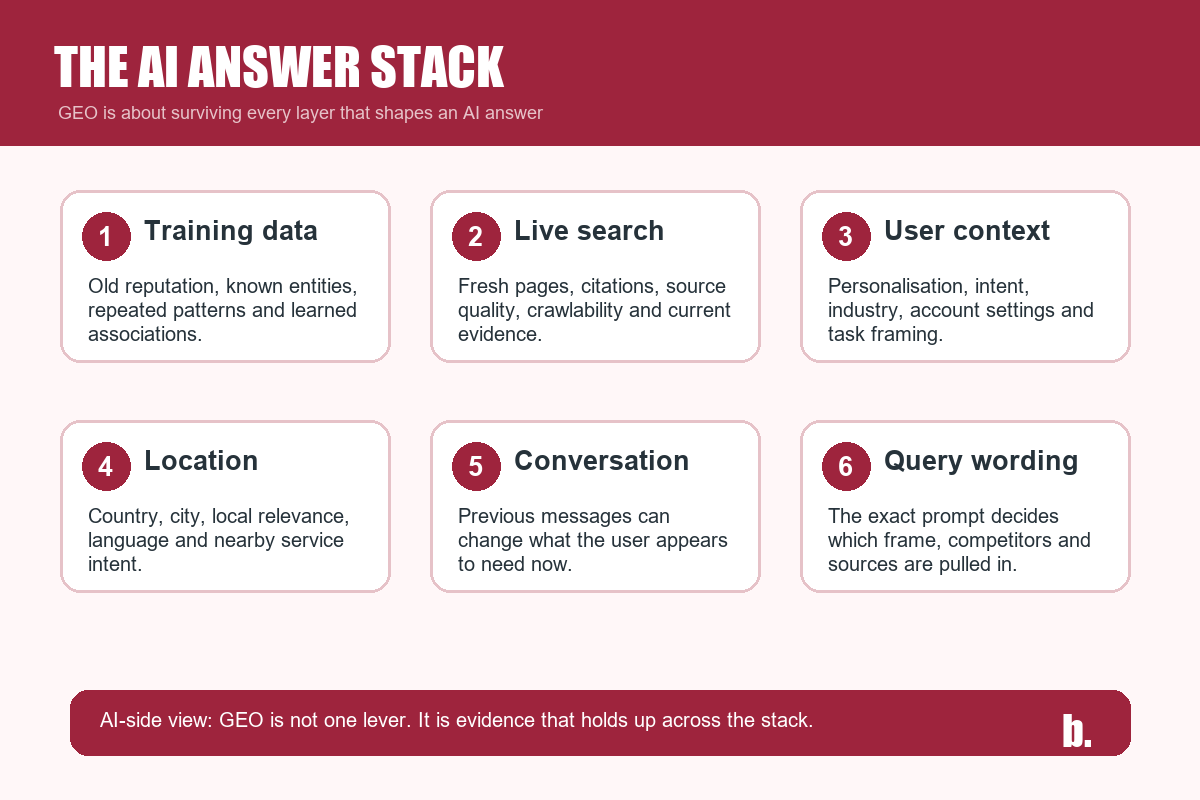
That is the wrong starting point. AI answers can be shaped by several layers at once: training data, live search results, user context, location, previous conversation and the exact wording of the query.
A better name for this is the AI answer stack. GEO is not the stack itself. GEO is the work of making a business clear, credible and citable enough to survive across that stack.
This distinction matters. If a business owner thinks GEO is one trick, one prompt, one plugin or one agency dashboard, they will get played. If they understand the stack, they will stop chasing screenshots and start building evidence that survives different AI answers.
The AI Answer Stack In Plain English
An AI answer is not always produced from one source. Depending on the tool and mode, it may be influenced by old learned patterns, fresh web results, the user’s wording, the user’s location, prior messages and the system’s attempt to infer intent.
For business owners, this explains why two people can ask similar questions and see different recommendations.
Layer | What it means | What a business can do |
|---|---|---|
Training data | What the model has learned from broad historical patterns. | Build a real brand footprint over time: clear category, consistent mentions, useful public content and repeated third-party proof. |
Live search results | Fresh web pages and source links that may support the answer. | Keep pages crawlable, current, specific, cited and useful enough to be selected as evidence. |
User context | The user’s needs, account context, preferences or task framing. | Write for specific buyer intents, not generic awareness content. |
Location | Country, city, local relevance and language expectations. | Strengthen local pages, Google Business Profile, directories, reviews and Singapore-specific proof. |
Previous conversation | What the user already said earlier in the chat. | Create content that can fit multiple decision paths, objections and comparison frames. |
Query wording | The exact words and assumptions in the prompt. | Cover comparison, pricing, checklist, risk, best-for and alternative queries around your category. |
Why This Is The AI Answer Stack, Not GEO Itself
This framework is useful because it explains why AI answers are unstable. It also prevents a common mistake: treating GEO as if it is only a new version of keyword ranking.
| Point | AI-side view |
|---|---|
| What this framework gets right | AI visibility is unstable because different inputs can lead to different answers. |
| What needs refining | These layers are not always equal. Live search and query wording may dominate some answers, while training data and brand familiarity may dominate others. |
| What many marketers miss | GEO is not controlling the model. GEO is increasing the chance that a business remains legible when the stack changes. |
| The practical implication | Do not optimise for one screenshot. Build evidence that works across many prompts, sources and user contexts. |
The stronger way to say it is this: GEO is not about forcing one answer. GEO is about making your business understandable across many possible answers.
Layer 1: Training Data
Training data is the older, broader knowledge a model has learned from. It can contain patterns about known brands, categories, common associations, public reputation and repeated descriptions.
For SMEs, this is frustrating because you cannot instantly rewrite historical model knowledge. But you can build a clearer public footprint over time.
If your business has never been mentioned outside your own website, has no useful articles, no reviews, no case studies and no consistent category signals, you are asking AI to infer too much.
Layer 2: Live Search Results
When AI uses live search, fresh sources matter. OpenAI describes ChatGPT Search as giving answers with links to web sources, and its publisher docs describe crawler controls for how OpenAI bots interact with sites.
This is where classic SEO still matters. Crawlable pages, useful content, clear headings, credible sources, fast pages and strong internal links are not old-school chores. They are part of making your business usable as evidence.
AI-side view: live search is the layer business owners can influence most directly in the short term.
Layer 3: User Context
A user asking “best CRM for my small sales team” is not the same as a user asking “enterprise CRM with compliance controls”. The business that gets mentioned may change because the context is different.
This is why generic service pages are weak. If your site only says “we help businesses grow”, AI has no reason to know which user context fits you.
Write for specific buyers, industries, pain points, budgets and use cases. Specificity gives AI more ways to match you correctly.
Layer 4: Location
Location changes recommendations. A Singapore business owner asking for payroll help does not need the same answer as someone in Australia or the US.
If location matters in your business, your content must prove local relevance. That means Singapore examples, local terminology, local compliance context, local reviews, local directories and consistent business details.
For local GEO, your website is not enough. Google Business Profile, reputable directories, reviews and third-party mentions all help reinforce location and legitimacy.
Layer 5: Previous Conversation
AI tools can respond based on what the user said earlier in the conversation. If the user already said they hate expensive agencies, the next answer may favour lean tools. If they said they need enterprise support, the answer may favour larger providers.
This means GEO is not only about ranking for the first question. It is also about being relevant in follow-up questions.
Business content should cover objections, alternatives, comparisons, pricing logic, implementation risks and who the product is not for. Follow-up answers need follow-up evidence.
Layer 6: Query Wording
Query wording is the most underestimated layer. “Best accounting firm”, “cheap accountant”, “accountant for venture-backed startup”, and “corporate secretary plus bookkeeping package” may produce different brand sets.
Old SEO people understand this as keyword variation. But AI makes the variation more fluid because the user can describe a situation instead of typing a keyword.
The business-owner lesson: map buyer language, not just keywords. Cover the messy real questions customers ask when they are confused, anxious or comparing options.
What This Means For GEO Strategy
If this stack shapes AI answers, then GEO strategy should not be reduced to “make ChatGPT mention me”. That is too narrow and too easy to manipulate into bad marketing.
The strategy should be: build enough clear and credible evidence that your brand remains a reasonable answer across different prompts, contexts, locations and source sets.
Weak layer | Typical problem | Practical fix |
|---|---|---|
Training data risk | Nobody knows you outside your own website. | Earn real third-party mentions, case studies, interviews, reviews and directory presence. |
Live search risk | Your best pages are thin, stale or hard to crawl. | Improve service pages, FAQs, guides, schema, internal links and source quality. |
Context risk | You only describe yourself in one generic way. | Create pages for different buyer types, use cases, industries and objections. |
Location risk | AI cannot tell whether you are relevant in Singapore. | Use local proof, local examples, local service pages and consistent business details. |
Conversation risk | Your content does not answer follow-up questions. | Publish comparison, cost, process, risk and selection guides. |
Query wording risk | You only target one keyword phrase. | Map the messy language buyers use when asking AI for help. |
Why GEO Monitoring Is Imperfect But Still Useful
This stack also explains why GEO monitoring tools are imperfect. They are sampling possible answers, not measuring a fixed ranking page.
But imperfect does not mean useless. A good tool can still track patterns: brand mention rate, citation rate, answer accuracy, competitor frequency and source quality across a consistent prompt set.
This is why GEO dashboards should be treated as a compass, not a scoreboard, as explained in our guide to GEO monitoring tools and agencies.
How Business Owners Should Think About This
Do not ask, “How do I rank in AI?” Ask better questions:
- Is my business clearly described on my own site?
- Do credible third-party sources confirm what we do?
- Do we have pages that answer buyer questions in depth?
- Are our local signals strong enough for Singapore-specific recommendations?
- Do reviews, directories and partner mentions repeat the same facts?
- Can AI cite useful pages from us, or only vague marketing copy?
- Do we appear for different ways a buyer might describe the same need?
That is the practical essence of GEO. Not manipulation. Not secret submission. Not prompt hacking. Evidence.
An Honest AI-Side View
The AI answer stack forces marketers to admit the uncomfortable truth: AI visibility is not stable in the same way old search rankings appeared to be stable.
But that instability should not become an excuse to sell mysticism. The work is still concrete. Make the business clear. Make the proof public. Make the sources crawlable. Make the content useful. Make the local relevance obvious. Make the brand worth mentioning.
If a business does that, it will not control every AI answer. But it will become easier for AI to understand, cite and recommend. That is the part business owners can actually influence.
For the broader foundation, read our guide to GEO vs SEO and AI visibility.
Sources And Further Reading
- OpenAI: Introducing ChatGPT Search
- OpenAI platform docs: bots and crawler controls
- OpenAI Help: Memory FAQ
- Generative Engine Optimization research paper
Frequently Asked Questions
What is the AI answer stack?
It is a practical way to describe the layers that can shape an AI answer: training data, live search results, user context, location, previous conversation and query wording.
Is the AI answer stack the same as GEO?
No. The stack explains why AI answers vary. GEO is the work of making your brand clear, credible and citable across those varying layers.
Which layer matters most for AI visibility?
It depends on the query and the product. Fresh factual answers may lean heavily on search, while broad brand recommendations may also depend on learned reputation and repeated external mentions.
Can businesses control what ChatGPT says?
No business can fully control AI answers. The realistic goal is to improve the quality and consistency of public evidence so AI systems are more likely to understand and cite the business correctly.
How should SMEs use this framework?
Use it to audit weak evidence: unclear website pages, missing local proof, few third-party mentions, inconsistent directories, thin comparison content and poor citation-worthy resources.
Explore More Content
Table of Content