
We make boring business stories sparkle.
Employment Pass vs Local Hiring in Singapore: What Foreign Founders Should Choose
A practical hiring decision guide for foreign founders choosing between Singapore local employees, Employment Pass holders, S Pass staff and offshore support.


A foreign founder starts hiring for a new Singapore company. The first candidate is a Singaporean sales lead who knows local customers. The second is a former colleague overseas who can run product. The third is a mid-skilled technical hire who may need an S Pass.
On paper, all three solve a staffing problem. In practice, each one creates a different cost, compliance and continuity profile.
This guide helps foreign founders decide when to hire local employees in Singapore, when an Employment Pass makes sense, when S Pass or Work Permit routes may fit, and when offshore hiring is the better answer.
The Short Answer
Do not choose by salary alone. Choose by role risk.
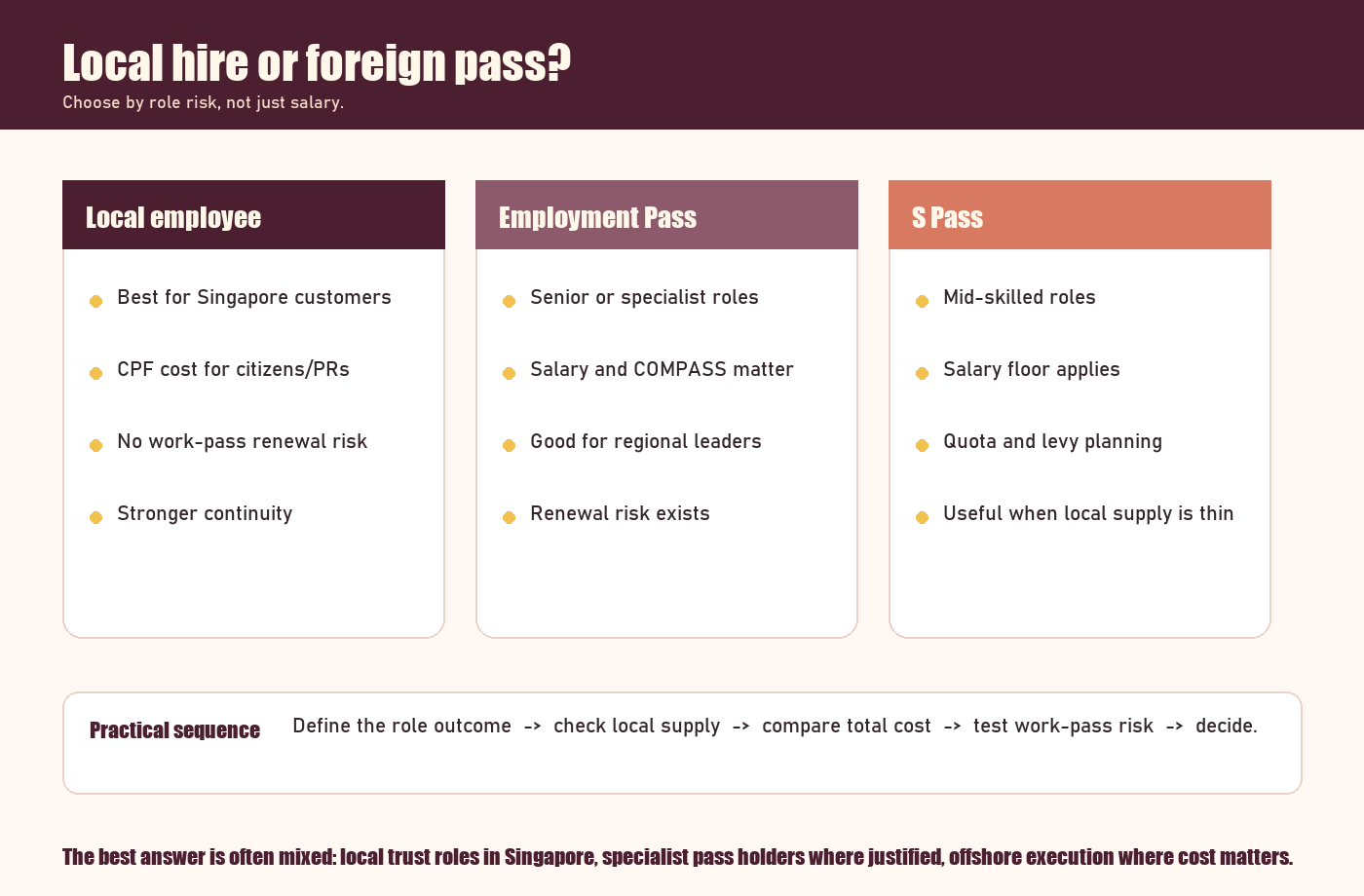
Hire locally when the role needs Singapore customer trust, local operating knowledge, continuity, government or banking interaction, and long-term team-building. Use Employment Pass hiring when the candidate brings senior expertise or specialist capability that is hard to find locally. Use S Pass or Work Permit hiring only after checking quota, levy, sector and salary rules. Offshore work that does not need Singapore presence can often sit in a lower-cost market.
Hiring route | Best fit | Main cost or rule | Founder risk |
|---|---|---|---|
Singapore Citizen or PR employee | Local sales, operations, finance, HR, customer success, management. | Salary plus employer CPF for eligible employees, benefits and leave. | Usually lower immigration risk, but salary expectations can be high. |
Employment Pass | Senior managers, specialists, regional leaders and hard-to-find professional roles. | MOM salary and COMPASS requirements; current EP floor starts at S$5,600, or S$6,200 for financial services, and rises with age. | Application or renewal may fail if the profile, salary or company case is weak. |
S Pass | Mid-skilled technical or associate-professional roles where local supply is limited. | Current floor starts at S$3,300 for new applications from 1 September 2025; quota and levy planning apply. | Quota pressure and policy changes can affect workforce planning. |
Work Permit | Sector-specific operational roles in approved sectors. | Sector, source country, medical insurance, security bond, quota and levy rules may apply. | Not suitable for professional or managerial hiring. |
Offshore employee or contractor | Execution work that does not require Singapore presence. | Local-market pay, vendor fees, management overhead and data/security controls. | Quality, communication and control can suffer if processes are weak. |
What Local Hiring Gives You
Local hiring is not only a compliance-friendly option. It is often a commercial advantage.
A strong Singaporean or PR employee may understand local customers, business norms, payroll practices, CPF, public holidays, workplace expectations, banks, landlords, government portals and local service providers. That context is hard to replace with an overseas hire.
Use Local Hiring For
- First Singapore sales or business development roles.
- Operations managers who need to coordinate local vendors and customers.
- Finance, HR and payroll roles that need Singapore rules and documentation.
- Customer success roles serving Singapore accounts.
- Government, bank, grant, licence or compliance-facing work.
The trade-off is cost. MOM’s 2025 data shows median gross monthly income for full-time employed residents at S$5,775 including employer CPF. Experienced managers and specialists can be much higher. For context, read SBO’s Singapore human capital guide for foreign investors.
When an Employment Pass Makes Sense
An Employment Pass is strongest when the person is genuinely hard to replace locally.
Examples include a regional general manager from headquarters, a niche product expert, a senior engineer with domain knowledge, a finance leader familiar with group reporting, or a sales leader with a proven enterprise network.
MOM’s current Employment Pass guidance states that candidates need to meet a minimum qualifying salary and pass the points-based COMPASS framework unless exempted. The minimum qualifying salary currently starts at S$5,600 for most sectors and S$6,200 for financial services, increasing with age. From 1 January 2027, those minimums increase to S$6,000 and S$6,600 respectively for new applications.
Use EP Hiring For
- A founding country manager who knows your product and can hire the first team.
- A regional director who already manages Asia-Pacific customers.
- A specialist technology, risk, finance or product role that is hard to fill locally.
- A transfer from headquarters where trust and institutional knowledge matter.
Do not treat EP hiring as an easy replacement for local hiring. If the salary, role scope, candidate profile or company substance is weak, approval and renewal risk becomes part of your workforce risk.
When S Pass or Work Permit Hiring Fits
S Pass hiring can fit mid-skilled roles, but it should be planned carefully. MOM describes S Pass eligibility as including a salary of at least S$3,300 for new applications from 1 September 2025, benchmarked against the top one-third of local associate professionals and technicians by age. S Pass salaries also increase progressively by age and sector, with higher financial-services thresholds.
Unlike EP hiring, S Pass hiring requires quota and levy planning. That makes it less flexible for founders who want to scale quickly without understanding manpower rules.
Work Permits are more sector-specific and are generally not the answer for professional, managerial or executive roles. MOM’s Work Permit guidance refers to sector-specific source-country, medical insurance, security bond, quota and levy requirements.
Total Cost: Compare the Whole Package
A common founder mistake is comparing one salary number with another. The better comparison is total employment cost plus execution risk.
Cost item | Local employee | EP holder | S Pass or Work Permit holder |
|---|---|---|---|
Base salary | Market-driven; can be high for experienced roles. | Must meet MOM qualifying salary and market expectations. | Must meet pass salary rules where applicable. |
CPF | Employer CPF applies for eligible Singapore Citizens and PRs. | No employer CPF for typical EP holders. | No employer CPF for typical foreign pass holders. |
Levy and quota | Not a work-pass issue. | EP is assessed through salary, role and COMPASS rather than levy/quota. | S Pass and Work Permit planning can involve quota and levy. |
Hiring speed | Depends on market supply and salary. | Depends on candidate, company case and MOM processing. | Depends on quota, sector, documents and MOM processing. |
Continuity risk | No pass renewal risk. | Renewal and rule-change risk exists. | Quota, levy, renewal and policy risk can matter. |
For CPF and payroll basics, read SBO’s employer CPF contribution guide and mandatory payroll deductions guide.
A Practical First-10-Hires Model
For many foreign founders, a mixed team is more practical than choosing one route for everything.
Role | Recommended starting approach | Why |
|---|---|---|
Country manager | Local senior hire or EP transfer. | Choose local if market access matters; choose EP if headquarters trust and product knowledge matter more. |
Finance and payroll | Outsource first, then local finance lead. | Singapore compliance context matters, but permanent headcount may wait until volume grows. |
Enterprise sales | Local or regionally experienced hire. | Customer trust, language and local network matter. |
Product or engineering lead | EP specialist or senior local hire. | The first technical lead should reduce product risk, not just write code. |
Customer support | Singapore lead plus offshore team. | Keep escalation and customer trust close; place volume work where cost makes sense. |
Back-office processing | Offshore or vendor. | Use Singapore only if regulation, security or customer trust requires it. |
Decision Checklist
Before deciding, answer these questions:
- Does the role need local customer trust or government/banking interaction?
- Can the role be done remotely without hurting speed or quality?
- Is the overseas candidate truly hard to find locally?
- Can the company support the pass application with real salary, scope and substance?
- Will a failed renewal create business disruption?
- Have you compared salary, CPF, levy, benefits, relocation and management overhead?
If the answer is still unclear, hire for the highest-risk function first. In Singapore, that is often local sales, finance control, compliance, or a senior product/customer lead.
Common Mistakes
- Assuming EP is a cheap workaround: strong EP candidates usually expect strong salaries.
- Ignoring local credibility: some customers trust a local team more than a fly-in founder.
- Using S Pass without quota planning: quota and levy can constrain scaling.
- Hiring too junior for market entry: a junior first hire cannot replace founder-level judgment.
- Forgetting renewal risk: a critical role tied to a pass should have a continuity plan.
For a pass-type comparison, read SBO’s Employment Pass vs S Pass vs Work Permit guide.
Sources Checked
- MOM: Employment Pass eligibility
- MOM: S Pass eligibility
- MOM: Work Permit sector-specific rules
- MOM: Income summary table
Frequently Asked Questions
Should a foreign founder hire locals or bring in Employment Pass staff first?
Start with the role outcome. Hire locally when Singapore customer trust, continuity, government context or day-to-day operations matter. Use Employment Pass staff when the person brings senior expertise or specialist skills that are hard to find locally.
Is an Employment Pass cheaper than hiring a Singaporean or PR?
Not necessarily. EP holders do not have employer CPF in the same way as Singapore Citizens or PRs, but salary floors, COMPASS, relocation, renewal risk and senior-market pay can make total cost high.
Does S Pass hiring have quota and levy issues?
Yes. S Pass hiring is subject to quota and levy planning. Employers should check current MOM rules before using S Pass hiring as a staffing strategy.
Can a new Singapore company sponsor an Employment Pass?
A Singapore company may apply for work passes if it meets MOM requirements, but approval is not automatic. The role, salary, candidate profile, company substance and current rules all matter.
Should offshore hiring replace Singapore local hiring?
Offshore hiring can reduce execution cost, but it should not replace Singapore-based roles that need local customers, compliance, banking, public-sector interaction, senior control or trust-heavy communication.
Explore More Content
Table of Content