
We make boring business stories sparkle.
Singapore Employer Costs Are Changing: 4 Manpower Rules SMEs Must Budget For
A practical SME guide to Singapore's 2026-27 Local Qualifying Salary, retirement, re-employment, Employment Pass and S Pass changes.

It is August 2026, and a small-business owner is preparing next year’s budget.
He starts with the easiest method: copy the current payroll sheet, add three per cent to salaries and change the year at the top.
No major hiring is planned, so the numbers should be safe.
Then his operations manager points out four details. Six full-time local employees were budgeted at the old Local Qualifying Salary. A long-serving employee will reach the new retirement age. A regional sales role is supposed to start on an Employment Pass in February 2027. A technician is budgeted on an S Pass using today’s qualifying salary.
The spreadsheet is neat. It is also wrong.
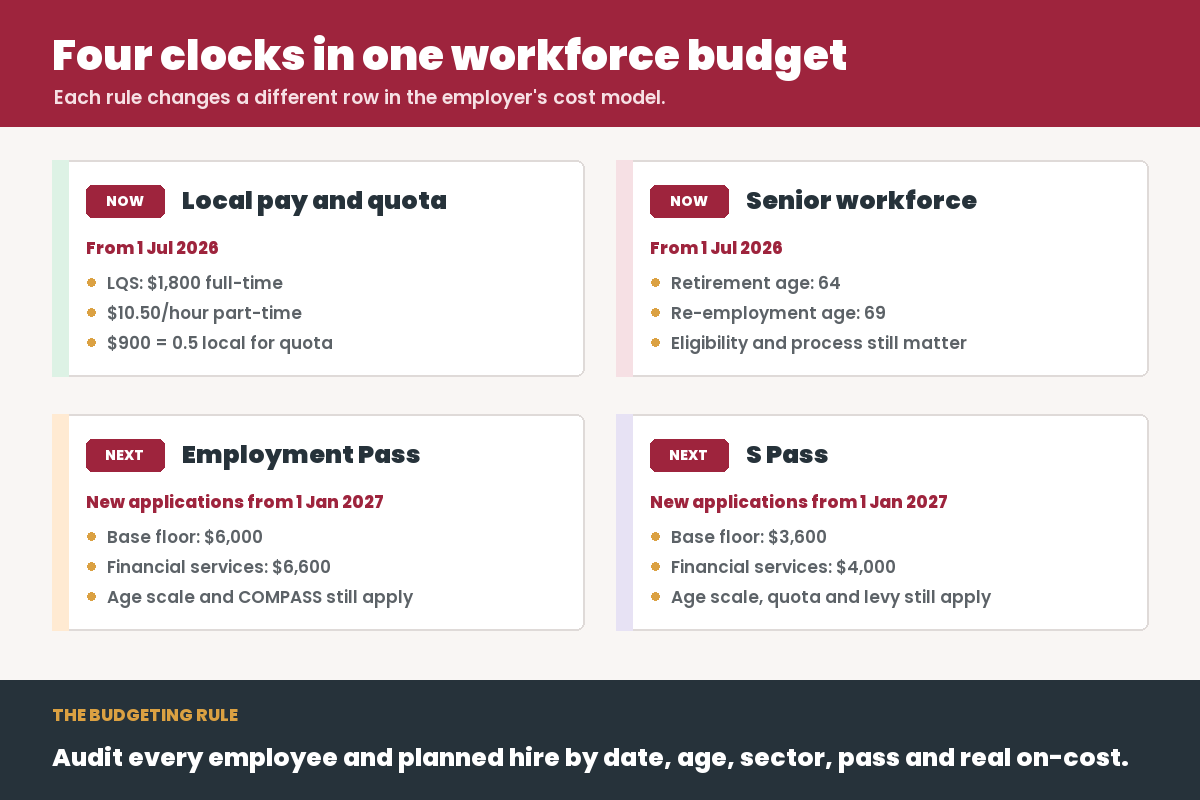
That is the real risk behind Singapore’s manpower changes. They do not arrive as one clean payroll increase. They affect different employees, different applications and different dates. One changes local wage and quota calculations. One changes what an employer must plan for an older employee. Two change the salary gates for foreign professional and skilled-worker passes.
The practical lesson is simple: do not increase the entire manpower budget by one percentage and call the job done. Audit it employee by employee and planned hire by planned hire.
This guide reflects official rules available on 4 August 2026. Manpower rules can change, and employers should confirm the latest position with MOM before making a hiring, renewal or termination decision.
The Four Changes At A Glance
Effective date | Change | Headline figure | What an SME should review |
|---|---|---|---|
1 Jul 2026 | Local Qualifying Salary | $1,800 monthly for full-time locals; $10.50 hourly for part-time locals | Local pay, PWM coverage and foreign-worker quota count |
1 Jul 2026 | Retirement and re-employment | Minimum retirement age 64; re-employment age 69 | Employee birth dates, eligibility, role design and contracts |
1 Jan 2027 | Employment Pass | Base qualifying salary $6,000; $6,600 in financial services | New applications, age-adjusted floor, COMPASS and renewal dates |
1 Jan 2027 | S Pass | Base qualifying salary $3,600; $4,000 in financial services | New applications, age-adjusted floor, quota, levy and renewal dates |
The Employment Pass and S Pass increases apply to new applications from 1 January 2027. They apply to renewals for passes expiring from 1 January 2028. That distinction matters: the relevant renewal trigger is the pass expiry date, not a vague assumption that every existing pass changes on New Year’s Day 2027.
These changes were announced as part of MOM’s 2026 manpower measures. The headline numbers are useful, but a headline number is not an eligibility decision and it is not a complete employer-cost calculation.
1. The Local Qualifying Salary Is Now $1,800
From 1 July 2026, firms that hire foreign workers must pay all local employees at least the Local Qualifying Salary, subject to the applicable full-time and part-time thresholds. A full-time local employee working 35 to 44 hours a week must receive at least $1,800 in gross wages a month. A part-time local employee working fewer than 35 hours a week must receive at least $10.50 an hour.
Workers in roles covered by the Progressive Wage Model must receive the applicable PWM wage. That amount may be higher than the LQS. The LQS is therefore not a universal answer to “what should I pay?” It is one floor within a wider set of wage and foreign-manpower rules.
Compliance And Quota Count Are Related, But Not Identical
MOM uses local salary data to determine how many local employees count towards a firm’s foreign-worker quota. A Singapore Citizen or Permanent Resident employed under a contract of service generally counts as one local employee when earning at least $1,800 a month, and half a local employee when earning at least $900 but below $1,800.
This creates a detail that simplified summaries often hide. A full-time local employee paid $1,600 may appear as half a local in the quota calculation, but that wage would not satisfy the $1,800 full-time LQS requirement for a firm employing foreign workers. Quota arithmetic does not excuse wage non-compliance.
Local employee example | LQS position | Quota count | Employer takeaway |
|---|---|---|---|
Full-time, $1,800 monthly | Meets the LQS floor, unless a higher PWM wage applies | 1 local | Check hours, gross wage and PWM occupation |
Full-time, $1,600 monthly | Does not meet the full-time LQS for a foreign-worker firm | Quota formula may show 0.5 | Do not treat the half-count as permission to underpay |
Part-time, $950 monthly at at least $10.50/hour | Can meet the part-time hourly floor | 0.5 local | Keep reliable hours and wage records |
Part-time, $700 monthly at at least $10.50/hour | Can meet the part-time hourly floor | 0 local | Compliant pay does not automatically create quota capacity |
Employers that fail to meet the LQS requirements may lose the ability to apply for or renew work passes. For a business that depends on foreign manpower, an under-budgeted local salary can therefore affect more than one employee. It can change the firm’s available foreign-worker headcount.
Use SBO’s Work Permit quota guide to understand the sector rules, then test actual headcount scenarios with the Work Permit calculator. MOM’s current rules and records remain authoritative.
A Worked LQS Budget Example
Suppose a services SME had six full-time local employees at the previous $1,600 LQS and employs foreign workers. Moving all six to $1,800 adds $1,200 to monthly gross wages.
If all six are Singapore Citizens or third-year-onward Permanent Residents aged 55 or below, a rough planning estimate adds another $204 in employer CPF at 17 per cent, plus about $3 in additional SDL at 0.25 per cent. The estimated monthly increase is therefore $1,407 before CPF rounding, wage ceilings, overtime, bonuses, leave, insurance or other employment costs.
Item | Illustrative calculation | Monthly increase |
|---|---|---|
Gross salary | 6 employees x $200 | $1,200 |
Employer CPF | 17% x $1,200 | About $204 |
Skills Development Levy | 0.25% x $1,200 | About $3 |
Estimated increase | Before other on-costs | About $1,407 |
This example is deliberately narrow. CPF depends on citizenship, PR year, age and wage profile. Use SBO’s CPF contribution calculator and the guide to mandatory payroll deductions for a more complete estimate.
2. Retirement At 64 Does Not Mean Everyone Automatically Works Until 69
From 1 July 2026, Singapore’s minimum retirement age is 64 and its re-employment age is 69.
The words are easy to compress into “64/69”. The employer obligation is more precise.
An employer cannot dismiss an employee on the ground of age before the statutory retirement age. When an eligible employee reaches 64, the employer must offer re-employment up to age 69. Re-employment is not an automatic five-year extension of the old employment contract, and age 69 is not a compulsory retirement age that every employee must reach.
Eligibility includes citizenship or permanent residence, satisfactory work performance and medical fitness. An employee hired at age 55 or older generally must have served the current employer for at least two years before reaching retirement age. Re-employment contracts should be for at least one year and can be renewed annually up to the re-employment age.
If the employer genuinely cannot offer a suitable role, it should not improvise a dismissal. MOM’s process includes transferring the re-employment obligation to another employer with the employee’s agreement, or providing an Employment Assistance Payment where the conditions are met.
The Cost Is Planning, Not Merely Salary
An older employee may be productive, experienced and difficult to replace. The bad outcome is not re-employment. The bad outcome is discovering the obligation one month before retirement and trying to invent a role, schedule and salary under pressure.
Maintain a 24-month age calendar. Begin the conversation early. Review which duties still fit, whether hours should change, what training or ergonomic support is sensible, and how the new role will be measured. Also remember that employer CPF rates vary by age and CPF policy can change separately from retirement-age policy.
For each employee approaching 64, record the eligibility assessment, discussion, proposed role, contract term and decision trail. This is workforce planning, not a birthday reminder.
3. The 2027 Employment Pass Floor Is Not Simply $6,000
For new Employment Pass applications from 1 January 2027, the minimum qualifying salary starts at $6,000 outside financial services and $6,600 in financial services. Renewals are affected for passes expiring from 1 January 2028.
The word starts matters. MOM’s qualifying salary rises progressively with age. Outside financial services, the 2027 range starts at $6,000 for younger candidates and reaches $11,500 at age 45 and above. In financial services, it starts at $6,600 and reaches $12,700 at age 45 and above.
Meeting the salary gate only gets an application through the first stage. Unless exempt, the candidate must also pass the Complementarity Assessment Framework, better known as COMPASS. Employers may also need to meet Fair Consideration Framework job-advertising requirements.
A 28-year-old sales candidate budgeted at $6,000 may therefore still be under the age-adjusted floor. A candidate who meets the salary requirement may still fail COMPASS. The correct budgeting tool is MOM’s Employment Pass Self-Assessment Tool, using the candidate’s actual age, sector, salary and employer profile.
4. The 2027 S Pass Floor Still Sits Inside Quota And Levy Rules
For new S Pass applications from 1 January 2027, the qualifying salary starts at $3,600 outside financial services and $4,000 in financial services. The new thresholds apply to renewals for passes expiring from 1 January 2028.
Again, these are starting points. Outside financial services, the 2027 qualifying salary rises with age to $5,100 at age 45 and above. In financial services, it rises to $5,650.
An S Pass also consumes quota and attracts a monthly levy. A business can have a suitable candidate at the right salary and still lack quota. This is why headcount planning should happen before the offer letter, not after the candidate resigns from another job.
Pass | 2027 starting salary | Higher end of age scale | Other gates |
|---|---|---|---|
EP, non-financial | $6,000 | $11,500 at age 45+ | COMPASS and, where applicable, job advertising |
EP, financial services | $6,600 | $12,700 at age 45+ | COMPASS and, where applicable, job advertising |
S Pass, non-financial | $3,600 | $5,100 at age 45+ | Quota, levy and age-adjusted salary |
S Pass, financial services | $4,000 | $5,650 at age 45+ | Quota, levy and age-adjusted salary |
SBO’s comparison of the Employment Pass, S Pass and Work Permit explains the role of each pass. Foreign founders deciding between relocation and local hiring can also read the EP versus local hiring guide.
Do Not Add The Four Headline Numbers Together
The four changes are not four universal pay rises.
The LQS affects local employees and foreign-worker quota calculations for firms that employ foreign workers. Retirement and re-employment rules create an age-based employment obligation and planning process. The EP and S Pass changes affect qualifying salary gates on different application and renewal timelines.
A useful budget therefore begins with a workforce register, not a company-wide percentage.
Field to record | Why it matters | Action trigger |
|---|---|---|
Citizenship or pass type | Determines CPF, quota, levy and pass rules | Any hiring or status change |
Date of birth and age | Affects retirement planning, CPF and pass salary | Review at least 24 months ahead |
Gross or fixed monthly salary | Different rules use different salary definitions | Compare with current and future floor |
Hours and occupation | Distinguishes full-time, part-time and PWM coverage | Roster or role change |
Pass expiry date | Determines when the 2027 salary rules reach renewals | Start review well before renewal |
Sector and employer profile | Affects pass floor, COMPASS, quota and levy | New entity, activity or headcount mix |
Real monthly on-cost | Salary alone understates the budget | Every offer and annual budget |
A Four-Person Example Shows Why The Method Matters
Imagine an SME with the following workforce issues in the same budget cycle:
Person or group | Old assumption | What is wrong | Correct action |
|---|---|---|---|
Six full-time locals at $1,600 | They still support the same foreign-worker quota | The $1,800 LQS has applied since 1 Jul 2026 | Correct wages, CPF/SDL budget and quota records immediately |
Employee turning 64 | Employment automatically ends | Eligible employees must be offered re-employment up to 69 | Assess eligibility and discuss a suitable re-employment arrangement early |
EP candidate starting Feb 2027 at $5,700 | Current salary floor remains enough | The new base is $6,000 and the age-adjusted floor may be higher | Run MOM’s SAT and assess COMPASS before making the offer |
S Pass candidate starting Feb 2027 at $3,400 | A small salary adjustment solves it | The new base is $3,600, age may raise it, and quota/levy still apply | Check salary, quota and levy together before promising the role |
Only the first row produces a simple worked increase. The older employee may require role redesign rather than a standard pay rise. The two pass candidates require individual eligibility checks. Pretending all four can be solved with one payroll percentage creates false confidence.
What SMEs Should Do Now
- Fix any LQS gap first. The 1 July 2026 change is already in force. Check full-time and part-time local wages, hours, PWM coverage and the resulting quota count.
- Map employees approaching 64. Review the next 24 months, not only the next payroll run. Begin re-employment conversations before the decision becomes urgent.
- List every EP and S Pass expiry date. Flag passes expiring from 1 January 2028 and work backwards from the renewal window.
- Reprice planned 2027 hires. Use the candidate’s age and sector rather than the headline starting salary. Test EP cases through MOM’s SAT and COMPASS framework.
- Model the real employer cost. Add employer CPF or foreign-worker levy, SDL, insurance, paid leave, recruitment, training, equipment and management time.
- Stress-test quota before hiring. A local resignation or wage change can reduce foreign-worker capacity. Keep a buffer where operations depend on pass holders.
- Record the source and review date. A workforce spreadsheet without an effective date becomes stale quietly.
For a broader view of Singapore’s salary expectations, skills and working culture, read SBO’s human capital guide for foreign investors. When the role itself is still uncertain, the article on choosing between an employee, freelancer or AI tool can help define the work before a permanent hire.
The Real Employer Cost Formula
A job offer is not a salary number. A more honest planning formula is:
Fixed or gross salary + employer CPF or levy + SDL + insurance + paid non-productive time + equipment + recruitment + training + management load + compliance buffer.
Not every term applies equally to every worker. That is the point. The cost should be calculated by worker profile, not guessed from one headline.
The best time to discover that a role is unaffordable is before the offer is signed. The second-best time is now, while the 2027 applications and 2028 renewal deadlines can still be planned.
Official Sources
- MOM: Local Qualifying Salary requirements and quota count
- MOM: Retirement and re-employment
- MOM: Employment Pass eligibility and qualifying salary
- MOM: S Pass eligibility and qualifying salary
- MOM: 2026 manpower policy changes
- CPF Board: Current employer and employee contribution rates
- CPF Board: Skills Development Levy
Frequently Asked Questions
Is the Local Qualifying Salary a national minimum wage for every employee?
No. The LQS applies to firms that employ foreign workers and also affects local workforce quota calculations. PWM-covered roles may have a higher wage requirement. Employers should check the rule that applies to the employee’s occupation, hours and workforce arrangement.
Does paying $6,000 guarantee an Employment Pass from 2027?
No. $6,000 is the starting qualifying salary outside financial services for younger candidates. The required salary rises with age, and most candidates must also pass COMPASS. Job-advertising requirements may apply as well.
When do the new EP and S Pass salaries affect existing pass holders?
The new thresholds apply to new applications from 1 January 2027 and to renewals for passes expiring from 1 January 2028. Employers should plan from each pass’s actual expiry date.
Must every employee retire at 64 and work until 69?
No. Employers cannot retire employees on the ground of age before the minimum retirement age. Eligible employees reaching 64 must be offered re-employment up to age 69, but eligibility, role suitability and the statutory process still matter.
What is the fastest way for an SME to prepare for these changes?
Build a worker-by-worker register containing citizenship or pass type, age, salary, hours, occupation, pass expiry, quota count and full employer cost. Then flag the effective date and required action for each row.
Explore More Content
Table of Content