We make boring business stories sparkle.
Your Friends Are Probably the Worst People to Validate Your Business Idea
Friends can provide emotional support, but compliments and favour-purchases are weak evidence. Real validation comes from customer behaviour and payment.

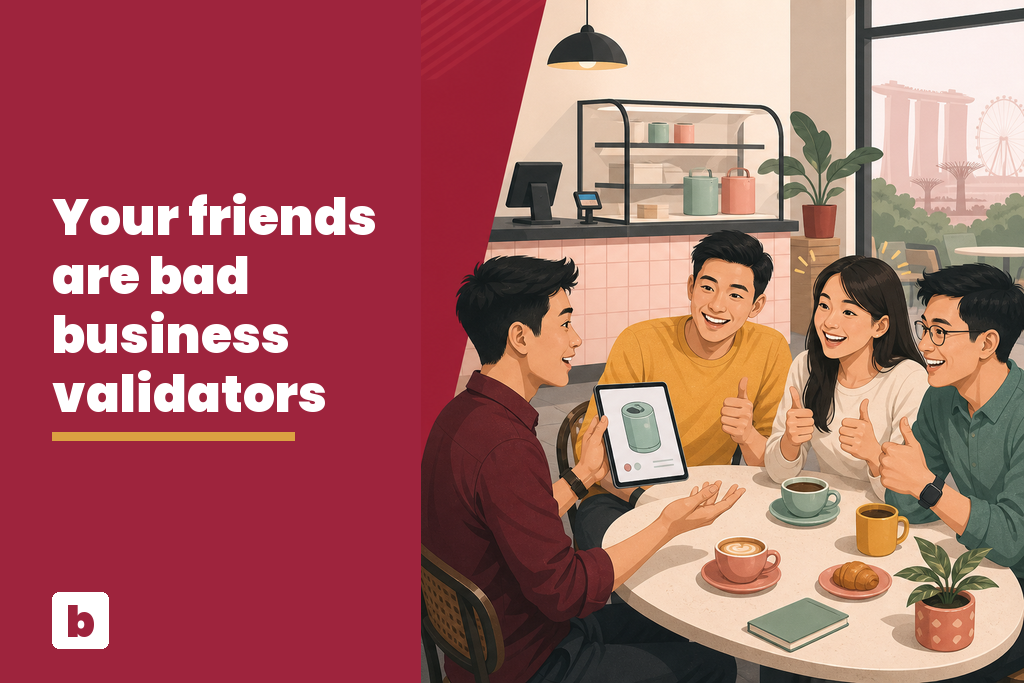
A woman tells six friends that she wants to launch a new wellness subscription.
Everyone loves it.
One friend says she has always wanted something like this. Another says the branding could be beautiful. A third volunteers to share it on Instagram. By the end of dinner, the founder has heard enough encouragement to spend S$8,000 building the first version.
Launch day arrives. Her friends like the announcement. Two repost it. Nobody subscribes.
Her friends did not betray her. They did exactly what friends are supposed to do: they protected her confidence.
That is why they were the wrong people to validate the business.
Friendship And Market Research Have Different Jobs
A good friend listens generously. A good customer makes a selfish decision.
The friend asks, “How can I support you?” The customer asks, “Is this better than keeping my money?” Those are completely different evaluation systems.
When founders ask friends whether an idea is good, the answer is contaminated before the conversation begins. Friends know the founder’s story. They understand the effort. They can imagine the best version. They often want to avoid embarrassment or discouragement.
The market does not know how hard you worked. It sees an offer beside ten alternatives and continues scrolling.
Why Friends Produce False Positives
- They are judging you as well as the idea. Rejecting the product can feel like rejecting your ambition.
- They fill gaps with context. A stranger needs the offer to explain itself. A friend already knows what you meant.
- They may not be the buyer. Interest from someone without the problem, budget or authority is almost meaningless.
- They imagine ideal behaviour. People are optimistic about exercising, budgeting, studying and supporting local brands. Actual calendars and bank statements are less optimistic.
- They expect friendship economics. They may buy once, ask for a discount or expect unusually personal service.
The result is a dangerous sentence: “Everyone I spoke to loved it.” Ask who those people were, what they paid and what they did next.
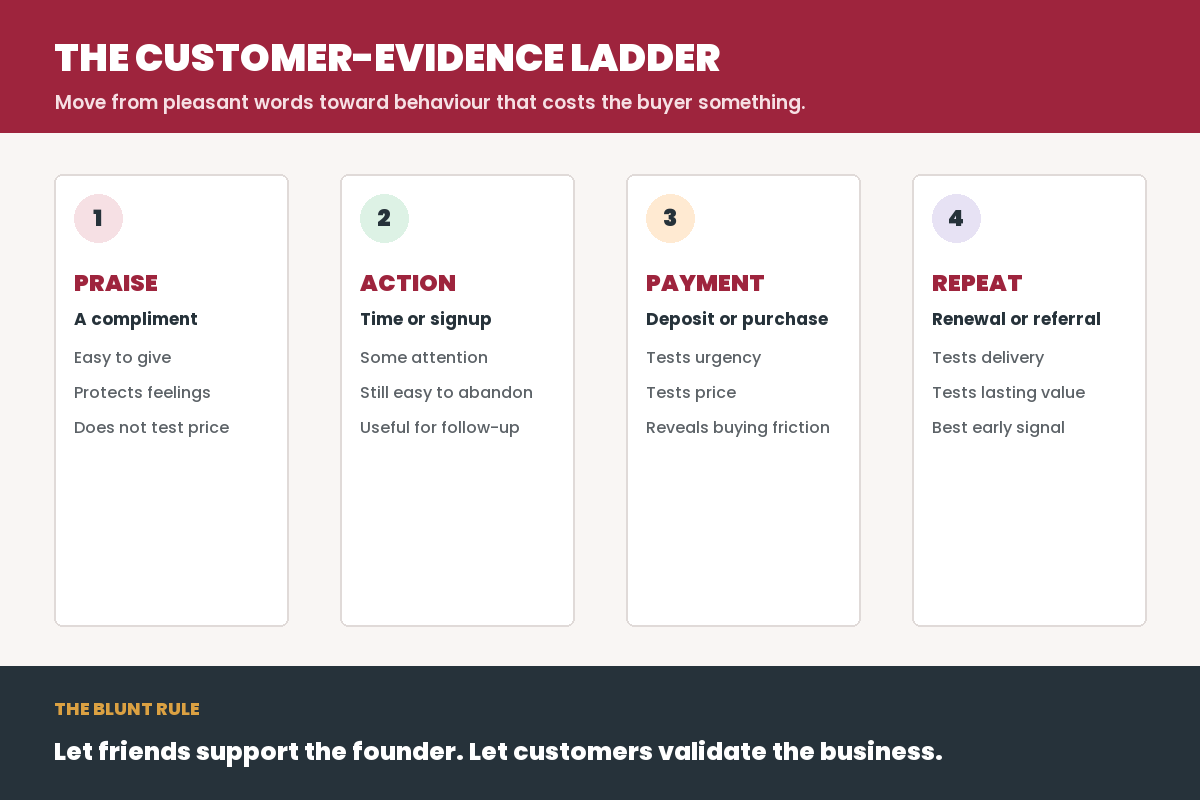
The Evidence Ladder
Signal | What it tells you | How much to trust it |
|---|---|---|
Compliment | The idea sounds pleasant in conversation | Very little |
Email signup | The topic earned a small action | A little |
Sales meeting | The problem earned time and attention | Some |
Deposit or preorder | The promise survived contact with money | Meaningful |
Full-price purchase | A buyer accepted the current trade-off | Strong |
Repeat purchase or referral | The delivered value survived experience | Stronger |
This is not a perfect scientific scale. A deposit can be refunded. A full-price buyer can still be unusual. A referral can happen for social reasons. But the direction matters: behaviour closer to payment and repetition contains more truth than an opinion.
SBO’s article on why a queue is not demand makes the same distinction. Attention is evidence of attention. Revenue is evidence of a transaction. Retention is evidence that the transaction may deserve to repeat.
Stop Asking Whether People Like The Idea
“Do you like this?” is a nearly useless validation question.
It invites taste, imagination and politeness. Ask about the past instead:
- When did this problem last happen?
- What did you do about it?
- How much time or money did it cost?
- Who else was involved in the decision?
- What have you already tried?
- Why was the existing solution not good enough?
Past behaviour is not a perfect predictor, but it is usually more honest than future enthusiasm. Someone who has never paid to solve the problem may still become a customer. But the founder should understand why this new offer will suddenly change that behaviour.
Ask For A Commitment Earlier
Founders often delay asking for money because they want the product to be complete. That instinct can waste months.
A commitment does not always need to be a full purchase. It can be a paid diagnostic, refundable deposit, preorder, signed pilot, scheduled trial with decision-makers, or written introduction to the budget owner. The right mechanism depends on the business.
Business type | Cheap validation test | Useful result |
|---|---|---|
Service business | Sell a narrow paid pilot manually | Buyer pays and completes delivery |
Consumer product | Preorder or small production batch | Unknown buyers accept the price |
B2B software | Paid prototype or design-partner agreement | User and budget owner stay involved |
Course or community | Run one paid cohort | Attendance, completion and referral |
Marketplace | Manually match both sides | Transactions clear without fake subsidies |
Startup SG has promoted programmes around identifying real customer pain points, building a minimum viable product and validating ideas. Enterprise Singapore’s business-support material also treats market viability and market validation as distinct work. The language matters: an idea is not validated because people understand it. It is validated through increasingly costly evidence.
Your First Customers Should Not Need To Love You
A friend may tolerate late delivery, unclear onboarding and a changing product because the relationship supplies patience. A stranger does not owe you that subsidy.
This is why the first ten stranger-customers can teach more than a hundred supportive comments. They reveal whether the offer earns trust without biography. They expose confusing language. They compare you against real alternatives. They complain at the level the wider market will complain.
Do not become defensive. The stranger is showing you the cost of being understood.
When Friends Can Still Be Useful
Friends are not automatically worthless research participants. A friend who genuinely belongs to the target market, recently experienced the problem and can pay full price may provide useful evidence.
But remove the friendship subsidy:
- Do not explain the product more patiently than you would to a stranger.
- Do not offer a special price in exchange for encouragement.
- Do not count social shares as purchases.
- Do not treat one favour-purchase as repeatable demand.
- Ask what nearly stopped them from buying.
The strongest friend is not the one who says, “This is amazing.” It is the one who says, “I would not pay for this, and here is exactly why.”
Build A Validation System, Not A Confidence Ritual
Set a number of customer conversations. Record recent problem evidence. Track offers made, deposits requested, objections, close rates, delivery time and repeat behaviour.
Use SBO’s guide to tracking a sales pipeline so interest does not become a vague pile of names. Use the small-business pricing guide to test a price that can support delivery rather than a friendship rate that proves nothing.
Most importantly, decide in advance what evidence will make you continue, change or stop. Otherwise every weak signal will be interpreted as encouragement.
My Opinion
Founders do not need less emotional support. Starting something is lonely, and friends can keep a person steady through rejection.
But emotional support and commercial evidence must be kept in separate accounts.
Let friends encourage the human being. Let strangers test the offer. Let payment test the price. Let repeat purchases test the delivery.
Your friends may believe in you before the market does. That is beautiful. It is simply not validation.
Sources And Further Reading
- Startup SG: Market validation and analysis
- Enterprise Singapore: Enterprise Development Grant project areas
- Enterprise Singapore: Open Innovation Network and market testing
Frequently Asked Questions
Are friends always useless for validating a business idea?
No. A friend who genuinely fits the target market and pays the normal price can provide evidence. The founder must still account for politeness, personal context and friendship discounts.
What questions should I ask potential customers?
Ask about the last time the problem happened, what they tried, what it cost, who made the decision and why the current solution was inadequate. Past behaviour is usually more useful than hypothetical enthusiasm.
Does a survey validate a business idea?
A survey can reveal language, preferences and patterns, but stated interest is weaker than behaviour. Follow it with a realistic offer, price and commitment test.
How many customers are needed to validate an idea?
There is no universal number. Seek enough evidence to understand the problem, buying process, price resistance, delivery economics and whether demand can repeat without relying on one unusual customer.
Explore More Content
Table of Content