
We make boring business stories sparkle.
Should Your Next Hire Be An Employee, Freelancer Or AI Tool?
A 2026 decision framework for Singapore SMEs choosing between permanent talent, external specialists and AI-enabled workflows.

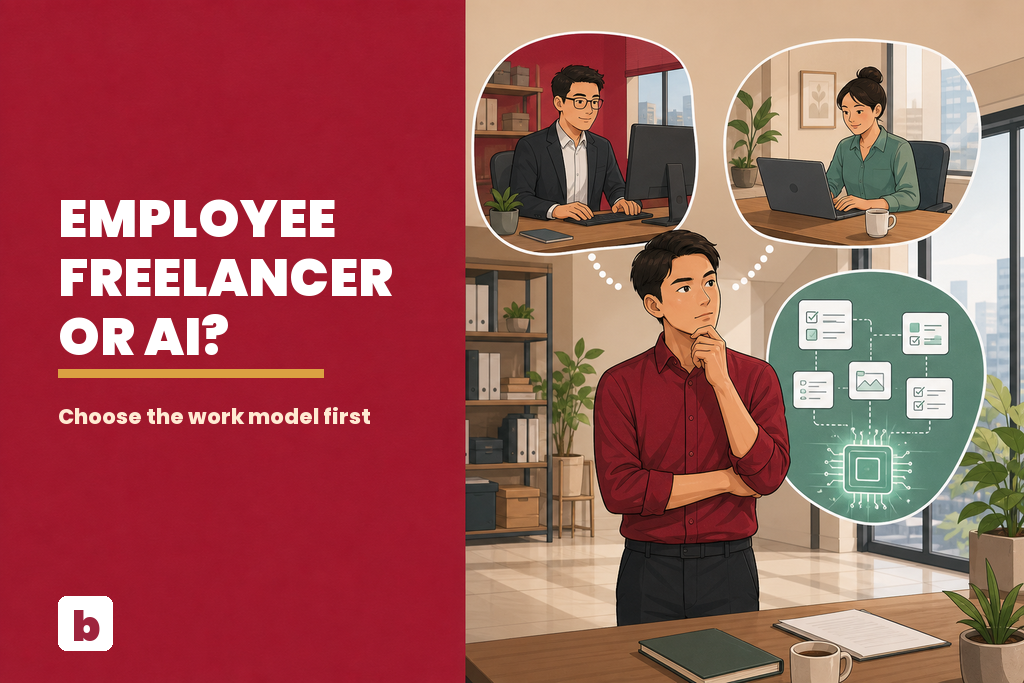
A founder tells her team, “We need to hire someone.”
She has 200 unanswered customer messages, invoices waiting to be reconciled, social posts that never get published and a sales spreadsheet nobody trusts.
She interviews an operations executive, asks a freelancer for a quotation and subscribes to three AI tools. One month later, the employee would be expensive, the freelancer cannot read her mind, and the AI subscriptions have become new tabs nobody opens.
The problem was not a shortage of labour. The problem was that four different kinds of work had been thrown into one sentence: “We need help.”
Before deciding whether your next hire should be an employee, freelancer or AI tool, define the work. These are not interchangeable cheaper and more expensive versions of the same thing. They are different operating models.
The Short Answer
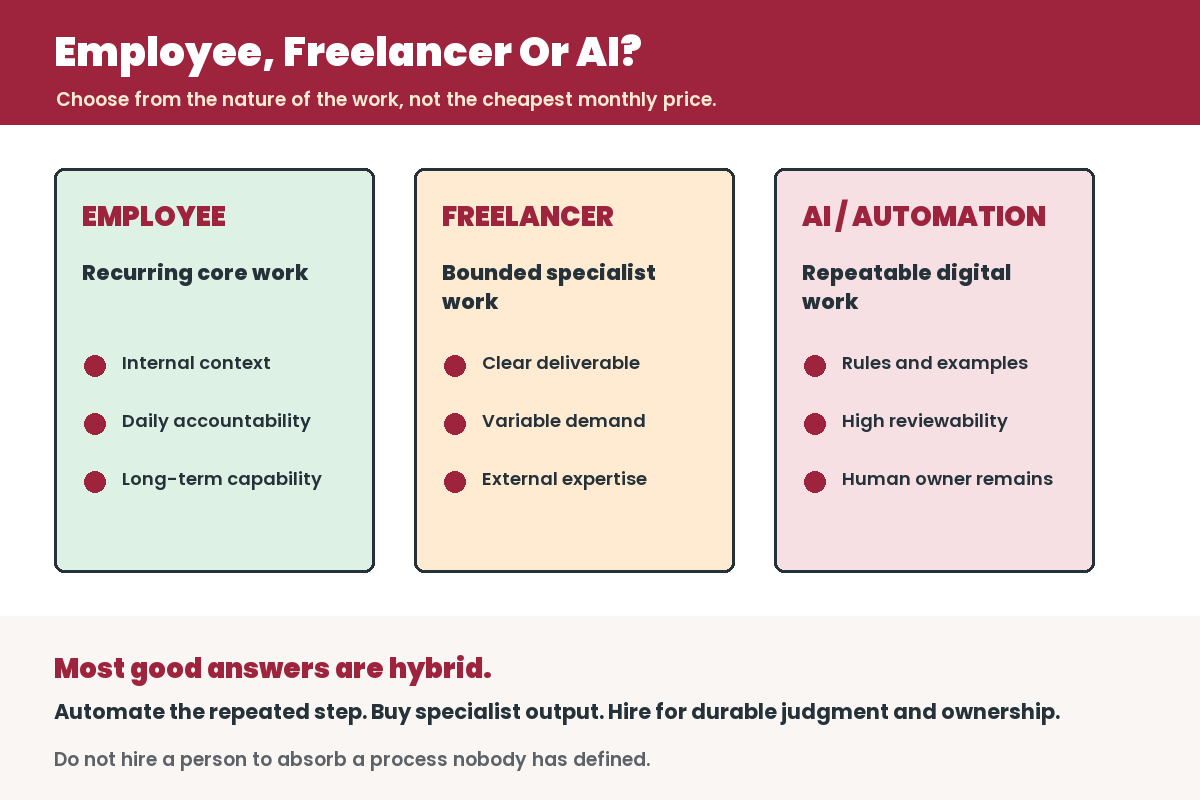
Hire an employee when the work is recurring, central to the company, rich in internal context and needs continuing accountability. Engage a genuine freelancer or vendor when the outcome is bounded, specialist and variable. Use AI or automation when the task is repeatable, digital, reviewable and supported by clear rules or examples.
Most sensible SME designs are hybrid: AI handles a repeated step, a freelancer supplies specialist output, and an employee owns the result.
Model | Best fit | Main risk |
|---|---|---|
Employee | Recurring core work requiring context, judgement and accountability. | Fixed cost and a bad hire becoming embedded. |
Freelancer or vendor | Defined specialist outcome or variable workload. | Weak scope, limited availability and low internal ownership. |
AI or automation | Repeatable digital tasks with examples and human review. | Errors, privacy exposure and automation of a bad process. |
Why This Decision Matters In Singapore In 2026
Singapore’s labour market remains active but costly and selective. MOM’s Labour Market Report for the first quarter of 2026 reported 73,300 vacancies in March, with 1.46 vacancies for every unemployed person. MOM also expects firms to be more cautious about hiring and wage increases amid global uncertainty.
At the same time, AI is moving from novelty into ordinary business functions. IMDA states that SME AI adoption rose from 4.2% in 2023 to 14.5% in 2024. It also reported average cost savings of 52% among SMEs using AI-enabled solutions under the Productivity Solutions Grant in 2024. That does not mean every AI subscription saves half your cost. It means properly selected and implemented use cases can produce real outcomes.
The government’s National AI Impact Programme aims to support 10,000 enterprises over three years. The business question is no longer whether AI exists. It is where it belongs in your operating model.
Start With The Work, Not The Worker
Write down the work for four weeks before choosing a resource. Group tasks by frequency, judgement, context, risk and output.
Work characteristic | What it suggests | Likely model |
|---|---|---|
Daily and central to customer delivery | Needs continuity and internal knowledge. | Employee. |
Specialist project with a clear end | Buy expertise without a permanent role. | Freelancer or vendor. |
Repeated digital transformation of information | Can be prompted, automated and reviewed. | AI or software. |
High-stakes decision or legal accountability | A named human must own judgement. | Employee or qualified adviser, with tools. |
Demand changes sharply each month | Keep capacity variable until volume stabilises. | Freelancer, vendor or part-time employee. |
Messy process nobody can explain | Map and simplify before adding capacity. | Founder or process owner first. |
When An Employee Makes Sense
An employee makes sense when you need someone to build context, make repeated decisions, coordinate across functions and remain accountable after the individual task is complete.
Good reasons to hire include:
- the workload is stable enough to fill a meaningful role;
- the person will handle core customer, operational or commercial knowledge;
- you need the capability to compound inside the company;
- the role must respond continuously rather than by project; and
- a manager exists who can set priorities, train and review performance.
A bad reason is that the founder is overwhelmed. Overwhelm may come from poor priorities, unclear products, broken processes or customers who should not have been accepted. A new employee can inherit chaos without removing it.
Singapore employers must budget beyond salary. For a Singapore Citizen or third-year-onward Permanent Resident aged 55 or below earning $4,000 a month, a simple illustration adds a 17% employer CPF contribution of $680 before Skills Development Levy, equipment, insurance, leave, recruitment, training and management time. Use SBO’s CPF contribution calculator for an estimate based on the employee’s actual profile and current limits.
For foreign investors, SBO’s Singapore human capital guide explains salary anchors, skills, language, working culture and where local hiring adds the most value.
When A Freelancer Or Vendor Makes Sense
A freelancer is useful when the business needs an outcome but not a permanent internal seat.
Examples include a brand identity, legal review, photography project, website migration, campaign launch, financial model, recruitment search or a few days of specialised engineering each month.
The engagement works best when you can define:
- the deliverable and acceptance criteria;
- what information and access will be provided;
- milestones, review rounds and deadline;
- fees and expenses;
- confidentiality, data handling and IP ownership; and
- what support is excluded after handover.
Do not call someone a freelancer merely to avoid employment obligations while controlling them like an employee. MOM explains that the actual relationship matters. A contract of service creates an employer-employee relationship, while a contract for service engages an independent contractor for an assignment or project. MOM considers factors such as control, who provides tools, and whether the person operates on their own account; there is no single conclusive label.
When AI Or Automation Makes Sense
AI makes sense when the work has a repeated input, a reasonably describable transformation and an output a human can review.
Useful SME examples include:
- classifying incoming enquiries;
- drafting a first response from approved knowledge;
- extracting fields from routine documents;
- summarising calls and assigning follow-up tasks;
- generating first drafts from a consistent brief;
- comparing records and flagging exceptions; and
- turning one approved source into several content formats.
AI is weak as an unnamed digital employee responsible for “marketing” or “operations”. A tool does not carry organisational accountability, understand every exception or repair the consequences of a confident mistake.
Read SBO’s opinion on what AI actually changes for Singapore SMEs. The central principle is the same: use AI to remove a defined bottleneck, not to create another subscription nobody owns.
A Practical Decision Scorecard
Score the role before interviewing anyone or buying software.
Question | If yes | Direction |
|---|---|---|
Will this work exist every week for the next year? | Continuity has value. | Employee. |
Does the person need deep internal context? | Knowledge should compound inside. | Employee. |
Is the output a bounded specialist deliverable? | Buy the result. | Freelancer or vendor. |
Does demand rise and fall sharply? | Avoid premature fixed capacity. | Freelancer or flexible staffing. |
Is the task repeated in a digital system? | Test workflow automation. | AI or software. |
Can a reviewer quickly detect a wrong answer? | Automation risk is more manageable. | AI with human review. |
Does the task involve sensitive personal data? | Governance and access matter more. | Controlled human/tool workflow. |
Who is accountable if the result fails? | A named owner is necessary. | Employee or qualified provider. |
How The Choice Changes By Function
Function | Sensible design | Poor design |
|---|---|---|
Bookkeeping | Software extracts records, outsourced bookkeeper reconciles, owner reviews cash. | AI makes unsupervised accounting decisions. |
Customer support | AI drafts routine answers, employee owns exceptions and recovery. | Bot blocks every customer from a human. |
Marketing | Freelancer brings specialist craft, employee owns brand and priorities, AI assists production. | Subscribe to tools without a market position. |
Sales | Automation updates records, employee builds trust and closes complex deals. | Automate spam and call it a pipeline. |
Legal or tax | AI organises questions, qualified adviser gives advice. | Rely on an unverified generated answer. |
Operations | Employee owns the system, vendors add capacity, software handles repetition. | Hire an assistant to remember everything. |
Compare Total Cost, Not The Invoice
The visible monthly price is misleading.
Model | Visible price | Costs owners forget |
|---|---|---|
Employee | Salary and employer contributions. | Recruitment, tools, leave, training, management and exit. |
Freelancer | Project fee or retainer. | Briefing, coordination, revisions, handover and knowledge loss. |
AI tool | Subscription or usage fee. | Setup, integration, review, data controls, errors and process ownership. |
An employee may cost more but retain customer knowledge and improve the system every month. A freelancer may appear expensive per hour but finish a specialist project in ten days. An AI tool may cost $100 but require twenty hours of cleanup because nobody designed the workflow.
Cost per month is not the decision. Cost per reliable outcome is closer.
Do Not Ignore Data And Accountability
Before giving a freelancer or AI system access to customer, employee or commercially sensitive information, decide what data is necessary, where it goes, who can retrieve it and how it will be deleted.
PDPC’s AI and personal-data guidance explains responsibilities for organisations and third-party developers under the PDPA. A vendor agreement or software checkbox does not eliminate the organisation’s accountability.
For consequential work, name a human owner. The tool may draft, classify or flag. A responsible person approves, acts and learns from the result.
A 30-Day Test Before Committing
- List the actual tasks and weekly volume.
- Remove work that should not be done at all.
- Document the inputs, output standard and exceptions.
- Automate one low-risk repeated step.
- Buy a small specialist project where expertise is missing.
- Measure the recurring work that remains.
- Hire only when a durable role has become visible.
This is consistent with a wider principle: a business should become a system, not merely a job created for the owner. People perform better when they enter a system with priorities, information and decision rights.
My Opinion: Do Not Hire A Human To Absorb Your Confusion
Some business owners do not want an employee. They want a witness to their chaos.
They want someone to monitor five inboxes, remember undocumented promises, chase customers who were given bad terms, fix files with no naming convention and ask the founder what matters every morning.
That role will disappoint both sides. The employee looks slow because the company has no priorities. The freelancer looks uncommitted because the scope changes daily. The AI looks stupid because the input is contradictory.
Define the work. Then choose the model.
Final Thought
Employees, freelancers and AI tools are not enemies competing for the same chair.
An employee can own judgement and relationships. A freelancer can inject scarce expertise. AI can reduce repeated digital labour. The strongest small businesses combine them deliberately.
Do not ask, “Which one is cheapest?” Ask, “What capability must remain in the company, what outcome can be purchased, and what repetition can be removed?”
That question produces a workforce. The first question merely produces a bill.
This article was reviewed on 25 July 2026 and provides general business information, not employment, legal, data-protection or payroll advice. Confirm worker classification and employer obligations from the actual relationship and current rules.
Frequently Asked Questions
Should a small business hire an employee or freelancer?
Hire an employee for recurring core work that needs internal context and continuing accountability. Use a genuine freelancer or vendor for a bounded specialist outcome or variable demand.
Can AI replace an employee in a Singapore SME?
AI can replace or reduce particular repeated tasks, but it does not automatically replace a complete role. A human should remain responsible for consequential decisions, exceptions, data controls and outcomes.
Does calling someone a freelancer avoid CPF and employment obligations?
No. MOM says the actual relationship matters. Control, tools, economic risk and whether the person operates on their own account help distinguish a contract of service from a contract for service.
What should an SME automate first?
Start with a frequent, low-risk digital task that has consistent inputs, clear examples and an output a human can review quickly. Do not automate a process the business cannot explain.
Explore More Content
Table of Content