
We make boring business stories sparkle.
Your Co-Founder Stopped Working. Why Do They Still Own Half The Company?
An opinionated but practical Singapore guide to the founder trap where contribution stops but equal share ownership remains.

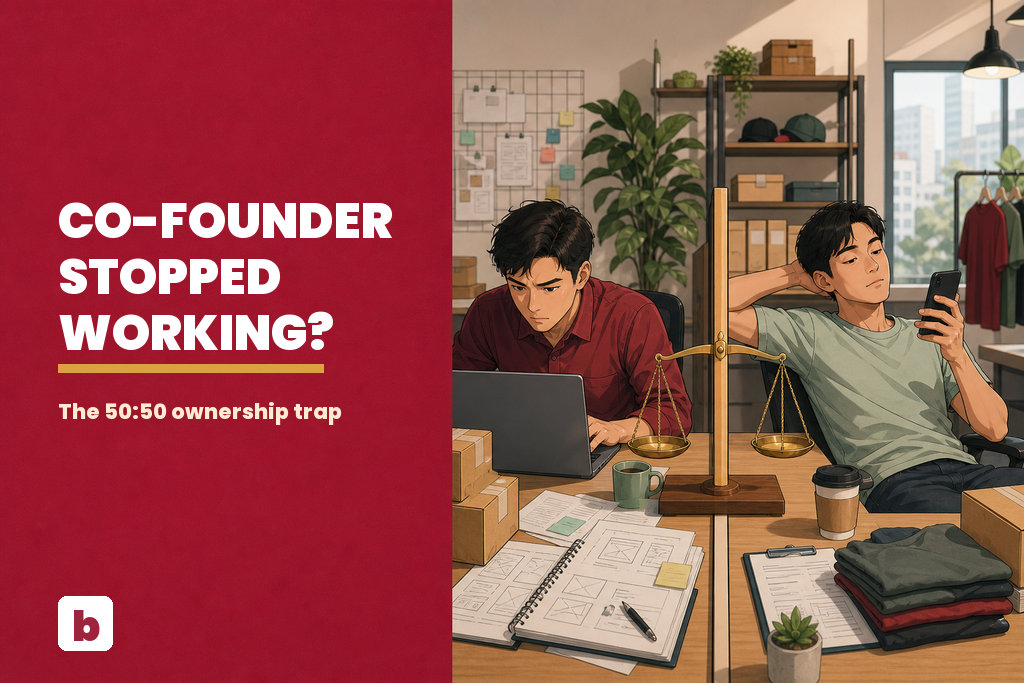
Marcus and Ben started the company together.
They put in the same amount of money and divided the shares equally. Marcus handled sales. Ben built the product. At incorporation, 50:50 felt honest, simple and fair.
Two years later, Ben took a full-time job. He stopped joining customer calls. Product decisions waited. Marcus worked nights, paid himself a modest salary and kept the company alive.
Then an investor expressed interest. Ben appeared again with a simple position: “I still own half.”
Marcus was furious. Ben was legally unsurprised.
My opinion is blunt: shares are ownership, not attendance points. Unless the founders created a mechanism that connects continued contribution to continued ownership, a founder does not normally lose shares merely because the other founder now works harder.
That may feel unfair. The feeling does not rewrite the cap table.
The Short Answer
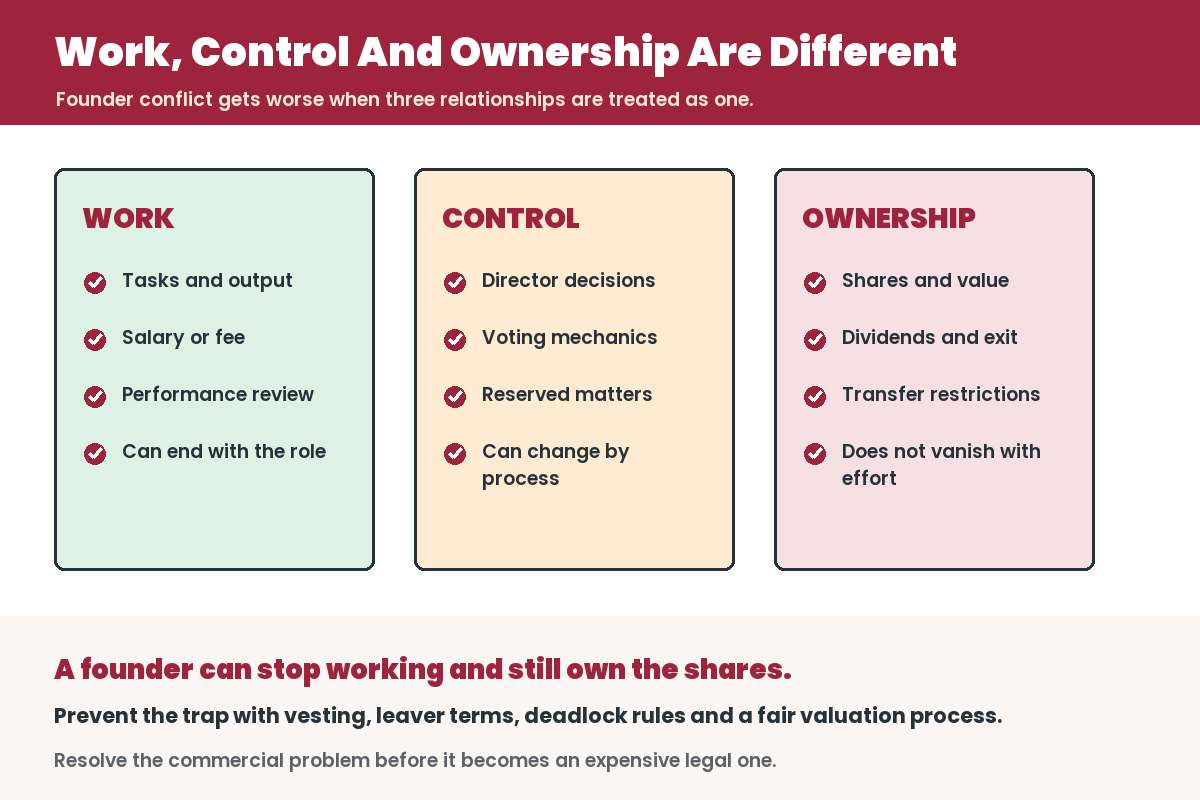
If a co-founder stops working but still owns 50% of a Singapore company, first separate three questions: What work are they required to perform? What management or director powers do they hold? What rights attach to their shares?
Employment can end. A director may resign or be removed through the proper process. Shares are a separate property and governance interest. They usually need a contractual transfer, negotiated sale, valid company action or court process. They do not evaporate because contribution became unequal.
Capacity | What it controls | What may happen if work stops |
|---|---|---|
Employee or contractor | Duties, pay, performance and termination. | The working relationship and salary may end. |
Director | Board decisions and statutory duties. | Office may end under the Act, constitution and agreed process. |
Shareholder | Voting, economic rights and value attached to shares. | Ownership usually remains until lawfully transferred, bought back or otherwise changed. |
Why Founders Choose 50:50
Equal ownership avoids an uncomfortable conversation at the beginning. Both founders feel respected. Nobody wants to say, “I think I will matter more than you.”
But equality at incorporation assumes equality will remain meaningful across time, work, risk, money, relationships and judgement. That is a heroic assumption.
One founder may go full-time first. One may bring the first customers. One may inject more money. One may personally guarantee a lease. One may care for a parent, become ill, relocate, lose interest or accept employment. The business changes. The cap table stays frozen.
A 50:50 split is not automatically wrong. A 50:50 split without deadlock rules, vesting, leaver terms and an exit method is lazy optimism converted into legal structure.
Why The Shares Do Not Simply Return
Founders sometimes speak as if shares were a uniform that must be handed back when someone stops reporting for duty. That is not how issued ownership generally works.
ACRA’s current guidance on filing a transfer of shares says an existing shareholder may transfer fully paid shares where the transfer complies with the company’s constitution. A proper instrument of transfer and company information are required, and for a private company the transfer takes effect after ACRA updates the Electronic Register of Members.
The practical lesson is not that every founder dispute needs a filing. It is that ownership changes require authority, documentation and process. Anger is not an instrument of transfer.
Read The Documents Before Arguing About Fairness
The answer may already be partly written in:
- the company constitution;
- the shareholders’ or founders’ agreement;
- share subscription and transfer documents;
- employment or service agreements;
- vesting, option or incentive documents;
- board and shareholder resolutions;
- intellectual-property assignments; and
- loan, guarantee or investment documents.
ACRA describes the company constitution as the rulebook defining rights and responsibilities and covering matters such as share transfers, meetings and director appointments. A private shareholders’ agreement can address additional commercial arrangements among its parties.
SBO’s guide to a shareholders’ agreement versus a company constitution explains why the two documents should be aligned instead of making conflicting promises.
The Missing Clause Is Usually Vesting
Founder vesting is designed to make ownership earn out over time or become subject to repurchase if the founder leaves early. The exact legal structure must be drafted correctly for the company, tax position and transaction.
A common commercial idea is that founder equity vests over four years with a one-year cliff. If the founder leaves before the cliff, none of the vesting-based entitlement is retained. After the cliff, part vests and the rest continues over time. But Singapore founders should not copy a foreign template and assume the mechanism works automatically. The documents, issued shares, repurchase rights, consideration and company-law process matter.
If all shares were issued outright on day one with no vesting or leaver mechanism, adding one after the relationship has collapsed generally requires agreement. You cannot retroactively invent consent because it would now be convenient.
What A Proper Founder Agreement Should Decide
Issue | Question to decide early | Useful mechanism |
|---|---|---|
Contribution | Who must work, fund or deliver what? | Roles, milestones and review dates. |
Ownership | What happens if someone leaves early? | Vesting and good/bad-leaver terms. |
Pay | How is current work compensated? | Salary, service fee and expense policy. |
Control | Which decisions need both founders? | Reserved matters and board rules. |
Deadlock | What happens when 50:50 cannot agree? | Escalation, mediation and buy-sell process. |
Exit value | How will shares be priced? | Valuation formula or independent valuer. |
IP and data | Who owns work created for the company? | Assignment, confidentiality and access rules. |
What To Do When The Problem Already Exists
1. Stop Making The Conflict Personal
“You became lazy” is emotionally satisfying and commercially weak. Build a timeline of agreed roles, work performed, money invested, salaries paid, loans made, guarantees given, decisions delayed and obligations outstanding.
Do not alter records, remove access destructively, issue shares, move assets or withhold information as a pressure tactic. Actions taken during founder conflict can create larger legal and fiduciary problems.
2. Separate Backward-Looking Grievances From The Future Deal
You may never agree on who sacrificed more. You can still negotiate what happens next.
The future choices are usually some combination of:
- both founders recommit to defined roles;
- the inactive founder keeps shares but gives up an operating role;
- the active founder receives a market salary or future performance equity;
- one founder sells some or all shares;
- the company conducts a lawful buyback where appropriate;
- a third party invests under agreed dilution and governance terms; or
- the company is sold or closed.
Do not disguise a punishment as restructuring. If the purpose is simply to strip value from the other founder, expect resistance and legal risk.
3. Value The Company Honestly
The active founder often says the company would be worthless without their continued effort. The inactive founder often values the business using tomorrow’s dream. Both positions can be self-serving.
Use an agreed valuation method or independent valuer. Consider cash, debt, recurring revenue, customer concentration, intellectual property, key-person dependency, liabilities and the cost of replacing founder labour.
4. Put A Commercial Offer On The Table
Possible route | When it may fit | Main difficulty |
|---|---|---|
Recommitment | Trust is damaged but work can be clearly divided. | Needs measurable duties and consequences. |
Role separation | Founder remains an owner but not an operator. | Control and information rights must be clear. |
Partial buyout | Inactive founder wants some liquidity and reduced exposure. | Price and funding. |
Full buyout | Relationship cannot continue but business can. | Valuation, payment terms and guarantees. |
Mediation | Both sides need help reaching a negotiated result. | Requires willingness to compromise. |
Litigation or winding up | Rights are seriously prejudiced or deadlock is terminal. | Cost, delay, uncertainty and business damage. |
5. Document The Result Properly
A handshake does not update the register of members. A WhatsApp message does not safely resolve every warranty, restraint, IP, tax, guarantee and director issue.
Use a Singapore corporate lawyer and competent corporate secretary for the actual transfer, buyback, resignation, release, settlement and ACRA filings. ACRA itself warns that share transactions are complex and errors can be costly.
When The Dispute Becomes A Legal One
Singapore’s Companies Act 1967 includes remedies where company affairs or directors’ powers are exercised oppressively, in disregard of a member’s interests, or in a way that unfairly discriminates or is otherwise prejudicial. Whether section 216 or another remedy applies depends heavily on facts and legal advice.
The Singapore Courts also identify management deadlock as one example relevant to a just-and-equitable company winding-up application. Winding up a viable company to end a founder quarrel is a severe outcome, not a clever negotiating line.
Litigation may sometimes be necessary. It is still an admission that the cheap conversation and careful drafting at the beginning were replaced by an expensive process at the end.
My Opinion: Equal Is Not The Same As Fair Forever
The active founder deserves sympathy, but not magical law. Working harder does not automatically create more shares. The inactive founder may own half because both founders chose that bargain when optimism was high.
The inactive founder also should not hide behind paperwork while demanding the economic reward of a future that only the other person is building. A legal right can be exercised in a commercially selfish way.
The adult solution is to acknowledge both truths. Existing ownership deserves respect. Future contribution deserves a new arrangement.
Negotiate from there.
Before Starting With A Friend
- Define each founder’s expected time, money and deliverables.
- Use a vesting and leaver structure drafted for the actual company.
- Separate salary for work from equity for ownership and risk.
- Decide reserved matters and what happens at 50:50 deadlock.
- Agree how a buyout will be valued and funded.
- Assign IP and control access to company systems.
- Review the agreement when the business or founder commitment changes.
Final Thought
Founders spend weeks discussing the name, logo and product. They divide ownership in fifteen minutes because legal tension feels unfriendly.
That is backwards.
A good founders’ agreement is not evidence of distrust. It is evidence that both people respect the company enough to imagine a future in which life changes.
Your friend may remain loyal. Your health, family, ambition, finances and appetite for risk may not remain identical.
Write for the humans you will become, not only the enthusiastic founders you are today.
This article was reviewed on 25 July 2026 and provides general business information, not legal advice. Shareholder, director, employment, tax and company-law outcomes depend on the documents and facts. Obtain advice from a qualified Singapore lawyer before changing ownership or commencing a dispute.
Frequently Asked Questions
Can a co-founder keep shares after they stop working?
Yes. Work, directorship and share ownership are separate relationships. Unless valid documents or law create a transfer, repurchase or other change, stopping work does not by itself make issued shares disappear.
Can I force an inactive co-founder to sell their shares in Singapore?
That depends on the constitution, shareholders agreement, vesting or leaver terms, statutory powers and facts. Do not attempt a forced change without advice from a Singapore corporate lawyer.
What is founder vesting?
Founder vesting links continued ownership or repurchase rights to time, milestones or continued service. The mechanism must be drafted and implemented properly; it should not be copied blindly from a foreign template.
How can a 50:50 founder deadlock be resolved?
Possible routes include agreed escalation, mediation, a buy-sell process, partial or full share transfer, a lawful company transaction, sale of the business or court remedies. The right route depends on the documents, solvency and conduct.
Explore More Content
Table of Content