
We make boring business stories sparkle.
The F&B Rulebook Has Changed. Good Food Is No Longer Enough
At 11.40am on a Tuesday, the first queue formed outside the new restaurant. The chef had spent fifteen years learning...

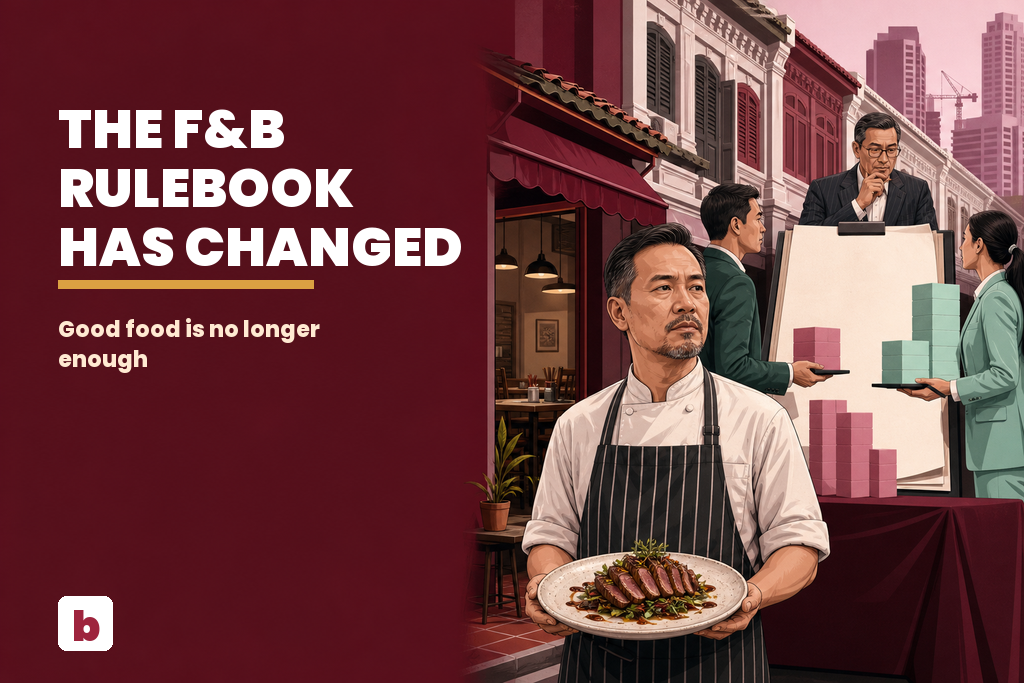
At 11.40am on a Tuesday, the first queue formed outside the new restaurant.
The chef had spent fifteen years learning the unglamorous parts of food: how long stock can hold, when oil has turned, why the same cut behaves differently in wet weather, and how to make a junior cook care about the last plate of the night.
Reviews were good. Weekends were full. Customers told him the food was better than the famous place two streets away.
Six months later, he was still losing money.
The problem was not an empty dining room. The problem was that the restaurant had been born into the wrong financial game. Its rent reflected what a capital-backed brand was willing to pay for the same address. Its renovation reflected what social media expected from a launch. Its menu prices reflected what ordinary customers could afford. Those three numbers never agreed.
The chef thought he was opening a place to cook good food, attract a crowd and make a living.
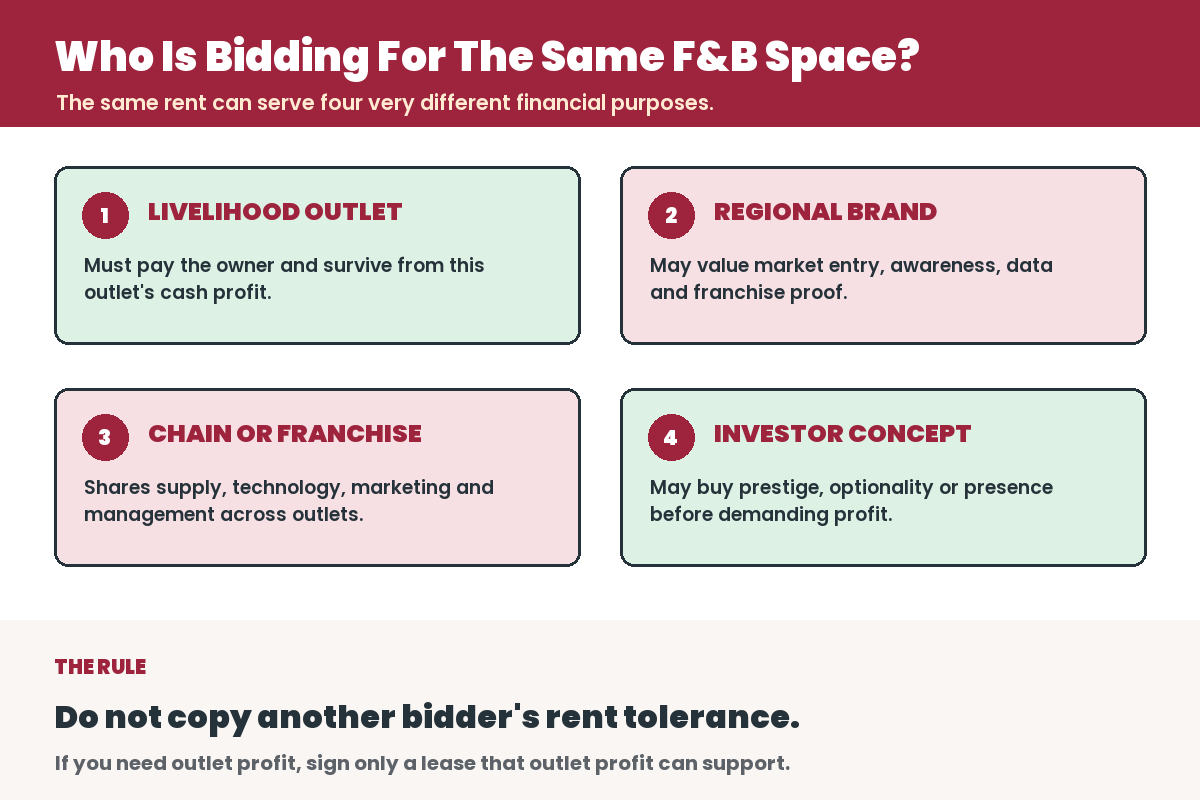
Some of the other bidders were buying something else entirely: market entry, brand visibility, a regional flagship, investor prestige, franchise proof or simply the option to be present in Singapore.
The F&B rulebook has changed. Good food is still necessary. It is no longer enough.
The Old F&B Promise
The old promise was simple enough to understand.
Make food people want. Find a location with sufficient traffic. Keep the shop busy. Control wastage. Pay the landlord, staff and suppliers. The remainder becomes the owner’s living.
It was never easy. F&B has always been physically demanding, perishable, manpower-heavy and exposed to rent. Nostalgia should not turn the past into a fantasy.
But the mental model was coherent: the outlet existed primarily to earn money from selling food at that outlet.
That assumption can no longer be made safely.
The old rule | What changed | The new question |
|---|---|---|
Good food creates a viable restaurant | Quality is only one part of the cost structure | Can each seat and labour hour earn enough? |
A full shop means success | Peak crowds can hide weak weekdays and margins | What is the contribution after every variable cost? |
Competitors also need outlet profit | Some operators value strategy or presence | What financial game is each bidder playing? |
Rent follows food-business economics | Rent follows the highest credible use of the space | Can this concept support this exact lease? |
Hard work closes the gap | Bad capital structure compounds with every month | Which problem cannot be solved by working harder? |
You May Be Competing Against Someone Who Does Not Need The Outlet To Make Money
This is the most important change.
A traditional owner-operator needs the restaurant to produce cash. The outlet must eventually pay salaries, rent, suppliers, debt, the owner’s household expenses and a return for the risk.
A regional chain may evaluate the same outlet differently. Singapore can be a showcase for Southeast Asia, a source of consumer data, a credibility signal for future franchisees, a training base or a line in an investor presentation. A weak standalone return may be tolerated if the outlet creates value elsewhere.
An investor-backed concept may also accept losses for longer because its first objective is growth, visibility or optionality. A wealthy owner may simply want a restaurant. A property owner may prefer a fashionable concept because it improves the building’s tenant mix and traffic.
These are not necessarily stupid decisions. They are different decisions.
Reporting on the expansion of mainland Chinese F&B brands has made this asymmetry more visible. CNA reported in 2025 that more brands were entering Singapore and that operators disagreed over how much this contributed to rent pressure. The same report also showed that these entrants are not one uniform group: some have powerful supply chains and disciplined formats, while others are testing a market.
Foreign capital is not automatically irrational capital. Many foreign chains are better at procurement, automation, branding and replication than local independents. Customers may benefit from their prices and variety.
But when an outlet serves a regional strategy, its rent ceiling is not calculated from the same spreadsheet as a chef trying to make a living from one dining room.
It Is Not A Conspiracy. It Is A System Of Incentives
It is tempting to describe the situation as landlords, investors and foreign brands working together to force rents upward.
That claim is too neat. There is no need for a secret meeting.
The incentives already point in the same direction:
- Landlords want the strongest rent, dependable covenant and useful tenant mix.
- Agents are rewarded when transactions happen at higher values.
- Capital-backed brands want visible locations and rapid market entry.
- New concepts need attractive spaces to create launch attention.
- Investors often reward expansion before they demand mature profitability.
- Customers want novelty but resist the menu prices required by expensive novelty.
No single participant has to intend to make F&B unsustainable. Each participant can act rationally and still produce a rent baseline that a normal livelihood operator cannot safely carry.
URA’s fourth-quarter 2025 statistics show that retail rents rose 1.9% across 2025 and island-wide retail vacancy fell to 6.3% at year-end. Those aggregate figures are not proof of an industry-wide rent explosion. They also do not describe the renewal shock for one attractive corner unit.
In April 2026, the Ministry of Trade and Industry said rental cost as a share of total F&B business costs had declined from 26% in 2019 to 17% in 2024. But the same parliamentary reply said data was not available on the median, interquartile range or the proportion of firms facing rent increases above 10%, 20% or 30% at renewal.
Both things can be true: rent may have become a smaller share of aggregate sector costs, while particular operators at particular locations face brutal numbers.
The Demand Side Has Not Rescued Restaurants
If customers were spending fast enough, stronger competition for space might still be manageable.
They are not.
MTI’s Economic Survey of Singapore 2025 reported that restaurant sales volume fell 4.5% for the year. Overall F&B services volume contracted 0.9%, following a 1.1% contraction in 2024.
That is the trap: capital can keep bidding for attractive space even while the operating market is weak.
A full dining room on Friday does not settle the issue. The restaurant must survive Monday afternoon, delivery commissions, promotions, staff gaps, spoilage, card fees, utilities, maintenance, depreciation and the renovation bill that is slowly dying behind the walls.
Crowds are a visual fact. Profit is an accounting fact.
Good Food Is The Ticket To Enter, Not The Whole Moat
This sounds insulting to cooks, but it should not.
Food quality remains essential. Bad food destroys repeat demand. Inconsistent food destroys trust. A restaurant without a product worth returning for has no foundation.
But the market does not pay separately for effort, taste and craft. It pays through a commercial system.
The modern F&B moat may include:
- a format that serves quickly without damaging quality;
- a menu designed around ingredient overlap and low waste;
- strong weekday demand, not only weekend hype;
- an audience that follows the brand before a lease is signed;
- catering, wholesale, delivery or packaged products beyond dining seats;
- central preparation and procurement advantages;
- management systems that do not depend on the founder at every station;
- a location customers deliberately visit rather than one bought at peak rent.
Enterprise Singapore’s 2025 Food Services Productivity Report studied more than 350 F&B companies. Its official release said top-performing outlets using process optimisation, centralised preparation and technology produced close to twice the sales per man-hour of an average outlet.
That gap is not solved by seasoning.
Critical Advice For Anyone Opening An F&B Business Now
1. Decide Which Game You Are Playing
Are you building a livelihood outlet, a scalable chain, a flagship, a franchise platform, a packaged-food brand or an investor-backed concept?
Do not answer with ambition. Answer with capital, capabilities and the source of expected return.
If you need this outlet to pay your mortgage, you are playing the cash-profit game. Do not copy the lease tolerance of a brand buying regional presence.
2. Treat Rent As A Residual Number
Do not fall in love with a unit and then invent sales to justify it.
Start with conservative covers per day, realistic average spending, gross margin, labour, utilities, platform fees, repairs, marketing and owner pay. What remains is the maximum occupancy cost. If the asking rent exceeds it, the unit belongs to someone with a different model.
SBO’s guide to the full cost of starting a business in Singapore is a useful starting checklist, but an F&B founder should model the outlet month by month.
3. Build Demand Before Building A Dining Room
Test the food through pop-ups, catering, private orders, delivery, markets, shared kitchens or a small-format counter. Build an email list, repeat customer base and recognisable product before committing to a three-year fixed cost.
A landlord’s footfall forecast is not your demand.
The earlier SBO opinion comparing business to tower defence applies perfectly: a beautiful tower placed away from the creeps is still useless.
4. Make Every Square Foot And Labour Hour Defensible
A large kitchen, broad menu and elaborate service style can feel professional while quietly destroying productivity. Measure sales per seat, table turn, square foot and man-hour. Remove complexity that customers do not value enough to fund.
This is not a demand to automate hospitality out of existence. It is a demand to know which human touches customers value and which tasks are simply expensive repetition.
5. Underwrite The Renewal Before Signing The First Lease
Opening rent is not the whole rent risk. Ask what happens at renewal, what comparable transactions the landlord may use, how reinstatement works and how much of the fit-out becomes stranded if you leave.
Assume success makes the address more valuable. Be prepared to move anyway.
6. Keep Enough Capital To Say No
The owner with three weeks of cash cannot negotiate with a landlord, remove a bad menu item, replace equipment properly or survive a slow launch. Thin capital turns every ordinary problem into a desperate decision.
Do not spend the entire budget on renovation. A beautiful restaurant that has no working capital is already closing; the date is merely unknown.
7. Create Distribution The Landlord Does Not Own
If all demand comes from the mall corridor, the landlord owns access to your customer. Build catering accounts, corporate orders, direct reservations, customer data, packaged products, community and content that can travel with the business.
The more demand follows the brand, the less one address can hold it hostage.
8. Be Willing To Walk Away From A Full Restaurant
This is emotionally difficult. A busy dining room looks like proof that the owner was right.
But if the lease renewal transfers every improvement in sales to the landlord, the business may have created an excellent location rather than an excellent company. Re-underwrite from zero. Ignore sunk renovation cost. Walk if the next lease destroys the return.
A Simple Lease Test
Question | Proceed only if | Warning sign |
|---|---|---|
What must the outlet achieve? | The financial purpose is explicit | Branding and profit are mixed vaguely |
Is demand proven? | Customers have already paid repeatedly | Footfall and compliments are the evidence |
Can conservative sales cover rent? | Yes, with owner pay and buffer included | Only the optimistic case works |
Can the format be operated reliably? | Labour and process metrics are credible | The chef must rescue every service |
Can the business survive delay? | Working capital remains after fit-out | Opening month must be profitable |
Can the owner leave? | Closure or relocation is financially survivable | Personal pride has made exit impossible |
What This Argument Is Not Saying
It is not saying foreign businesses should be kept out. Competition can improve value, formats, technology and customer choice. A local operator does not deserve survival merely for being local.
It is not saying every landlord is greedy. A landlord also carries financing, maintenance, vacancy and asset obligations. A strong tenant mix can matter more than the last dollar of rent.
It is not saying good independent restaurants are doomed. Smaller operators can still win through discipline, distinctive food, direct customer relationships, modest locations and formats that capital-heavy chains are too slow or standardised to copy.
It is saying that founders must stop pretending everyone is trying to make money from the same place in the same way.
Somebody else may be able to lose money at the outlet because they make value elsewhere. You may not.
The New Rulebook
Make excellent food. That remains non-negotiable.
Then do the work that the romantic version of F&B leaves out:
- know what financial game you are playing;
- refuse rent that depends on fantasy sales;
- prove demand before committing to space;
- design for throughput, repeatability and low waste;
- build customer access that survives a change of address;
- keep enough capital to make rational decisions;
- walk away when the location consumes the business.
The chef in the opening story did not fail because the food was poor. He failed because he believed food quality would correct a capital structure that was wrong on signing day.
Good food can bring the crowd. Only a good business model lets the owner keep enough of the money.
References
- URA: Fourth-quarter 2025 real estate statistics
- MTI: Rental costs for retail and F&B sectors, April 2026
- MTI: Economic Survey of Singapore 2025
- Enterprise Singapore: F&B productivity initiatives and findings
- CNA: Mainland Chinese F&B brands and Singapore retail rents
This opinion article was reviewed on 23 July 2026. The opening story is a fictional composite based on common F&B operating patterns, not an account of a named business.
Frequently Asked Questions
Is good food still important for a Singapore F&B business?
Yes. Good, consistent food is essential for repeat demand, but it cannot compensate for unsustainable rent, weak labour productivity, excessive fit-out cost or a concept that depends on unrealistic sales.
How can a foreign or regional F&B brand afford a location that a local operator cannot?
A regional brand may value market entry, awareness, consumer data, franchise proof or wider supply-chain returns in addition to the outlet’s profit. It may therefore accept a different return or loss period from a livelihood operator.
What should an F&B founder calculate before signing a lease?
Model conservative daily covers, average spending, food cost, labour, utilities, platform fees, marketing, maintenance, owner pay, working capital and reinstatement. Rent should fit the conservative case, not require the optimistic case.
How can an independent restaurant compete with capital-backed chains?
Avoid trophy-location bidding, build demand before leasing, keep the format focused, improve sales per man-hour, own direct customer relationships and create revenue channels such as catering or packaged products that are not tied to one address.
Explore More Content
Table of Content