We make boring business stories sparkle.
Semrush AI Visibility: A Practical Guide For Business Owners
A Singapore business owner hears about AI visibility, signs up for a dashboard, and sees a score, a list of...

A Singapore business owner hears about AI visibility, signs up for a dashboard, and sees a score, a list of competitors, some citations, and a few prompts where the brand appears. For a moment, it feels like SEO all over again: another ranking system, another chart, another thing to chase.
But AI visibility is not just “SEO with a new name”. It measures a messier thing: whether AI systems know enough about your brand, trust the right sources, and choose to mention you when a customer asks a question.
That is why Semrush AI Visibility can be useful. It gives business owners a way to move from guessing to measuring. But the dashboard is only useful if you understand what the metrics actually mean. A high citation count can still produce weak brand awareness. A mention can appear without a link. A score can rise while commercial value stays flat.
This guide explains how to read Semrush-style AI visibility metrics, what to do with them, and where business owners should stay sceptical.
What Semrush AI Visibility Is Trying To Measure
Semrush describes AI visibility as how often a brand is mentioned, cited, or recommended in AI-generated responses across platforms such as ChatGPT, Perplexity, and Google AI Mode. Its AI visibility product area positions itself around prompt-level tracking, brand performance, sentiment, share of voice, citations, and competitor comparison.
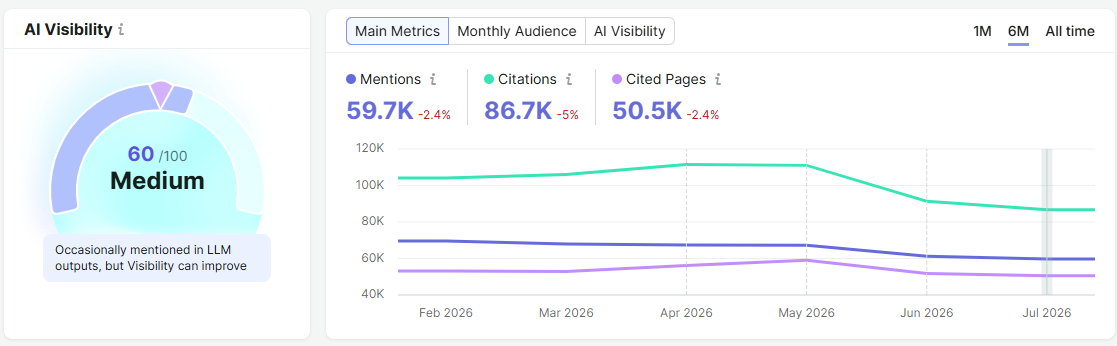
For a business owner, the practical question is simpler:
When a potential customer asks an AI tool for advice, does your business appear in the answer, and is that appearance supported by sources that make you look credible?
That question matters because many buyers now research with AI before they search, shortlist vendors, or contact anyone. The old world was mostly about ranking as a blue link. The new world is about being part of the answer.
If you want the broader foundation first, read our earlier guide on GEO vs SEO and AI visibility. This article focuses specifically on how to interpret the numbers inside a tool such as Semrush.
The Four Metrics Business Owners Must Not Confuse
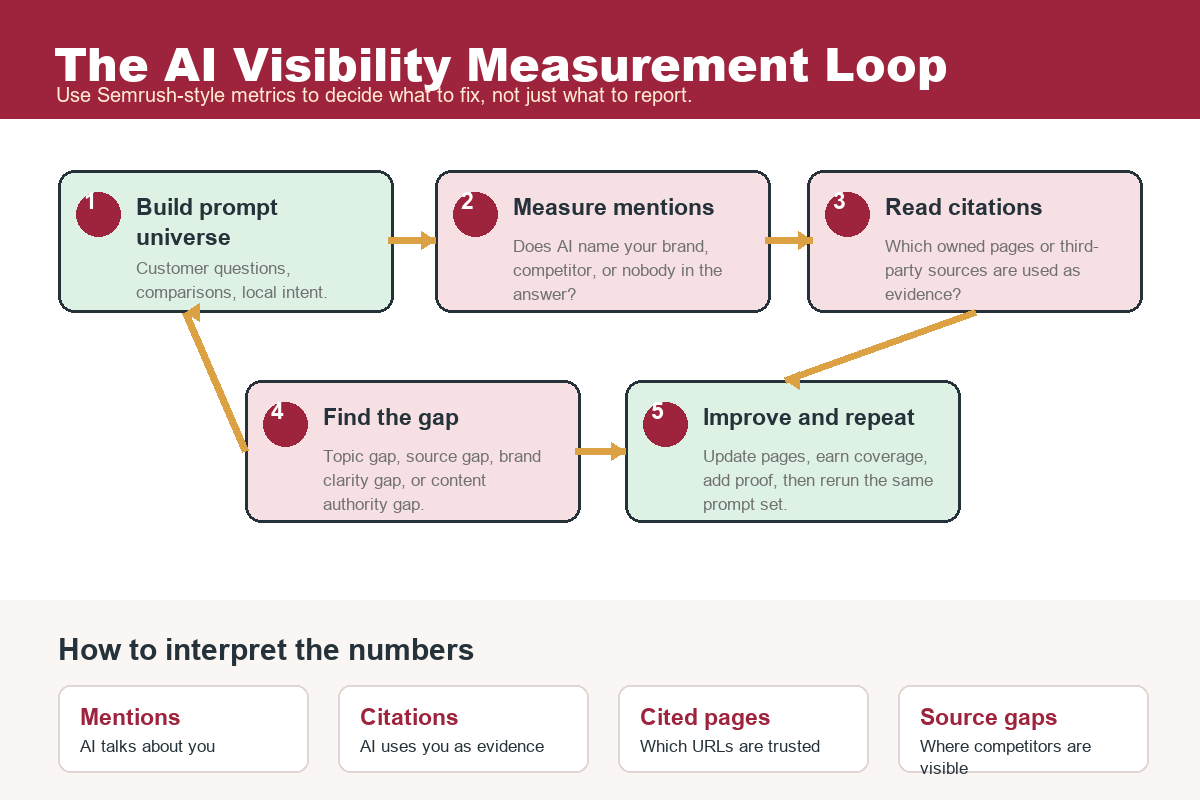
Most AI visibility misunderstandings come from treating mentions, citations, cited pages and sources as the same thing. They are not.
Metric | What it means | Business interpretation |
|---|---|---|
Mentions | Your brand name appears in the AI answer. | AI is willing to talk about you, recommend you, compare you, or include you in the shortlist. |
Citations | An AI answer links to or references a page from your domain. | AI may trust your content as evidence, even if your brand is not the hero of the answer. |
Cited pages | The unique URLs from your website that AI uses as sources. | You can see which pages are considered useful enough to support answers. |
Cited sources | The external domains AI relies on in your category. | You can identify publications, review sites, forums, directories, and communities where your brand may need presence. |
A mention is about visibility. A citation is about evidence. A cited page is about which asset earned trust. A cited source is about the wider ecosystem that shapes AI answers.
Do not report them as one number. Each metric answers a different business question.
The Most Important Distinction: Mentioned Versus Cited
Imagine an AI answer recommends three accounting firms in Singapore. Your firm is not named. But the answer uses your detailed GST guide as one of its sources.
That is a partial win, not a full win.
Your content helped the answer, but another brand received the commercial visibility. This is common in AI visibility work. A business can have useful educational content, but weak brand association. AI may treat the website like a library instead of treating the company like a recommended provider.
The reverse can also happen. A brand may be mentioned frequently because it is well known, but AI cites third-party review sites, directory pages, or media articles instead of the brand’s own website. That tells you brand awareness is stronger than owned-source authority.
How To Read Good And Bad AI Visibility Patterns
Do not celebrate one metric in isolation. Read the pattern.
Pattern | What it usually means | What to do next |
|---|---|---|
High mentions, high citations | Strong brand visibility and strong owned-source authority. | Protect the position. Refresh content, monitor sentiment, and expand into adjacent prompts. |
High mentions, low citations | People or AI know the brand, but external sources carry much of the evidence. | Improve your own comparison pages, guides, case studies, FAQs, and proof assets. |
Low mentions, high citations | Your content is useful, but the brand is not strongly associated with the answer. | Clarify authorship, expertise, service relevance, entity signals, and brand positioning on cited pages. |
Low mentions, low citations | You are mostly absent from the AI answer ecosystem. | Build topic coverage, publish stronger assets, earn third-party mentions, and fix technical crawl issues. |
The most painful pattern is low mentions and high citations. It means AI learns from you but talks about someone else. That should irritate a business owner enough to act.
What An AI Visibility Score Can And Cannot Tell You
A visibility score is useful because it compresses many prompt results into something you can track over time. It can help you see whether visibility is improving, flat, or declining compared with competitors.
But a score is not revenue. It is not brand preference. It is not proof that customers will choose you.
Use the score as an early warning system, not as a trophy. If the score improves because you appear in low-value informational prompts, that may be nice but not urgent. If the score is weak for high-intent prompts such as “best payroll software for Singapore SMEs” or “accounting firm for ecommerce business Singapore”, that is a more serious issue.
The better question is not “how do we get a higher score?” The better question is:
Which AI answers influence buyers, and are we visible in those answers in a way that helps us win trust?
Build A Prompt Universe Before You Trust The Dashboard
An AI visibility tool is only as good as the prompts being tracked. If you monitor the wrong questions, you will optimise for the wrong reality.
Start by building a prompt universe. This is a structured list of questions your customers may ask AI tools before buying, comparing, or solving a problem.
Use four prompt groups
- Problem prompts: “Why is my website not generating leads?”
- Solution prompts: “How to improve B2B lead generation in Singapore.”
- Comparison prompts: “SEO agency vs GEO agency for small business.”
- Vendor prompts: “Best marketing agency for Singapore SMEs.”
The vendor prompts are closest to money, but the earlier prompts shape perception before the buyer even has a shortlist.
Semrush and similar tools can help track prompt-level visibility across AI platforms, but business owners should still sanity-check the prompt list. A tool may generate many prompts. You must decide which prompts have business value.
Topic Opportunity Versus Source Opportunity
The source note behind this article makes a useful distinction: topic opportunities and source opportunities.
A topic opportunity means competitors appear for a subject where your brand is absent. For example, competitors show up when people ask AI about “best CRM for tuition centres”, but you do not.
A source opportunity means AI frequently cites an external website where your brand is missing. That external website might be an industry publication, forum thread, comparison page, directory, YouTube video, LinkedIn post, or review platform.
Opportunity type | What it reveals | Best response |
|---|---|---|
Topic opportunity | You are not part of the answer for an important customer question. | Create or improve content, service pages, case studies, and examples around that topic. |
Source opportunity | AI relies on places where competitors are visible and you are not. | Earn inclusion through PR, expert comments, partnerships, reviews, directories, community participation, or original research. |
Brand clarity opportunity | AI cites you but does not name you clearly. | Strengthen author bios, about pages, internal links, service relevance, schema, and consistent entity language. |
This is where AI visibility becomes broader than SEO. You cannot fix every visibility problem by publishing another blog post. Sometimes the missing asset is third-party credibility.
What To Do If Citations Are High But Mentions Are Low
This is the situation many content-heavy businesses will face. Their guides are good enough to be cited, but the brand is not memorable enough to be named.
Here is the practical repair plan:
- Review cited pages one by one. Ask whether each page clearly explains who produced it, why the business is credible, and what problem the business solves.
- Add original value. Publish proprietary data, calculators, local examples, benchmarks, templates, or case studies that other pages cannot easily copy.
- Connect education to commercial relevance. A guide can teach without being spammy, but it should still make the brand’s expertise obvious.
- Strengthen entity consistency. Use consistent company descriptions across your website, Google Business Profile, LinkedIn, directories, author bios, and third-party profiles.
- Earn credible external mentions. If AI trusts certain sources in your category, work towards appearing in those sources honestly.
- Monitor prompt movement. Check whether citation-only prompts slowly become mention-and-citation prompts after improvements.
The goal is not to stuff the brand name everywhere. The goal is to make the relationship between the information, the expertise, and the business unmistakable.
Where Business Owners Should Be Sceptical
AI visibility measurement is useful, but it is not clean like a bank statement.
AI answers vary based on training data, live search results, user context, location, conversation history, model behaviour, and query wording. Two people can ask similar questions and receive different answer shapes. Even the same person can ask again and get a different mix of brands and sources.
That does not make monitoring useless. It means the numbers should be treated as directional evidence, not absolute truth.
My view: AI visibility tools make sense when they are used to spot patterns, not when they are sold as a perfect rank tracker. If an agency promises guaranteed ChatGPT rankings, be careful. If a tool helps you find missing topics, weak source coverage, brand sentiment issues, competitor patterns, and pages worth improving, that is genuinely useful.
For a more opinionated view on this problem, read our guide on whether GEO monitoring tools and agencies actually make sense.
A Simple Monthly AI Visibility Review For SMEs
Most SMEs do not need a complicated war room. They need a repeatable review rhythm.
- Pick 30 to 80 prompts. Include problem, solution, comparison, and vendor-intent prompts.
- Track the same prompts monthly. Do not keep changing the test set unless your business changes.
- Separate money prompts from awareness prompts. A mention in a buyer prompt matters more than a citation in a generic education prompt.
- Check competitors. Identify who appears repeatedly and which sources support them.
- Review cited sources. Look for places your brand should reasonably appear.
- Improve two or three assets per month. Update pages, add evidence, build internal links, publish original data, or pitch relevant sources.
- Record what changed. The real value comes from comparing direction over time.
How To Decide Whether Semrush AI Visibility Is Worth Paying For
For a very small business with little content and no marketing rhythm, manual tracking in a spreadsheet may be enough at first. Ask the same prompts in a few AI platforms, record mentions, citations, position, sentiment, and sources, then repeat monthly.
Semrush AI Visibility starts making more sense when:
- You compete in a category where buyers ask AI for recommendations.
- You have multiple competitors to benchmark against.
- You publish content regularly and need to know what is working.
- You rely on trust, authority, or comparison before customers contact you.
- You want to connect SEO, content, PR, and brand monitoring into one workflow.
The tool should save time and reveal patterns you would not reliably catch manually. It should not become another expensive dashboard that nobody acts on.
The Real Lesson For Business Owners
AI visibility is not magic. It is the result of being findable, understandable, credible, and repeatedly associated with the right problems.
Semrush can help you measure that. But measurement is not the work. The work is still business work: clearer positioning, better content, stronger proof, more useful tools, credible external mentions, and a brand that deserves to be named when a customer asks for help.
If AI is becoming a new discovery layer, then businesses should stop asking only “how do we rank?” and start asking “what would make us the obvious answer?”
That is the useful mindset. The metric is only the mirror.
What is Semrush AI Visibility?
Semrush AI Visibility helps track how often a brand appears in AI-generated answers, which prompts mention the brand, which sources are cited, and how competitors compare.
What is the difference between mentions and citations?
A mention means the brand appears in the AI answer. A citation means a page is used as a source or reference. A brand can be mentioned without being cited, and a page can be cited without the brand being recommended.
Should small businesses use AI visibility tools?
They can be useful if customers use AI to research the category and the business is ready to act on the findings. Very small businesses can start with manual prompt tracking before paying for tools.
Can AI visibility replace SEO?
No. AI visibility extends SEO, content, PR and brand work. Traditional SEO still matters, but AI answers may use different sources and may not mirror Google rankings exactly.
Explore More Content
Table of Content