
We make boring business stories sparkle.
When Should a Business Owner Give Up and Go Back to Employment?
There is a strange shame attached to going back to employment after running a business. Some owners would rather keep...

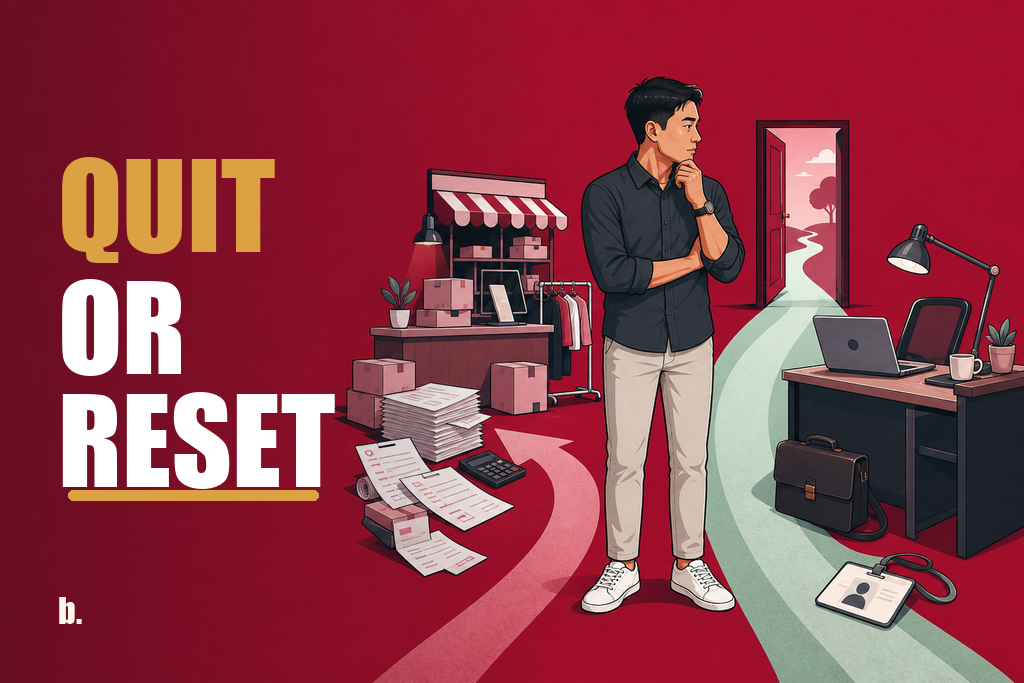
There is a strange shame attached to going back to employment after running a business.
Some owners would rather keep bleeding cash, energy and confidence than admit the business is not working. They tell themselves they are persistent. Sometimes they are. Sometimes they are only protecting an identity.
The honest view: going back to employment is not automatically failure. Staying in a dying business just because the word “founder” feels better than “employee” can be the real failure.
The question is not whether quitting hurts. It will. The question is whether continuing has a rational path, or whether each month is just a more expensive way to avoid grief.
First, Stop Using Pride As A Business Strategy
Business owners like to say they are committed. Commitment is useful when the business has evidence, learning and a path. It is dangerous when it becomes emotional sunk cost.
There is a point where “I refuse to give up” stops being brave and starts being lazy thinking. It avoids the harder question: what does the evidence say?
If customers are not buying, margins do not work, debt is growing, health is collapsing and the owner has no precise next move, the business is not being saved by passion. It is being kept alive by denial.
Do Not Quit Too Early. Do Not Quit Too Late.
Both mistakes are common.
Some people quit too early because they expected business to feel exciting every day. The moment sales slow, customers complain, or operations become boring, they assume the idea is dead.
Others quit too late because they confuse endurance with wisdom. They keep paying for a business model that has already answered them.
The mature decision sits between cowardice and stubbornness.
Signal | Keep going if… | Consider employment if… |
|---|---|---|
Customer demand | People buy, repeat, refer or clearly ask for the offer. | Interest is polite but payment is rare. |
Cash flow | Losses are temporary and tied to a specific test. | Each month creates more debt without better evidence. |
Owner energy | You are tired but still clear and capable. | You are constantly anxious, bitter or unable to think. |
Business model | The numbers can work with realistic changes. | The numbers require fantasy volume, free labour or perfect luck. |
Learning | Every cycle produces useful insight. | Every cycle repeats the same excuse. |
Family impact | The sacrifice is understood and bounded. | The business is quietly damaging people who did not choose it. |
When Going Back To Employment Is The Smart Move
Employment is often treated as defeat in founder culture. That is childish.
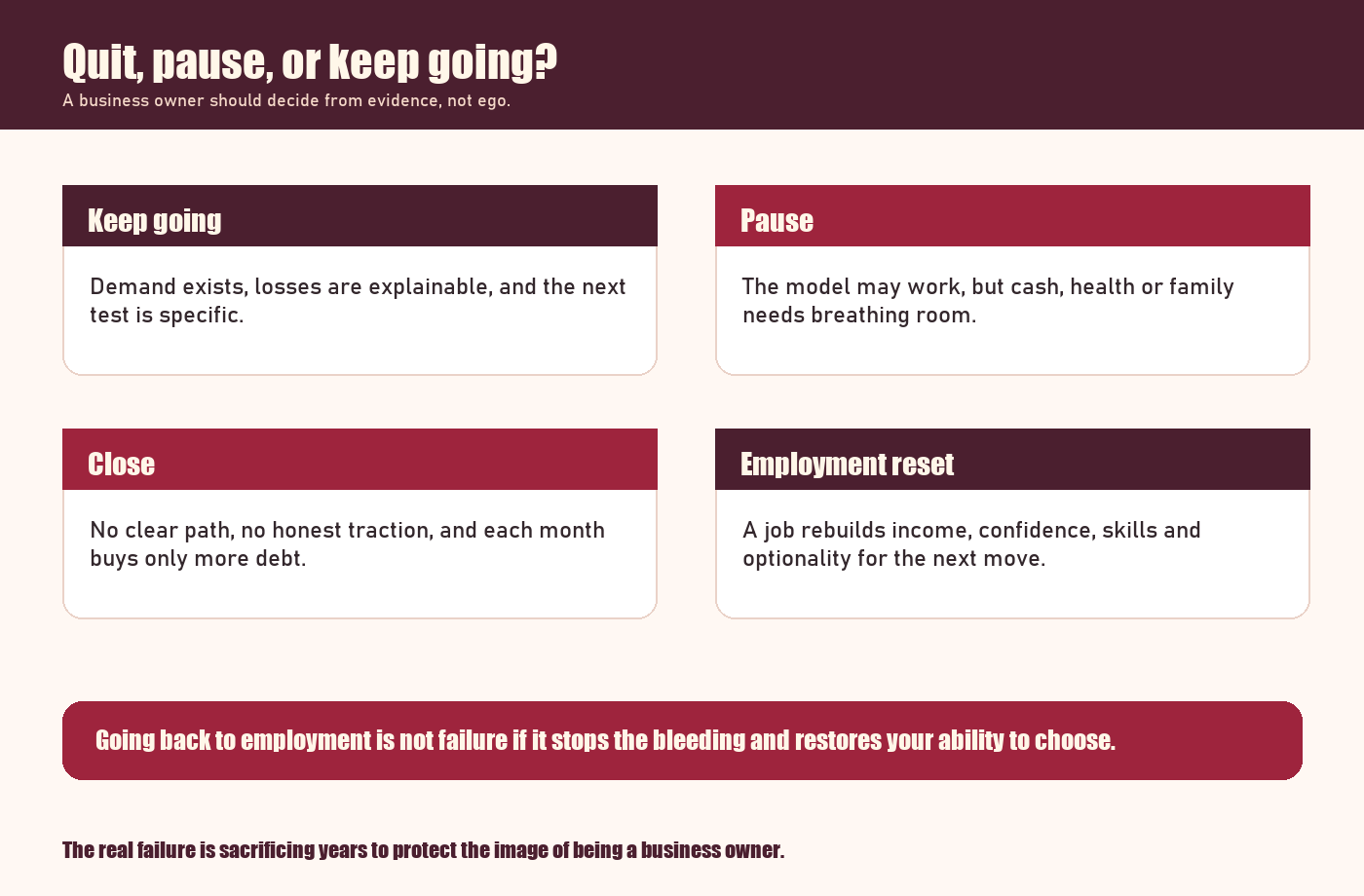
A job can be a strategic reset. It can restore cash flow, reduce pressure, rebuild confidence, deepen skills, expose the owner to better systems, and buy time to think properly again.
Going back to employment makes sense when:
- The business has no honest traction. People praise it but do not pay.
- The owner is funding the same mistake repeatedly. The numbers do not improve after real attempts to fix them.
- Debt is turning a business problem into a life problem. Risk has moved beyond the company into personal survival.
- The owner cannot think clearly anymore. Exhaustion makes every decision worse.
- The opportunity cost is too high. A job could rebuild income, savings, skills and optionality faster than the current business.
- The business is hurting family and relationships. Ambition does not give a person unlimited permission to damage everyone nearby.
The Difference Between A Hard Season And A Dead Business
A hard season still has information.
Customers are slow, but some are buying. Margins are weak, but the cause is clear. Marketing is not working yet, but experiments are producing data. The owner is tired, but still learning. The business hurts, but the pain points toward a specific next adjustment.
A dead business has repetition without insight. Same lack of sales. Same unclear offer. Same cash problem. Same excuses. Same hope that next month will magically feel different.
Hope is not a plan. Hope is useful only when it is attached to evidence and action.
Before Quitting, Run One Honest Review
Do not close a business only because one week was terrible. But do not keep it alive because one random good day gave you emotional relief.
Before deciding, write the answers down:
- What exactly is the business selling?
- Who exactly has paid for it?
- What is the gross margin after real delivery cost?
- How many months of runway remain?
- What is the next specific experiment?
- What result would prove the business deserves another round?
- What result would prove it is time to stop?
If you cannot define what would change your mind, you are not making a decision. You are drifting.
Employment Does Not Have To Be Permanent
Some owners resist employment because they imagine it as surrender forever.
It does not have to be. A job can be a bridge. A recovery phase. A way to clear debt, rebuild savings, gain industry knowledge, learn better management, and return later with more discipline.
A person who failed honestly, studied the reasons, rebuilt capital and came back sharper is not weaker. That person may be more dangerous the second time.
If you are still deciding whether business makes sense for your life, read SBO’s opinion piece on whether it is worth starting a business in Singapore or staying employed. If the issue is the business model itself, the article on choosing the pain you can tolerate is a useful companion.
What To Do If You Decide To Stop
Do not disappear emotionally and leave a mess.
If the decision is to close, close like an adult:
- Inform customers clearly and early where possible.
- Settle outstanding obligations as responsibly as you can.
- Keep records, accounts and tax matters organised.
- Thank people who helped you, even if the outcome was painful.
- Write a private post-mortem while the lessons are fresh.
- Protect your health and confidence during the transition.
There is dignity in ending cleanly. There is no dignity in creating chaos because the ego could not tolerate a proper ending.
When You Should Not Give Up Yet
This article is not an excuse for quitting the moment business becomes uncomfortable.
Do not give up yet if there is real demand, a clear path to improvement, manageable risk, and a specific test worth running. Do not quit only because your ego dislikes being a beginner. Do not quit because the first version was ugly. First versions are supposed to be ugly.
If the business has a painful but real signal, improve it. If it has no signal and only consumes you, stop romanticising the suffering.
Final View
A business owner should give up and go back to employment when continuing is no longer a disciplined bet, but an identity-protection exercise.
There is no shame in returning to a job to rebuild money, health, confidence and judgment. There is shame in sacrificing years, family and sanity just to avoid telling people the business did not work.
The goal is not to look like an entrepreneur forever. The goal is to build a life that can survive the truth.
Frequently Asked Questions
When should a business owner give up?
A business owner should consider giving up when there is no honest customer traction, cash losses keep growing, the model has no realistic path, and continuing only protects the owner’s identity rather than improving the business.
Is going back to employment after business failure bad?
No. Going back to employment can be a smart reset if it restores income, health, skills and optionality. It becomes failure only if the owner refuses to learn from what happened.
How do I know if I am quitting too early?
You may be quitting too early if customers are buying, the numbers can work, and you still have a specific experiment to run. Discomfort alone is not proof that the business is dead.
What should I do before closing my business?
Review the numbers honestly, settle obligations where possible, communicate clearly with customers and partners, organise records, and write down what the business taught you before moving on.
Explore More Content
Table of Content