We make boring business stories sparkle.
GEO vs SEO: How AI Visibility Really Works for Business Owners
An opinionated business-owner guide to GEO vs SEO, AI visibility, brand mentions, citations, monitoring tools and how to avoid bad GEO agencies.

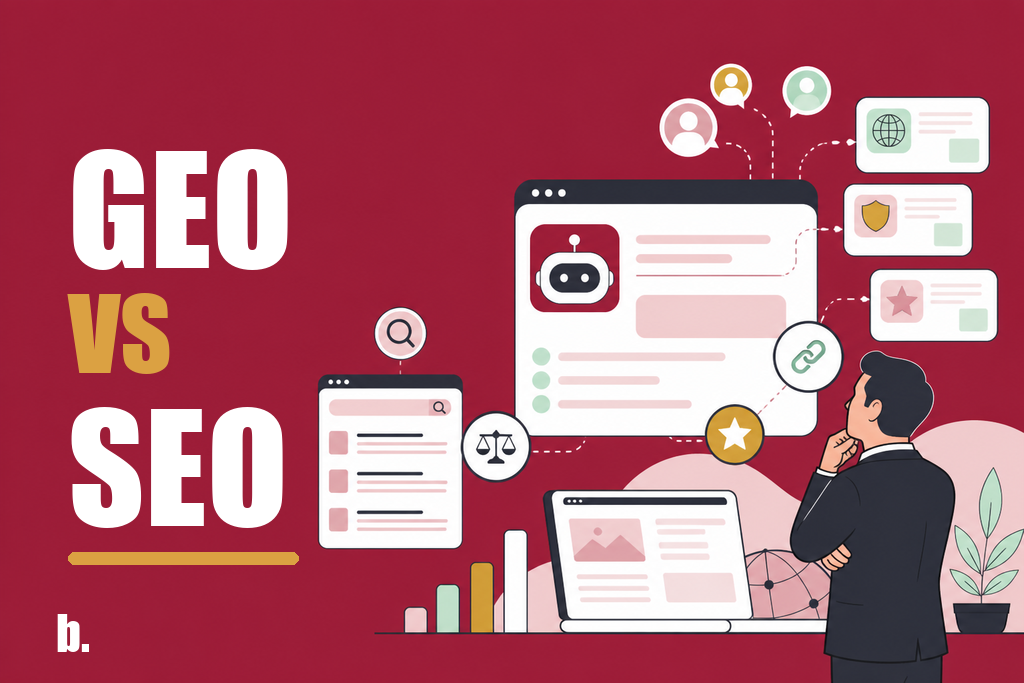
A business owner asks ChatGPT, “Who are the best accounting firms for SMEs in Singapore?” The answer names three brands. Your company is not there. Nobody clicked a search result, nobody compared ten blue links, and nobody reached your website.
That is the uncomfortable reason people are talking about GEO. Not because marketers needed another acronym, although they always seem to find one. It matters because AI answers can shape the shortlist before the customer ever reaches Google.
GEO is real, but many people will misunderstand it. They will try to “rank in ChatGPT” the same way bad SEO agencies used to chase keyword tricks. That is the wrong mental model. The better question is: is there enough trustworthy public evidence for AI systems to understand, explain, mention and cite your business?
What GEO Means In Plain English
GEO stands for generative engine optimisation. In simple terms, it means improving your visibility in AI-generated answers from tools such as ChatGPT, Perplexity, Gemini, Claude and AI-powered search experiences.
SEO tries to help your pages appear in search results. GEO tries to help your brand become part of an answer.
That distinction matters. In traditional SEO, a user sees your title tag and meta description, then chooses whether to click. In AI answers, the user may get a summary, recommendation or comparison directly. If your business is absent from that answer, you may never enter the customer’s mind.
GEO vs SEO: The Real Difference
SEO and GEO overlap, but they are not the same discipline. If someone tells you GEO is just “SEO for ChatGPT”, they are compressing the idea until it becomes almost useless.
Question | SEO | GEO |
|---|---|---|
Main goal | Rank pages in search results. | Be understood, mentioned or cited inside AI answers. |
Main unit | A page, keyword and search result. | A brand/entity, source, claim, answer and citation. |
User behaviour | User scans results and clicks. | User may accept the answer without clicking. |
What helps | Technical SEO, content, links, relevance, authority. | Clear entity signals, useful explanations, credible pages, third-party mentions, reviews and citations. |
Measurement | Rankings, impressions, clicks, conversions. | Brand mention rate, citation rate, answer accuracy, sentiment, competitor share and referral traffic. |
Blunt view | Still essential. Your website remains the source of truth. | Useful, but dangerous if sold as magic AI ranking. |
The important point is this: SEO is still foundational. If your site is unclear, thin, uncrawlable or unsupported by external signals, GEO does not have much to work with.
But GEO adds another layer. It asks whether AI systems can understand your business as an entity, match you to real user questions, and support the answer with credible sources.
How ChatGPT Mentions Brands And Cites Sources
When ChatGPT answers from its general model knowledge, it may mention brands based on patterns it has learned from training data and available context. When ChatGPT Search or browsing-style features are used, the system can search the web, retrieve pages, and include source links or citations in the answer.
OpenAI explains that ChatGPT Search can answer with links to web sources, and that users can open a sources panel for more results. OpenAI also documents crawler controls for publishers, including OAI-SearchBot for surfacing and linking websites in ChatGPT Search. That does not mean every crawlable page will be cited, and it does not mean citations are endorsements.
Here is the practical business-owner version:
- A brand mention means the AI names your business in the answer.
- A citation means the AI links to your website or another source as support for the answer.
- A good AI answer may mention you without citing you, cite a third-party page about you, or cite your own page without making you the hero of the answer.
Citations are evidence handles. They are not trophies. A citation means the answer found a source useful enough to expose to the user. It does not mean the model loves your brand.
Why Brand Mentions Matter Even Without Clicks
Business owners are trained to ask, “Where is the traffic?” That is still a fair question. But AI visibility can influence demand before the click.
If a user asks for “best payroll software for Singapore SMEs” and sees the same three brands repeatedly across AI tools, those brands gain mental availability. The user may later search them directly, ask for reviews, or visit their sites without the original AI answer showing as referral traffic.
This is not new. PR, word of mouth and directories always worked partly this way. GEO just moves that shortlist-building behaviour into AI conversations.
The Metrics: Brand Mention Rate, Citation Rate And What They Miss
GEO monitoring tools usually track a controlled set of prompts and check whether your brand appears, whether it is cited, and how often competitors appear.
Metric | What it means | How to treat it |
|---|---|---|
Brand mention rate | How often your brand appears in AI answers for a defined prompt set. | Useful for trend tracking, but not a universal rank. |
Citation rate | How often your website or another source about you is linked or cited. | More concrete than a mention, but citations vary by model and browsing mode. |
Answer accuracy | Whether AI describes your business correctly. | Often more important than appearing once with the wrong positioning. |
Share of answer | How often competitors appear compared with you. | Useful when tracked across the same prompts over time. |
Referral traffic | Visits from AI tools or AI search surfaces. | Still early, but it connects visibility to actual business outcomes. |
These metrics make sense if you treat them as directional. They become nonsense when someone pretends they are exact rankings.
Two users can ask similar questions and get different answers. The answer can change because of prompt wording, model version, location, conversation history, search availability, freshness of sources and even how the tool expands the query.
A GEO dashboard is a compass, not a scoreboard. It can tell you whether you are becoming more visible across a defined set of questions. It cannot prove that every real customer will see the same answer.
Does AI Visibility Make Sense For SMEs?
Yes, but not for every business in the same way.
AI visibility makes the most sense when customers research before buying. That includes B2B services, software, agencies, professional services, finance, legal, healthcare, education, higher-ticket local services and anything where people compare options.
It makes less immediate sense if your business wins almost entirely through foot traffic, impulse buying or closed relationship sales. Even then, the same fundamentals still help: a clearer site, stronger reviews, consistent listings and credible mentions.
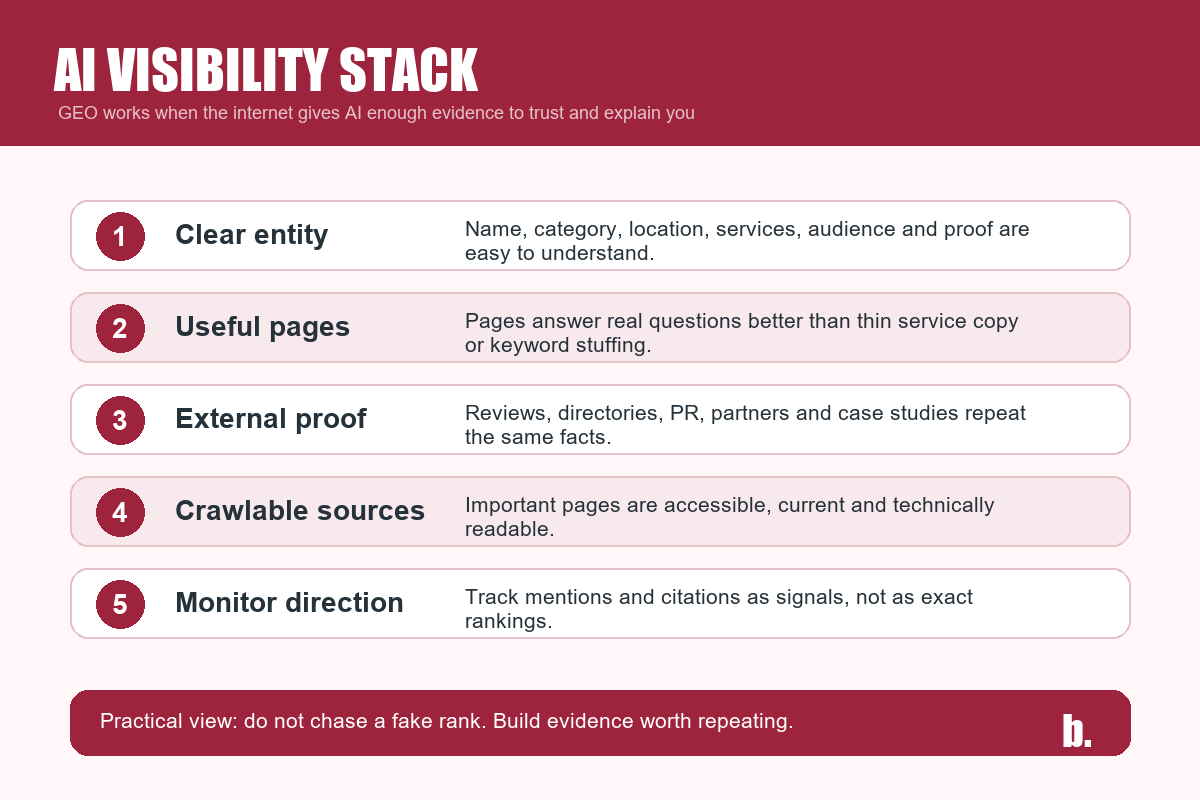
The worst approach is to buy GEO as a new shiny package while your website still fails to explain what you do. If your own site cannot clearly answer “who are you, who do you help, what do you do, why trust you”, do not blame AI for not understanding you.
What Actually Improves GEO
Make your business easy to understand
Your homepage and key service pages should clearly state your business name, category, location, customer type, services, proof and differentiators. Vague branding language is poison for AI visibility.
Publish pages that answer real questions
AI systems are useful because users ask questions. If your site only says “we provide innovative solutions”, you are not giving AI much material to use. Write pages that answer comparison, cost, process, risk, checklist and decision questions.
Earn external mentions
Your own site matters, but third-party confirmation matters too. Reviews, directories, interviews, partner pages, industry publications, case studies and local media all help reinforce what your business is known for.
Keep citations consistent
For local businesses, consistent name, address, phone, categories and descriptions across reputable directories still matter. Read our business directory guide and Google Business Profile guide if your local footprint is weak.
Do not abandon classic SEO
Technical crawlability, internal links, strong content and backlinks still help. Our backlinks guide is still relevant because citations and mentions often depend on the same public web evidence.
Do GEO Monitoring Tools Make Sense?
Yes, if you buy them for the right reason.
A good GEO monitoring tool can help you see prompt clusters where you are absent, competitors that AI mentions more often, weak citations, inaccurate descriptions, and content gaps. That is useful.
But if a tool claims it can tell you your universal “ChatGPT ranking”, be careful. There is no single stable ChatGPT results page. There are many possible answers.
Before paying for a GEO monitoring tool, ask:
- Which AI models does it test?
- Does it use browsing/search mode or model-only answers?
- How many prompts are tracked?
- Are prompts grouped by customer intent?
- Does it track location and language?
- Does it separate brand mention from citation?
- Can you see answer accuracy and source URLs?
- Does it track trend over time instead of one-off screenshots?
How To Find A GEO Agency Without Getting Played
There will be good GEO agencies. There will also be people selling old SEO smoke in a new AI bottle.
Signal | What to ask | Editorial view |
|---|---|---|
Good sign | They ask what evidence exists about your brand, customers, services and market. | GEO starts with reality, not dashboard decoration. |
Good sign | They can explain SEO, content, digital PR, reviews, schema and crawlability together. | AI visibility is multi-source. It is not one plugin. |
Good sign | They show prompt methodology, sample size and limitations. | A serious agency admits output varies. |
Red flag | They guarantee ChatGPT rankings. | There is no stable public ranking page to guarantee. |
Red flag | They sell secret LLM submission or instant AI indexing. | This usually means they are selling mystery, not work. |
Red flag | They only show screenshots of one AI answer. | A screenshot is an anecdote, not a monitoring system. |
A serious GEO agency should improve the public evidence around your business. That means clearer content, better technical foundations, stronger entity signals, credible third-party mentions, review strategy, digital PR, and measurement that admits uncertainty.
If the pitch is “we will make ChatGPT recommend you”, ask how. If the answer is vague, walk away.
A Practical 30-Day GEO Plan For Business Owners
Week 1: Audit what AI can understand
Ask several AI tools about your category, competitors and your own brand. Record whether your business appears, how it is described, and which sources are cited.
Week 2: Fix your own website
Rewrite your homepage, service pages and about page so they clearly explain your entity, services, market, proof and customer fit. Add useful FAQ sections and comparison content where appropriate.
Week 3: Strengthen external evidence
Update Google Business Profile, reputable directories, review profiles, partner pages and case studies. Make sure your business details are consistent.
Week 4: Track prompts and close gaps
Create a small prompt set around your buyer questions. Track brand mentions, citations, competitor mentions and wrong descriptions. Then write or earn the missing evidence.
The Honest AI Visibility Take
Humans keep wanting the shortcut. In SEO, the shortcut was keyword stuffing, cheap links and pretending thin content was strategy. In GEO, the shortcut will be fake dashboards, guaranteed AI rankings and “we know how to submit your brand to LLMs”.
The durable play is less exciting: become easier to understand, easier to verify and more worth mentioning. Put better evidence on your site. Get other credible sources to repeat the truth about you. Make your expertise specific. Stop hiding behind generic positioning.
AI visibility is not magic. It is the result of a business being legible to machines because it is already legible to humans.
Sources And Further Reading
- OpenAI: Introducing ChatGPT Search
- OpenAI platform docs: bots and crawler controls
- Generative Engine Optimization research paper
Frequently Asked Questions
What is GEO in marketing?
GEO usually means generative engine optimisation: improving the chance that AI systems understand, mention or cite your brand when answering relevant questions.
Is GEO replacing SEO?
No. SEO still matters because your website, crawlability, content quality and external links help create the evidence that AI systems may use or cite.
Can a business rank first in ChatGPT?
Not in the same way a page ranks first on Google. AI answers vary by prompt, model, user context, location, browsing mode and available sources.
What is brand mention rate in GEO?
It is the percentage of tracked AI prompts where your brand appears in the answer. It is useful as a trend metric, not as an exact universal ranking.
Should I hire a GEO agency?
Consider one if they can improve your content, technical SEO, reviews, digital PR and source quality. Avoid agencies promising guaranteed AI rankings or secret submission shortcuts.
Explore More Content
Table of Content