
We make boring business stories sparkle.
The Business Is Profitable. So Why Is There No Money In The Bank?
A practical guide to why profit and cash differ, where business cash gets trapped and how a 13-week forecast can prevent a profitable company from failing.

Daniel’s accountant told him the company had made a profit of $28,000.
Daniel opened the business bank account. There was $4,000 left.
Customers still owed him money. New inventory had already been paid for. A machine had been purchased in cash. The bank loan instalment included principal that did not appear as an expense in the profit and loss statement. GST was due. Payroll was five days away.
Nothing was necessarily wrong with the accounts. Nothing was necessarily missing from the bank. Profit and cash were answering different questions.
This is one of the most important financial lessons a business owner can learn: a profitable business can run out of cash. Profit measures whether the business created accounting value over a period. Cash determines whether it can pay the next obligation when it falls due.
The Short Answer
Your business can report a profit while cash is tied up in unpaid invoices, inventory, deposits or equipment. Cash may also leave through loan principal repayments, tax payments, dividends and owner withdrawals that do not reduce operating profit in the same way as ordinary expenses.
Measure | Question it answers | What it can miss |
|---|---|---|
Profit | Did revenue exceed recognised expenses? | When customers actually paid. |
Cash balance | How much money is available now? | Whether the period was economically profitable. |
Cash flow | Where did cash enter and leave? | Whether every movement is revenue or expense. |
Working capital | How much short-term funding is tied up in operations? | Long-term profitability and asset value. |
A Worked Example: $28,000 Profit, Only $4,000 Cash
Consider an illustrative Singapore trading company. Its profit and loss statement for the quarter looks healthy.
Profit and loss item | Amount | Accounting effect |
|---|---|---|
Revenue earned and invoiced | $120,000 | Increases profit. |
Cost of goods sold | ($45,000) | Reduces profit. |
Payroll | ($28,000) | Reduces profit. |
Rent and operating costs | ($15,000) | Reduces profit. |
Depreciation | ($4,000) | Reduces profit without current-period cash payment. |
Profit before tax | $28,000 | Positive result. |
Now look at the bank movements. The company started with $30,000, but collected only $88,000 of the $120,000 invoiced. It also paid for inventory that had not yet been sold and bought equipment upfront.
Cash movement | Amount | Why profit differs |
|---|---|---|
Opening cash | $30,000 | Existing balance, not current revenue. |
Customer cash collected | $88,000 | $32,000 remains in receivables. |
Supplier and inventory payments | ($52,000) | Includes stock not yet sold. |
Payroll | ($28,000) | Current cash expense. |
Rent and operating payments | ($15,000) | Current cash expense. |
Equipment purchase | ($10,000) | Only depreciation enters this P&L example. |
Loan principal | ($4,000) | Reduces debt, not operating profit. |
GST and tax payment | ($3,000) | Different recognition and payment timing. |
Owner withdrawal | ($2,000) | Distribution, not an operating expense. |
Closing cash | $4,000 | Profitable, but financially tight. |
The numbers are simplified, but the lesson is real. You cannot manage cash by staring only at net profit.
Seven Places Your Cash May Be Hiding
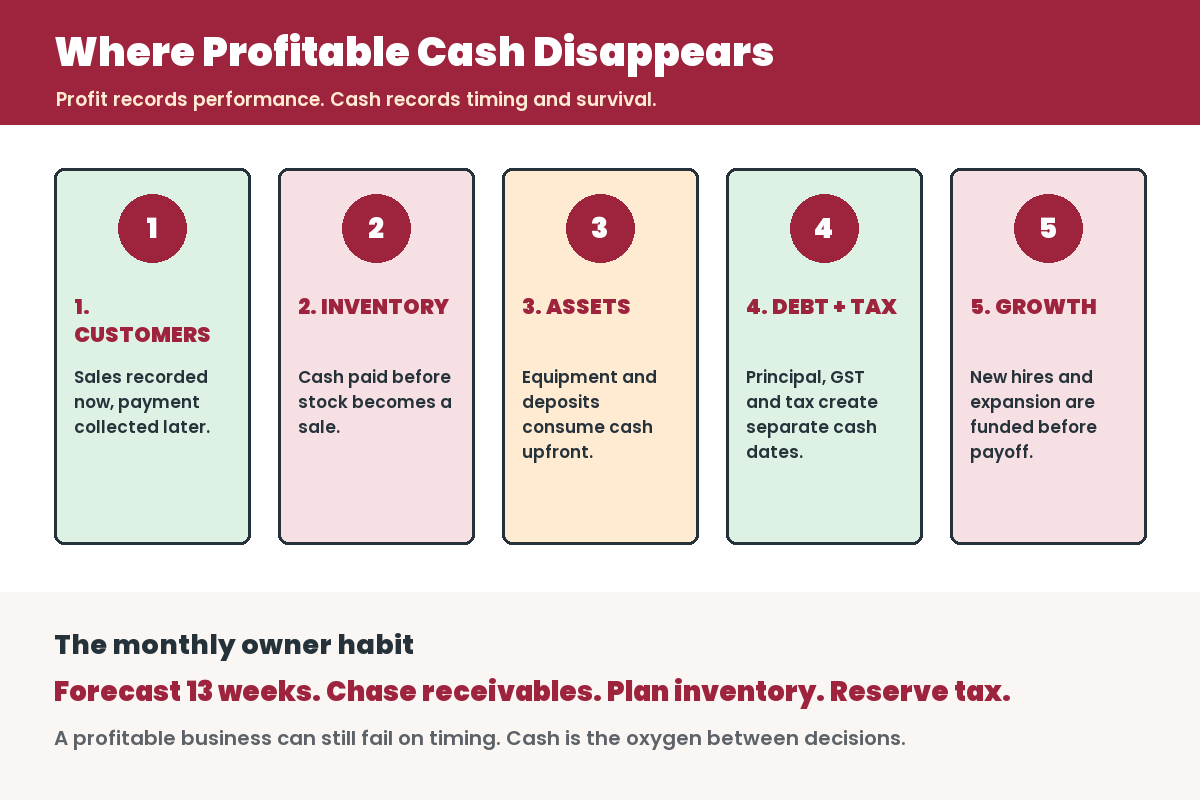
1. Customers Have Not Paid Yet
Revenue can be recognised when goods or services are delivered even though the invoice remains unpaid. The profit is visible. The money is still sitting in trade receivables.
An invoice is not cash. A purchase order is not cash. A customer’s promise to process payment next Friday is definitely not cash.
Track receivables by age, not only total value. A business with $100,000 owed within seven days is in a different position from one with the same amount already 120 days late. SBO’s guide to recovering unpaid business debt in Singapore explains how to escalate with evidence rather than emotion.
2. You Bought Inventory Before Selling It
Inventory consumes cash when it is purchased. The accounting cost may only reach the profit and loss statement when the stock is sold. Slow-moving products can therefore make the shelves look valuable while the bank account becomes weak.
Owners often call this growth. Sometimes it is simply cash trapped in products nobody has yet chosen.
3. Deposits And Prepayments Left The Bank Early
Rental deposits, annual insurance, software subscriptions and supplier deposits can leave the bank before they are fully recognised as expenses. They may sit on the balance sheet as assets or prepayments while cash is already gone.
4. Equipment Used Cash Faster Than Depreciation Records Cost
If a company buys a $24,000 machine in cash, the bank loses $24,000 immediately. The accounts may spread the cost across its useful life through depreciation. Profit and cash therefore move at different speeds.
5. Loan Principal Is Not The Same As Interest
Interest is generally a finance cost, subject to accounting and tax treatment. Repayment of loan principal reduces a liability. Both leave the bank, but only the interest component ordinarily affects profit as a financing expense.
6. GST And Income Tax Have Their Own Timing
GST collected from customers is not free business income. It may need to be paid to IRAS after allowable input tax is accounted for. A GST-registered business can therefore feel cash-rich after collections and cash-poor when the filing payment arrives.
IRAS explains that businesses outside the approved Cash Accounting Scheme may have to account for output tax based on time-of-supply rules before customer payment is received. The scheme has eligibility conditions and is not something a business should assume automatically applies.
Corporate income tax also needs a cash reserve. Accounting profit is not automatically chargeable income, so use SBO’s Singapore corporate income tax guide and corporate income tax calculator to understand the estimate before the payment becomes urgent.
7. Growth And Owner Withdrawals Consume The Surplus
A growing business may hire before the new employee produces revenue, open a location before customers arrive, or increase advertising before sales convert. Those choices can be rational. They still require cash.
Dividends and owner withdrawals also reduce available money. Owners sometimes ask why profit did not increase the bank balance after they have already taken the cash out.
The Cash Conversion Cycle In Plain English
The cash conversion cycle is the time between paying for what the business needs and collecting money from the customer.
A simple version asks three questions:
- How long does inventory sit before being sold?
- How long do customers take to pay?
- How long can the business take to pay suppliers under agreed terms?
If you pay suppliers in 15 days, hold stock for 60 days and collect from customers 45 days after sale, the business may fund a long gap. More sales can make that gap larger. This is why rapid growth can create a cash crisis even when margins look healthy.
Build A 13-Week Cash-Flow Forecast
An annual budget is useful for direction. A rolling 13-week cash forecast is useful for survival.
For each week, record the opening bank balance, realistic customer collections, payroll, CPF, rent, suppliers, loan instalments, GST, tax, equipment commitments and owner distributions. End with the projected closing cash.
Use collection dates you can defend, not invoice due dates you hope customers will respect. Update the forecast every week with actual movements.
Weekly line | Owner question | Warning sign |
|---|---|---|
Customer collections | Which named invoices will actually clear? | Forecast depends on one uncertain payment. |
Committed outflows | What must be paid and when? | Payroll, CPF, rent or tax cannot be covered. |
Discretionary spend | What can be delayed without damaging the business? | Growth spending is treated as unavoidable. |
Closing cash | What is the lowest point in the next 13 weeks? | Balance falls below the operating buffer. |
Five Actions When Profit Is Positive But Cash Is Tight
- Collect faster: invoice immediately, state payment terms clearly, follow up before due dates and escalate overdue accounts.
- Buy inventory from evidence: reduce slow-moving stock, smaller purchase batches and speculative variety.
- Negotiate timing: ask suppliers for sustainable terms before a crisis, not after breaking a promise.
- Separate reserves: keep GST and estimated tax away from money available for ordinary spending.
- Control growth: stage hiring, equipment and expansion against collection milestones.
Monthly bookkeeping should give the owner a profit and loss statement, balance sheet, receivables ageing and cash-flow view. If the provider only tells you annual profit after year-end, the information is too late for many operating decisions. Read SBO’s comparison of a bookkeeper, accountant and corporate secretary to assign the work properly.
Should You Borrow To Solve The Gap?
Working-capital financing can bridge a timing gap when the underlying business is healthy and repayment is credible. It cannot repair products sold at a loss, permanently late customers or uncontrolled owner spending.
Enterprise Singapore states that the Enterprise Financing Scheme – SME Working Capital Loan supports operational cash-flow needs. From 1 April 2026, the published maximum loan quantum is $500,000 per borrower with a maximum repayment period of five years. EnterpriseSG’s risk share does not forgive the debt: the borrower remains responsible for repaying 100% of the loan.
Borrow only after the forecast shows where repayment cash will come from. Debt should buy time for cash to arrive, not delay recognition that the model does not work.
The Numbers An Owner Should Review Every Month
Number | Why it matters | Useful comparison |
|---|---|---|
Gross margin | Shows whether sales contribute enough after direct cost. | By product, service or customer type. |
Operating profit | Shows whether the operating model creates profit. | Against budget and prior months. |
Bank cash | Shows immediate capacity to pay. | Against the next 13 weeks of commitments. |
Receivables ageing | Shows cash delayed by customers. | Current, 30, 60 and 90-plus days. |
Inventory days | Shows how long cash sits in stock. | By product and sell-through rate. |
Debt service | Shows cash required for principal and interest. | Against operating cash generated. |
Final Thought
Profit matters. A business that never earns a profit eventually runs out of other people’s patience.
But cash decides whether the business reaches that future. Suppliers, employees, IRAS and landlords do not accept accounting profit as payment.
Do not ask only, “Did we make money?” Ask, “Where is the money, when will it arrive, and what must leave before then?”
That habit is less exciting than celebrating revenue. It is also how a profitable business stays alive.
This article was reviewed on 25 July 2026 and provides general business information, not accounting, financing or tax advice. Examples are simplified. Obtain advice based on your records and obligations.
Frequently Asked Questions
Can a profitable business run out of cash?
Yes. Profit may be tied up in unpaid invoices, inventory or assets, while cash leaves through supplier payments, loan principal, tax, deposits, growth spending and owner distributions.
Why is profit not the same as the bank balance?
Profit follows accounting recognition rules. The bank balance records actual cash movements. Revenue can be recognised before collection, and some cash movements do not appear as ordinary income or expenses.
What is a 13-week cash-flow forecast?
It is a rolling weekly forecast of opening cash, expected collections, required payments and closing cash for the next 13 weeks. It helps owners identify a funding gap before an obligation is missed.
Should I take a loan when business cash is tight?
Only when the underlying business is viable, the shortage is a timing problem and the forecast shows a credible repayment source. Borrowing does not fix weak margins or permanent operating losses.
Explore More Content
Table of Content