
We make boring business stories sparkle.
Bookkeeper vs Accountant vs Corporate Secretary: Who Does What in Singapore?
A practical comparison of bookkeeping, accounting and corporate secretary work for Singapore SME owners.

A founder starts a new company and quickly collects three names from different providers: bookkeeper, accountant and corporate secretary. The invoices all sound administrative. The work all feels like “finance and compliance”.
Then something breaks. Receipts are missing, the tax estimate is late, a bank asks for financial statements, and ACRA filing reminders are sitting in someone’s inbox.
The problem is not always a bad provider. Often, the owner has never clearly separated the jobs.
This guide explains the difference between a bookkeeper, accountant and corporate secretary in Singapore, what each role should handle, and when a business should use one provider versus separate specialists.
The Short Answer
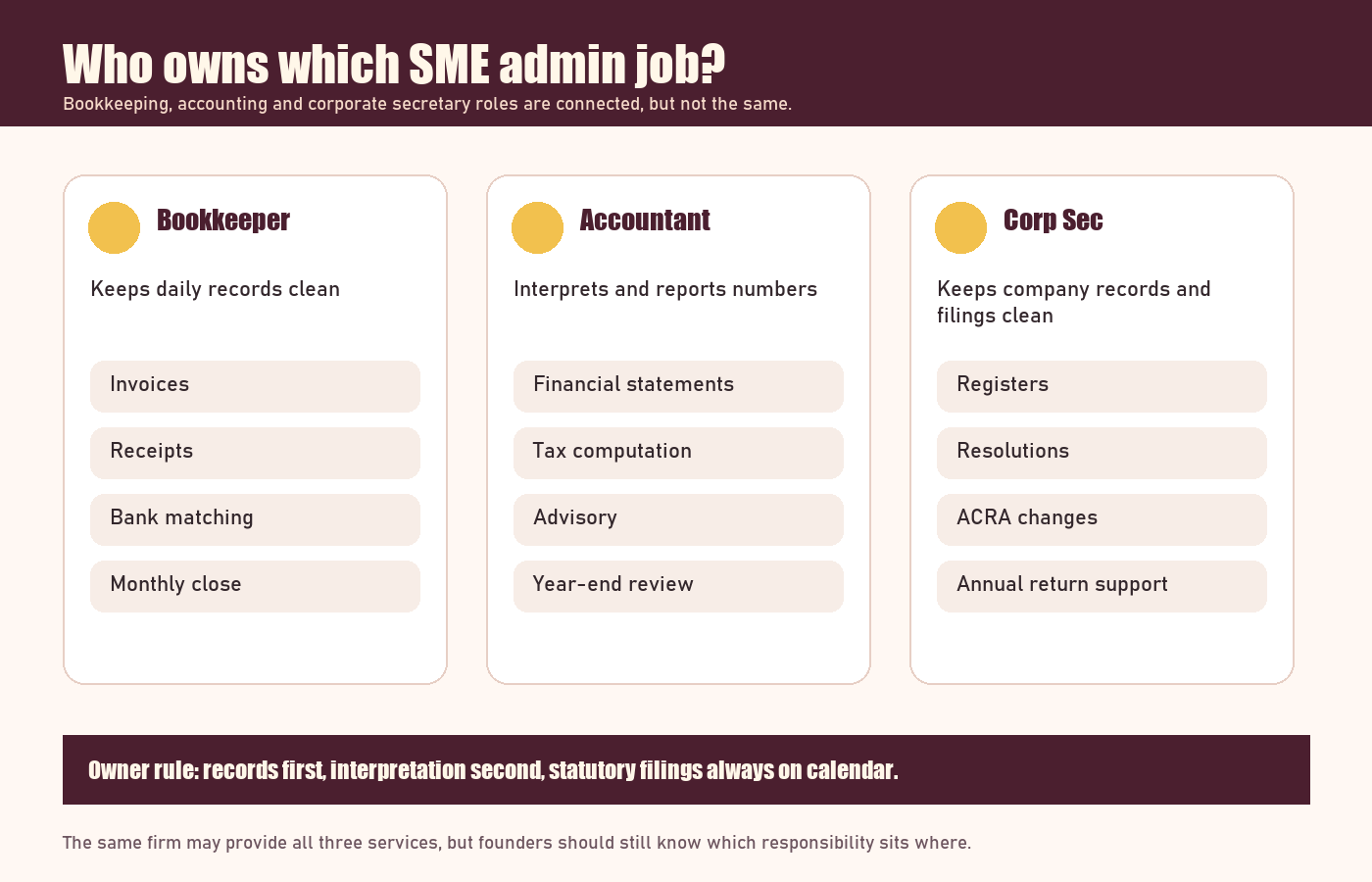
Bookkeeping keeps the numbers clean. Accounting explains and reports the numbers. Corporate secretarial work keeps the company records and statutory filings clean.
Role | Main job | Typical owner question |
|---|---|---|
Bookkeeper | Records transactions and keeps accounts updated. | Are our invoices, receipts and bank records clean this month? |
Accountant | Reviews, interprets and reports financial information. | What do the numbers mean for tax, profit, cash flow and decisions? |
Corporate secretary | Maintains statutory records, filings and company administration. | Are our ACRA records, registers, resolutions and annual filing matters in order? |
What a Bookkeeper Does
A bookkeeper keeps the day-to-day accounting records tidy. This is the operational layer of finance.
For a small Singapore business, bookkeeping often includes:
- Recording sales invoices and supplier bills.
- Matching bank transactions to invoices, receipts and payments.
- Organising receipts and source documents.
- Keeping customer and supplier balances updated.
- Reconciling bank accounts, payment gateways and petty cash.
- Preparing monthly management reports for review.
Good bookkeeping is not glamorous, but it is the base layer. If the bookkeeping is messy, the accountant spends more time cleaning data and less time giving useful advice.
What a Bookkeeper Usually Should Not Decide Alone
A bookkeeper may flag issues, but higher-judgment items should usually go to an accountant or tax adviser.
- Whether an expense is tax-deductible in a borderline case.
- How to treat complex revenue, grants, loans or related-party transactions.
- Whether financial statements are ready for external use.
- How to structure tax provisions or year-end adjustments.
For a deeper guide on setting up the monthly records, read SBO’s bookkeeping guide for small businesses in Singapore.
What an Accountant Does
An accountant turns records into meaningful financial information. They help with reporting, tax, year-end review and interpretation.
Depending on the engagement, an accountant may help with:
- Preparing or reviewing financial statements.
- Preparing tax computations and corporate tax filing support.
- Reviewing GST, payroll, CPF or other reporting workflows where relevant.
- Advising on profit, margins, cash flow and business performance.
- Making year-end adjustments such as accruals, depreciation and provisions.
- Explaining what changed compared with last month or last year.
The accountant should not be treated only as the person who appears at year end. If the business is growing, taking loans, applying for grants, raising investment or managing cash constraints, accounting advice becomes more useful when it happens before decisions are made.
When the Accountant Needs Clean Bookkeeping
An accountant can only interpret what the records support. If receipts are missing, personal and business expenses are mixed, bank reconciliation is months behind, or invoices are not issued properly, the accountant has to spend time repairing the base records.
That is why monthly bookkeeping discipline often reduces year-end stress.
What a Corporate Secretary Does
A corporate secretary handles company administration and statutory compliance. This is not the same as bookkeeping or accounting.
In Singapore, ACRA guidance says companies must have a company secretary, and the secretary should be appointed within 6 months after incorporation. The company secretary role supports the company in maintaining statutory records and meeting required filing rhythms.
A corporate secretary commonly helps with:
- Maintaining statutory registers and company records.
- Preparing directors’ and shareholders’ resolutions.
- Updating ACRA records when officers, addresses or share details change.
- Supporting annual return filing and related company administration.
- Keeping reminders for key company compliance dates.
- Documenting board or shareholder approvals properly.
The corporate secretary does not replace the directors’ responsibility. Directors still need to understand and approve important filings, resolutions and company changes.
For more detail, read SBO’s company secretary guide for Singapore SMEs.
Where the Roles Overlap
These roles work closely together, especially for small companies.
Situation | Bookkeeper | Accountant | Corporate secretary |
|---|---|---|---|
Monthly accounts | Records and reconciles transactions. | Reviews numbers and flags issues. | Usually not involved. |
Year-end accounts | Provides clean records and schedules. | Prepares or reviews financial statements and tax support. | May need figures for annual return work. |
New share issue | Records payment if money enters the company. | Checks accounting impact. | Prepares resolutions and updates statutory records. |
Director loan | Records transaction and supporting documents. | Reviews classification and tax/accounting treatment. | May help document approvals if needed. |
Change of registered address | No main role. | No main role unless billing changes. | Updates ACRA and company records. |
Can One Firm Handle All Three?
Yes, many corporate service providers offer bookkeeping, accounting, tax and corporate secretarial services together. This can be convenient for small companies because the provider sees the whole compliance picture.
But convenience is not the same as clarity. Even when one firm provides all three services, the owner should still know which function is responsible for what.
When a Combined Provider Works Well
- The company has simple transactions and predictable monthly records.
- The provider gives clear service scope and deadlines.
- There is one owner-side contact who responds quickly.
- The provider separates bookkeeping, tax and corporate secretarial deliverables clearly.
- The business does not need specialised audit, complex tax or fundraising support yet.
When Separate Specialists May Be Better
- The business has many transactions, inventory, multi-currency sales or complex revenue.
- The company is preparing for investment, acquisition, bank financing or audit.
- There are shareholder changes, option plans, restructuring or unusual corporate actions.
- The owner needs stronger advisory, not just filing support.
- Deadlines are being missed because one provider is overloaded.
What to Outsource First
Most founders should not try to do everything themselves forever. The right order depends on risk.
Business stage | Most urgent support | Why |
|---|---|---|
New Pte Ltd | Corporate secretary and basic bookkeeping setup | You need company records, statutory rhythm and clean transaction habits early. |
First sales and expenses | Bookkeeping | Receipts, invoices and bank records become messy quickly if ignored. |
First year-end | Accountant | Accounts, tax computation and financial statement review need judgment. |
Growing team or GST exposure | Accountant plus payroll/GST process review | Compliance risk rises as transactions and obligations multiply. |
Shareholder or director changes | Corporate secretary | Company records and ACRA updates need proper documentation. |
Questions to Ask Before Hiring
Before engaging a provider, ask direct questions. You are not only buying a service; you are building the company’s admin operating system.
- What exactly is included each month, quarter and year?
- Who handles bookkeeping, accounting, tax and corporate secretarial work?
- What documents do you need from us, and by when?
- How are receipts, invoices and bank statements submitted?
- Do you reconcile bank accounts monthly?
- Will you explain management reports in plain English?
- Who tracks ACRA and tax deadlines?
- What is excluded from the package?
- What happens if records are late or incomplete?
Common Mistakes SME Owners Make
The first mistake is thinking a corporate secretary handles accounting. They usually do not. Their core job is company administration and statutory records.
The second mistake is thinking an accountant can fix a year of messy bookkeeping instantly. They can help clean it, but cleanup costs time and money.
The third mistake is treating bookkeeping as low-value data entry. Clean monthly records help you manage cash, tax exposure, pricing and collections.
The fourth mistake is outsourcing without owner oversight. Providers can support the work, but directors and owners still need to know what is being submitted and approved.
A Simple Owner Workflow
- Set up bookkeeping categories and document capture from day one.
- Close bookkeeping monthly, not only at year end.
- Review P&L, balance sheet and receivables with the accountant regularly.
- Keep corporate secretary updates separate from accounting questions.
- Put ACRA, tax, GST, CPF and annual return dates into one shared compliance calendar.
- Ask each provider what they need from the other role before deadlines arrive.
Final Thought
Bookkeeper, accountant and corporate secretary are not interchangeable labels. They protect different parts of the company.
A good bookkeeper keeps the records clean. A good accountant helps you understand the numbers. A good corporate secretary keeps company decisions and statutory records properly documented.
When all three work together, the business owner gets fewer surprises, cleaner filings and better decisions.
Frequently Asked Questions
Is a bookkeeper the same as an accountant?
No. A bookkeeper usually records and reconciles transactions. An accountant reviews, interprets and reports the numbers, especially for financial statements, tax and business decisions.
Does a corporate secretary do bookkeeping?
Usually no. A corporate secretary focuses on statutory records, resolutions, ACRA updates and company administration. Bookkeeping is a separate accounting-record function.
Does every Singapore company need a corporate secretary?
ACRA guidance says Singapore companies need a company secretary, and the secretary should be appointed within 6 months after incorporation. Check current ACRA guidance for exact requirements.
Can one firm provide bookkeeping, accounting and corporate secretarial services?
Yes, many corporate service providers offer all three. The key is to confirm scope, deadlines, document requirements and who is responsible for each deliverable.
Which role should a new company outsource first?
A new Pte Ltd usually needs corporate secretary support early, plus a basic bookkeeping setup. Accountant support becomes important for year-end accounts, tax, financing and business decisions.
Sources Checked
- IRAS record keeping requirements
- IRAS basic guide to corporate income tax for companies
- ACRA setting up a local company guidance
- SBO bookkeeping guide for small businesses
- SBO company secretary guide for SMEs
Explore More Content
Table of Content