
We make boring business stories sparkle.
Singapore Business Filing Requirements: Government Paperwork SMEs Must Track
A practical guide to Singapore government paperwork and filing requirements SMEs should track across ACRA, IRAS, GST, CPF and employer submissions.


It usually starts with one small reminder.
A founder opens email after dinner and sees a notice about tax filing. Another reminder from the corporate secretary mentions the annual return. Payroll is due soon. The bookkeeper is asking for missing bank statements. Nobody is panicking yet, but the business owner suddenly realises one thing: government paperwork is not one annual task. It is a rhythm.
This guide explains the main Singapore business filing requirements that SME owners should track, especially ACRA annual returns, IRAS corporate income tax, GST, CPF and employer submissions. It is not a substitute for advice from your accountant, tax adviser or corporate secretary, but it will help you know what questions to ask before deadlines arrive.
The Big Picture
For most Singapore companies, government paperwork falls into five buckets: company filings, tax filings, GST filings, employer/payroll filings, and record keeping.
Bucket | Agency | Typical paperwork | Who should watch it |
|---|---|---|---|
Company filings | ACRA | Annual return, officer changes, registered address changes, share updates and company records. | Director and corporate secretary. |
Corporate income tax | IRAS | Estimated Chargeable Income, Form C-S, Form C-S (Lite) or Form C, tax computation and supporting records. | Director, accountant and tax preparer. |
GST | IRAS | GST F5 returns and GST payment, if the business is GST-registered. | Finance owner, bookkeeper and accountant. |
Employer submissions | CPF Board and IRAS | CPF contributions, Skills Development Levy where applicable, IR8A/AIS employment income reporting. | Payroll owner, HR and accountant. |
Records | Multiple agencies | Invoices, receipts, contracts, bank statements, payroll support, accounting schedules and tax workings. | Business owner, bookkeeper and accountant. |
Why This Matters More Now
Many SME owners treat paperwork as a cost centre. They only think about it when a form is due. That approach becomes risky as the business grows.
Clean filings affect more than avoiding penalties. Banks may ask for financial statements. Grant claims may need proper invoices and payment proof. Corporate customers may request an ACRA profile, tax residency information, or evidence that the company is in good standing. Investors and buyers will review records before they trust the numbers.
In other words, paperwork is not just admin. It is proof that the business is real, organised and financeable.
ACRA Filings: Company Records and Annual Return
ACRA filings relate to the legal company record. This is separate from tax filing.
For a Singapore company, the corporate secretary usually helps prepare and file ACRA matters, but directors should still understand what is being filed. Common ACRA-related items include annual return filing, updates to company officers, registered address changes, share changes, and maintaining statutory registers.
For many private companies, the annual return timing is tied to the financial year end and AGM or AGM exemption position. A practical planning rule is to ask your corporate secretary for the exact annual return due date as soon as your financial year end is confirmed, then place that date in the same calendar as tax and payroll deadlines.
Do not assume the annual return is only the secretary’s problem. The figures and confirmations may depend on accounting records, financial statements and director approval.
IRAS Corporate Income Tax: ECI and Annual Tax Return
Corporate income tax is filed with IRAS. This is the part many owners think of as annual tax.
There are usually two major moments to watch:
- Estimated Chargeable Income (ECI): IRAS guidance states that companies generally file ECI within 3 months from the financial year end, unless they qualify for a waiver.
- Corporate income tax return: IRAS states that companies e-File Form C-S, Form C-S (Lite) or Form C by 30 November each year, depending on eligibility and filing requirements.
The company tax return is not simply 17% of revenue. The numbers usually flow from accounting profit to tax-adjusted chargeable income. That may involve non-deductible expenses, capital allowances, loss items, exemption schemes and tax rebates where applicable.
For a plain-English walkthrough, read SBO’s Singapore corporate income tax guide. You can also use the Corporate Income Tax Calculator to estimate tax payable before your accountant finalises the filing.
Example: Company With 31 December Financial Year End
Here is a simple planning example for a company with a 31 December financial year end. Exact dates can vary by filing status and agency updates, so treat this as a planning structure rather than legal advice.
Timing | What to prepare | Why it matters |
|---|---|---|
January to February | Close bookkeeping, collect missing invoices, reconcile bank accounts, prepare year-end schedules. | Clean records make ECI, annual return and tax work easier. |
By 1 March | Submit employment income information under AIS, or provide required forms to employees where applicable. | Employees need accurate income information for personal tax. |
By 31 March | File ECI if required, or confirm waiver eligibility. | ECI is generally due within 3 months after financial year end. |
After accounts are ready | Coordinate annual return workflow with the corporate secretary. | ACRA filing may need accounting figures and director confirmation. |
By 30 November | e-File Form C-S, Form C-S (Lite) or Form C. | This is the annual corporate income tax return deadline stated by IRAS. |
GST Filings: Only If You Are GST-Registered
Not every business files GST. GST filing applies if the business is GST-registered.
For GST-registered businesses, IRAS states that GST F5 returns and payment are generally due one month after the end of the GST accounting period. Many SMEs operate on quarterly GST periods, but your assigned GST cycle should be checked in myTax Portal and with your accountant.
GST becomes painful when the company treats it like normal revenue. GST collected from customers is not the company’s money. It should be tracked, reconciled and set aside so the business is not short when the GST payment date arrives.
Employer Paperwork: CPF, SDL and IR8A/AIS
Once you hire staff, filing work becomes more regular.
Employers need to manage CPF contributions for eligible employees, Skills Development Levy where applicable, payroll records, payslips and employment income reporting. For CPF, many employers use the 14th of the following month as the operational cut-off because enforcement can begin if payment is not made by then. Check CPF Board guidance and payment method rules for exact treatment of weekends, public holidays and payment processing time.
For employment income reporting, employers under the Auto-Inclusion Scheme submit employee income information to IRAS. IRAS guidance generally points employers to a 1 March deadline for the relevant year of assessment. If you are not under AIS, you may still need to provide employees with the relevant income forms on time.
For a dedicated walkthrough, read SBO’s IR8A and AIS employer filing guide.
Record Keeping: The Part People Ignore Until It Hurts
Filing forms is only the visible part. The real work is keeping records good enough to support the forms.
IRAS states that companies should maintain proper records and keep source documents, accounting records, schedules, bank statements and other transaction records for at least 5 years from the relevant Year of Assessment.
That means a company should not only keep final accounts. It should also keep the evidence behind the numbers.
- Sales invoices and credit notes.
- Supplier invoices and receipts.
- Bank statements and payment proof.
- Payroll records, CPF submissions and employee details.
- Loan agreements and director loan support.
- Fixed asset schedules and depreciation/capital allowance support.
- Contracts, grant claim evidence and correspondence that explains unusual transactions.
If your company cannot explain a number later, the filing may have been submitted but the support is still weak.
Who Should Own the Filing Calendar?
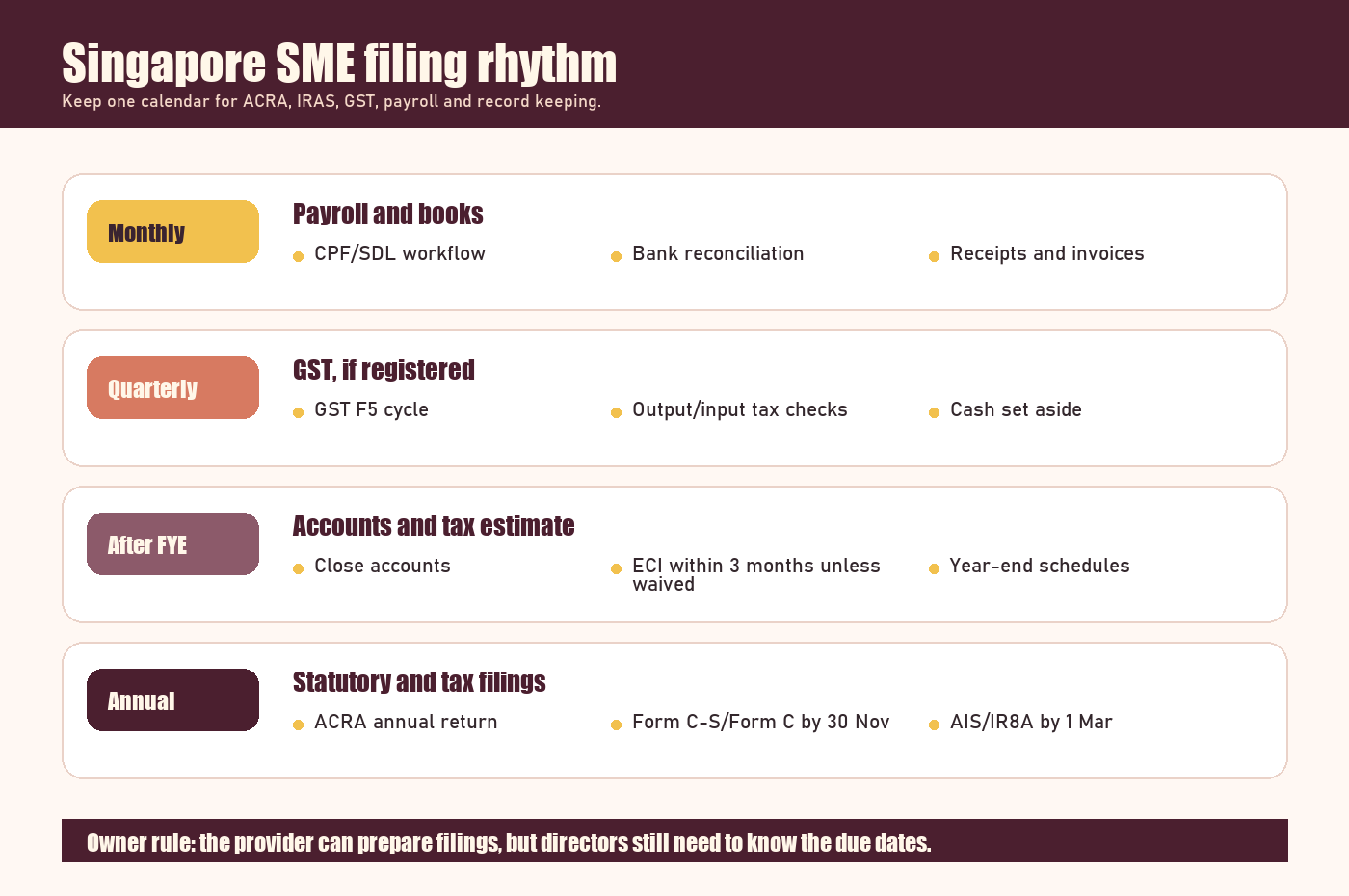
Different providers can prepare different submissions, but the business owner should still keep one master calendar.
Person or provider | Good role | What the owner should confirm |
|---|---|---|
Owner or director | Overall accountability, approvals and cash planning. | What is due, who is preparing it, and what documents are missing? |
Bookkeeper | Monthly records, reconciliations, invoices, receipts and source documents. | Are records current enough for tax, GST and management review? |
Accountant or tax agent | Tax computation, financial statements, GST review and filing support. | What assumptions, add-backs or reliefs are used? |
Corporate secretary | ACRA annual return, statutory registers, resolutions and company changes. | What approval is needed and what is the exact due date? |
Payroll or HR owner | CPF, payroll records, income reporting and staff-related documentation. | Are employee records accurate before submission? |
If you are unsure how these roles differ, read SBO’s guide on bookkeeper vs accountant vs corporate secretary.
A Simple SME Filing Routine
The best compliance system is not complicated. It is visible and repeatable.
Every Month
- Reconcile bank accounts and payment platforms.
- Upload invoices, receipts and payroll records.
- Prepare CPF and payroll submissions.
- Review aged receivables and supplier balances.
- Set aside cash for GST, tax, CPF and recurring compliance costs.
Every Quarter
- Review management accounts with your accountant or finance owner.
- File GST if your business is GST-registered and your period has ended.
- Check whether revenue growth may trigger GST registration monitoring.
- Review whether any director, shareholder, address or business activity changes need company updates.
After Financial Year End
- Close accounts and collect all missing support.
- Prepare ECI or confirm waiver eligibility.
- Ask your corporate secretary for the annual return timeline.
- Prepare financial statements and tax computation support.
- Plan cash for final tax payment, GST, CPF and other compliance obligations.
Common Mistakes to Avoid
Most paperwork problems are not caused by one dramatic error. They come from small gaps that compound over months.
- Waiting until the tax deadline to clean records: By then, invoices and explanations may already be hard to find.
- Confusing ACRA filing with IRAS tax filing: They are separate workflows and may involve different providers.
- Assuming the secretary handles tax: Corporate secretarial work and accounting/tax work are different scopes.
- Using personal bank accounts for company spending: This makes records messy and harder to explain.
- Ignoring GST until revenue is high: If your business is growing, monitor GST registration and cash flow early.
- Not keeping source documents: A filed return is weaker if you cannot support the numbers later.
Practical Next Step
Open one calendar and add every known government filing date: CPF payroll cut-offs, GST periods, ECI, annual tax return, IR8A/AIS, and ACRA annual return. Then assign one person or provider to prepare each item and one owner to confirm it is done.
The goal is not to become a compliance expert overnight. The goal is to stop treating government paperwork as surprise email. When the rhythm is visible, the business has more control.
Sources Checked
- IRAS: filing Estimated Chargeable Income
- IRAS: basic guide to corporate income tax for companies
- IRAS: filing GST returns
- IRAS: Auto-Inclusion Scheme for employment income
- IRAS: record keeping requirements
- ACRA: managing a company overview
- CPF Board: employer CPF contribution guidance
What government paperwork must a Singapore company file every year?
Common annual items include ACRA annual return requirements, IRAS corporate income tax filing, employer income reporting where applicable, and supporting accounting records. GST-registered businesses also file GST returns based on their GST accounting periods.
Is annual tax the same as the ACRA annual return?
No. Corporate income tax is filed with IRAS. The annual return is a company filing with ACRA. Both may depend on your financial year end, but they are different obligations.
Do I still need to track deadlines if I outsource accounting and corporate secretary work?
Yes. Outsourcing helps with preparation and filing, but directors and business owners should still keep a master compliance calendar and review reminders before deadlines.
What happens if I miss government filing deadlines?
Late filings can lead to penalties, enforcement letters, extra administrative work, and avoidable stress during tax, banking, grants or due diligence. The exact consequence depends on the agency and filing type.
How long should company records be kept in Singapore?
IRAS states that companies should retain proper records and supporting documents for at least 5 years from the relevant Year of Assessment. Keep accounting records, invoices, bank statements and schedules organised, not only final tax forms.
Explore More Content
Table of Content