
We make boring business stories sparkle.
A Queue Is Not Demand: Why Singapore Businesses Confuse Launch Hype With A Real Market
By 9am, the queue reached the next shop. People filmed the line before joining it. A creator announced that the...

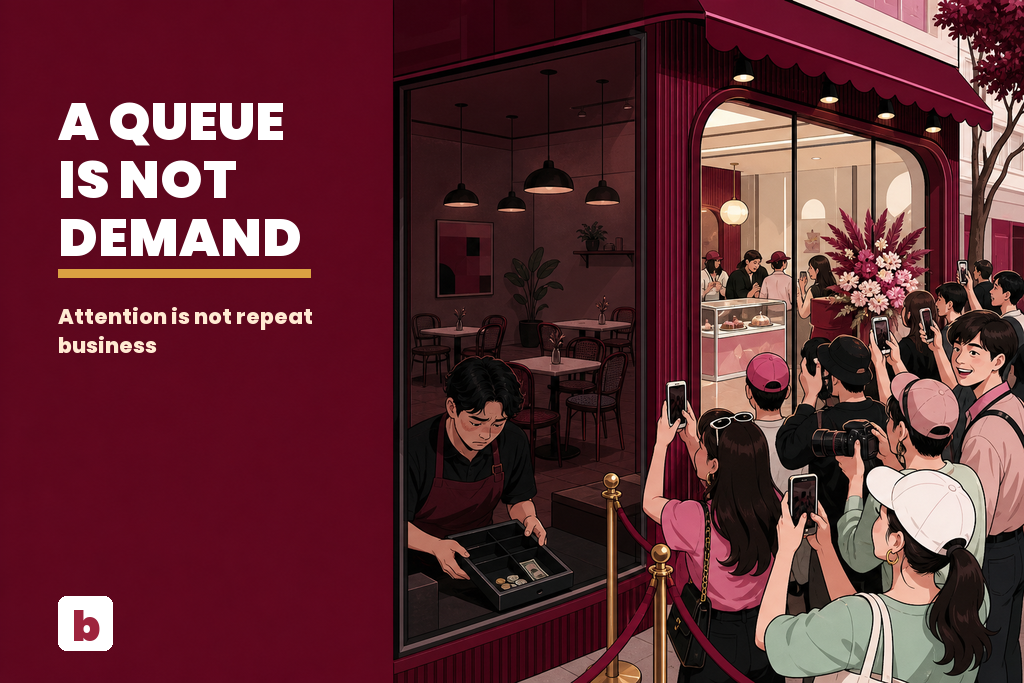
By 9am, the queue reached the next shop.
People filmed the line before joining it. A creator announced that the new bakery’s signature item was limited to two per customer. The first batch sold out. The owner reposted every video and told friends that demand had exceeded all expectations.
Three months later, the red ropes remained outside but the queue did not.
The bakery launched weekday discounts, then a second promotion for returning customers. Most people did not return. They had not been buying breakfast. They had been buying the experience of being early.
The owner had mistaken a crowd for a market.
A queue is not demand. It is only a line of people whose reasons you have not yet measured.
Why Founders Love Queues
Queues are emotionally perfect evidence.
They are visible, photographable and easy to explain. Investors can see them. Landlords can see them. Friends who doubted the idea can see them. A sales dashboard requires interpretation; a line around the corner appears to settle the argument.
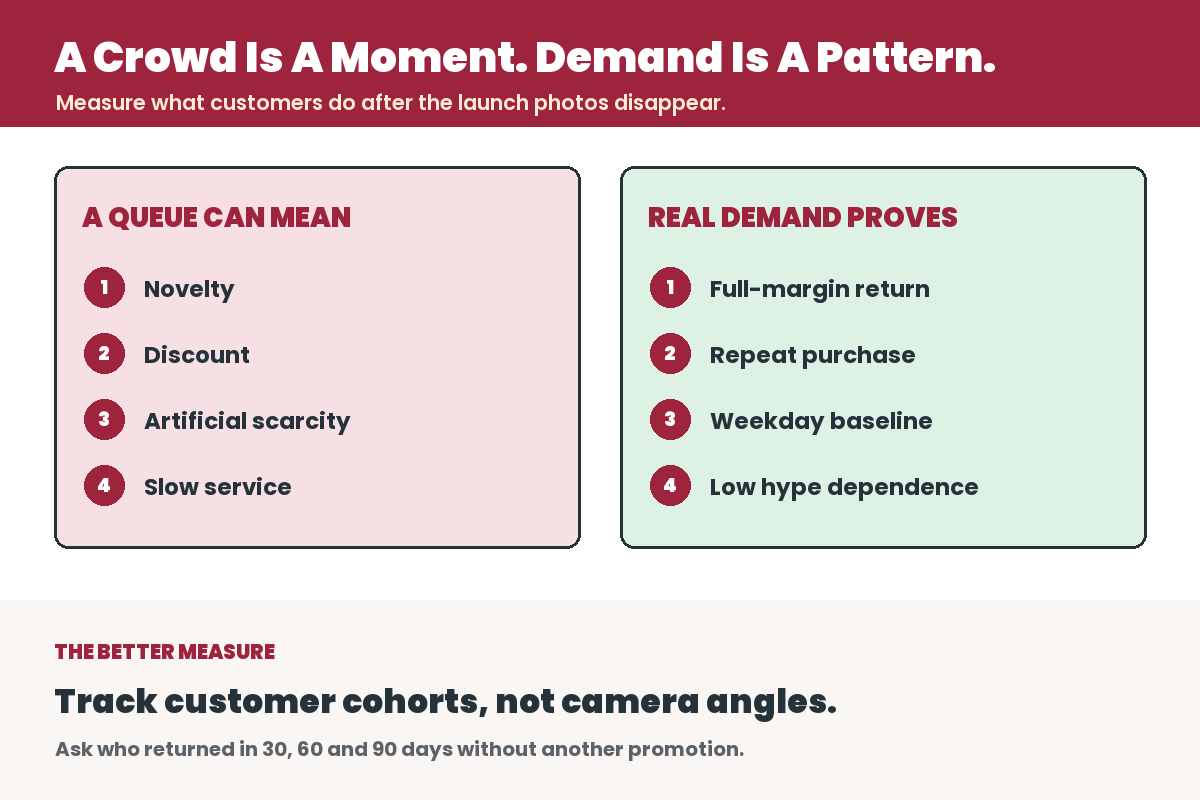
But a queue answers only one question: were enough people willing to wait at this moment?
It does not tell you:
- whether they paid full price;
- whether the sale produced contribution margin;
- whether they will return;
- whether they came for the product or the spectacle;
- whether the queue exists because service is slow;
- whether ordinary weekday demand can support fixed costs.
Attention creates traffic. Demand creates repeated economic exchange.
Visible signal | What it might mean | What must be measured |
|---|---|---|
Long opening queue | Novelty or social participation | 30-, 60- and 90-day return rate |
Sold out quickly | Strong demand or low capacity | Margin and lost-sales estimate |
Many redemptions | Offer worked | Full-price conversion afterwards |
High social reach | Content attracted attention | Tracked profitable purchases |
Weekend crowds | Peak demand exists | Ordinary weekday economics |
Positive reviews | Customers liked the experience | Whether enough return frequently |
Five Different Things Can Create A Queue
Novelty
People enjoy being first. A new foreign brand, limited product or unusual concept can attract customers who want one visit, one photograph and one opinion. Curiosity is real demand for an experience, but it may have a one-purchase lifetime.
Discount
A promotion can create volume by transferring value from the business to the customer. That proves customers like receiving more than they pay. It does not prove they accept the normal price.
Scarcity
Limited quantities and timed drops can concentrate purchases. Sometimes scarcity supports a strong premium model. Sometimes it hides the fact that total weekly demand is small.
Social Participation
The queue itself becomes the product. People join because others have joined, and posting the visit provides status or belonging. This can be commercially powerful, but it decays when attention moves elsewhere.
Operational Failure
A slow queue may simply mean the business cannot process orders. Twenty people waiting thirty minutes can represent only forty transactions per hour. A competitor with no visible queue may be serving twice as many customers.
Never treat customer inconvenience as proof of commercial strength.
Singapore Is Especially Good At Producing Launch Attention
Singapore is compact, connected and highly responsive to new concepts. One creator’s video can send customers across the island. Malls and media welcome fresh brands. Customers actively compare openings.
This makes Singapore an excellent place to create a launch and a dangerous place to mistake launch behaviour for normal behaviour.
Economic conditions also matter. The Economic Survey of Singapore 2025 reported that restaurant sales volume fell 4.5% during the year. SingStat then estimated January 2026 F&B sales at S$1.6 billion, with 22.1% coming from online sales.
The point is not that every new business is weak. It is that attention sits on top of a competitive, multi-channel market. One crowded launch cannot overrule the underlying spending environment.
Transactions Are Not The Same As Demand
A transaction happened when a customer bought.
Demand is a pattern explaining who buys, why, how often, at what price and with what margin.
A thousand launch transactions may be less valuable than two hundred customers who return every month without a promotion. The launch customers create revenue once. The returning customers support rent, payroll and planning.
This applies beyond F&B:
- a tuition centre can fill a trial class without converting a term;
- a gym can sell discounted memberships that lapse after January;
- an app can gain downloads that never become active users;
- an online shop can acquire promotion hunters who never pay full price;
- an event can sell out once because the speaker is novel;
- a service firm can book consultations that never become profitable work.
The unit of evidence is not the first action. It is the valuable behaviour that follows.
The Metrics That Expose Real Demand
Repeat Rate By Customer Cohort
Group customers by the month or campaign that acquired them. Measure how many return within 30, 60 and 90 days. A blended repeat rate hides whether launch customers disappeared while older loyal customers kept the average alive.
Contribution Margin After Every Incentive
Revenue is not demand worth buying. Subtract direct product cost, platform commission, payment fees, discounts, fulfilment and any acquisition cost tied to the order. A campaign that produces volume but negative contribution has purchased activity.
Full-Price Conversion
Track what promotion-acquired customers do after the promotion ends. If they require another voucher, the discount may be the product they value most.
Ordinary-Day Baseline
What happens on a rainy Tuesday after payday and before the next campaign? A durable business has a boring baseline. Fixed costs are paid by ordinary weeks, not screenshots from opening weekend.
Acquisition Independence
How much revenue remains when paid promotion, influencer seeding or founder publicity stops? Marketing should amplify demand, not continually manufacture a temporary audience from zero.
Service Capacity
Measure orders or customers served per labour hour. Enterprise Singapore’s 2025 food-services research found that top-performing outlets using process optimisation, central preparation and technology generated close to twice the sales per man-hour of an average outlet.
The goal is not a longer queue. It is more valuable output from the resources already paid for.
A Practical Demand Test
- Identify the first hundred customers: record source, product, price and discount.
- Tag the acquisition reason: opening event, referral, paid ad, creator, passing traffic or existing audience.
- Calculate first-purchase contribution: not merely revenue.
- Track 30-, 60- and 90-day return: use customer identifiers where lawful and practical.
- Remove the promotion: test whether customers accept the intended price.
- Measure quiet periods: know the weekday and non-campaign baseline.
- Ask what would make them switch: novelty customers often leave for the next novelty.
SBO’s guide to tracking leads through a sales pipeline applies the same discipline to service businesses: count movement through the system, not just names entering the top.
Critical Advice Before Expanding From A Successful Launch
Do Not Open Outlet Two To Solve Outlet One
A second outlet does not diversify an unproven model. It duplicates its fixed costs. Expand only when the first unit has stable full-price cohorts, reliable operations and management capacity beyond the founder.
Do Not Let Scarcity Hide Capacity
Selling out can be excellent. It can also mean the business produced too little to cover overhead. Calculate whether expanding supply improves profit or merely eliminates the social proof created by scarcity.
Do Not Reward Marketing For Unprofitable Customers
A campaign team will naturally celebrate reach, redemptions and cost per first purchase. The owner must connect those figures to contribution and repeat behaviour. Acquisition without retention is rented attention.
Do Not Sign Rent Against The Launch Peak
Landlords and founders both notice a crowd. Model rent against the conservative ordinary-day baseline, not the most photographed week. The recent SBO opinion on why good food is no longer enough in F&B explains the danger of using a strategic market’s rent for a livelihood outlet.
Let The Business Become Boring
Founders fear the loss of excitement. But repeatable demand often looks boring: familiar customers, predictable reorder intervals, stable margins, controlled capacity and fewer emergency campaigns.
Boring is not failure. Boring is what can be scheduled, financed and improved.
Queue Or Demand? A Decision Table
Question | Evidence of demand | Evidence of hype |
|---|---|---|
Why did customers come? | A recurring problem or desire | To try what everyone posted |
Will they pay normal price? | Full-price conversion remains healthy | Purchases collapse without offers |
Do they return? | Cohorts repeat within expected cycle | New customers replace disappearing ones |
Does volume create profit? | Contribution grows with sales | Every campaign creates more loss |
Can operations handle demand? | Output per labour hour improves | Waiting time creates the appearance of scarcity |
What happens without attention? | A stable baseline remains | The business becomes empty |
The Final Opinion
Launch hype is useful. Take the photographs. Welcome the crowd. Sell out if you can. Attention gives a new business a chance to collect evidence quickly.
Then stop admiring the queue and examine the customers.
Who paid full price? Who returned? Who brought someone else? Which product survived after novelty? What margin remained? What happened on Tuesday? What happened when the next opening became popular?
The earlier SBO argument that business resembles tower defence begins with placing the tower where demand moves. This article adds a warning: one wave of creeps does not prove the route will remain busy.
A queue is a moment. A market is a pattern. Build for the pattern.
References
- MTI: Economic Survey of Singapore 2025
- SingStat: Retail Sales and Food & Beverage Services Index, January 2026
- Enterprise Singapore: F&B productivity findings
This opinion article was reviewed on 23 July 2026. The opening story is a fictional composite illustrating launch behaviour, not an account of a named bakery.
Frequently Asked Questions
Does a long queue prove strong customer demand?
No. A queue can result from novelty, discounts, scarcity, social participation or slow service. Strong demand is better demonstrated through repeat purchases at healthy margins.
What is the best way to measure repeat demand?
Track customer cohorts by acquisition period and measure how many return within a commercially relevant 30-, 60- or 90-day window without requiring another promotion.
Can a sold-out launch still be a weak business?
Yes. The business may have produced too little, discounted heavily or attracted one-time curiosity. Calculate contribution margin, capacity and repeat behaviour before treating a sell-out as validation.
When should a business expand after a successful launch?
Expand after full-price repeat demand, ordinary-day economics, reliable operations and management capacity are proven. Do not use a second location to discover whether the first model works.
Explore More Content
Table of Content