
We make boring business stories sparkle.
Singapore Regional HQ Setup: What Functions Should You Put Here?
A practical guide to deciding which functions belong in a Singapore regional headquarters and which work can stay in lower-cost markets.


A foreign company opens a Singapore entity and immediately asks the expensive question: should the regional team sit here?
The first plan is ambitious. Regional sales, finance, HR, marketing, product, customer support, compliance and operations all appear on the same Singapore headcount spreadsheet. Then the salary estimates, office costs and work-pass questions arrive.
The better question is not “Can we put everything in Singapore?” It is “Which functions become more valuable because they are in Singapore?”
This guide helps foreign founders decide which regional headquarters functions belong in Singapore, which can be shared with nearby markets, and which should usually stay in lower-cost execution hubs.
The Short Answer
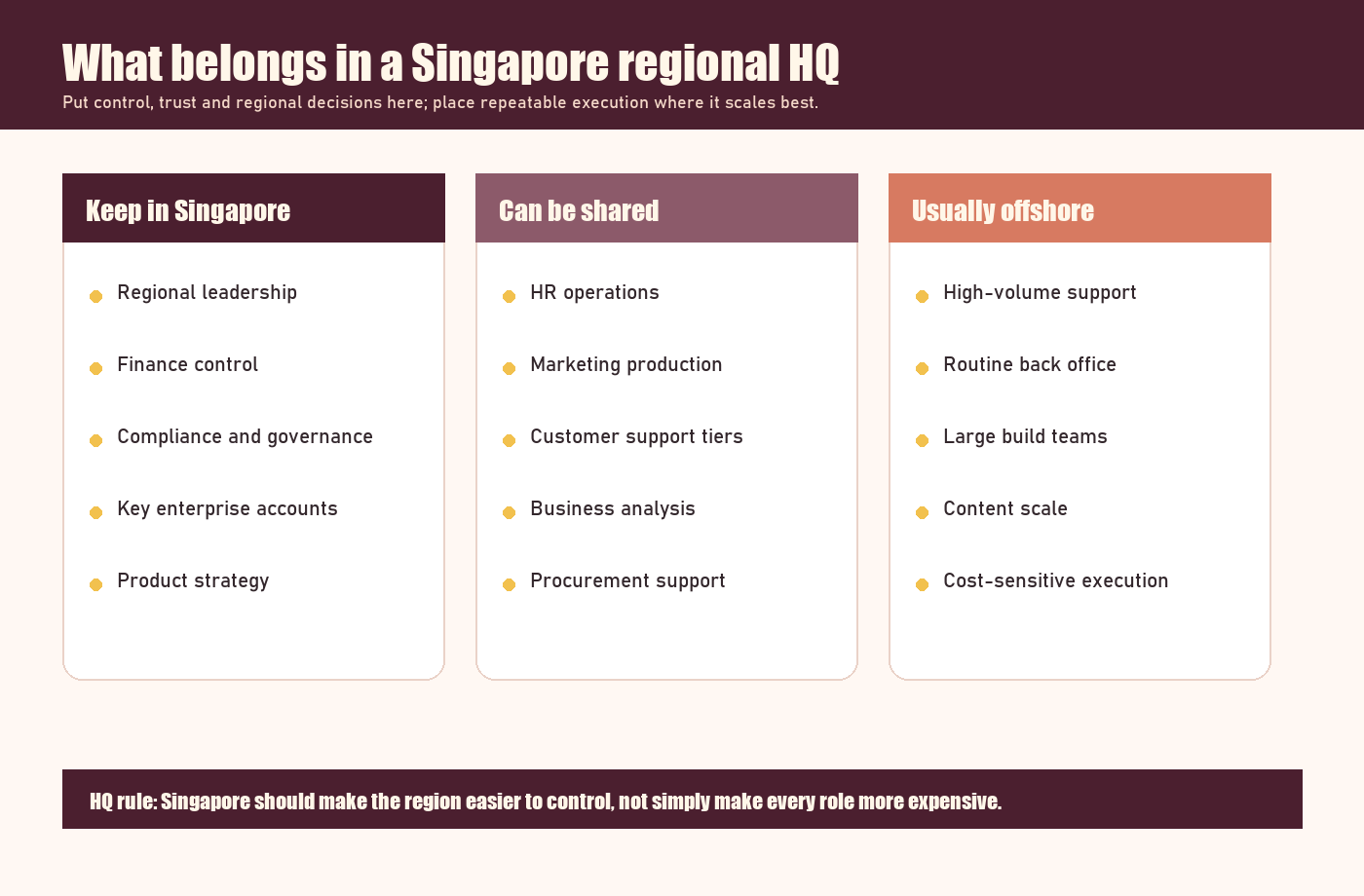
A Singapore regional HQ should hold decision-making, trust, control and high-value customer work. It should not become an expensive container for every back-office task.
Function | Put in Singapore? | Why | Alternative |
|---|---|---|---|
Regional leadership | Usually yes | Singapore works well for Asia or ASEAN coordination, senior hiring, travel and investor/customer credibility. | Keep country execution in local markets. |
Finance control | Usually yes | Useful for reporting, controls, tax coordination, banking and board visibility. | Routine bookkeeping can be outsourced or shared. |
Compliance and governance | Usually yes | Singapore’s professional services ecosystem supports regulated and documentation-heavy work. | Local-country compliance still needs local advice. |
Enterprise sales | Often yes | Good for regional key accounts, partnerships and high-trust commercial work. | Country-level sales can sit near customers. |
Product strategy | Often yes | Useful when Singapore customers, regulators or partners influence roadmap. | Engineering build teams can be distributed. |
High-volume support | Usually no | Singapore cost is high for repeatable support work. | Malaysia, Philippines, Vietnam, India or other hubs depending on language and service model. |
What Singapore Is Good For
Singapore is often useful as a headquarters because it combines English business communication, finance infrastructure, professional services, regional travel access, legal predictability and a skilled workforce.
That does not mean every function must be local. The strongest Singapore HQs are deliberate. They use Singapore for the work where trust and coordination matter most.
Functions That Commonly Belong in Singapore
- Regional general management: accountability for revenue, hiring, country expansion and operating rhythm.
- Finance control: reporting, cash visibility, transfer-pricing coordination, budget control and tax workflow.
- Compliance and governance: company records, data protection, regulated-market coordination and policy oversight.
- Enterprise sales and partnerships: regional key accounts, strategic alliances, channel management and executive relationships.
- Product or solution leadership: customer discovery, product-market fit, solution design and regional roadmap decisions.
- Senior HR governance: compensation philosophy, leadership hiring, employment standards and performance frameworks.
These functions justify Singapore cost because they reduce regional uncertainty.
What Usually Should Not Be Centralised in Singapore
If a function is repeatable, process-heavy and not dependent on Singapore trust or senior judgment, placing it in Singapore can make the company unnecessarily expensive.
Common examples include:
- Large first-line customer support teams.
- Routine data processing and back-office administration.
- Large engineering build teams where product leadership can manage distributed delivery.
- Content production, creative resizing or campaign operations at scale.
- Transaction processing that can be handled by a shared-services provider.
For human-capital cost context, read SBO’s Singapore human capital guide for foreign investors.
Three Regional HQ Models
Different companies need different levels of substance. A small market-entry office does not need the same structure as a regional operating company.
Model | What sits in Singapore | Best for | Watch out for |
|---|---|---|---|
Lean market-entry hub | Country lead, outsourced accounting, corporate secretary, sales support and key contractors. | Testing demand before major hiring. | Founder must stay close to execution. |
Regional control hub | Regional GM, finance controller, compliance lead, senior sales and HR governance. | Companies managing several ASEAN markets. | Needs clear authority over country teams. |
Full operating HQ | Leadership, finance, HR, legal coordination, product, customer success, partnerships and selected shared services. | Companies with real regional revenue, teams and board oversight. | High cost; requires substance and disciplined role design. |
Cost Stack to Plan Before Hiring
Regional HQ cost is not only office rent and salaries. Budget the operating stack.
Cost area | What to include | Planning note |
|---|---|---|
People | Salary, CPF where applicable, bonus, benefits, insurance and recruitment fees. | Senior Singapore talent is valuable but expensive. |
Entity administration | Company secretary, registered office, accounting, tax filing, audit if required and annual returns. | Do not treat compliance as an afterthought. |
Work passes | Employment Pass, S Pass or other pass planning where foreign employees are needed. | MOM salary thresholds, COMPASS, quota and levy rules can affect plans. |
Office and systems | Workspace, laptops, cybersecurity, HR/payroll software, accounting software and collaboration tools. | Regional teams need strong documentation and access control. |
Travel and market coverage | Regional travel, local-country vendors, translation, legal advice and market research. | A Singapore HQ still needs local market presence. |
For payroll and first-hire basics, read SBO’s guide to hiring your first employee in Singapore and Employment Pass vs local hiring guide.
Singapore Versus Lower-Cost Markets
Singapore is rarely the cheapest place to hire. That is not the point.
Use Singapore where the cost buys speed, trust, governance and regional leverage. Use Malaysia, Vietnam, China, the Philippines, India or other markets where the work can be scaled through process and management.
Work type | Singapore fit | Lower-cost market fit |
|---|---|---|
Regional strategy | Strong. Senior leaders can coordinate markets, investors and partners. | Useful for local-market execution, less ideal for regional control. |
Finance and compliance | Strong for control, reporting and governance. | Routine processing can be shared if review stays strong. |
Enterprise sales | Strong for regional and Singapore key accounts. | Country sales should sit near local buyers. |
Engineering build | Good for product leadership and architecture. | Often better for larger build teams if quality management is mature. |
Customer support | Good for escalation and premium accounts. | Often better for volume support and extended hours. |
Tax and Substance: Do Not Build a Paper HQ
Singapore’s corporate income tax rate is 17%, according to IRAS. That headline rate is only one part of the decision. A regional HQ also needs real commercial substance: people, decisions, contracts, risks, functions and records that match the story the company tells banks, tax advisers and counterparties.
Do not set up a Singapore HQ purely for a tax headline or incentive hope. Cross-border charging, transfer pricing, tax residency, permanent establishment risk and group structure should be reviewed by qualified advisers.
For a plain-English tax overview, read SBO’s Singapore corporate income tax guide.
How to Decide What Goes Into the HQ
Use this simple filter for each function:
- Decision value: Does the function make regional decisions?
- Trust value: Does the function face customers, banks, regulators, investors or partners?
- Control value: Does the function reduce financial, legal, compliance or brand risk?
- Talent value: Is Singapore a better market for this capability than nearby alternatives?
- Cost value: Does the extra Singapore cost produce measurable speed, quality or risk reduction?
If a function does not pass at least one of the first three filters, think carefully before putting it in Singapore.
Suggested First-Year Setup
For many foreign companies, a sensible first year looks like this:
- Appoint a local or regional lead with clear authority.
- Outsource corporate secretary, accounting, tax and payroll until volume justifies in-house roles.
- Hire one finance or operations controller once transactions and headcount grow.
- Put senior sales or partnerships in Singapore if regional customers are here.
- Keep build, support or processing teams offshore until the workflow needs Singapore control.
- Review the structure after 6 to 12 months using revenue, cost, risk and hiring data.
Common Mistakes
- Moving every function to Singapore: this can make the HQ expensive without improving control.
- Keeping only a paper company: banks, customers and tax authorities may expect substance.
- Hiring a country manager with no clear authority: a Singapore HQ needs decision rights.
- Under-budgeting finance and compliance: regional growth creates reporting complexity.
- Forgetting local markets: Singapore can coordinate ASEAN, but it cannot replace local country knowledge.
Sources Checked
- Enterprise Singapore: Go Global
- IRAS: basic guide to corporate income tax for companies
- MOM: Income summary table
- MOM: Employment Pass eligibility
- MOM: S Pass eligibility
Frequently Asked Questions
What functions should a Singapore regional HQ usually keep locally?
Common Singapore HQ functions include regional leadership, finance control, compliance, legal coordination, enterprise sales, partnerships, product strategy, senior HR governance and investor or banking relationships.
Should a Singapore regional HQ hire a large execution team?
Not always. Singapore is usually better for control, customer trust and regional coordination. Large support, production, content or development teams may be more cost-effective in lower-cost markets if quality controls are strong.
Is Singapore a good place for a regional headquarters?
Singapore can be strong for ASEAN or Asia-Pacific headquarters because of its business environment, English working language, finance ecosystem, logistics links and professional talent base. The cost makes sense when the HQ has real decision-making work.
Can a Singapore HQ manage teams in Malaysia, Vietnam or China?
Yes, if the operating model is clear. The Singapore team should own standards, reporting, customer commitments and governance, while offshore teams handle work that can be managed through process and quality checks.
Should tax incentives decide where I put HQ functions?
No. Tax and incentive planning can matter, but the HQ should first have commercial substance. Get professional tax advice before relying on incentives or cross-border charging structures.
Explore More Content
Table of Content