
We make boring business stories sparkle.
If Customers Keep Asking the Same Question, Your Business Has Failed to Explain Itself
Repeated customer questions are operational data. Businesses should fix the unclear offer or process instead of blaming customers for not reading.


A business owner receives the same message again.
“What exactly is included in the package?”
He sends the standard reply, closes the chat and complains to his colleague: “Customers never read.”
The next morning, another prospect asks the same question. By Friday, five people have asked it. One pays for the wrong package. Another abandons checkout. A third demands a refund because her understanding of “unlimited support” was very different from his.
The owner still thinks he has a customer problem.
He has an explanation problem.
One confused customer may have missed something obvious. When many unrelated customers misunderstand the same point, the business has received data. Refusing to recognise that data is not toughness. It is operational denial.
Repeated Confusion Belongs To The System
Business owners love to believe that the explanation is clear because it is clear to them.
Of course it is. They designed the offer. They know which exceptions sit behind each sentence. They know that “basic setup” excludes migration, that “monthly support” means two calls, and that the cheapest plan does not include custom reporting.
The customer sees a page for 30 seconds between two meetings.
Clarity is not measured by what the writer intended. It is measured by what the buyer can correctly understand without a private lesson from the founder.
If the same question keeps appearing, the system is producing it.
Confusion Has A Real Cost
Repeated question | Likely weakness | Business cost |
|---|---|---|
“How much is it really?” | Hidden conditions or fragmented pricing | Abandoned sales and distrust |
“What is included?” | Vague scope or overlapping packages | Long sales calls and scope disputes |
“What happens next?” | Weak onboarding or no visible process | Support load and customer anxiety |
“Is this suitable for me?” | Poor customer definition | Bad-fit buyers and refunds |
“Who is responsible?” | Unclear ownership or handoffs | Delay, blame and duplicated work |
“Can it do this too?” | Unclear limits or inflated promise | Disappointment and reputation damage |
Support time is only the visible cost. Confusion also lowers conversion, lengthens sales cycles, attracts the wrong customers, creates inconsistent promises between employees and turns ordinary delivery issues into arguments about what was sold.
A ten-minute repeated explanation delivered 200 times is no longer a ten-minute problem. It is a broken interface between the business and the market.
“Customers Do Not Read” Is Sometimes True And Usually Useless
People skim. They overlook terms. They click too quickly. Some customers will ignore even excellent instructions.
That observation changes nothing.
A business cannot redesign human attention. It can redesign the information customers encounter. Important conditions should not depend on a buyer reading twelve paragraphs of equal-looking text. The price, outcome, limit, next step and major exception need visual priority.
CCCS states that businesses should be upfront about prices and avoid hidden charges. Its fair-trading guidance also emphasises transparent conduct so consumers can make informed decisions. That is not merely a compliance concern. It is good commercial design.
A mandatory condition hidden in fine print is not made clear by the technical fact that the sentence exists somewhere.
Build A Repeated-Question Log
Most businesses answer questions and throw away the evidence.
Instead, record the customer’s exact words, where the question appeared, which product or stage caused it, whether the person bought, and how much staff time the answer required. Include live chat, sales calls, WhatsApp, refund requests, reviews and staff escalations.
What to record | Why it matters | Action trigger |
|---|---|---|
Exact customer wording | Reveals the customer’s mental model | Same meaning appears three times |
Page or process stage | Locates the information failure | Questions cluster at one step |
Outcome | Connects confusion to sales or churn | Lost sale, refund or delay |
Staff answer | Exposes inconsistent promises | Different employees answer differently |
Time consumed | Shows the operational cost | Repeated explanation exceeds rewrite effort |
This is not a request to build a giant dashboard. A shared sheet with disciplined categories can be enough. The purpose is to turn irritation into prioritised work.
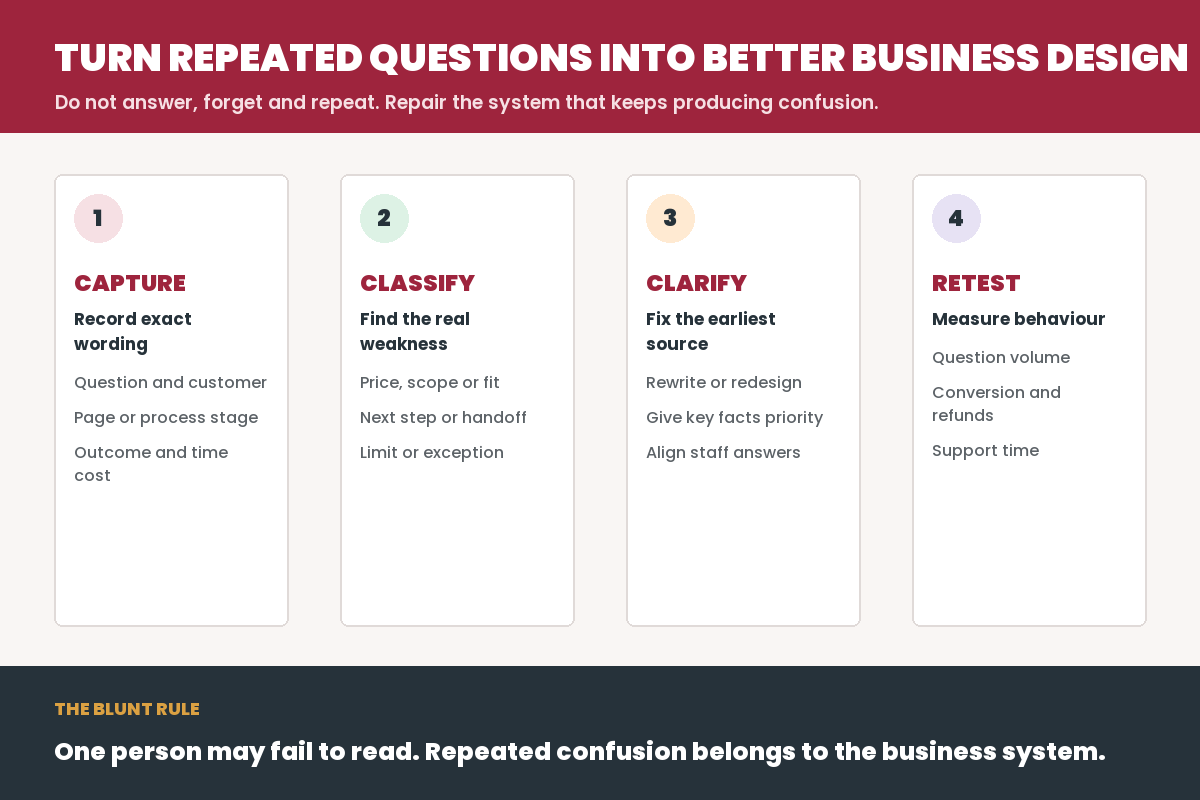
Fix The Earliest Point Of Confusion
Do not solve every repeated question by adding another FAQ at the bottom of the page.
If people cannot tell packages apart, redesign the comparison. If the final price surprises them, fix the price presentation. If new customers do not know what happens after payment, show the onboarding sequence before checkout. If employees give different answers, clarify the internal rule before rewriting marketing copy.
The best support answer is sometimes the one the customer never needs to request.
Use SBO’s guides to small-business pricing strategy and productised services to make price, scope and delivery boundaries more explicit. Then track the effect through the sales pipeline instead of assuming the rewrite worked.
Test Comprehension, Not Beauty
Show the page, quotation or onboarding message to someone who was not involved in creating it. Give them a short time and ask them to explain:
- Who is this for?
- What result is being sold?
- What does it cost?
- What is excluded?
- What happens after payment?
- What would make them hesitate?
Do not correct them while they answer. Every correction is evidence that the page depended on information that was inside your head rather than on the screen.
After the rewrite, compare question volume, conversion, support time and refund reasons. Clarity should change behaviour, not merely satisfy the person who wrote the copy.
Clear Does Not Mean Saying Yes To Everything
Some business owners resist clarity because they fear that visible limits will reduce sales.
Good. A visible limit should reduce the wrong sales.
If weekend support is unavailable, say so. If revisions are capped, state the number. If a result depends on the customer’s input, explain that dependency. Ambiguity can close a deal today and create an expensive customer tomorrow.
SBO’s article on why the cheapest customer can cost the business the most applies here. A customer who bought through an unclear promise may consume far more time than the revenue deserves.
Not Every Question Requires A Redesign
A repeated question matters when it comes from relevant customers, appears at a meaningful rate and affects trust, purchase or delivery. Do not bloat the product because one unusual buyer requests an edge case.
Separate confusion from negotiation. “I do not understand the revision limit” is a clarity problem. “I understand the two-revision limit but want ten for the same price” is a commercial boundary.
The first deserves explanation. The second deserves a different package or a polite no.
My Opinion
Businesses should stop treating repeated customer questions as evidence that the public is stupid.
Customers have limited attention. Competitors are one click away. Staff have imperfect memories. The business owns the responsibility of making its offer, price, limits and process understandable under those conditions.
One person may fail to read.
When everyone keeps asking the same question, the business has failed to explain.
Sources And Further Reading
- CCCS: Policies and positions on price transparency
- CCCS: Fair trading practices
- CCCS: Example guidance on clear quotations, timelines and service descriptions
Frequently Asked Questions
Why do customers keep asking questions that are already answered?
The information may exist without being prominent, understandable or placed at the right decision point. Track the repeated wording and process stage before assuming customers simply refuse to read.
Should every customer question be added to an FAQ?
No. Fix the earliest source of confusion. A pricing question may require a clearer comparison table, while an onboarding question may require a visible sequence before payment.
How can a business measure customer confusion?
Track repeated questions, page or process stage, staff answer, support time, abandoned sales, refunds and complaints. Compare these measures after changing the explanation.
What if the customer understands the limit but still wants an exception?
That is negotiation rather than confusion. Keep the boundary, offer a suitable higher package or decline the request instead of repeatedly changing the standard offer.
Explore More Content
Table of Content