We make boring business stories sparkle.
Passive Income in Singapore: Active, Semi-Passive and Passive Income Explained
A practical guide to passive, semi-passive and active income, with ideas for building income streams beyond one salary.

Passive income is attractive because it sounds like freedom: money coming in even when you are not working. But the honest version is less magical and more useful. Most passive income starts as active work, then becomes more passive only after you build an asset, system, audience, product, or capital base.
That distinction matters today. A job can still be valuable, but it should not be the only pillar of your financial life. Companies restructure, industries change, skills expire faster, and loyalty from either side is less certain than it used to be.
The point is not to quit your job tomorrow. The point is to start building something outside your salary so your life is not completely dependent on one employer’s decision.
Passive, semi-passive and active income: what is the difference?
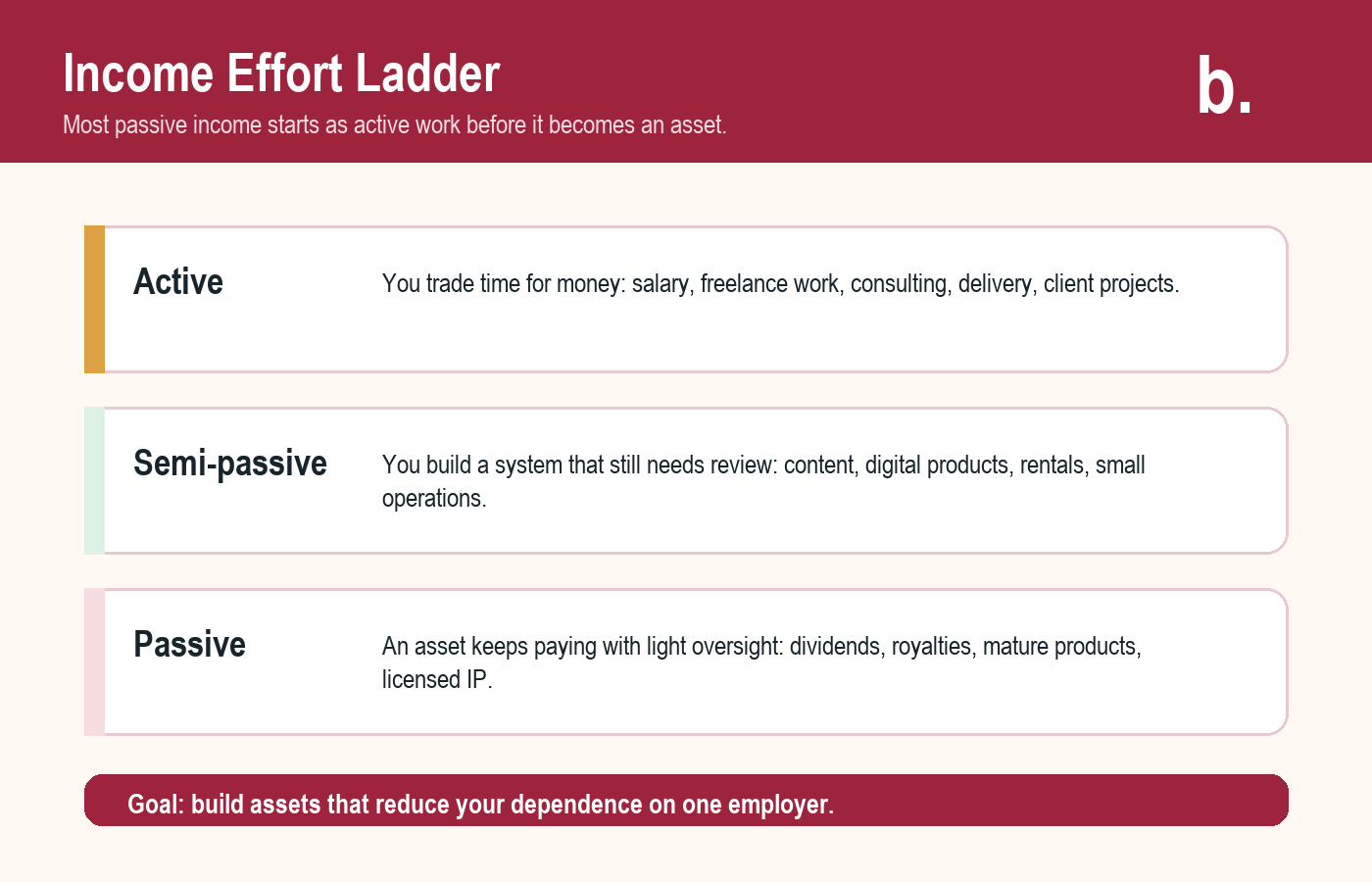
The cleanest way to understand income is by asking how much ongoing effort is needed to keep it alive.
Income type | What it means | Examples | The honest catch |
|---|---|---|---|
Active income | You earn mainly by showing up and doing the work. | Salary, freelance projects, hourly consulting, delivery work, service business owner doing delivery personally | If you stop working, income usually stops quickly. |
Semi-passive income | A system or asset earns, but you still maintain, update, sell, manage, or review it. | Affiliate site, YouTube channel, digital templates, rental property, productised service, ecommerce with outsourced fulfilment | It still needs decisions, maintenance, and problem-solving. |
Passive income | An asset keeps paying with light oversight after the hard setup or capital investment is done. | Dividends, mature royalties, licensed IP, automated digital products with steady traffic, well-managed rental income | It usually needs capital, time, risk, or years of upfront work. |
Why passive income matters more now
For many people, the old career bargain feels weaker: work hard, stay loyal, and a stable employer will take care of your future. Some companies still treat people well, but it is risky to build your whole life around that assumption.
Passive and semi-passive income matter because they create optionality. Optionality means you have more choices when your job changes, your industry slows, your family needs time, or your body simply cannot keep working at the same pace forever.
- It reduces dependence on one paycheck. Even a small second income can make job loss or reduced hours less frightening.
- It forces you to build assets. Skills, content, products, relationships, IP, and capital can outlast a job title.
- It teaches business thinking. You learn how to create value, reach buyers, manage risk, and improve systems.
- It gives your time a future value. Work done today can keep producing later if it becomes an asset.
The truth: passive income usually starts active
A common mistake is chasing passive income before earning the right to make it passive. A dividend portfolio needs capital. A rental property needs money and management. A YouTube channel needs content. A digital product needs distribution. A course needs trust.
So the better question is not, “How do I make money without work?” It is, “What can I build now that may need less of my time later?”
Active first, system second
Many strong income streams start with active service work. You freelance, consult, teach, design, write, code, or help clients directly. Then you notice repeated problems and turn them into templates, guides, retainers, products, courses, or repeatable offers.
Capital can help, but capital is not the only path
Investments can be passive, but they usually require savings first. If you do not have much capital, start with skill-based assets: content, audience, digital products, productised services, or tools that solve a narrow problem.
Passive income ideas you can start building
Use these ideas as inspiration, not as promises. The best option depends on your skills, time, risk tolerance, and whether you can stay consistent long enough for the asset to compound.
1. Dividend and income investing
This can be one of the cleaner forms of passive income because the asset is financial. But it requires capital, patience, risk control, and a willingness to accept that returns are not guaranteed.
Do not treat investing as quick money. Learn basic diversification, fees, risk, time horizon, and emergency-fund planning before chasing yield. Singapore readers can use neutral education resources such as MoneySense as a starting point.
2. Content assets
A blog, YouTube channel, newsletter, podcast, or social content library can become semi-passive when older content keeps attracting readers, leads, affiliate income, sponsors, or product buyers.
The hard part is distribution. Most people quit before the audience compounds. Start with a topic where you can publish useful material for at least a year.
3. Affiliate and review sites
Affiliate income is semi-passive when useful content keeps bringing buyers through search, social, or email. It works best when the content genuinely helps a reader decide, not when it feels like random product pushing.
For broader context, read SBO’s guide on how to make money online in Singapore.
4. Digital products
Templates, spreadsheets, Notion systems, design assets, checklists, training guides, mini-courses, and calculators can keep selling after the first version is built. They are not fully passive because you still need updates, support, and marketing.
The best digital products usually come from repeated problems you understand deeply.
5. Productised services
A productised service turns custom work into a fixed offer with a clear scope, price, process, and outcome. It is not passive at first, but it can become less dependent on you if the workflow is documented and delivery can be delegated.
This is often a realistic bridge for people who have skills but not much capital. SBO has a deeper guide to productised services.
6. Rental or asset leasing income
Property rental, equipment rental, or leasing useful assets can generate recurring income, but it is rarely completely passive. You still deal with maintenance, vacancies, tenants, regulations, repairs, and cash-flow risk.
7. Royalties and licensed IP
Books, music, software, designs, photos, training materials, patents, or branded frameworks can produce royalty-like income. This is difficult but powerful because the asset can outlive the original work session.
How to choose your first income stream
Do not choose based on what sounds most passive. Choose based on what you can actually build.
- If you have skill but little capital: start with services, content, templates, coaching, or productised offers.
- If you have savings but little time: learn long-term investing basics and avoid complicated high-maintenance schemes.
- If you have an audience: consider affiliate income, digital products, sponsorships, courses, or paid communities.
- If you run a business: look for processes, products, licences, or recurring revenue that reduce dependence on your own labour.
- If you are unsure: start with active income that teaches you a market, then convert repeated work into an asset.
What to avoid
Passive income attracts hype. Be careful when someone sells certainty, urgency, or effortless returns.
- Avoid anything that promises guaranteed high returns with little explanation.
- Avoid borrowing heavily for something you barely understand.
- Avoid business models where you are the product and only the platform earns consistently.
- Avoid building too many income streams at once. One serious project beats five abandoned ideas.
- Avoid calling something passive when it is really another job with worse pay.
A practical 12-month starting plan
If you want inspiration but also structure, use a simple year-long plan.
Months 1 to 3: pick one lane
Choose one income stream based on your current skill, available time, and resources. Define what the first small win looks like: first client, first article, first product, first email list subscriber, or first investment plan.
Months 4 to 6: publish or sell consistently
Do the boring repetitions. Create content, pitch clients, improve your offer, talk to buyers, save capital, or build the product. At this stage, consistency matters more than perfection.
Months 7 to 12: turn work into an asset
Document your process. Package the repeated part. Build a page, template, checklist, course, email sequence, or workflow. The goal is to make the income stream less dependent on your daily energy.
The bottom line
Passive income is not about escaping work. It is about making sure some of your work survives beyond the hour you spent doing it.
In a world where job loyalty and stability are less certain, building income outside your salary is not just a money move. It is a life-resilience move. Start small, stay honest, avoid hype, and build one asset at a time.
Frequently Asked Questions
What is considered passive income?
Passive income is income from an asset that can keep paying with light ongoing oversight, such as dividends, royalties, mature digital products, or well-managed rental income. Most streams still need some monitoring.
What is semi-passive income?
Semi-passive income is income from a system or asset that still needs regular maintenance, marketing, review, or management, such as affiliate sites, content assets, digital products, or rentals.
Is a side hustle passive income?
Usually not at the start. A side hustle is often active income until you turn repeated work into a product, process, audience, or asset that can earn with less direct effort.
Why is passive income important?
It reduces dependence on one paycheck, gives you more choices when jobs or industries change, and encourages you to build assets that can outlast a single employer.
Explore More Content
Table of Content