
We make boring business stories sparkle.
Singapore Corporate Income Tax Filing 2026: What to Do by 30 November
A practical guide to the 30 November 2026 deadline, the right IRAS form, and what the enhanced 50% corporate tax rebate means for your tax bill.

Singapore companies with a Year of Assessment (YA) 2026 corporate income tax return due must file it by Monday, 30 November 2026 through myTax Portal. A company that traded at a loss can still have a return to file. Even a dormant company usually has to file unless IRAS has granted it a waiver.
If someone else handles your accounts, ask for three things this week: the form they will use, the name of the person authorised to submit it, and the acknowledgement once it goes through. Then check how the enhanced rebate affects the cash you’ll need when the tax bill arrives. This guide builds on IRAS’s 2026 TaxBytes update.
Who has to file for YA 2026?
For an established company with a 31 December year-end, YA 2026 typically covers the financial year ended 31 December 2025. If you started trading or received income, a loss does not remove your filing obligation. Estimated Chargeable Income (ECI) is a separate filing, so check that the annual return has been submitted even if you already filed ECI or qualified for an ECI waiver.
First return? If you incorporated in 2025, closed your first accounts in 2025 and started business or earned income that year, IRAS says you generally have a YA 2026 return to file. If your first accounts closed in 2026 or cover more than 12 months, check how IRAS assigns the accounting period across YAs. IRAS’s guide for companies has examples.
Dormant? If the company carried on no business and received no income during the financial year, check its status under Update Corporate Profile in myTax Portal. IRAS says a company marked Active in this situation should file the Form for Dormant Company. No Business Done indicates that IRAS has granted a filing waiver. If the company has resumed business and still shows that status, submit the Recommencement of Business form to request the return. See the IRAS 2026 filing guide.
Which corporate tax form should you use?
| Form | When to use it | What to prepare |
|---|---|---|
| Form C-S (Lite) | You qualify for Form C-S and annual revenue is S$200,000 or less. | Six essential fields. Prepare and keep your financial statements and tax computation. |
| Form C-S | A Singapore-incorporated company with annual revenue generally up to S$5 million that meets the other eligibility conditions. | Prepare and keep your financial statements and tax computation for IRAS if requested. |
| Form C | The company needs to file and does not qualify for the other forms. | Submit financial statements, tax computation and applicable supporting schedules. |
| Form for Dormant Company | No business and no income during the financial year, with filing still required. | Complete the dormant company declarations. |
Revenue is only one test. For example, claiming foreign tax credit or group relief generally rules out Form C-S, even if revenue is under S$200,000. There is also a concession for a temporary revenue increase: if you filed Form C-S in YA 2025 and went over S$5 million in YA 2026, you may still use Form C-S if you meet the other conditions. Check the full eligibility rules and IRAS’s Form C-S FAQ.
What the 50% rebate actually does to your tax bill
For YA 2026, the enhanced Corporate Income Tax (CIT) Rebate is 50% of corporate tax payable. The rebate and the S$2,000 CIT Rebate Cash Grant together are capped at S$40,000 per company. The grant is paid automatically to eligible active companies. The standard employee condition is that the company made CPF contributions for at least one Singapore citizen or permanent resident employee in calendar year 2025, excluding shareholders who were also directors of that company.
Suppose your tax payable before the rebate is S$18,000. Half is S$9,000. If the company qualifies for the S$2,000 cash grant, IRAS applies the remaining S$7,000 as a rebate against the tax bill, leaving S$11,000 payable. The S$2,000 arrives separately. If the company does not qualify for the grant, it gets the full S$9,000 as a rebate and the bill is S$9,000. In both cases the benefit is S$9,000, but the amount to set aside for the bill differs. File your chargeable income without deducting the rebate. IRAS calculates it as part of the assessment. See the IRAS rebate rules and SBO’s corporate income tax guide for how the underlying tax is calculated.
Two other schemes worth checking
- SME Cash Grant 2026. Eligible companies can receive S$500 per qualifying local employee, up to S$2,500, based on their highest qualifying monthly headcount from April to June 2026. IRAS assesses eligibility automatically. This grant is taxable for companies, while the CIT Rebate Cash Grant is non-taxable. See the SME Cash Grant rules.
- Enterprise Innovation Scheme (EIS). Qualifying spending can attract deductions or allowances of up to 400%, subject to the applicable limits. Eligible companies may instead convert up to S$100,000 of qualifying spending into a cash payout at 20%. If you want the payout, submit the tax return before the deadline so you can make the separate payout application by 30 November. Check the EIS eligibility and application rules, including the three full-time local employee condition for the cash option.
What to do before you close the filing task
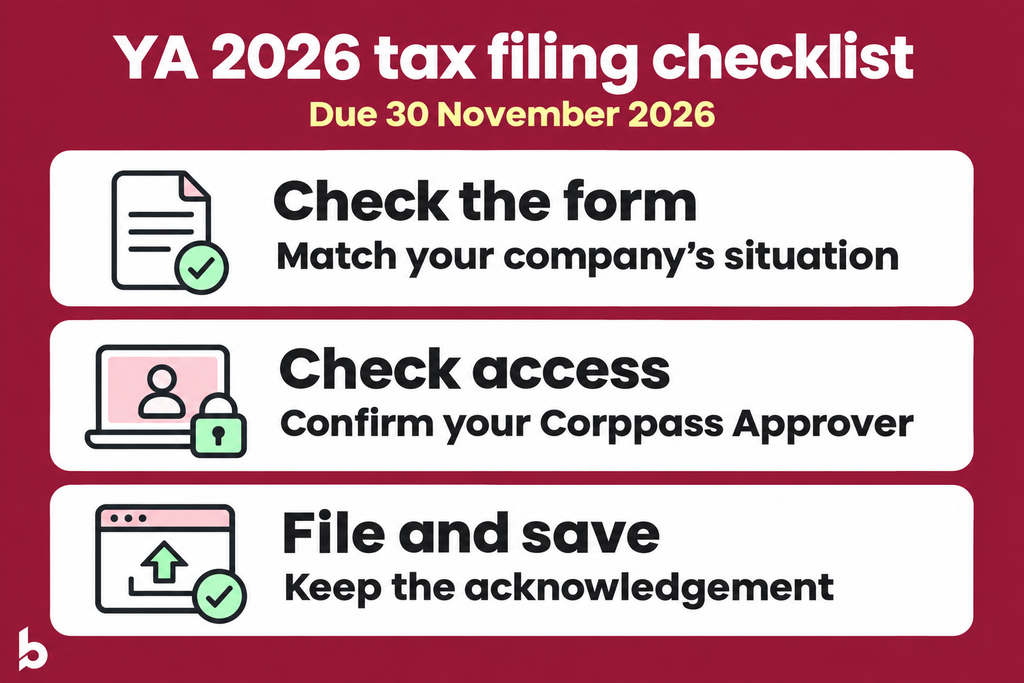
- Confirm who can submit. Have the person filing test their access to myTax Portal. Your staff member or tax agent needs the Corppass Approver role for corporate tax filing. Directors remain responsible for timely and accurate filing.
- Review the figures against the tax computation. Check that the return reflects tax adjustments to accounting profit, such as adding back non-deductible expenses. A small form can still contain a consequential error. See SBO’s guide to tax-deductible business expenses.
- Save the acknowledgement. Ask whoever submits the return to share it. A return marked Pending Approval still needs the Approver to submit it. See IRAS’s filing and acknowledgement guidance.
Put two dates in your calendar when the bill arrives
Once IRAS issues the Notice of Assessment, payment is due within one month of the notice date, even if you file a revision or objection. You have two months from the notice date to submit a revision or objection through myTax Portal. Set both reminders when you receive the notice. See IRAS’s filing and payment guidance.
Frequently asked questions
When is Singapore’s YA 2026 corporate income tax filing deadline?
The YA 2026 annual corporate income tax return is due on 30 November 2026 if your company is required to file. Submit it through myTax Portal.
Does a loss-making company still need to file?
Yes. If your company carried on business or received income in the relevant financial year, a loss does not remove the requirement to file the annual return.
Does filing ECI complete the annual corporate tax return?
No. Estimated Chargeable Income is a separate filing. If your company has a YA 2026 annual return due, you must still submit it by 30 November 2026.
Do I enter the 50% corporate tax rebate in the return?
No. Declare chargeable income without deducting the rebate. IRAS will apply any rebate due when it assesses the company’s tax.
Explore More Content
Table of Content
