
We make boring business stories sparkle.
Doing Business Is Like Playing Tower Defence: Build Where Demand Actually Moves
An opinion piece using tower defence as a business strategy metaphor: demand lanes, offer placement, upgrades, capacity and growth that can overwhelm you.


A founder spends six months building the perfect business.
The logo is clean. The website is polished. The pricing page has three neat packages. The proposal deck looks like it came from a venture-backed company. Then launch day arrives, and almost nobody comes.
It feels unfair, but it is also familiar if you have played tower defence games.
In tower defence, you do not win by building the nicest tower. You win by placing the right tower on the right lane, where the creeps actually pass. In business, the creeps are demand. If no demand passes your location, channel, offer or timing, you built a beautiful tower for nothing.
The Core Idea
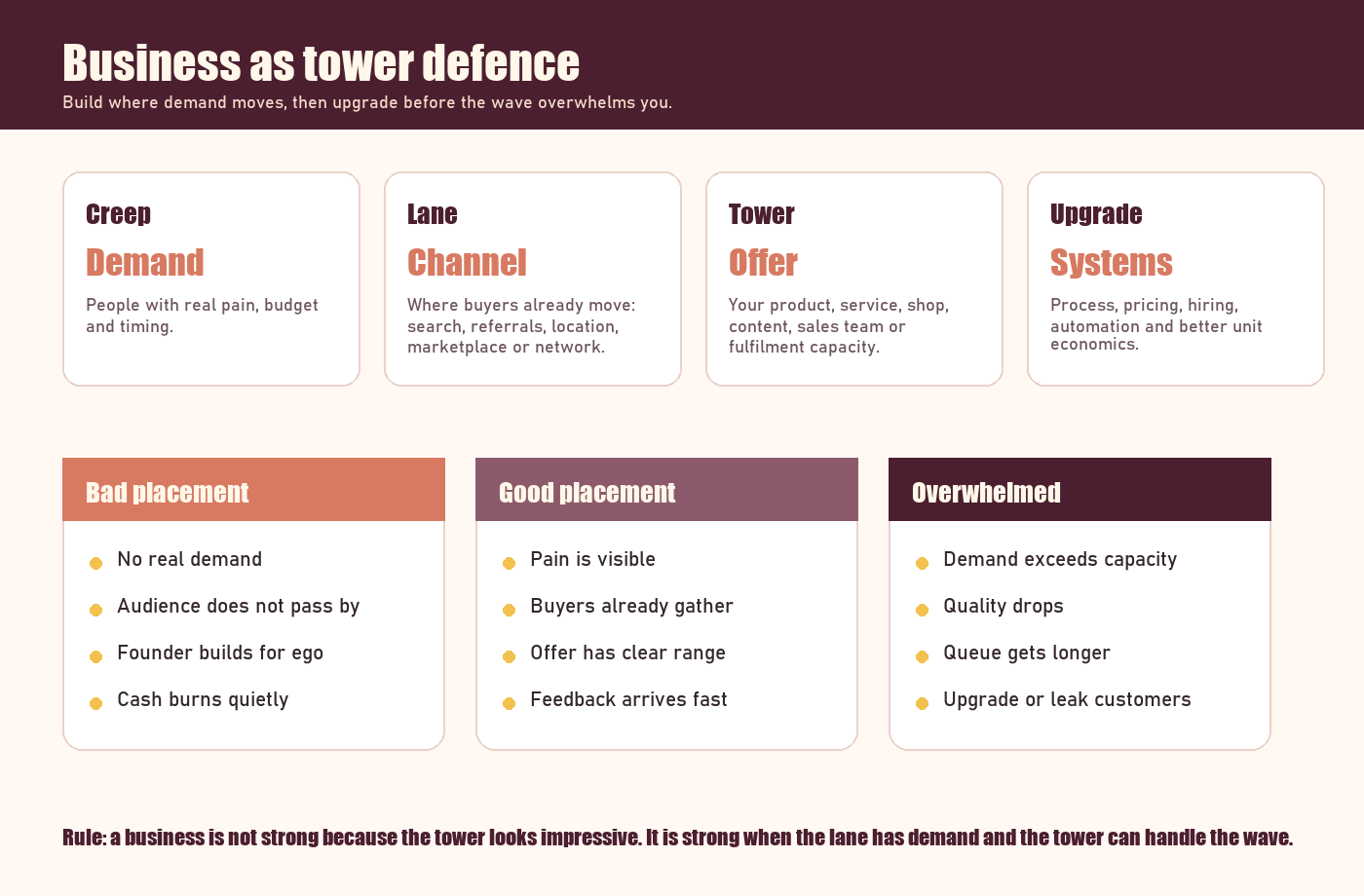
Business is not only about building. It is about placement, timing, efficiency and capacity.
Tower defence idea | Business version | What it teaches |
|---|---|---|
Creeps | Demand | Customers with real pain, urgency and money. |
Lane | Channel or market path | Where buyers already move: search, referrals, location, social, marketplace or industry network. |
Tower | Offer or capacity | Your product, service, shop, sales team, content engine or delivery system. |
Range | Distribution | How far your offer can reach and who can see it. |
Damage per second | Throughput | How much demand you can convert, serve and fulfil before quality drops. |
Upgrades | Systems | Better process, hiring, pricing, automation, positioning and unit economics. |
Leaks | Lost customers | People who would have paid, but left because the offer, timing, service or capacity failed. |
Most People Build the Tower First
Many business owners start with the tower.
They build a cafe, agency, SaaS product, course, retail shop, content page, membership, consultancy, marketplace listing or app. Then they ask how to find customers.
That is backwards.
In tower defence, the lane exists before the tower. You study where the creeps move, where the path bends, where the choke point is, and where one tower can cover the most ground. Business owners should do the same.
Look for Demand Lanes
- What are people already searching for?
- Where do buyers already gather?
- Who already spends money to solve this problem?
- What painful workaround are customers using now?
- Which competitor proves that this demand exists?
- Which moment makes people urgent enough to buy?
If you cannot describe the lane, you may be building in an empty corner of the map.
Bad Placement Makes Good Towers Useless
A good product in the wrong place can still fail.
A premium service placed in front of price-sensitive buyers will struggle. A great restaurant hidden from foot traffic needs another channel. A software tool solving a real problem may still fail if the buyer does not know the category exists. A consultant can be excellent, but if no one with budget sees the offer, the tower has no range.
Weak demand is not always a product problem. Sometimes it is a lane problem.
Symptom | Possible tower defence diagnosis | Business fix |
|---|---|---|
People say it is interesting but do not buy. | Creeps are passing, but they are not the right type. | Clarify buyer pain, budget and urgency. |
No one sees the offer. | The tower has poor range. | Improve distribution: SEO, partnerships, location, referrals or paid channels. |
Many enquiries, few conversions. | The tower is hitting but not doing enough damage. | Fix sales process, proof, pricing and offer clarity. |
Customers buy once but do not return. | Creeps leak after first contact. | Improve fulfilment, onboarding, retention and follow-up. |
Growth creates chaos. | The wave exceeds tower capacity. | Upgrade operations before pushing harder for demand. |
Sometimes You Build Before the Creep Arrives
Of course, business is not only reactive.
Some founders win because they build a tower where demand will pass later. They see a new regulation, technology shift, demographic change, platform behaviour, lifestyle trend or market gap before others do.
That is valid. But it is different from guessing.
Prediction Needs a Thesis
If you are building ahead of demand, you need to know what future wave you are betting on.
- What change will make customers care?
- When is the demand likely to arrive?
- How much cash runway do you have while waiting?
- What early signals would prove you are right?
- What signal would tell you to stop upgrading this tower?
Early placement can be powerful. But early placement without evidence is just building in the dark.
Upgrade the Tower, Not Just the Paint
When demand appears, many businesses upgrade the wrong thing.
They redesign the logo, change the tagline, add more social posts, buy nicer furniture, create more brochures or launch another promotion. Sometimes that helps. Often, the real upgrade should be operational.
Can the business serve more customers without breaking? Can the team reply faster? Can the owner stop being the bottleneck? Can the business keep quality consistent when the wave grows?
Upgrade type | Business example | When it matters |
|---|---|---|
Range upgrade | SEO, partnerships, sales outreach, better location, marketplace presence. | When demand exists but does not see you. |
Damage upgrade | Sharper offer, stronger proof, better pricing, faster sales process. | When attention does not convert. |
Fire-rate upgrade | Templates, automation, CRM, faster quoting, better scheduling. | When leads arrive but response is slow. |
Area-of-effect upgrade | Productised service, group programme, scalable content, self-serve onboarding. | When one effort can serve many customers. |
Durability upgrade | Hiring, SOPs, cash buffer, training, quality checks. | When growth threatens service quality. |
This connects closely to productising a service. If you can turn repeated delivery into a system, one tower can cover more of the map. SBO’s productized services guide goes deeper into that idea.
Too Much Demand Can Kill You Too
Business owners often think the problem is not enough customers. Sometimes the bigger danger is demand arriving before the tower is ready.
A restaurant gets viral attention but cannot keep standards. An agency signs too many clients and misses deadlines. A product launch brings users before support is ready. A service business takes deposits, then realises delivery depends entirely on the founder’s time.
In tower defence, that is the wave overwhelming your defence. In business, it looks like:
- Longer response times.
- Rushed work and quality drops.
- Staff burnout.
- Cash collected before delivery capacity exists.
- Bad reviews from customers who arrived during the overload.
- The founder becoming the final bottleneck for everything.
Growth is not automatically good. Profitable, fulfilable growth is good.
The Choke Point Is Where Strategy Lives
The best tower placement is often near a choke point: a place where many creeps must pass through a narrow route.
In business, choke points are moments where customer pain becomes concentrated.
- A new founder needs incorporation, bank account, accounting and payroll help at the same time.
- A company hiring its first employee suddenly needs contracts, CPF, payslips and onboarding.
- A business applying for financing needs financial statements, cash flow and documents.
- A retailer expanding online needs inventory, fulfilment, ads and customer support to work together.
If your offer sits at the choke point, demand is easier to see and serve. If your offer sits far away from the moment of pain, you need much stronger marketing to pull people over.
What This Means for Small Business Owners
Before building the next tower, ask harder questions.
Before You Start
- Where is the demand already moving?
- Is the lane growing, shrinking or imagined?
- What proof shows that customers pay for this?
- What is the smallest tower you can test first?
After You Launch
- Which lane brings the best customers?
- Which enquiries waste time?
- Where do customers leak?
- Which upgrade improves profit, not just vanity?
- Can operations handle the next wave?
This is why the best business is not always the most exciting idea. It is often the business placed in a real demand lane, with enough operational discipline to keep upgrading.
The Final Lesson
Do not fall in love with the tower.
Fall in love with reading the map.
The market does not reward you for building something impressive in an empty lane. It rewards you for understanding where demand moves, placing the right offer there, upgrading before capacity breaks, and knowing when to stop defending the wrong path.
That is business. Less like a motivational poster. More like tower defence with cash flow.
If you are deciding what kind of business to build in the first place, read SBO’s opinion piece on what business makes sense to base in Singapore. If you are still weighing whether to start at all, read Is It Worth Starting a Business in Singapore?.
Frequently Asked Questions
What does tower defence have to do with business?
Tower defence is a useful business metaphor because it forces you to think about demand lanes, capacity, placement, upgrades and overload. A good offer in the wrong lane still fails.
What is the business version of creeps in tower defence?
Creeps are demand. They represent customers with a real problem, budget, urgency and a path that brings them near your offer.
Is it bad to build before demand arrives?
Not always. Some businesses win by predicting future demand early. But if you build ahead of demand, you need a clear thesis, enough cash runway and evidence that the wave is likely to arrive.
What is the biggest lesson for small business owners?
Do not fall in love with the tower. Watch the lane. If demand is weak, improve positioning before upgrading the business.
What happens when demand overwhelms the business?
Quality drops, customers wait longer, staff burn out and reputation leaks. Growth is only good if the business can fulfil it profitably and consistently.
Explore More Content
Table of Content